
Phycocyanin stabilizers are often proposed when a vivid blue trial sample fades after heating, storage, light exposure, or a change in the surrounding food. A supplier's claim of “stabilized phycocyanin” can hide the ingredient, concentration, processing step, and test conditions that created the result. Food developers need to know what was added, what it does in their product, and whether the finished formula still meets its label and sensory requirements.
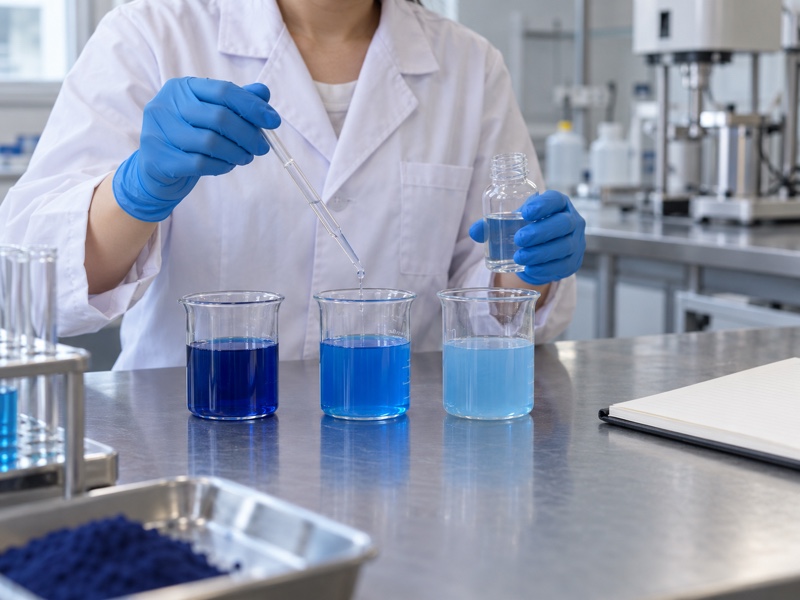
This article treats phycocyanin stabilizers as food-compatible ingredients or formulation approaches added to help preserve color or dispersion. It does not claim that every additive is approved in every market, or that a published result transfers to a commercial blue spirulina powder. A research review of phycocyanin physical stability describes how food biopolymers, preservatives, oils, and other approaches can affect pigment behavior. The practical buyer task is to test candidate systems under the actual process and label rules.
The offered blue spirulina powder is a phycocyanin-rich extract, not whole spirulina. Our E3, E6, E18, E25, E35, and E40 names identify current powder models; they do not reveal pigment concentration, carrier composition, or inherent stability. Request the model's current specification and lot COA, then compare stabilizer options using a fixed dose and the same food matrix. A stabilizer should solve an observed failure, not decorate a formulation.
Contents
- What problem should a stabilizer solve?
- Which ingredient classes are worth screening?
- How can a buyer separate pigment effect from matrix effect?
- What must a supplier disclose about a stabilized grade?
- How do pH and salts change the choice?
- What can hydrocolloid complexes contribute?
- How should a pilot measure color and texture together?
- What belongs in a storage study?
- How do labeling and sourcing affect selection?
- When is a stabilizer worth buying at scale?
1. What problem should phycocyanin stabilizers solve?
Start with a measured failure
Start with a measurable defect. Is the finished beverage losing blue intensity, shifting toward green, forming visible particles, or separating after filling? Does a gel keep its color but become too firm? Different failures need different interventions. An additive that protects the protein structure may not prevent sediment in a complex beverage. An ingredient that suspends particles may alter mouthfeel without improving pigment retention.
Define the control before the supplier proposes a solution. Make a batch using the current blue extract and the intended recipe. Record pigment dose, pH, solids, salts, processing temperature and hold, packaging, and storage. Measure color at filling and through the desired shelf-life window. Keep a visual sample under controlled lighting, but do not rely on photographs alone. Without the control, a supplier can show a brighter sample simply by adding more colorant.
| Observed failure | Useful measurement | Candidate action |
|---|
Color loss after processing | Instrumental color before and after step | Screen matrix or processing changes |
Color loss in storage | Timed color and pigment assays | Screen stabilizing ingredient |
Haze or particles | Turbidity, sediment, microscopy | Review complexation and dispersion |
Texture drift | Viscosity or gel modulus | Reduce or change hydrocolloid |
Flavor or label conflict | Sensory and ingredient review | Reject otherwise effective additive |
2. Which ingredient classes are worth screening?
Screen candidates for the actual food
The literature covers polysaccharides, proteins, small food ingredients, and formulation changes. Carrageenans can interact with phycocyanin and alter its physical stability in certain research systems. Sugars and salts change the aqueous environment. Oils may protect color in selected foods. Preservatives may affect both microbial shelf life and pigment stability, but the two functions should be tested separately. No class is universally best.
Avoid reading “stabilizer” as a promise that the supplier has solved heat, acid, oxygen, and light sensitivity simultaneously. Ask which failure was studied and at what concentration. The review on physicochemical degradation presents stabilization techniques alongside the conditions that damage phycocyanin. Those conditions matter when translating a published observation into a beverage, dessert, coating, or dry mix.
| Class to screen | Possible role | Buyer watchpoint |
|---|
Anionic polysaccharide | Protein interaction and color retention | Haze, gelation, label fit |
Neutral gum or carbohydrate | Viscosity or water environment | Mouthfeel and dose |
Edible salt or acidulant | Ionic or pH environment | Taste and pH shift |
Oil phase | Protection in selected matrices | Emulsion stability and labeling |
Food preservative | Microbial control; possible pigment effect | Market allowance and sensory impact |
3. How can a buyer separate pigment effect from matrix effect?
Use a controlled comparison
Use an equal starting pigment dose and an equal starting visual color target, but do not assume they are the same experiment. For a chemistry comparison, hold pigment concentration constant. For a commercial application comparison, adjust each candidate to the same initial target shade and measure the dose required. These two views reveal whether an additive protects pigment or simply makes the product look stronger at time zero.
Include controls for the stabilizer alone, colorant alone, and the complete system. A thickener can increase optical scattering and change perceived color without preserving the pigment molecule. A clearer system may look less intense although the pigment assay is similar. Record both instrumental color and a pigment-relevant analytical method where available. Keep test containers, fill level, light exposure, and headspace consistent.
When a commercial grade contains an undisclosed carrier blend, request enough composition detail to evaluate label and allergen implications. It may be reasonable for a supplier to protect exact ratios as confidential, but the buyer still needs the ingredient identities, relevant use level, and change-notice commitment. Otherwise the trial cannot be repeated or cleared for a finished-food label.
4. What must a supplier disclose about a stabilized grade?
Request the full formula disclosure
Ask whether the stabilizer is already inside the blue powder, added during reconstitution, or recommended for the customer's formulation. These are different products and different approval tasks. A powder containing a carrier should have a complete ingredient declaration and specification. A process aid may have separate disclosure rules depending on the market. Do not assume that a food-compatible ingredient is automatically allowed for the buyer's specific food category or claim.
Request the supplier's study design: material identity and lot, stabilizer composition, concentration, control, matrix, process conditions, storage conditions, analytical methods, and raw results. A one-page brochure with two blue photographs is not enough to claim shelf-life performance. Ask whether the study used the same sold grade and whether a second lot reproduced the result.
| Supplier item | Reason to request it | Decision supported |
|---|
Full ingredient identities | Label and allergen review | Can the grade be used at all? |
Recommended use range | Pilot design | Is the dose practical? |
Stability protocol | Compare like conditions | Does the result transfer? |
Lot-to-lot data | Reproducibility | Can the supplier scale supply? |
Change notification | Maintains approval | Will a future blend change be caught? |
5. How do pH and salts change the choice?
Challenge the real acid and mineral load
Phycocyanin is a protein-pigment complex whose charge and structure respond to the surrounding solution. Lower pH can change the interaction with polysaccharides, while ionic composition may screen or strengthen electrostatic effects. The direction is not predictable from “more stabilizer” alone. A formulation can protect color at one pH and form haze at another. This is especially relevant for beverages that see acid addition after color blending.
Measure the actual pH at the point when color is added, after processing, and during storage. Also record the sources of salts, buffers, minerals, and acidulants in the full recipe. A lab test in pure water may not represent a juice concentrate or a dairy alternative. The site's acidic beverage stability guide covers pH stress in depth; here the concern is how a proposed stabilizer behaves in that environment.
Do not change multiple ingredients at once. If a supplier proposes both a new pigment grade and a hydrocolloid, separate the trials or use a small factorial design. Otherwise a successful sample cannot tell the buyer which factor solved the problem.
6. What can hydrocolloid complexes contribute?
Check the effect on both color and texture
Food polysaccharides can associate with phycocyanin and alter color and colloidal stability. In a study of lambda-carrageenan complexation, researchers investigated blue color under thermal and acidic stress. The result is a promising mechanism, not a universal commercial formula. The type of carrageenan, pH, concentration, mixing order, and food composition can all change behavior.
Hydrocolloids also change texture. A drink may become too viscous, a clear beverage may develop haze, and a gel may become too elastic. A stabilizer trial must therefore include the application's texture acceptance criteria. Some formulations need transparent blue; others can tolerate or benefit from a gel network. The material choice should follow the product, rather than forcing one protective ingredient into every food.
Distinguish complexation from encapsulation. Encapsulation encloses pigment in a particle and is covered in the site's separate phycocyanin encapsulation guide. This article compares ingredients mixed into a food or offered in a pre-stabilized grade, with attention to the finished matrix.
7. How should a pilot measure color and texture together?
Use a pilot that reflects processing
Build a small trial with a control and a limited set of candidate levels. Use the same blue powder lot, preparation water, mix sequence, shear, and holding time. Include the industrial process step that causes the problem: heating, homogenization, acidification, or filling. Measure immediately after each step. Then repeat at least the best candidate on a second powder lot to see whether the effect survives routine variation.
Report visual color, instrumental color coordinates or absorbance method, turbidity or sediment where relevant, and viscosity or gel behavior. Include a sensory screen. The candidate with the slowest color loss may still fail because it changes taste, mouthfeel, or appearance. Write a failure rule before the trial starts to avoid selecting whichever sample looks most impressive in a photograph.
| Pilot stage | Hold constant | Measure |
|---|
Ingredient prep | Powder lot and reconstitution | Baseline color and pH |
Stabilizer addition | Mixing order and time | Haze and viscosity |
Process simulation | Heat, shear, acid, fill | Immediate color loss |
Storage | Package, light, temperature | Color drift and sediment |
Second-lot repeat | Formula and method | Reproducibility |
8. What belongs in a storage study?
Follow color through the intended shelf life
Store the actual finished matrix in the intended package. Include realistic light and temperature conditions and a clearly defined accelerated condition only if it has been shown to predict the real product. An accelerated test can compare candidates quickly, but it cannot replace real-time evidence for a commercial shelf-life claim. Record package material, oxygen headspace, fill level, and sampling schedule.
Measure at enough intervals to see the shape of decline, not just day zero and the end. Photograph under fixed lighting if appearance is central. Analyze pigment with a method that remains valid in the chosen matrix. Document any precipitate, ring, phase separation, odor change, or viscosity drift. A stabilizer that preserves color while creating a sediment layer has not solved the buyer's problem.
Food safety and microbiological stability require their own evidence. A color-stability trial does not prove preservative efficacy or finished-food safety. If a preservative is part of the system, run the microbiological studies appropriate to that food and market.
9. How do labeling and sourcing affect selection?
Check label and supply consequences
The technical winner may be commercially unusable. Check ingredient declaration, allergen policy, organic eligibility if claimed, halal or kosher requirements when applicable, customer restrictions, and market-specific permissions. Ask whether the proposed stabilizer is available at the same scale as the blue powder and whether supply changes could alter the formula. A rare ingredient with an unstable supply chain can create more risk than the original color problem.
Evaluate dose on a finished-product basis. An additive level that works in a laboratory cup may affect nutrition labeling, flavor, cost, or viscosity at production scale. Check whether the supplier recommends the same formulation for all E-model powders; do not assume model names imply identical carriers or pigment content. Require documentation for the exact supplied model and stabilizer blend.
Change control belongs in the commercial agreement. If the supplier changes a gum source, carrier, or additive level, the customer may need to repeat color and texture trials. Obtain notice before the changed material ships.
10. When is a stabilizer worth buying at scale?
Decide from finished-product evidence
Calculate cost per acceptable finished unit, not price per kilogram of blue powder. Include the pigment dose needed for target shade, stabilizer cost, process changes, rejected product avoided, testing cost, and label impact. A stabilizer that reduces pigment loss may allow a lower dose; one that causes haze may require a different package or a reformulation. Record all of those effects before declaring it economical.
Approve a candidate only after a production-relevant trial, a second-lot check, and a written specification for the new grade or ingredient blend. Define color and texture acceptance criteria, storage evidence, supplier documents, and change notice. The decision should be easy for quality, procurement, and product development to use on the next order.
| Outcome | Technical result | Buying decision |
|---|
Approve | Color and texture meet targets in real matrix | Specify grade and use range |
Run more work | Color improves; texture or label unresolved | Continue limited pilot |
Reject | Color benefit disappears after process or storage | Keep control formulation |
Change strategy | Additive cannot fit claim or market | Revisit process or packaging |
Frequently asked questions
Q1: Is a phycocyanin stabilizer already present in every blue powder?
No. Ask for the exact product's complete ingredient declaration and technical specification. The model name alone does not reveal its carrier or stabilizer system.
Q2: Can a hydrocolloid prevent all phycocyanin fading?
No. Published effects depend on polymer type, pH, concentration, processing, and food matrix. Test the proposed system in the finished product.
Q3: Does better visual blue prove the pigment is chemically more stable?
Not by itself. Viscosity and light scattering can change appearance. Compare equal pigment doses and use an appropriate analytical method alongside color measurements.
Q4: Can a color-stability test replace a microbial challenge test?
No. Color retention and microbiological safety answer different questions. Use the food safety work required for the finished product.
Q5: Should a buyer accept an undisclosed stabilizer blend?
The supplier may protect exact ratios, but the buyer needs ingredient identities, relevant use level, label and allergen details, and a change-control commitment before approval.