
A microbiology line on a supplier COA is useful only when the buyer knows what was sampled, which method was used, and what a result means for the intended product. Spirulina powder microbiological testing begins with those questions. Whole spirulina powder may pass through cultivation, drying, milling, packing, transport, and opening at the buyer’s site; each step can change the relevant contamination route. This guide is a design framework for bulk buyers, not a claim that every lot needs an identical panel or that one passing sample proves every bag safe. It concerns whole powder in our product catalog. Blue phycocyanin extract has its own process and should receive a separate risk assessment.
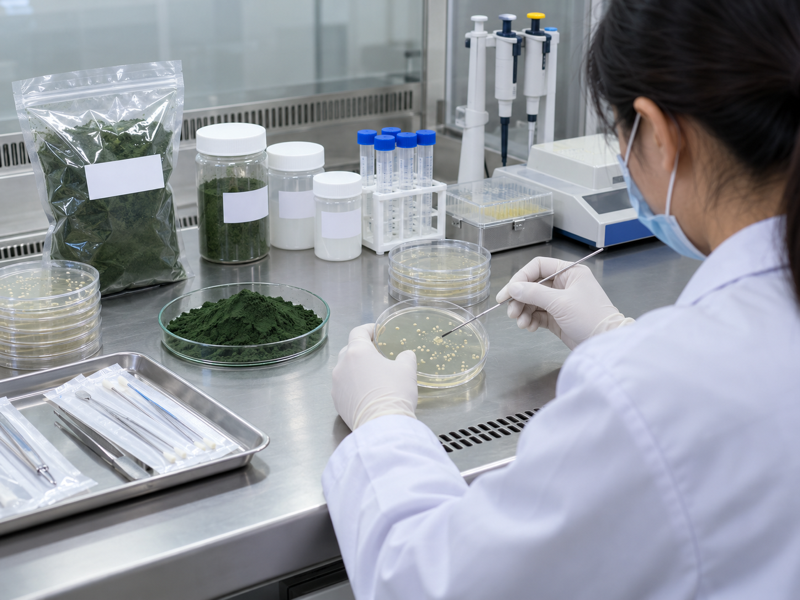
1. What should spirulina powder microbiological testing answer?
Begin with intended use and process exposure
The first question is how the customer will use the powder. A material added before a validated kill step may need different control evidence from material added to a ready-to-eat product after processing. Ask whether the finished product is consumed without further treatment, whether vulnerable consumers are involved, and where the powder will be opened. Record the destination market and any customer specification before asking a lab to quote a test panel. The FDA’s Bacteriological Analytical Manual lists methods, but a method list is not a buyer’s hazard assessment.
Map the stages from source to use: cultivation water and equipment, harvest, drying, milling, packing, storage, and receiving. Identify where organisms could enter or persist and which preventive controls the supplier uses. The buyer then selects organisms or indicator counts that answer a release question. Avoid a generic “microbial purity” promise; it hides whether the concern is a specific pathogen, general hygiene trend, or spoilage risk. Record each selected target, reason, decision limit, and testing frequency in the approved whole-powder specification. A supplier can then quote a service that produces comparable evidence.
| Planning input | Question to answer | Why it changes testing |
|---|---|---|
| Finished use | Further treatment or direct addition? | Changes exposure |
| Process map | Where can contamination enter? | Focuses sampling |
| Destination | Which rules and customer limits apply? | Sets acceptance criteria |
| Prior results | Any failures or trends? | Adjusts verification frequency |
2. Which organisms and counts should the plan consider?
Separate pathogens from process indicators
A pathogen test asks whether a named organism is detected in a defined sample amount by a stated method. Indicator tests, such as an aerobic plate count or selected yeast and mold count, can help monitor process hygiene or storage conditions. An indicator result cannot substitute for a pathogen result, and a pathogen-negative result does not prove excellent hygiene. Choose each test for a reason linked to the product and buyer’s use. The approved limits should come from the applicable market, customer standard, and risk assessment, not a universal number copied from a blog.
Spirulina cultivation conditions do not remove the need to assess contamination after harvest. Drying can reduce available water, yet subsequent handling can introduce organisms, and some hazards may persist in low-moisture foods. The buyer should ask what the supplier monitors in its environment and whether a process change has altered the risk. For a specified pathogen, identify the exact species or group, method, test portion, and confirmation rule. For counts, identify the reporting unit and threshold that prompts hold or investigation. A COA saying “TBC: pass” leaves too much unresolved for a serious purchasing decision.
| Test category | Typical purpose | COA detail needed |
|---|---|---|
| Named pathogen | Release against a defined hazard | Target, portion, method, result |
| Aerobic count | Hygiene trend | Unit, method, number |
| Yeast and mold | Handling or storage trend | Unit, method, number |
| Environmental sample | Verify a plant control | Site, timing, corrective action |
3. How should samples represent a production lot?
Define lot boundaries before taking a scoop
A result is attached to a sample, not automatically to an entire warehouse. Specify what one lot means: a production run, blend, packing run, or another traceable unit. Then agree when and where increments are collected, how many packs are represented, who takes them, and how samples are sealed and shipped. A single convenient scoop from a top bag may miss variation across a large run. The required plan depends on the hazard, lot size, process, and applicable protocol; do not invent a fixed number of bags for every order.
Keep chain-of-custody data with the sample: lot code, collection point, date, operator, container, and conditions during transport. Avoid creating contamination during sampling with unclean tools or an open receiving area. If a distributor repacks powder, ask whether the original manufacturer’s result remains representative after that extra handling. A retained sample can help investigate disagreements, but its storage and seal history must be known. When a result is surprising, compare the actual sampling procedures used by supplier and buyer before concluding that one laboratory is wrong.
4. Which laboratory method should be written into the specification?
Make method suitability part of the purchase agreement
Name a method with enough detail that another qualified lab can repeat it for this matrix. A standard method may still need verification for spirulina powder because pigments or background organisms can affect reading and recovery. Ask whether the lab has demonstrated suitability for the product, which test portion it uses, and how presumptive positives are confirmed. The FDA BAM Salmonella chapter illustrates why enrichment, screening, and confirmation steps matter; the BAM aerobic plate count chapter shows a different kind of output for a count method.
For counts, record the unit, dilution and reporting range. For presence/absence testing, record the mass tested and exact wording of the outcome. Ask the laboratory how it reports results below its quantification limit, unreadable plates, or an inhibited method. A result written as “zero” should not erase the method’s detection limit. If supplier and buyer use different methods, agree how disagreements will be adjudicated before a shipment is in dispute. Name the lab’s accreditation scope when accreditation is a contract requirement; a certificate alone does not prove the specific method and matrix are covered.
| Method field | Ask the laboratory | Risk if omitted |
|---|---|---|
| Matrix suitability | Verified for whole powder? | False reassurance |
| Sample portion | How many grams tested? | Results not comparable |
| Confirmation | How is a presumptive result resolved? | Premature release or rejection |
| Reporting | Unit and detection limit? | Misreading “not detected” |
5. How should a buyer interpret a negative result?
Understand what the result can and cannot establish
“Not detected in 25 g,” if that is the agreed test portion, describes the tested material under that method. It does not guarantee absence from every kilogram in a production lot. The probability of finding sparse, uneven contamination depends on the sampling plan and the organism’s distribution. For this reason, testing should verify a controlled process rather than replace sanitation, water control, equipment maintenance, and personnel practices. A buyer should look for evidence of those controls in supplier qualification.
Also read timing. A test on powder before a later milling or repacking step does not necessarily cover the handling that followed. Conversely, a negative test after packing may be strong evidence for a defined lot when sampling and methods were appropriate. Keep the result tied to the lot code, sample time, and process stage. If a certificate uses “complies” without a numerical count or named portion, ask for the underlying report where the contract requires it. The useful question is narrow: does this result, combined with process evidence, support the specific release decision in the approved plan?
6. When does the plant environment need sampling?
Use location trends to test preventive controls
Environmental monitoring can reveal contamination routes that finished-product sampling might miss. A supplier might sample contact surfaces, nearby noncontact areas, or equipment niches according to its risk assessment. The FDA’s environmental sampling overview explains its role in finding contamination in food-production settings. A buyer should ask how the supplier selects sites, responds to positives, and checks that corrective actions worked. Request trends and procedure summaries where commercially appropriate, not only one clean swab result.
Environmental positives need interpretation by location and timing. A positive on a noncontact floor point is not identical to a positive on a cleaned food-contact surface, yet both may indicate a route requiring action. The supplier should assess affected product, intensify cleaning or investigation as warranted, and document the decision. The buyer’s supplier review can focus on whether the program is capable of finding problems and whether positive findings lead to credible corrections. An implausibly spotless history without a clear plan is not automatically reassuring.
7. What should happen after an out-of-spec result?
Preserve the first finding and hold the affected lot
When a result exceeds an agreed count limit or a specified pathogen is detected, isolate the affected lot and stop shipment or use while QA investigates. Confirm the result using the approved procedure, trace which bags and processing windows may be involved, and review sampling and laboratory records. Do not quietly retest until a passing number appears. A retest can help investigation, but it does not erase the original finding. The disposition must follow the buyer’s and supplier’s documented quality system and applicable requirements.
Investigate likely sources: water, drying, equipment, post-drying transfer, employee practices, packing, or opened-bag handling. Assess adjacent lots only when traceability and process evidence show a plausible connection. Record the corrective action and a verification step before normal release resumes. A buyer also needs commercial terms for notification timing, independent confirmation, costs, return or destruction, and downstream recall support. Those terms make a quality response possible under time pressure. One rule keeps the record honest: retain every relevant report, including a failed preliminary result, with the lot history.
| Finding | Immediate hold | Evidence to review |
|---|---|---|
| Pathogen detected | Affected lot and linked product | Confirmation and traceability |
| Count above limit | Affected lot | Sampling, method, process trend |
| Environmental positive | Relevant area and exposed material | Site map and corrective action |
| Result mismatch | Disputed lot | Both labs and sample custody |
8. How often should testing occur?
Match frequency to risk and supplier performance
Testing frequency is a decision, not a fixed property of spirulina. Define which tests are required for every lot and which are periodic verification. Base that choice on the intended use, hazard severity, process controls, supplier history, lot definition, and changes to the site or method. A new supplier may warrant closer incoming verification while an established supplier with stable data can follow a different documented schedule. A serious failure or process change should trigger reassessment.
Keep trend charts for numerical counts rather than only pass/fail flags. A gradual rise inside an allowable limit can point to a sanitation or moisture issue before a formal rejection occurs. Trend data also show whether a proposed limit is realistic for this process. Review the plan on a set schedule and when incidents occur. If the product is stored for months, check that sealed-pack and opened-pack conditions do not undermine the original test result. The existing blue spirulina microbiological specifications guide covers an extract, whose limits must be reviewed separately.
| Trigger | Plan response | Record |
|---|---|---|
| New supplier | Increase verification | Qualification review |
| Stable history | Consider justified frequency | Trend approval |
| Process change | Reassess hazards | Change notice |
9. How should supplier and buyer results be compared?
Align sampling, methods, and reporting before a dispute
Two laboratories can produce different numbers from the same lot because they received different subsamples or used different methods. Before declaring a supplier unreliable, compare lot definition, sampling point, sample mass, homogenization, method version, units, test date, and transport conditions. Request raw or full laboratory reports for disputed results. For counts near a limit, ask the lab how its reporting and measurement uncertainty should be understood. The buyer’s acceptance rule should state how a confirmed conflict is handled.
Use a pre-agreed independent laboratory when needed, with a sealed retained sample and documented custody. If the sample was stored poorly, its result may answer a different question about storage rather than original manufacture. Preserve the first result and any later results in the same file. A shared method sheet and sample plan are often more valuable than a contract sentence saying “third-party tested.” The blue spirulina COA guide explains lot-document review for an extract; keep whole-powder methods and limits separate.
10. What should the purchase order require?
Make microbial evidence available before release
Attach the approved specification or reference its controlled version. State the lot definition, named tests, methods or approved equivalents, sample plan, limits, COA fields, reporting deadline, and rule for a confirmed failure. If testing is performed after shipment, explicitly decide whether the buyer may use the lot before results arrive. A simple release gate is often safer than relying on an email that may arrive after production. Require notification of changes to the supplier’s process, laboratory, or sampling plan that could alter comparability.
For the first orders, review full reports as well as summarized COAs and compare them with actual received labels. Track incoming results and any handling complaints. Then update the plan through quality review rather than copying another company’s panel. Microbiological testing is most valuable when it is tied to process prevention, representative sampling, a method suited to whole spirulina powder, and a clear lot disposition. That makes the evidence useful to both procurement and production, and gives the supplier a precise service to deliver.
Frequently asked questions
Q1: Does a passing COA prove every bag is pathogen-free?
No. It reports the tested sample under a defined method. Combine it with representative sampling, traceability, and verified process controls.
Q2: Is an aerobic plate count a pathogen test?
No. It is an indicator count. Use named pathogen methods when a pathogen result is part of the approved risk plan.
Q3: Must every order have the same microbial panel?
No. The buyer should justify targets and frequency from the intended use, market, supplier process, and observed history.
Q4: What does “not detected” mean on a report?
It means the named target was not found in the stated test portion by the stated method. Check the portion and method before comparing reports.
Q5: Can a retest automatically release a failed lot?
No. Preserve the initial finding, investigate its cause, and apply the agreed quality disposition procedure to all evidence.