
A one-kilogram pouch can be large or compact depending on how its powder packs. A blue phycocyanin ingredient that flows into a pilot jar may bridge in a hopper or vary in fill weight on a production line. These issues are often discussed as “powder handling,” but one of the first measurable properties is phycocyanin bulk density: mass divided by the volume occupied by the loose powder, including the air between particles.
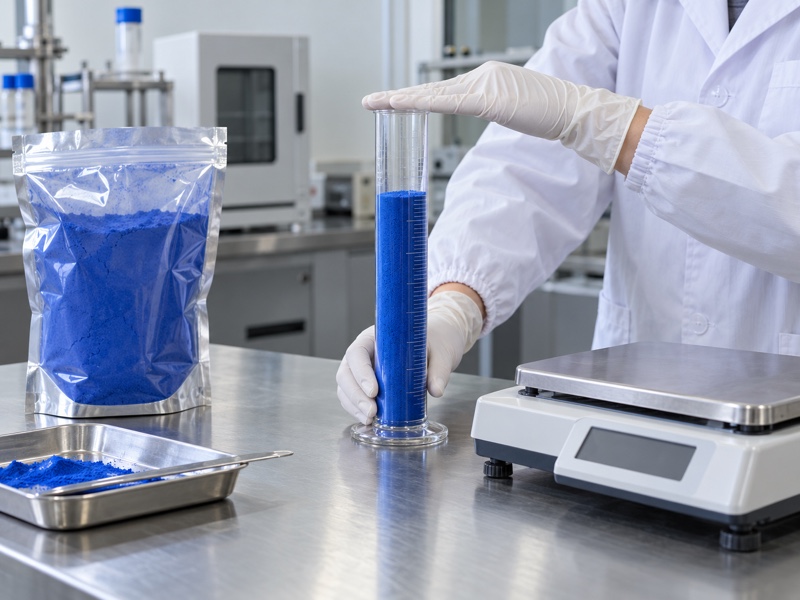
The value belongs to a particular powder, preparation, and test method. A published study of freeze-dried phycocyanin microcapsules measured physical properties while changing coating materials. That illustrates why density can change with formulation. It does not provide a specification for every commercial extract powder. Bulk buyers should request a method and lot result for the exact grade they plan to use, then test it in their equipment.
The current catalog includes E3, E6, E18, E25, E35, and E40 blue spirulina/phycocyanin powders. Those are model names, not density classes or disclosed pigment percentages. Check each model's technical specification, ingredients, and lot COA. Whole spirulina powder and phycocyanin-rich extract can have different particle shapes and carriers, so a whole-spirulina mesh-size or moisture result cannot replace a blue-extract handling study.
Contents
- What is bulk density and what is it not?
- Why do buyers need both loose and tapped values?
- How should a supplier measure the powder?
- Which sample conditions change the result?
- How does density affect bags, drums, and pallets?
- What can density tell you about filling and flow?
- How do carriers and drying processes alter packing?
- How should a buyer compare two blue powder grades?
- What belongs in a production trial and specification?
- When should a density change trigger investigation?
1. What is phycocyanin bulk density, and what is it not?
Define the measurement basis
Loose bulk density is the powder mass divided by its unsettled bulk volume. The volume includes spaces between particles. It is not the density of phycocyanin molecules and does not measure pigment concentration, purity, or color strength. A powder with a lower bulk density takes more package volume for the same mass. A denser powder takes less space, but that alone says nothing about how fast it dissolves or whether it will meet a color target.
The USP general chapter on bulk and tapped density describes bulk density as a mass-to-volume measurement that depends on particle packing. Buyers can use a recognized method as a reference point, while adapting the procedure to the product and contract. What matters commercially is that supplier and buyer use the same method and report the sample condition.
| Term | What is measured | Common misuse |
|---|
Loose bulk density | Mass per volume before intentional compaction | Treating it as pigment potency |
Tapped density | Mass per volume after defined tapping | Comparing it with a loose value |
True particle density | Solid material excluding voids | Using it to size a bag |
Color strength | Optical effect or pigment assay | Inferring it from powder compactness |
Flow behavior | Powder movement under an applied condition | Assuming one density value proves flow |
2. Why do buyers need both loose and tapped values?
Record both handling states
Handling changes how powder packs. Filling a pouch, vibrating a shipping carton, or tapping a hopper may settle it. The tapped value therefore adds information about how much volume can change under a defined mechanical action. Compare the two values to identify powders that compact substantially. This can guide a flow trial, but it is not a substitute for one.
A large difference between loose and tapped density may signal that particle arrangement changes readily. It does not diagnose the cause on its own. Particle size distribution, shape, surface properties, moisture, and carrier all contribute. Two materials can have similar density ratios and still behave differently in a screw feeder or during cold-water dispersion. Do not use a single calculated index as a universal “pass” label.
Request both results on the same sample, under stated humidity and test conditions. If the supplier reports only “density,” ask which one it means. A tapped result can look reassuringly high while the receiving team's loose powder occupies far more space than expected.
3. How should a supplier measure the powder?
Specify the measuring procedure
Specify the method before comparing quotes. The method should name sample preparation, container, fill procedure, mass, volume reading, tapping apparatus and endpoint if used, number of replicates, and reporting units. A graduated cylinder or a defined-volume vessel can both be used under suitable procedures; numbers from unlike procedures should not be pooled into one supplier ranking.
Ask whether agglomerates are broken before testing and whether the powder is sieved. A sieve can change the result by removing large clumps. That may be acceptable for a defined laboratory method but may understate the handling problem a factory will see when it opens a real bag. Record the “as received” condition alongside any prepared-sample measurement when caking is a concern.
| Method element | Record explicitly | Reason |
|---|
Sample state | As received, conditioned, or sieved | Preparation changes packing |
Container | Cylinder or fixed vessel and size | Wall effects and reading differ |
Filling | Pour height, speed, no tamping | Avoids accidental pre-compaction |
Tap procedure | Apparatus, cycles, endpoint | Defines tapped density |
Replicates | Individual values and average | Shows measurement spread |
4. Which sample conditions change the result?
Control sample moisture and history
Moisture exposure can change cohesion and clumping. Static charge, temperature, storage time, prior vibration, and how an operator transfers the powder can also affect the bed. Fine particles may cling to the cylinder wall. A recently opened bag and a bag that spent weeks in a humid warehouse are not necessarily equivalent samples, even if the nominal formulation is unchanged.
Handle samples in a way that represents the buyer's decision. For a pre-shipment comparison, condition all candidates identically. For a receiving investigation, measure the suspect material as it arrived before changing it by drying, deagglomerating, or sieving. Keep a sealed retain sample for later comparison. If packaging is opened for days before use, test that scenario too.
The site's transit-humidity article covers shipment controls. Here humidity is a measurement variable and a possible cause of packing change. Density can reveal a handling symptom, but moisture and water activity measurements are needed to investigate the cause.
5. How does density affect bags, drums, and pallets?
Calculate pack volume from measured data
Container capacity is limited by both mass and usable volume. A low-density blue powder may fill a bag before it reaches the desired mass. Overfilling can compromise closure, create dust during sealing, or leave insufficient headspace for a liner. A denser powder may fit easily but compact during transit and form a hard layer that needs breakup at use.
Calculate packaging volume from measured loose density as an initial estimate, then run a real filling trial with the intended liner, bag, or drum. Allow for fill headspace, settled volume, and a workable sealing operation. Do not size a commercial drum from one laboratory cylinder result. The physical container, vibration, and powder aeration at filling can change the outcome.
| Buyer operation | Density question | Trial evidence |
|---|
Bag filling | Will target mass fit with closure headspace? | Trial fill and seal check |
Drum packing | Will powder settle during handling? | Transit simulation or observation |
Pallet planning | How many units fit safely? | Actual packaged dimensions |
Warehouse picking | Does settling change scoop volume? | Mass-per-scoop check |
Plant charging | Can operators empty a container cleanly? | Discharge trial |
6. What can density tell you about filling and flow?
Check filling behavior separately
Bulk density helps translate a volumetric feeder setting into a likely mass flow, but the feeder must still be calibrated with the actual powder. If loose density changes, a fixed screw speed or cup volume may deliver a different mass. Check fill-weight variability through the production run, including startup, middle, and near-empty hopper conditions. Powder aeration during charging can make early fills different from later fills.
Flowability involves more than mass per volume. Bridging, rat-holing, wall friction, and segregation depend on particle properties and equipment geometry. Run a hopper or feeder trial when those risks matter. A supplier's “free flowing” statement needs a defined test and conditions; the phrase alone does not establish performance in the customer's line.
Also inspect dust and operator handling. Fine blue powder can create visible staining and loss at transfer points. A denser or agglomerated form may reduce some dust yet disperse differently in water. Balance filling, safety, cleaning, and finished-food performance instead of optimizing density alone.
7. How do carriers and drying processes alter packing?
Compare composition and process
The powder may contain a carrier or be built from particles created by different drying processes. Coating material, solids level, droplet formation, and powder collection can alter particle shape and packing. The referenced phycocyanin microcapsule study compared coating materials and measured density as one of several physical properties. Other research on freeze-dried C-phycocyanin microcapsules reported powder-property results under its own materials and process. These observations support testing; they are not evidence that one carrier will always increase density.
The commercial question is whether the offered grade behaves predictably after shipment and in the buyer's line. Request the full ingredient declaration and a representative commercial-scale sample. A lab-scale microcapsule batch can have different particle distribution from a production lot. If a supplier changes the drying route or carrier ratio, ask for renewed density, flow, reconstitution, and color checks.
Avoid equating “more dense” with “more active pigment.” A carrier-heavy powder could be denser while requiring more dose to reach the same color. Compare cost per acceptable finished unit.
8. How should a buyer compare two blue powder grades?
Normalize the test conditions
Use the same test method, sample conditioning, and reporting units. Obtain lot-specific results for at least more than one production lot when a large purchase depends on repeatability. Record supplier name, model, formulation version, lot, package form, date, moisture condition, loose density, tapped density, and measurement spread. If one supplier reports only a specification range, request actual observed values.
Then run application tests at an equal color target, not equal scoop volume. A density difference changes the mass delivered by a fixed scoop; it does not necessarily change the color delivered per gram. Weigh ingredient additions and record the dose required. Check dissolution or dispersion, texture, and visible residue, because a physically convenient powder can still fail the food application.
| Comparison item | Keep equal | Observe separately |
|---|
Density method | Container and procedure | Loose/tapped results |
Sample condition | Humidity and handling | Caking or static |
Color trial | Finished target shade | Dose per finished unit |
Plant trial | Equipment and settings | Fill variability |
Commercial review | Order quantity basis | Package count and cost |
9. What belongs in a production trial and specification?
Translate results into an operating limit
Specify the handling outcome that matters. A purchasing specification may include a density range with a named method, but it should also state relevant package, appearance, moisture, and functional criteria. If the filler can tolerate a broad density range, do not write a narrow arbitrary limit merely because a laboratory can report more decimals. Make the range from production lots that work.
Run a trial with the actual bags or drums and the target feeder, scale, or blending system. Measure fill-weight variation, discharge time, dust, residue, and any bridging. Then use the powder in the real recipe. Retain beginning, middle, and end samples to check whether segregation occurs. A pilot that only measures a cylinder cannot establish plant performance.
Document how the supplier will notify the buyer of a carrier, particle-formation, packing, or production-site change. Those changes may affect density without changing the product name. Connect the physical-property specification to the supplier's change-control process.
10. When should a density change trigger investigation?
Investigate a sustained shift
Investigate when a result falls outside the agreed range, when filling behavior changes, or when a receiving bag looks unusually compact or fluffy. First confirm that the same test method and sample preparation were used. Then compare moisture, particle size, carrier declaration, package condition, and lot history. A method change can create an apparent trend even when the powder is unchanged.
| Trigger | First check | Possible disposition |
|---|
Unexpected low density | Method and aeration at filling | Repeat under defined method |
Unexpected high density | Transit compaction and moisture | Check discharge and caking |
Changed feeder mass | Calibration and bulk density | Adjust only after line trial |
New carrier or drying route | Specification and sample history | Requalify handling performance |
Hold a suspect lot when it cannot be filled or dosed within validated settings, especially if the discrepancy also appears in color or dispersion. For a small difference with no performance impact, a documented disposition may be reasonable. Keep the decision tied to the buyer's process and specification.
The final approval should state what density means in this contract: a method, a range based on successful lots, the receiving test frequency, and the action when results shift. That turns a laboratory number into a useful control for a production team.
Frequently asked questions
Q1: Does higher bulk density mean higher phycocyanin purity?
No. Density describes powder packing. Purity and pigment content require their own defined analytical methods and lot results.
Q2: Is tapped density the same as loose bulk density?
No. Tapping compacts the powder under a defined procedure. Report the two values separately with the method used.
Q3: Can a buyer calculate bag size from a lab density result?
It is an initial estimate. Confirm with a real filling trial that includes headspace, settling, liner, and closure.
Q4: Does a good density result prove the powder will flow through a feeder?
No. Calibrate and trial the actual feeder because cohesion, wall friction, and particle distribution also affect flow.
Q5: Should all E-model blue spirulina powders have the same density limit?
No. Treat each model and formulation as a separate material until current specifications and production-lot data show otherwise.