
Phycocyanin E18 vs E25 is a higher-concentration buying decision, not a contest to select the largest printed number. At these grades, small additions can magnify weighing and mixing error. Buyers need a matched-shade trial, full carrier disclosure and a cost model that accounts for process recovery. The FDA spirulina-extract listing provides the applicable starting point for product review; the commercial decision still needs lot and application evidence.
Contents
- What should E18 and E25 communicate?
- How should a buyer compare concentrated grades?
- Which formulations favor E18?
- Which formulations favor E25?
- How does heat or acid affect the decision?
- What quality file should accompany a high grade?
- How can microdosing be controlled?
- How should total cost be calculated?
- What proves scale readiness?
- When should E18 or E25 be approved?
1. What should E18 and E25 communicate?
Confirm the measurement
An E designation is a trade shorthand tied to a supplier color-value test. E18 and E25 do not establish purity, pigment percentage or a guaranteed dose ratio without the method. Ask for the certificate, procedure, color-value range, carrier and moisture. If methods differ, send coded samples to a common laboratory.
Write the proposed ingredient identity and intended technical function on the first line of the trial brief. A sales name alone cannot settle how purchasing, quality and label teams classify it. Keep a retained sample of the first acceptable lot so later comparisons use the same reference, not a memory of its appearance.
Buyer action: Write the agreed assay and units into the purchase specification, including the allowed lot range.
Before requesting a sample, ask the team to put the intended product, consumer-facing promise and disqualifying conditions in writing. This makes the first supplier conversation specific enough to yield comparable information.

2. How should a buyer compare concentrated grades?
Target identical finished color
Prepare a controlled dose ladder in the actual formulation and choose a target shade before seeing the results. Record the grams required for E18 and E25 and the uncertainty across replicate batches. A high grade may reach target at very low mass, but that advantage is valuable only if it disperses uniformly.
Ask two candidates to answer the same written request, including test method, units, sample age and package format. Differences in reported numbers can be caused by method or dilution rather than useful performance. When figures are not directly comparable, run the candidates side by side in one laboratory and do not average away a failed criterion.
Buyer action: Judge both instrument readings and trained visual checks at the same package age.
If one candidate looks better, repeat the measurement under the same conditions before changing the specification. A small difference can disappear when samples, instruments or operators change.
| Claim | E18 document | E25 document |
|---|---|---|
| Color value | Named assay | Named assay |
| Carrier | Composition | Composition |
| Lot range | Certificate | Certificate |
3. Which formulations favor E18?
Consider accurate addition
E18 may be easier to weigh or meter when batch size is small and the accepted color is pale. If a higher powder mass improves distribution, it can reduce flecking or batch-to-batch error. That benefit depends on equipment, carrier and addition method. It does not establish that E18 is intrinsically more stable.
Split the evaluation into ingredient screening and an actual finished-product trial. Prepare both candidates at controlled mass, mixing time and temperature; use coded samples and record the base formula. A favorable jar photograph is only a starting point. The saleable product must survive its real process, packaging and expected storage conditions.
Buyer action: Compare minimum reliable scale increments and color variance at the planned batch size.
For a related supplier-side workflow, see the SpirulinaCN guide to phycocyanin color value vs pigment content. Use its questions alongside this product-specific acceptance plan.
The trial record should identify who prepared each sample and whether the sample represents routine commercial output. Archive the base formula and a dated photograph under controlled lighting.

4. Which formulations favor E25?
Value lower addition mass
E25 may reduce carrier addition, shipping mass and warehouse space for the same shade. It can suit high-throughput lines when premixing or liquid dosing makes a tiny ingredient addition reliable. Check whether higher concentration increases cost per kilogram enough to offset the dose advantage.
Set a target, an acceptable band and a failure definition before the next formulation round. Include flavor, color, texture and label effect where relevant. Record the uncolored or unfortified control. If a blend changes, document the new ingredient addition and its cost, because an apparently better ingredient can simply be receiving more help from the formula.
Buyer action: Use measured dose, not the ratio of grade names, in the savings estimate.
The benefit of concentration is most convincing when the plant can deliver the smaller dose repeatably. Weigh a typical production quantity of E25, transfer it through the intended premix equipment, and measure what remains on the weighing boat, hopper and tubing. Repeat with E18. The loss fraction may matter more than the nominal difference between the two labels for short runs, where equipment hold-up is large relative to the dose.
Keep any formulation change small enough to explain. Changing color, flavor, texture and process together prevents the team from learning which adjustment solved the problem.
| Use case | E18 question | E25 question |
|---|---|---|
| Small batch | Reliable weighing? | Need premix? |
| High volume | Higher mass? | Lower handling? |
| Pale shade | Dose precision? | Overcolor risk? |
5. How does heat or acid affect the decision?
Test exact process stress
Phycocyanin can lose color under heat, low pH and light; studies demonstrate the effect depends on conditions and material. A concentrated grade is not guaranteed better survival. Run the full formulation through thermal holding, acidification, filling and storage. Some foods may need a different color strategy if both grades fail.
This technical issue is illustrated by the phycocyanin stability experiment. Its conditions are evidence for a risk to test, not a universal prediction for another formula.
Map the ingredient addition to the actual plant sequence: receiving, staging, weighing, premixing, addition, heat treatment, fill and cleaning. Note which steps expose it to water, air, light or temperature. A bench mixture that skips the limiting factory step cannot support a release decision. Preserve process settings with each retained sample.
Buyer action: Measure color after each step to locate where the loss occurs before changing dose.
Where a process step is difficult to reproduce on the bench, flag the uncertainty explicitly and move that question into the pilot. Do not convert a convenient laboratory shortcut into a production claim.

6. What quality file should accompany a high grade?
Ask for lot evidence
Obtain identity, assay method, certificate, contaminant and microbiological results, carrier and processing-aid information, storage limits and shelf-life basis. A higher color value does not substitute for a food-grade safety file. Confirm the extract is authorized for the intended destination and label use.
For the relevant rule or evidence context, consult the pasteurization and storage experiment; confirm the current requirements for the destination and exact product.
Separate legal permission, identity and contaminant evidence from desirable commercial attributes. Require the lot certificate, agreed analytical methods and an escalation route for results near limits. Build a risk-based incoming check for the actual use and market. A supplier assurance letter can start the conversation but cannot replace product-specific review.
Buyer action: Approve only a commercial-lot representative sample and establish retest or hold rules.
For a related supplier-side workflow, see the SpirulinaCN guide to e25 vs e35 phycocyanin for manufacturers. Use its questions alongside this product-specific acceptance plan.
Quality should set the disposition for missing documents before purchasing creates a shipment commitment. Written acceptance criteria make later discussions with a supplier faster and less subjective.
| Quality item | Evidence | Release concern |
|---|---|---|
| Identity | Method and lot | Wrong material |
| Microbiology | Lot test | Contamination |
| Color value | Defined assay | Off-shade |
7. How can microdosing be controlled?
Design a premix
A tiny direct addition can leave concentrated streaks. Prepare a validated premix with a known portion of the product, then add it at a documented mixing step. Check vessel residues and transfer losses. For E25 especially, a few grams trapped on equipment can change the effective dose.
Put the buyer, supplier technical contact, formulation lead, quality reviewer and regulatory reviewer on one document register. Record the exact grade, version date and any change notice obligation. If a proposed substitution changes carriers, preservatives, extraction method or source, reopen the relevant approval steps before material goes to the line.
Buyer action: Reconcile weighed material against material actually delivered into the batch.
Include substitutes and second-source proposals in the change-control rule. A different trade name can have the same technical function but a different composition or production history.

8. How should total cost be calculated?
Include the small losses
Calculate landed ingredient cost times grams required for acceptable saleable output. Include losses in bags, premix tanks and lines, plus cleaning and rework. A higher-grade quote may look expensive per kilogram but efficient per finished case. A lower-grade quote may win if it handles better.
Normalize every offer to delivered usable output, including preparation labor, line loss, rejected material and storage. Request written assumptions for minimum order, lead time, freight basis, pack size and remaining shelf life at receipt. A lower invoice price is useful only if the accepted finished-product yield and schedule also work.
Buyer action: Use realistic production consumption and shelf-life scenarios, then identify the break-even dose.
Ask purchasing to model both a steady campaign and a line that changes products often. High-concentration color can reduce package handling in long runs, while frequent changeovers may waste more material in the dosing system. Include expiry of opened packs if a grade is used infrequently. This gives a more realistic comparison than one price per kilogram and prevents a theoretically efficient grade from raising real factory cost.
Report the economics as a range when consumption, line loss or demand is uncertain. That is more useful than a single precise-looking number built from assumptions.
| Cost input | E18 | E25 |
|---|---|---|
| Landed price | Actual quote | Actual quote |
| Accepted dose | Trial g/kg | Trial g/kg |
| Loss | Reconciled g | Reconciled g |
9. What proves scale readiness?
Pilot beyond the beaker
Trial the selected grade at production batch size, using normal operators and addition equipment. Collect samples across the run and through shelf life in the actual package. Watch for shade gradients, foaming, residues and line stops. Supplier lab success does not qualify a new grade for a plant.
Run at least one pilot or production-scale lot with the proposed addition point and normal equipment. Sample early, middle and late output, then review uniformity and retained samples after a defined storage interval. Record line stoppages and cleaning work; these are part of qualification, even when color or flavor meets its target.
Buyer action: Tie every result to a lot number, grade, exact dose and process record.
For a related supplier-side workflow, see the SpirulinaCN guide to phycocyanin supplier lab comparison. Use its questions alongside this product-specific acceptance plan.
A scale trial is also a training test. Ask operators to record whether the written instructions were usable and which steps required improvised decisions.
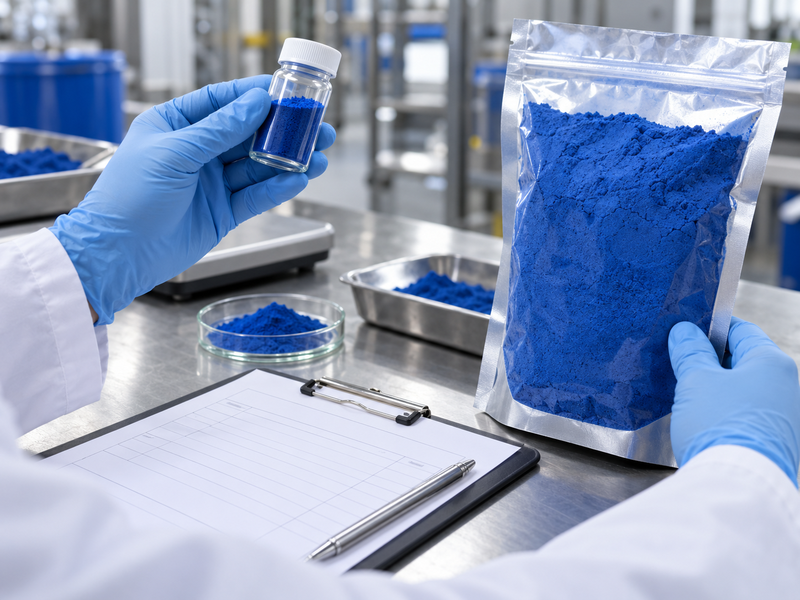
10. When should E18 or E25 be approved?
Keep a fit-for-use record
The winner meets color tolerance, stability, lawful use, quality criteria and cost-in-use. If both pass, choose based on supply reliability and operational simplicity as well as price. Keep different dosing instructions for the two grades.
Close the decision with a signed specification, approved sample reference, conditional market review, change-control contact and first-order acceptance plan. Name the measurements that would trigger a hold, further trial or supplier discussion. A clear no-go outcome is valuable: it prevents an attractive sample from becoming an uncontrolled routine purchase.
Buyer action: Require change notice for assay method, extraction, carrier or formulation changes and repeat targeted trials after a change.
The approved file should be understandable to a colleague who did not attend the trial. Include the rationale for rejection as well as the chosen option.
| Approval gate | Record | Owner |
|---|---|---|
| Shade | Retained sample | Formulation |
| Safety | Lot file | Quality |
| Cost | Saleable unit model | Buyer |
Frequently asked questions
Is E25 always purer than E18?
No. The code may describe color value, not biochemical purity. Request both methods if purity matters.
Can grade numbers be divided to predict dose?
Use that only as a rough hypothesis. Confirm at a matched final shade.
Does E25 always cost less per color unit?
Price, dose, process loss and waste determine cost-in-use.
Can the grades share a supplier specification?
Keep grade-specific color ranges and dose instructions even when other safety controls overlap.
What is the key scale risk?
Very small additions can amplify weighing, transfer and distribution errors.
Conclusion
Buy the E18 or E25 grade that performs in the product and plant. The label on the bag starts the inquiry; the method-matched assay, measured dose and controlled pilot close it.