
A supplier reports one color value while a buyer’s laboratory reports another. The disagreement can stop a shipment even when both teams tested honestly. A phycocyanin supplier lab comparison resolves the dispute by aligning sample identity, preparation, analytical method and uncertainty before judging the lot. Published phycocyanin analytical research uses different absorbance measures for pigment concentration and optical purity; those results illustrate why a number without its method has limited meaning.
Contents
- Which result is actually in dispute?
- How should samples be split and sealed?
- Which method details need alignment?
- How do E-value, pigment content and purity differ?
- Which instrument checks come before retesting?
- How should laboratories compare results?
- When is a third laboratory useful?
- How can finished-food color be assessed separately?
- What belongs in a dispute protocol?
- How should a buyer close the case?
1. Which result is actually in dispute?
Name the analyte and the decision rule
Start with the purchase specification and both reports. Are teams debating a photometric color value, estimated C-phycocyanin concentration, optical purity ratio or visual shade in a beverage? These are related but distinct outcomes. Record exact units, reference wavelength, lot and specification revision. A frequent surprise: a supplier COA may report a color-strength result at one wavelength while an independent lab reports pigment mass using a two-wavelength equation. The figures cannot be compared as if they shared a unit. Identify whether the buyer needs a contractual release decision or an application-development answer. Keep those questions separate. The site’s color value versus pigment content guide offers a useful vocabulary, while the signed SKU method controls the commercial comparison. Avoid suspending unrelated lots until traceability shows shared exposure.

2. How should samples be split and sealed?
Make the material truly comparable
Use one representative, mixed lot sample divided into coded aliquots under a written procedure. Document container type, mass, seal, collection point, date, storage temperature, light protection and custody at every transfer. A supplier’s retained sample and a buyer’s opened bag may have different exposure histories; testing both can diagnose transport or handling effects but does not create a clean interlaboratory comparison. The practical rule: run a fresh split from the same unopened batch when possible, and reserve a third aliquot for an independent laboratory. Check whether the powder segregates or absorbs moisture during sampling. Record any pre-sieving or blending step. Send enough material for replicate preparations and reanalysis. The site’s sealed-samples procurement guide helps frame identity and custody. A chain-of-custody label cannot repair a poorly mixed original sample.
| Sample field | Required record | Why it matters |
|---|---|---|
| Source | Bag and lot code | Same population |
| Split | Mixing and aliquot order | Homogeneity |
| Pack | Seal and light barrier | Exposure control |
| Custody | Names, dates, temperatures | Defensible comparison |
Before distributing aliquots, test homogeneity within the original sample. Take portions from different positions in the container and prepare each independently under one method. If those results vary more than normal analytical repeatability, remix using a documented technique or sample individual packs rather than assuming one scoop represents the lot. Include a blank container and seal check in the shipment packout. Ask each receiving laboratory to photograph the seal and report material condition before opening. A wet or compacted sample may need investigation before it enters the agreed method; an analyst should not quietly alter preparation to make it flow.
3. Which method details need alignment?
Compare written procedures line by line
Request both laboratories’ versions of sample mass, extraction medium, dilution, mixing, hold time, filtration or centrifugation, blank, cuvette path length, measurement wavelength, calculation and reporting basis. Note whether results are reported as-is or on a dry-weight basis. One small difference can move the result: an undissolved particle fraction affects apparent absorbance, while a different blank changes the baseline. Run a side-by-side method review before paying for repeated blind testing. The site’s E-value test method article outlines the commercial questions; the laboratories should exchange actual controlled procedures for this SKU. Confirm the acceptance method specified in the contract. If none exists, agree on a reference method prospectively and avoid retroactively treating one lab’s convention as an undisclosed contractual limit. Record deviations from method during the actual test.
4. How do E-value, pigment content and purity differ?
Put every metric in its own column
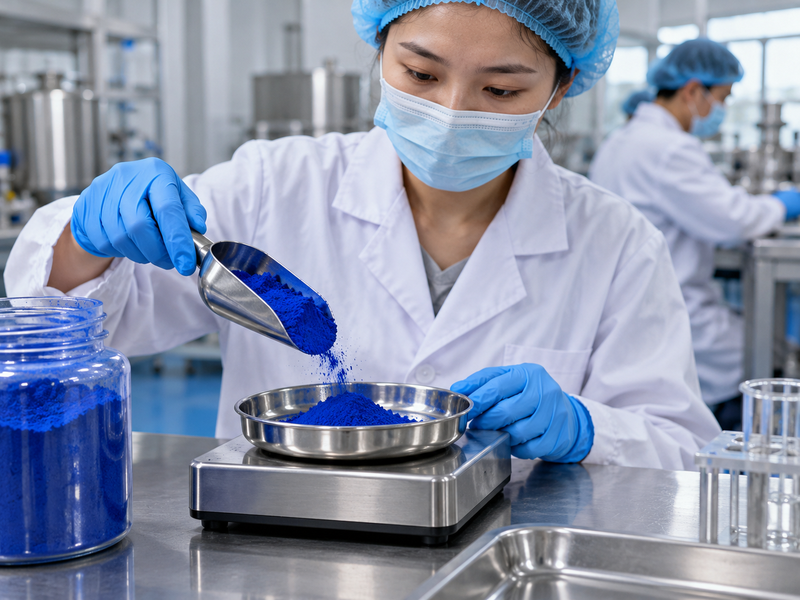
An E-value describes absorbance-based color strength under a defined concentration and path length. Pigment content estimates C-phycocyanin concentration from an assay, and optical purity commonly compares pigment-region absorption with protein-region absorption. The published analytical study describes C-phycocyanin concentration using 620 and 652 nm readings and an A620/A280 purity ratio. Do not translate by label: a grade called E25 does not by itself mean 25% C-phycocyanin. Carrier, water and extraction completeness affect reported mass-based results. Ask which metric the finished product requires. A colorant buyer may care most about delivered hue per dose; a research buyer may need an explicitly defined pigment assay. Both still require safety and composition documents. Put numerical results beside methods and uncertainty, never in an unlabeled “quality” column.
| Metric | Typical evidence | It does not prove |
|---|---|---|
| E-value | Defined absorbance method | Pigment mass percentage |
| C-PC concentration | Assay equation and basis | Finished-food shade |
| Optical purity | Absorbance ratio | Regulatory suitability |
| Application color | Standardized food test | Raw-material identity alone |
5. Which instrument checks come before retesting?
Review performance and data integrity
Check spectrophotometer calibration or verification, wavelength accuracy, photometric performance, cuvette condition, blank trace and linearity at the chosen dilution. Request raw spectra where available, not only a final spreadsheet cell. If absorbance lies outside the method’s validated working range, prepare a new dilution. Look for preparation variance: replicate readings from one cuvette can look precise while separate sample preparations disagree. Include preparation replicates. Examine whether samples sat in bright light or warm conditions before measurement. A documented laboratory system consistent with ILAC guidance on measurement uncertainty can help explain whether a difference is meaningful, but accreditation alone does not make two different methods identical. If an instrument fails a check, investigate affected historical results before simply recalculating the current lot.

6. How should laboratories compare results?
Use a planned paired study
Send identical coded aliquots and specify one agreed method, reporting template and deadline. Ask each lab for at least independent sample preparations, raw absorbances, calculation, result, uncertainty or precision information and any deviation. Compare within-lab spread before between-lab difference. A useful diagnosis: if each lab is internally consistent but results differ, method execution, calibration or systematic bias deserves review. If each lab varies widely, sampling or preparation may dominate. Avoid declaring a winner solely because one result sits nearer the specification midpoint. The ILAC proficiency-testing policy recognizes interlaboratory comparisons as a competence tool; a one-off commercial split still requires its own agreed decision rule. Document whether results are compared with combined uncertainty and whether a retest can replace or only supplement an original result.
| Comparison | Possible signal | Next check |
|---|---|---|
| High within-lab spread | Prep/sample variation | Homogeneity and dilution |
| Consistent offset | Systematic method difference | Blank, path, wavelength |
| One outlier | Handling or transcription | Raw data and custody |
| Agreement, poor food color | Application issue | Matrix trial |
7. When is a third laboratory useful?
Appoint an independent referee with scope
A third lab helps when supplier and buyer methods have been aligned yet a material release difference remains. Agree on its identity, competence for the specific method, sample custody, reporting basis, cost allocation and decision rule before results arrive. Avoid a vote of three numbers: a third result is informative only if the same material and method were used, or if the referee method is explicitly authoritative. Send an unopened reserved aliquot when available. Disclose the relevant matrix and expected grade so the lab can choose a validated range without being told the desired outcome. Review the full report, including uncertainty and deviations. If all three results cluster near the limit, the business may need a guard band or application trial rather than another round of testing. The site’s independent-testing guide provides procurement context, but the signed agreement should define this dispute path. Before shipment, confirm that the referee can perform the specified procedure within its validated range and can report the same units. Ask how it will treat any insoluble residue, since that handling can materially affect an absorbance result. Preserve unused material and all sample seals until the case is closed; a later audit may need to reconstruct the chain.
8. How can finished-food color be assessed separately?
Run a controlled application test
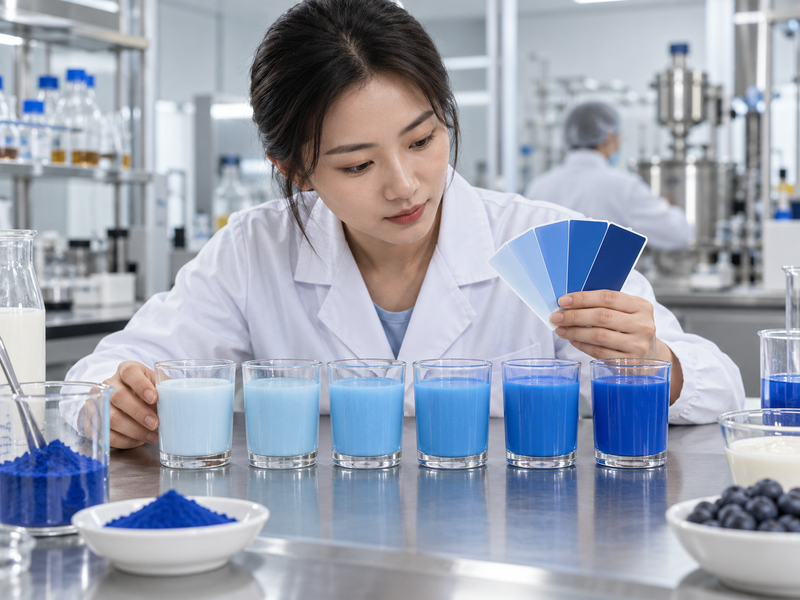
An analytically acceptable extract can behave poorly in a specific beverage, icing or coating. Make matched food samples with identical base, dose, addition point, pH and thermal history. Compare hue, sediment, clarity and storage color under the product’s conditions. This is a different question: application performance can justify rejecting a supplier for that product even if the raw-material assay complies; conversely a small raw-method disagreement might not affect finished color, though contractual resolution remains necessary. Published phycocyanin stability work identifies heat, pH and light as relevant variables, so record those exposures in the comparison. Use the site’s color measurement in food approach for repeatable presentation. Do not use a vivid photograph as a substitute for controlled product samples.
| Food-test control | Keep constant | Observe |
|---|---|---|
| Base | Same formula batch | Hue and opacity |
| Dose | Accurate mass | Color efficiency |
| Process | Same pH and heat | Loss during making |
| Pack | Same light barrier | Shelf-life drift |
For the application comparison, use both an analytically matched dose and a visually matched dose. The former asks whether equal reported strength gives equal finished color; the latter asks how much of each material a manufacturer actually needs. Keep these questions in separate result columns. If one sample produces haze, note whether filtration or mixing removes it and whether that step is allowed in the intended plant process. Check color after the actual hold and packaging interval, since a match immediately after mixing may disappear later. An application trial can guide purchasing while the laboratory dispute is resolved under its own contract rule. Keep its raw recipe and coded samples so a later supplier change can be screened against the same baseline.
9. What belongs in a dispute protocol?
Agree before the next contested lot
The quality agreement should identify governing specification, method revision, sampling point, split procedure, retain duration, test laboratory, uncertainty treatment, retest conditions and final arbitration rule. State who pays for a third test and when material can be released under concession. Build a clock into the process: perishable customer production schedules need response and escalation times, but urgency must not erase traceability. Separate analytical nonconformance from visual application dissatisfaction; each has its own evidence and remedy. Include notification if the supplier changes carrier, extraction route, manufacturing site or test method. A buyer can compare this framework with the site’s blue spirulina wholesale quality agreement guidance. The agreement should refer to specific SKU and method codes. “Color matches sample” alone is too ambiguous to settle a technical disagreement.

10. How should a buyer close the case?
Record both result and process correction
Close with the lot disposition, reconciled method, reason for difference, financial or production consequence and preventive action. If sample preparation caused the difference, revise work instructions and verify next-lot agreement. If genuine lot variation occurred, decide whether specification, supplier process or application dose must change. Do not lose the learning: preserve raw data, sealed retains and the signed decision memo. A near-limit lot may deserve enhanced monitoring even when accepted. Repeat a small paired check on the following lot to confirm the corrective action. Report unresolved uncertainty honestly; a single third-party number rarely explains every discrepancy. Procurement should receive a clear status for the current shipment and a method-specific condition for future orders, while product development receives any evidence of changed finished-food behavior. If the case exposed ambiguous units, add a worked example to the testing instruction. Train both laboratories against the same sample before the next commercial release window.
| Closure question | Required answer | Record owner |
|---|---|---|
| Is lot released? | Yes, hold or concession | Quality |
| Why did values differ? | Evidence-backed cause | Laboratories |
| Does formula change? | Trial-based decision | Product development |
| What happens next lot? | Verification check | Supplier and buyer |
FAQ
Q1: Are E-value and phycocyanin percentage equivalent? No. One is method-defined optical color strength; the other estimates mass concentration under a separate assay.
Q2: Can a COA settle every dispute? It shows a reported batch result, but sample identity and method comparability still need review.
Q3: Should both labs test the same opened bag? Prefer sealed, representative split aliquots with a documented chain of custody.
Q4: Does a third lab automatically decide the winner? Only if the parties agreed its method and decision rule before testing.
Q5: What if both labs agree but the drink looks wrong? Investigate the formula and process with a separate, controlled finished-product trial.
Next action
Collect both methods and raw reports, prepare a representative sealed split and agree on a decision rule. Compare replicate preparations before judging the supplier lot.