
Phycocyanin color value vs pigment content describes two different measurements that buyers may see on one sheet. A supplier can describe a powder as “E18,” “high purity,” and “phycocyanin-rich” in the same quotation. Those phrases may refer to different measurements. If a buyer treats them as interchangeable, a formulation calculation or label decision can rest on a number that never measured pigment mass. The distinction matters most when comparing powders with different carriers or when moving from an extract sample to a commercial lot.
The Spirulina CN Blue Spirulina page correctly cautions that a grade name is not a universal specification and asks buyers to confirm color value, test method and composition. This article turns that caution into a document review. It explains what each optical or compositional figure can support, where it stops, and how to tie laboratory data to a finished product. No health claim or nutritional protein claim follows from the shade of a powder.
Contents
- What is a phycocyanin color value?
- What does pigment content mean?
- How is an optical purity ratio different?
- Why can two powders look equally blue but differ in composition?
- Which method details make a percentage credible?
- How should carriers appear in the calculation?
- What can a spectral scan reveal?
- How should buyers compare COAs across suppliers?
- What does the finished food test add?
- Which numbers belong in a purchase specification?
1. What is a phycocyanin color value?
It describes a defined optical response
Color value expresses how strongly a prepared sample absorbs light at a specified wavelength under stated conditions. Spirulina CN’s factory page uses the expression “E10% 618 nm” for listed blue powder products. That tells a buyer the result is connected to a 10% preparation and a wavelength, but the full method is still needed: sample mass, final volume, solvent, clarification, path length, calculation and reporting basis. E6 and E18 are commercial directions until the current SKU specification fixes these details.
A color value is useful when incoming quality teams want to check whether the lot resembles the approved sample. It does not directly reveal how many grams of phycocyanin are present in one kilogram of as-sold powder. Other absorbing components, carrier formulation and preparation choices can influence the result. Nor does it say how the blue will behave in an acidic drink or heated filling. The buyer should read it as a controlled color-strength measure and link it to a finished-product trial.

| Figure on a document | Primary question | It does not prove |
|---|---|---|
| E/color value | How strong is optical response by this method? | Pigment mass fraction |
| Pigment concentration | How much target pigment was calculated or measured? | Finished-food shade |
| A620/A280 ratio | How pigment-associated absorbance compares with protein-region absorbance | A percent by weight |
| Color difference | How far two finished samples differ visually by a chosen formula | Ingredient identity |
2. What does pigment content mean?
Require a mass basis and an analytical procedure
“Pigment content” should identify the analyte, unit and reference material. It might mean C-phycocyanin mass per gram of powder, a percentage of dry solids, concentration in a reconstituted solution or a broader phycobiliprotein estimate. Those figures are not interchangeable. Ask the laboratory to state whether the result applies to the as-sold powder, a carrier-free fraction or a dried-solids basis. A 10% result for an isolated pigment fraction cannot simply be printed as 10% of the commercial blend.
Published laboratory methods sometimes calculate C-phycocyanin concentration from readings at multiple wavelengths to account for overlapping pigment signals. An original encapsulation study describes its A620 and A650 concentration equation and separately calculates A620/A280 as a purity ratio. The existence of two calculations in the same experiment makes the purchasing lesson plain: ask which one the supplier used. Method suitability also matters. A research equation may need validation for a powder with specific carriers and other ingredients before it becomes a contractual assay.
| Question for the laboratory | Acceptable answer format |
|---|---|
| Which pigment? | C-phycocyanin or named total pigment group |
| Which unit? | mg/g as sold, percent by mass or mg/mL solution |
| Which basis? | As sold, dry solids or isolated fraction |
| Which method? | Named validated procedure and calculation |
| Which uncertainty? | Repeatability, range and detection limits where relevant |
3. How is an optical purity ratio different?
A ratio has no mass unit
The A620/A280 ratio compares absorbance around the phycocyanin band with absorbance in a region where proteins and other components may contribute. Researchers use it to follow purification. A C-phycocyanin purification paper reported a high ratio for a purified preparation, and another large-scale recovery study used the ratio to track its isolated product. Neither result means that a commercial food powder with a carrier can be described by the same number without a comparable preparation.
The ratio can rise when the numerator increases, the denominator falls or both occur. It has no “percent” symbol and cannot be converted directly to percent phycocyanin by moving a decimal point. A supplier may also use the word “purity” for chromatographic area percentage, total protein share or absence of an impurity. Ask which meaning is intended. If a label or purchase specification requires a mass claim, request a validated mass-based assay rather than an attractive optical ratio. Keep ratio and concentration on separate rows of the technical file.
4. Why can two powders look equally blue but differ in composition?
A photograph hides the formulation
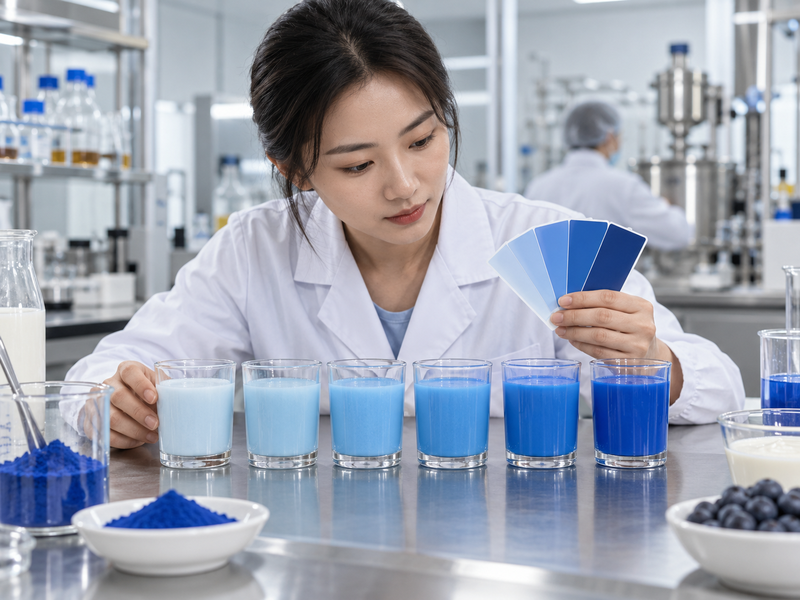
Powder color depends on pigment concentration, particle form, moisture, carrier and lighting. A blend with more carrier can still appear intense in a photograph, especially against a white background or under saturated light. A finer powder may spread differently on a tray. A phone camera’s automatic exposure and white balance make visual rankings still less reliable. A purchasing decision needs samples weighed into the same reference preparation and the intended finished formula, both observed under controlled conditions.
The US identity rule for spirulina extract describes filtered aqueous extraction from Arthrospira platensis and says phycocyanins are the principal coloring components. It also addresses color additive mixtures. That rule identifies the regulated color, not the composition of every marketed powder. Spirulina CN’s product page notes that commercial “blue spirulina” may include carriers or formulation ingredients. The buyer should therefore ask for a full ingredient statement, carrier proportion where available and analytical results on the as-sold SKU. A visual swatch can begin a trial, but it cannot close a composition review.
| Same-looking samples may differ in | Why it changes the buying decision |
|---|---|
| Carrier identity | Label, handling and formulation fit |
| Carrier share | Dose and cost per unit |
| Moisture | As-sold mass basis and storage behavior |
| Particle size | Dispersion and appearance |
| Other soluble pigments | Spectral profile and shade |
5. Which method details make a percentage credible?
Make the result reproducible on the purchased powder
The assay should specify how the sample is taken, extracted or dissolved, clarified and measured. It should name the calibration material or extinction equation, instrument wavelength, dilution steps, recovery checks and reporting basis. If the product is a complex blend, ask how the method handles interference from carriers or other ingredients. A supplier’s internal method may be suitable, but the buyer needs enough detail to understand its intended scope and to commission a verification test if a dispute arises.
Look for validation evidence at concentrations near the product’s specification limits. A method that works on purified pigment may not recover the same result from a spray-dried blend. The encapsulation experiment reported concentration and purity using defined spectroscopy conditions for its own materials; those figures should not be transplanted to another supplier’s product. Ask whether the method has been checked for the actual carrier system and whether the COA reports a measured lot value, not a marketing minimum. If a percentage has no analyte, unit or basis, it is not ready for a purchase contract.

6. How should carriers appear in the calculation?
Work from the as-sold ingredient
Food developers buy a formulated powder, so the relevant dose normally uses the powder’s as-sold mass. If a certificate gives pigment content on a dry or carrier-free basis, convert it only when moisture and carrier proportions are known and the method allows the conversion. The simplest protection is to require both a complete ingredient statement and an as-sold analytical result for the exact SKU sampled. That keeps an apparently strong pigment fraction from obscuring how much of the final bag is carrier.
Carriers may be selected for drying, handling, dispersion or stability, and the choice can affect the finished food. An original spray-drying study used maltodextrin as a comparator while assessing different carrier systems; its outcome is formulation-specific rather than proof that one carrier always wins. Spirulina CN lists maltodextrin, trehalose and sodium citrate as possible options on its product page, subject to the current specification. The buyer should ask which ingredient is in the offered lot, how it is declared and whether a carrier change triggers requalification.
| Reporting basis | Buyer interpretation |
|---|---|
| mg pigment/g as-sold powder | Direct input to a powder dose calculation |
| mg pigment/g dry solids | Needs moisture correction for as-sold dose |
| Percent in isolated fraction | Needs fraction yield and blend composition |
| A620/A280 | Optical ratio, not mass percentage |
7. What can a spectral scan reveal?
Use the curve as supporting evidence
A scan over a defined wavelength range can reveal the position and shape of the main absorption band and any shoulders that may suggest other absorbing material. This is useful when two products share an E number but produce different shades. An original study of C-phycocyanin in carbonated beverages reported a visible peak around 618 nm for its purified material and discussed the absence of certain shoulder peaks. That is a research observation, not a universal fingerprint for every commercial powder.
The scan must be paired with the sample preparation and blank used to produce it. Scattering from cloudy samples can lift the baseline and make a simple peak height misleading. A carrier may affect extraction or clarity even if it does not itself absorb strongly at the target wavelength. Ask the lab to retain the full scan when a lot is disputed or a supplier changes formulation. It may help explain a mismatch between a passing single-wavelength color value and an unexpected finished-product hue. It still cannot substitute for a validated composition assay.
8. How should buyers compare COAs across suppliers?
Make a method map before a number map
Place each supplier’s COA beside its written method and specification. Record the exact SKU, batch, color-value expression, pigment-content assay, purity metric, carrier, moisture and result basis. Mark any field with a different method as “not directly comparable” until a common-method test is completed. A table of E values alone is too thin for a supplier qualification decision. If the supplier only reports pass/fail, request the actual measured result and acceptance range.
Check whether the document refers to the material being offered for the order, not a demonstration lot. The Spirulina CN product page asks buyers to confirm the specification and batch COA for the selected product. That same rule should apply to every competing supplier. When results disagree, retain both reports and test sealed samples in one qualified laboratory under one protocol. Do not average unlike assays or infer an exact phycocyanin percentage from an E category. A clean comparison may reveal that the real choice is between different formulated ingredients, not simply two concentrations of the same one.
| COA field | Supplier A | Supplier B | Comparable? |
|---|---|---|---|
| Exact SKU and lot | Record | Record | Only if correctly matched |
| Color method | Method ID | Method ID | Check preparation and units |
| Pigment assay | Analyte and basis | Analyte and basis | Check validation scope |
| Carrier | Ingredient statement | Ingredient statement | Assess formulation impact |
| Moisture | Measured value | Measured value | Check same basis |
9. What does the finished food test add?
Measure the result customers will see
Color value and pigment content describe the ingredient under laboratory conditions. The customer sees a drink, yogurt, coating or dessert after mixing, processing, packaging and storage. Run a dose ladder in that product, then compare initial and retained samples at defined intervals. Record pH, heat exposure, package opacity and the rest of the formula. A pilot-scale study compared phycocyanin stability across temperature and pH conditions, illustrating why an ingredient assay alone cannot predict every application.
Specify how color will be judged. A controlled visual panel may be suitable for a small project; instrumental CIELAB measurements can support tighter production control if the method is consistent. The CIE definition of CIELAB color difference gives a standard vocabulary for describing difference between measured colors, but an acceptance threshold still belongs to the buyer’s product and customers. A higher pigment percentage is valuable only if it produces the desired shade and process performance at an acceptable cost and label composition.
10. Which numbers belong in a purchase specification?
Contract for the properties the product needs
Name the identity, exact SKU, full ingredient composition, applicable color-value method and acceptance range. Add a pigment-content requirement only if it serves a real formulation or quality decision and the supplier can support a validated assay on the as-sold powder. If an optical purity ratio is useful for process monitoring, state its method and purpose separately. Do not write “purity 18%” when the only source is an E18 category. That wording could create a false product description and an untestable dispute.
Include moisture, contaminant and microbiological requirements appropriate to the product and destination market, plus batch COA, change notification, packaging and storage terms. For US coloring uses, check current 21 CFR 73.530; it sets identity, impurity and use conditions but does not approve a particular supplier’s claim. Link the ingredient specification to the finished-food trial and keep both in the approval record. The best purchasing description is one a receiving laboratory can test and a production team can use without guessing what “high purity blue” meant.
Frequently asked questions
Q1. Does E18 mean 18% phycocyanin? No. E18 is a commercial color-value designation unless a separate validated mass assay states a percentage.
Q2. Is A620/A280 a pigment percentage? No. It is an absorbance ratio with no mass unit.
Q3. Can two equal E-value powders need different doses? Yes. Their carriers, spectral profiles and behavior in the finished formula may differ.
Q4. What result should be used in a dose calculation? Prefer an approved as-sold powder dose established in the finished product, with any pigment assay used for a clearly defined supporting purpose.
Q5. What should be requested first? Ask for the exact SKU, ingredient statement, color method, pigment-content method if claimed, lot COA and matching sample.
Request a measurable product specification
Ask Spirulina CN for the current specification and representative batch documents through its Blue Spirulina page. State whether the project needs color strength, quantified pigment mass or both. Approve the material only after the method and finished-product trial answer those separate questions.