
Blue spirulina milk is a dairy or plant-based milk drink colored with a phycocyanin-rich spirulina extract. The idea is visually simple, but commercial execution depends on the milk base, pigment grade, heat treatment, package, and storage. A blue sample mixed at a café counter cannot prove that a bottled product will keep its shade. This guide gives beverage teams a practical way to build and test the drink.
Contents: 1 · 2 · 3 · 4 · 5 · 6 · 7 · 8 · 9 · 10
1. What belongs in a blue spirulina milk formula?
The base can be dairy milk, oat milk, almond milk, coconut milk, or another permitted product. The blue component is usually phycocyanin-rich spirulina extract rather than whole green spirulina powder. A sweetener, flavor, stabilizer, or additional color may also appear, depending on the brief. Each ingredient changes the final shade and label. Decide whether the product is a fresh café drink, a chilled bottle, or a shelf-stable beverage before selecting a formula.
What should the first brief say?
Name the milk base, serving size, target shade, sugar goal, flavor, process, package, shelf-life target, and destination market. If the brand wants a pale blue color, a small dose may suffice; a deep blue image can require a dose that affects cost or taste. Ask the supplier for the exact grade composition and intended uses. “Blue spirulina” is a commercial shorthand, while phycocyanin names the main blue pigment component. A formulated ingredient can also contain carriers that belong in the label review.
| Decision | Why it matters |
|---|---|
| Milk base | Opacity and flavor |
| Extract grade | Shade and dispersion |
| Process | Color and safety |
| Package | Light exposure |
| Market | Naming and claims |
The product brief should describe a drink customers can buy, not only a color sample.
2. How does the milk base change the blue?
Milk is opaque, so it scatters light and softens the blue that looks brilliant in clear water. Dairy, oat, almond, and coconut bases differ in natural color, fat, protein, and sweetness. A slightly yellow base can push a blue extract toward teal or gray. Test each base separately at the same measured doses before making a family of products. Changing the base late in development can change the look even when every other ingredient stays fixed.
What is a fair screening method?
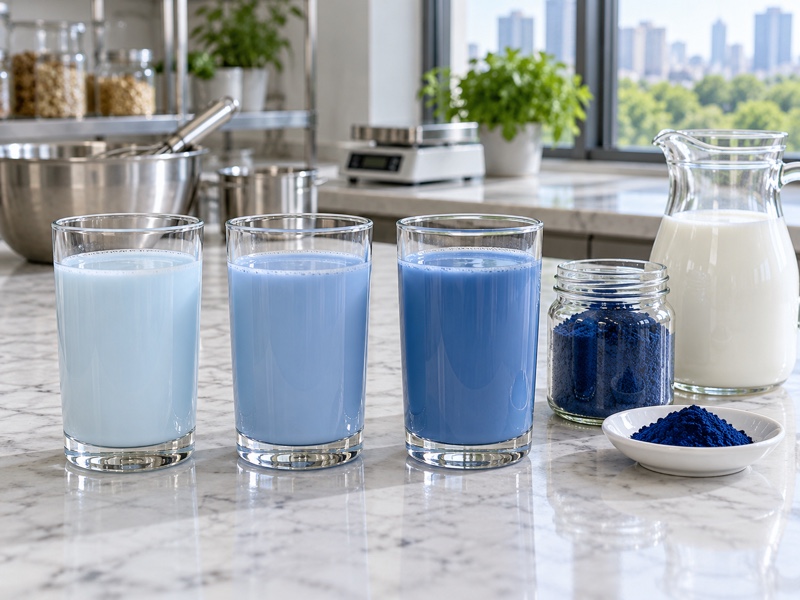
Prepare uncolored controls and a low, target, and high blue dose in each base. Hold the same temperature, glass, lighting, and mixing method. Assess shade immediately and after the normal service hold. Taste samples blind when practical. A blue color that works in sweet vanilla oat milk may reveal an off-note in unsweetened dairy milk. Record the dose as grams per kilogram of finished drink so it can be reproduced by a production team.
| Base | Likely pilot question |
|---|---|
| Dairy milk | How does heat treatment affect shade? |
| Oat milk | Does the natural beige tone mute blue? |
| Almond milk | Does separation change appearance? |
| Coconut milk | Does fat affect uniformity? |
The winning base should meet taste, shade, nutrition, and cost targets together.
3. How should the blue extract be selected?
Request a food-grade sample tied to a named commercial grade, its full composition, specification, COA, color-strength method, and storage guidance. A powder may ship efficiently but need careful pre-dispersion; a liquid may dose quickly but need different storage and open-container controls. Compare formats at the same finished shade. A supplier's concentration figure is useful only when the assay method and units are clear.
What should the bench test observe?
Look for specks, haze, foam color, ring formation, sediment, and flavor changes. If the base is homogenized, test the extract before and after the relevant process. Record mixing order because adding powder straight into cold milk may clump while a measured preblend may disperse evenly. A product that looks uniform in a beaker may still form a blue line in the bottle neck during storage. Shake or stir only as the intended customer would.
The blue spirulina extract guide describes ingredient forms. The exact milk matrix determines whether that ingredient performs.
4. Can the color survive heat treatment?
Phycocyanin can lose color under some heat and pH conditions. A published stability study found changes in pigment concentration and half-life when phycocyanin solution was heated at different pH values. A dairy product is more complex than that solution, so a manufacturer must test its own formula and process. Do not reduce a validated food-safety step merely to protect color.
Which process checkpoints matter?
Compare color in the premix, after homogenization if used, immediately after the heat step, after filling, and across shelf life. Record temperature exposure and pH. If the extract is added after heating, confirm that the addition method meets the product's safety system and process authority requirements. If a grade cannot meet the desired shade safely, consider another grade or a different product format. A cold café drink and a shelf-stable carton may need separate recipes.
| Checkpoint | Observation |
|---|---|
| Premix | Dispersion |
| Post-process | Heat impact |
| Post-fill | Package effect |
| Shelf end | Consumer shade |
Approve the packaged result, not the most vivid intermediate sample.
5. What role do pH, flavor, and sweetness play?
Vanilla, fruit, citrus, and cultured-milk flavors change the drink's acidity and perceived color. They also change whether any extract taste is noticeable. Begin with a simple base and add flavor components one at a time. Measure pH instead of describing a drink as “slightly tart.” For a cultured product, check color after fermentation and during refrigerated storage. For a sweet milk drink, taste after chilling because sweetness and flavor release can differ from a warm bench sample.
What should a sensory panel compare?
Serve coded samples at normal drinking temperature. Ask about sweetness, off-notes, mouthfeel, color appeal, and aftertaste. Include an uncolored control. If children are the intended audience, do not infer acceptance from an adult team; conduct appropriate consumer testing without presenting the color as a health promise. For a low-sugar claim, review the full formula and market rules. The blue extract is not a substitute for a balanced flavor system.
| Variable | Possible consequence |
|---|---|
| Acidity | Color change |
| Vanilla | Flavor masking |
| Sweetener | Taste and cost |
| Stabilizer | Texture and suspension |
A blue drink that tastes flat will struggle after the novelty wears off.
6. How should the package be chosen?
Clear bottles reveal the color on shelf but expose the drink to more light. Opaque cartons or sleeves can protect appearance while hiding the blue until opening. Test package candidates with the real formula and distribution conditions. Check headspace, closure, and whether the shade looks different through tinted plastic. The packaging artwork should use a photograph that reflects the normal product after storage, not a freshly mixed laboratory glass.
What should shelf-life work include?
Use the intended package, fill method, and storage temperatures. Monitor microbial safety through the appropriate program, then assess color, flavor, sediment, separation, and package integrity at planned intervals. Include a normal customer action such as shaking, if the label asks for it, and see whether the drink returns to the expected shade. Record color photos under consistent lighting. A shelf-life result for a powder in water does not validate a milk beverage.
The quality team should agree on an acceptable color range before the first long-term trial. Otherwise, the launch deadline can influence how people interpret faded samples.
7. Does blue spirulina milk have special nutrition benefits?
Its nutrition comes mainly from the milk base and the complete formula. A small color dose of blue extract should not be credited with the protein or minerals listed for whole green spirulina unless the finished product has supporting data. Dairy milk, fortified plant milk, and sweetened plant drinks can have very different nutrition profiles. Calculate the actual serving and test or substantiate claims according to the target market.
What should product pages avoid?
Avoid disease, detox, or immune claims based on the color. Do not call the product caffeine-free if the formula includes other caffeinated ingredients. If the brand says “natural blue,” review the exact ingredient and jurisdiction. The FDA food substance listing identifies spirulina extract as a color additive in US food context; the finished drink still needs its own label review.
| Statement | Evidence required |
|---|---|
| Protein amount | Finished-product nutrition |
| No added sugar | Complete formula |
| Natural color | Ingredient and market rules |
| Shelf-life appearance | Packaged-product trial |
A precise ingredient story is stronger than borrowed claims from a different spirulina product.
8. What changes for café service?
A café can mix and serve the drink cold, which may make color control easier than for a heat-treated bottle. Even then, stores need a measured recipe and a defined preparation sequence. Ice amount, milk temperature, powder preblend, and cup shape can change appearance. Train staff with ordinary equipment and a visual acceptance reference. A seasonal drink should be tested during a busy shift rather than only by the developer in a quiet kitchen.
Can a café batch the blue milk ahead?
Possibly, but set a validated hold time for the actual recipe under the café's food-safety system. Assess settling, shade, flavor, and container handling over that interval. A blue premix that separates may require shaking before each pour, which adds labor and inconsistency. Use a dedicated, labeled container with lot and preparation time. If different locations use different milk brands, the color may vary; specify the base or approve each substitute.
The café recipe must survive routine service if it is going to be a repeat menu item.
9. How should buyers compare suppliers?
Ask for the exact extract grade, full composition, sample, specification, representative COA, lead time, package, and change-notice policy. Compare cost per finished drink at the approved shade. A cheaper grade may require a higher dose or fail a process trial. A more expensive grade may be justified if it reduces waste and protects a stable shelf-life color. Ask whether the supplier can support the projected scale without substituting a different carrier.
What should the supply agreement include?
Record the approved grade, manufacturing site, color-strength method, acceptance range, storage requirements, remaining shelf life on delivery, and complaint route. If a distributor handles the sale, confirm that batch documentation and traceability remain available. Keep a retained sample of the approved lot. If the next shipment appears different, investigate before releasing it into production.
The blue spirulina wholesale article offers a broader procurement checklist. Milk beverages add a matrix and process test to that list.
10. What should the first pilot prove?
The pilot should show that ordinary production staff can make the drink with the approved shade, taste, nutrition, and safety profile using commercial equipment. It should also show that the package and shelf-life target are realistic. Run a measured dose ladder, lock the milk base, then test the complete formula through processing and distribution. Approve artwork only after a representative packaged product is available.
What should be kept in the launch file?
Include supplier documents, ingredient lots, formula version, process settings, sensory results, color photos, nutrition calculation, label sign-off, and shelf-life data. Assign owners to each approval. If the milk base, extract carrier, package, or heat process later changes, assess which trials need repeating. The blue shade is part of the product promise, so it should be controlled with the same care as flavor and safety.
FAQ
Q1: Is blue spirulina milk dairy-free?
It can be dairy or plant-based. The formula and label must identify the actual base.
Q2: Is the blue ingredient whole spirulina?
Usually it is a phycocyanin-rich extract. Ask for the supplier's composition statement.
Q3: Will the shade survive pasteurization?
It depends on the grade and process. Test the actual heat step without compromising food safety.
Q4: Does the drink contain significant spirulina protein?
Do not assume so from its color. Use finished-product data for nutrition claims.
Q5: What should a buyer test first?
Compare measured doses in the intended milk base, then test the full process and package.