
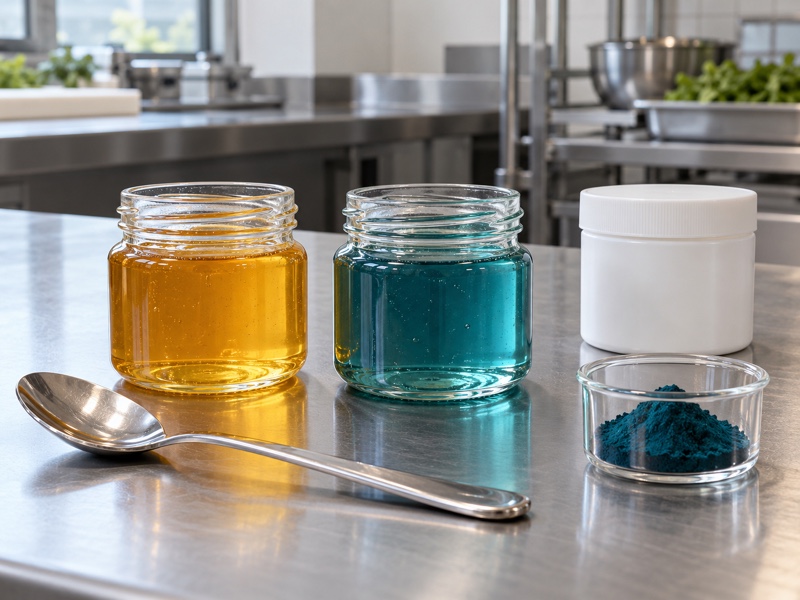
Blue spirulina honey is honey blended with a phycocyanin-rich spirulina ingredient for color. It can look distinctive in a jar or on a dessert, but a commercial formula needs more than a blue spoonful. The ingredient form, dose, moisture, mixing, label, and shelf life all affect whether the finished product remains saleable. This guide helps honey packers and food brands test the idea without treating a social-media photograph as a production specification.
Contents: 1 · 2 · 3 · 4 · 5 · 6 · 7 · 8 · 9 · 10
1. What exactly is blue spirulina honey?
It is a formulated honey product containing a blue spirulina extract or color preparation. Phycocyanin is the blue pigment component; the ingredient sold to a manufacturer may also contain carriers or water. The product is not automatically the same as pure honey under every market's naming rules. Before choosing a front-label name, ask regulatory staff to assess the complete formula and destination. Keep the ingredient declaration for the exact blue grade in the product file.
What should a product brief include?
State the honey type, target shade, flavor, jar size, serving idea, intended market, and whether the product will be heated, whipped, or blended with other ingredients. A dark amber honey may need much more blue extract than a pale honey and may never appear clean blue. Set a color goal that the base can deliver. If a brand wants a bright blue product, a pale base may be the practical starting point.
| Brief element | Why it matters |
|---|---|
| Honey color | Final hue |
| Extract form | Mixing and moisture |
| Process | Color retention |
| Jar | Light exposure |
| Market | Product naming |
The base honey controls the first impression before any blue ingredient is added.
2. Which blue ingredient should be used?
Request a food-grade grade with a complete composition statement, specification, COA, color-strength method, and storage instructions. A dry powder may be easier to blend without adding water but can form blue specks. A liquid extract may disperse faster, yet its water and other components need review in a low-moisture honey system. Compare both in the actual honey at measured doses. Do not judge an ingredient from its color in plain water.
What should a small-scale comparison record?
Use the same honey lot, temperature, mixing vessel, and batch size. Add low, target, and high pigment doses by weight. Record mixing time, visible streaks, shade after standing, flavor, and any change in texture. Check the surface and bottom of the jar for separation. If the product is intended as a drizzle, test flow at normal room and refrigerated temperatures. Keep a plain honey control so testers can identify changes beyond color.
The blue spirulina powder guide explains ingredient-grade questions that apply here. Honey adds a specific concern: introducing water or poorly dispersed solids can change the finished product's behavior.
3. How can powder be mixed evenly into honey?
Honey is viscous, so powder can sit in streaks unless the mixing sequence is designed carefully. Preblend a measured amount of extract with a small portion of honey, then return it to the main batch under controlled mixing. Follow the supplier's handling guidance and avoid adding unapproved water simply to make the powder dissolve. If warming the honey helps flow, keep that step within a validated process and check its effect on both the honey and the blue pigment.
What should scale-up verify?
A hand-stirred jar does not predict a larger tank. Check color samples from the top, middle, and bottom of the batch and from the first and last filled jars. Record mixer speed, time, temperature, and fill conditions. If pigment clusters remain, assess the powder grade, screen size, and preblend method rather than increasing dose. A bright blue speck may look like contamination to a customer even if it is only unmixed ingredient.
| Production point | Check |
|---|---|
| Preblend | No dry clusters |
| Main tank | Uniform shade |
| First fills | Same color as tank |
| Last fills | No concentration drift |
Uniformity needs proof across the whole batch, not one sample taken beside the mixer.
4. Why does moisture matter?
Honey's low available water is part of its normal stability profile. Adding a liquid color preparation can change moisture and water activity, especially at a high use level. A small amount may be manageable, but the outcome must be measured in the finished formula. Do not assume the supplier's liquid is “just color.” Request its complete composition and assess whether it fits the packer's microbiological and shelf-life controls.
Which tests belong in a pilot?
Measure moisture or water activity according to the product's quality system and compare the plain honey control with the colored version. Observe gas, off-odor, separation, crystallization, and cap integrity during storage. If the product includes fruit, syrup, or other ingredients, treat it as a different formulation with its own safety plan. A blue color can hide early appearance changes; use objective measurements and sensory checks rather than relying only on visual appeal.
The quality team should decide how the formulation is classified and tested. A recipe that looks stable for a week is not a shelf-life study.
5. Will heat or acid change the blue shade?
Phycocyanin can respond to heat, pH, light, and storage. Honey is acidic, and blending or filling may involve warmth. A published phycocyanin study reported strong effects of temperature and pH in solution. Honey is a different matrix, so the study cannot tell a producer exactly how long its jar will stay blue. Test the real honey, process, jar, and storage conditions.
What should the color study compare?
Photograph the product under fixed lighting immediately after mixing, after filling, and at planned shelf-life intervals. Include the plain honey and a retained approved-color jar. Observe a closed jar and an opened, reclosed jar if the product is likely to be used over weeks. Check whether color collects near the lid or changes in a clear package exposed to light. If shade shifts, identify whether the cause is ingredient grade, process heat, base honey variation, or packaging.
| Stress | Pilot question |
|---|---|
| Warm mixing | Does color fade before filling? |
| Honey acidity | Does shade shift over time? |
| Clear jar | Does light alter the product? |
| Repeated opening | Does appearance remain acceptable? |
Approve the shelf-end jar, not only the first blue spoonful.
6. How should flavor be evaluated?
A color ingredient can be nearly invisible to taste at one dose and noticeable at another. Honey type also matters: delicate varieties may expose an extract note while full-flavored varieties may mask it but darken the color. Run blind tasting with the plain control and several measured blue doses. Evaluate the product as consumers will use it, such as stirred into yogurt, drizzled on a pastry, or dissolved in a cold drink.
What should the sensory form ask?
Record sweetness, honey character, any marine or earthy note, aftertaste, texture, and visual appeal. Test after shelf storage, not only on mixing day. If a brand wants to add citrus or other flavor to balance the extract, treat that as a formula change and reassess stability and naming. A striking blue jar that no one wants to eat again is a weak commercial product.
The useful target is the lowest measured dose that meets the approved shade without disturbing the honey's expected flavor.
7. What should packaging and labels say?
The product name, ingredient list, and color statements must reflect the complete formula and destination market. Adding blue extract may affect whether the product can be sold simply as “honey” under local standards. Ask qualified regulatory staff before printing labels. A phycocyanin-rich extract is not automatically a meaningful source of protein or other nutrients at a color dose. Do not transfer whole-spirulina nutrition claims to this product.
What should a buyer verify with the supplier?
Request the exact ingredient declaration, carrier information, and color-additive status for the market. The FDA food substance listing identifies spirulina extract as a US food color additive, but current detailed uses and labeling still need product-specific review. Check any “natural color,” organic, or no-artificial-color claim against the full formulation. Product photographs should show the ordinary production shade.
| Copy element | Review basis |
|---|---|
| Product name | Honey and blend rules |
| Ingredient list | Full grade composition |
| Nutrition claim | Finished serving data |
| Color statement | Market-specific rule |
Accurate copy preserves the product's charm without making a claim that cannot be supported.
8. What changes for foodservice buyers?
A bakery or café may buy blue spirulina honey as a topping rather than a retail jar. The product must pour or spread at service temperature, hold a consistent color, and survive normal handling. Test it on the intended food. A blue drizzle may disappear on a dark pastry or bleed into a wet topping. If it is stirred into a hot drink, the final shade may differ from the jar. A foodservice pack also needs practical dispensing and cleanability.
What should a service trial record?
Check portion size, flow from a bottle or pump, waste at the end of a shift, and appearance after holding. Train staff to use a fixed amount. A dramatic blue dessert photographed with a heavy pour may be too costly for normal service. If the product separates, define whether stirring is permitted and how the container is handled safely. Use the same honey lot and blue grade during trials so the team can identify a real process problem.
The menu result matters more than the color in bulk storage.
9. How should the product be costed?
Calculate cost per finished jar or portion using the pigment dose that passes shade, flavor, and shelf-life tests. Include honey cost, mixing loss, packaging, freight, quality testing, and rejected batches. A stronger blue grade may cost more per kilogram but less per jar; a liquid may save mixing time but introduce moisture-management work. Compare offers at equal finished outcome rather than headline ingredient price.
What should the supply agreement include?
Record the approved extract grade, full composition, color-strength method, lot COA, storage, minimum shelf life on arrival, and change-notice terms. If the honey base varies seasonally, define whether the formula will be adjusted and who approves a new shade. Keep a retained jar and ingredient sample. The blue spirulina wholesale guide covers general procurement controls; a honey product also needs base-lot and blending controls.
Repeatability is a joint problem for the honey packer and the color supplier.
10. What is the sensible launch sequence?
Choose a pale honey base and a target shade, then screen blue grades with a measured dose ladder. Approve flavor and mixing uniformity before moving to larger tanks. Test moisture or water activity under the quality plan and run a packaged shelf-life study. Review the product name and ingredient declaration for every target market. Only then finalize artwork and a commercial purchase agreement.
What belongs in the launch file?
Keep the honey and extract specifications, ingredient lots, formula version, mixing settings, fill records, color photos, sensory results, shelf-life data, and label approval. Give production a clear process card and an acceptable shade reference. If either the honey or blue ingredient changes, assess whether the trial must be repeated. The finished jar should look, pour, and taste like the sample that earned approval.
| Release check | Evidence |
|---|---|
| Uniformity | Top and bottom jars |
| Moisture | Finished batch test |
| Shade | Retained sample |
FAQ
Q1: Is blue spirulina honey naturally blue?
Its color can come from spirulina extract, but the exact ingredient and label claim need verification.
Q2: Is phycocyanin the same as the whole blue ingredient?
Phycocyanin is the blue pigment component; a commercial preparation can include other constituents.
Q3: Can a liquid extract be mixed into honey?
It may be possible, but its water and composition require a finished-product stability review.
Q4: Does blue honey provide spirulina protein?
Do not assume so from the color. Test the finished serving before making a nutrition claim.
Q5: What should a packer test first?
Dose, mixing uniformity, flavor, moisture-related stability, and color in the final jar.