
A blue spirulina supplement usually contains a blue extract from cultivated spirulina rather than the whole green biomass. That distinction changes what buyers can expect from the ingredient, the evidence behind nutrition claims, and the documents a manufacturer should request. A food color preparation, a capsule ingredient, and a finished dietary supplement may share a vivid blue appearance while serving different purposes. This guide explains how to identify the material, compare grades, and build a defensible product brief.
Contents: 1 · 2 · 3 · 4 · 5 · 6 · 7 · 8 · 9 · 10
1. What does “blue spirulina supplement” describe?
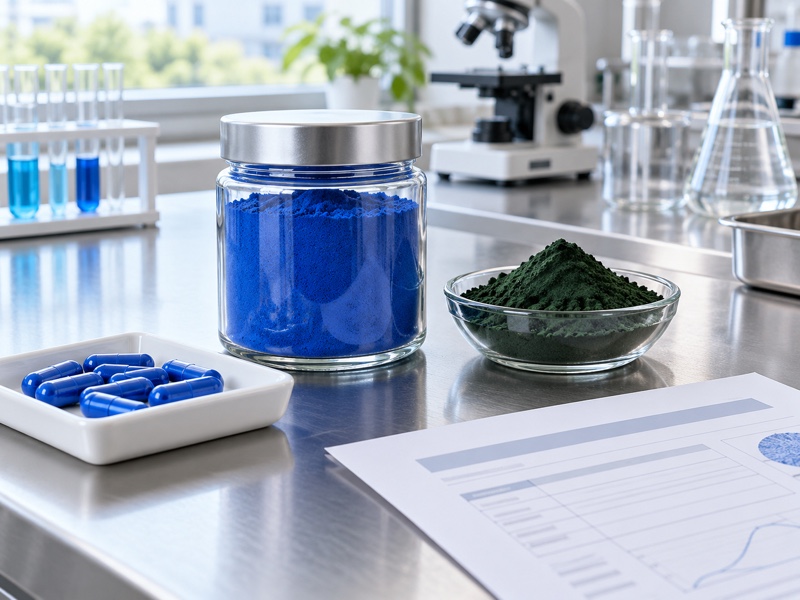
The phrase can describe a capsule filled with phycocyanin-rich extract, a powder sold for mixing into drinks, or a finished supplement that contains blue spirulina alongside other ingredients. Ask which of these the supplier actually offers. Whole spirulina biomass contains a range of proteins, pigments, and other components and usually looks dark green. Blue spirulina extract concentrates the water-soluble blue pigment phycocyanin, so its nutrition profile cannot be assumed from a whole-spirulina label.
Which identity questions belong on the purchase brief?
Request the botanical source, the manufacturing process, the carrier ingredients, and a specification for the exact grade. “Pure blue spirulina” is a marketing phrase unless the composition is defined. Some powders contain a carrier to make drying, dosing, or dispersion practical. For a finished capsule, ask for the entire formula and serving size rather than the extract name alone. A photograph of a blue spoonful establishes color, not identity or dose.
| Product form | What to verify | Typical buyer |
|---|---|---|
| Blue extract powder | Composition and color strength | Food or supplement formulator |
| Capsules | Extract amount per serving | Supplement brand |
| Drink blend | Full ingredient list | Beverage brand |
| Whole spirulina | Biomass identity | Nutrition product brand |
Write the product identity before comparing prices. Otherwise, quotations for different materials will look deceptively similar.
2. How is blue extract different from whole spirulina?
Whole spirulina and blue extract start with related biomass, but the finished products are not nutritionally interchangeable. Extraction and filtration separate much of the material that gives whole spirulina its green color. A blue powder may be valued mainly for appearance or for a specified phycocyanin content. It does not inherit the protein, iron, or other nutrient quantities printed on a whole-spirulina powder label. Manufacturers should obtain test results for the exact ingredient they intend to use.
What should marketing teams avoid transferring?
Do not copy a whole-spirulina benefit claim onto a blue extract label. The ingredient, dose, and evidence may differ. The FDA's food substance listing identifies spirulina extract as a color additive in food, which is a different regulatory context from a supplement efficacy claim. Likewise, a supplier's pigment-strength figure is not a clinical dose. Separate three questions in the product brief: what the ingredient is, what it does in the formula, and what a claim can lawfully say in the destination market.
| Claim question | Evidence to request |
|---|---|
| Ingredient identity | Specification and composition |
| Amount per serving | Formula and batch record |
| Nutrient content | Finished-product analysis |
| Health benefit | Applicable human evidence and legal review |
That separation keeps product development from turning an attractive color into an unsupported promise.
3. What benefits can a brand responsibly discuss?
A brand can describe blue spirulina's color and its role in a formula with direct evidence from the ingredient and finished product. Some scientific work examines phycocyanin's biological activity, but laboratory results do not prove that a particular supplement improves health in people at its sold dose. The distinction matters in product pages, sales sheets, and distributor training. Buyers should expect careful language about what is measured, what is hypothesized, and what has been tested in humans.
How should claims be checked?
Collect the proposed claim, intended market, dose, ingredient specification, and supporting study in one review file. Check whether the study used isolated phycocyanin, whole spirulina, a different species, or a combined formula. Check the population and endpoint as well as the amount consumed. If the evidence is limited, describe the ingredient accurately without translating a mechanistic finding into a consumer outcome. The product can still have a clear value proposition: a naturally derived blue appearance, a defined ingredient, and a traceable supply chain.
Marketing copy should not imply that the vivid color itself proves antioxidant effects, improved energy, or immune support. A technically sound claim is narrower, easier to substantiate, and more durable across channels.
4. Which specifications distinguish a usable supplement grade?
Start with identity, composition, assay method, microbiology, contaminants, moisture, and the declared carrier system. A supplier may report phycocyanin concentration using a method that differs from another supplier's method. Ask for the method and units rather than treating two percentages as automatically equivalent. Confirm whether the powder is intended for capsule filling, sachets, gummies, or ready-to-mix drinks; flow, taste, and color dispersion can vary with the use.
What belongs in a comparison sheet?
Record the tested grade code, color strength in a defined application, serving-dose calculation, price per finished serving, lead time, and shelf life. Request a lot-specific certificate of analysis for the material that will ship. Sample approval should refer to a retained lot and specification, not simply the supplier's brand name. If an excipient changes, the finished label and performance may change too.
| Specification item | Practical question |
|---|---|
| Phycocyanin assay | Which method and units were used? |
| Carrier declaration | What else is in the powder? |
| Microbiology | Does the lot meet the buyer's limits? |
| Heavy metals | Which analytes and limits apply? |
| Shelf life | Under what packaging and storage conditions? |
The comparison sheet gives purchasing, quality, and marketing teams one agreed description of the material.
5. How should safety and contaminants be evaluated?
Safety review starts with the actual ingredient and supplier, not with a broad statement that spirulina is natural. Cultivation water, processing controls, and storage affect the material a consumer receives. Ask for relevant contaminant and microbiological data, manufacturing controls, and traceability for each lot. The finished supplement also needs a review of other active ingredients, allergens, excipients, and intended users. A capsule combining several botanicals creates different questions from a single blue extract powder.
Which records are useful before purchase?
Request the current specification, batch COA, manufacturing-site information, ingredient statement, and a change-control process. Confirm whether the supplier can identify the starting biomass lot and the extraction lot. If the brand sells in several countries, have regulatory staff assess each market before finalizing the label. Avoid blanket statements that a blue spirulina supplement is safe for pregnancy, children, or people taking medicines; those users need advice based on the complete product and their circumstances.
Retain a sample of the approved lot. If a later shipment differs in color, odor, or analytical results, quality staff can compare it with the reference instead of relying on memory.
6. How do dosage and form affect a product?
There is no universal serving size that fits every blue spirulina extract. A capsule's fill weight, an extract's phycocyanin concentration, and a drink powder's color target are different variables. Start with the intended use and the evidence for that exact ingredient. For a color-led drink mix, the dose may be set by visual performance and applicable color-additive rules. For a supplement claim, the dose needs its own evidence and legal assessment.
What happens during a pilot batch?
Test the chosen grade in the actual finished format. In capsules, assess fill flow, content uniformity, and moisture protection. In powder sticks, check dispersion, clumping, flavor, and package barrier. In gummies, assess color through processing and shelf life; phycocyanin can respond to heat, acidity, and light. A published stability study found temperature and pH strongly affected phycocyanin in solution, so a blue sample in a beaker is not enough to approve a heated product.
| Format | Pilot check |
|---|---|
| Capsule | Fill flow and uniformity |
| Sachet | Dispersion and moisture pickup |
| Gummy | Heat and color retention |
| Ready-to-drink | pH, light, and shelf life |
Document the trial conditions. A dosage figure without a tested formula tells buyers little about finished performance.
7. What should a supplier provide for a B2B launch?
A capable supplier should answer precise questions with current documents and representative samples. Ask for the ingredient specification, batch COA, full composition, manufacturing and packing sites, shelf-life basis, storage instructions, and lot traceability. If the product will be sold as organic or under another certification, check the certificate's scope, dates, product, and facility. A badge on a website does not establish that the offered grade qualifies.
How can buyers compare two offers fairly?
Send the same brief to each supplier: application, target market, dose or color target, annual forecast, package size, and required documents. Ask them to quote the exact grade that was sampled. Compare cost per finished serving or saleable unit, not only cost per kilogram. A lower-priced extract that needs twice the dose may be more expensive in the final product. Discuss lead time, minimum order, and change notification before committing to packaging artwork.
The blue spirulina wholesale guide covers the procurement side in more detail. For a supplement, add a regulatory and claims review to that purchase checklist.
8. How should labels and product pages be written?
The label should identify the finished product, ingredient amount, other ingredients, serving information, and required market-specific statements. Use the legal name and approved terminology for the destination market. “Blue spirulina” can be useful consumer language, but the ingredient declaration may require a more precise description. A food color, conventional food ingredient, and dietary supplement can sit under different rules even when the same extract appears in each.
Which phrases deserve special scrutiny?
Review claims about detoxification, immunity, inflammation, disease, and nutrient content before publication. If the finished product has not been tested for a nutrient, do not import that nutrient value from a whole-spirulina database. If the product uses a carrier, make the ingredient list reflect it. Product photography should show the real shade at the sold use level rather than an unusually strong laboratory sample. The customer should understand what will arrive and how it is meant to be used.
For internal approval, keep the proposed copy beside its evidence and sign-off date. This makes future revisions easier when a formulation or market changes.
9. What mistakes cause expensive reformulation?
The most common error is choosing a blue sample by appearance and learning later that it cannot survive the manufacturing process. Other problems include unclear composition, an unverified claim, a carrier that conflicts with the label, and a quoted grade that differs from the sampled grade. These problems are easier to find on a pilot bench than after printed packaging reaches a warehouse.
What should the launch gate include?
Require sign-off on ingredient identity, supplier documents, application testing, finished-product stability, formula cost, and market-specific copy. Set a clear change-control rule for new lots and supplier substitutions. Record the approved shade under consistent lighting so color acceptance does not become a subjective argument. If a batch shifts, investigate rather than simply increasing the dose; the problem could be pH, storage, or a changed material.
| Gate | Owner | Evidence |
|---|---|---|
| Ingredient approval | Quality | Specification and COA |
| Formula approval | R&D | Pilot record |
| Claims approval | Regulatory | Claim file |
| Commercial approval | Purchasing | Landed cost and supply terms |
A short gate prevents the supplement project from becoming four separate interpretations of the same blue powder.
10. What is the practical next step for a buyer?
Write a one-page brief naming the product form, destination market, target consumer, proposed serving, desired blue shade, package, and annual volume. Ask two or three suppliers for the same document set and representative samples. Test those samples in a pilot batch before choosing a source. If the product's value proposition depends on a health claim, settle the evidence and label position before ordering branded packaging.
How can a supplier conversation stay specific?
Send the formula constraints rather than asking for the “best” blue spirulina. State whether the product is a capsule, sachet, gummy, or beverage. Include process temperature, pH when relevant, shelf-life target, and the market where it will be sold. Ask the supplier to name the exact grade and to flag any carrier or processing aid. A useful reply should give a sample, specification, COA example, and clear next steps for a larger order.
The goal is a product that performs consistently and says only what its evidence supports. That is a stronger launch position than a bright color and a list of borrowed wellness claims.
FAQ
Q1: Is blue spirulina the same as whole spirulina?
No. Blue spirulina commonly refers to a phycocyanin-rich extract, while whole spirulina is the broader biomass.
Q2: Does a blue spirulina supplement contain the same protein as whole spirulina?
Do not assume so. Check the exact ingredient specification and finished-product nutrition analysis.
Q3: Can blue spirulina be put in capsules?
It can be formulated that way, but capsule flow, uniformity, moisture, dose, and the product's legal positioning need review.
Q4: Can a brand claim immune or detox benefits?
Such claims require appropriate evidence and market-specific legal review. Color alone does not substantiate them.
Q5: What should a buyer request first?
Request the exact grade specification, composition, representative sample, batch COA, and intended-use information.