
Phycocyanin freeze drying sounds gentle, and that makes it appealing for a heat-sensitive blue pigment. Yet a cold process does not make every powder equal. The recipe entering the dryer, its protective solids, final moisture, milling, and pack all affect what a buyer receives. A successful freeze-dried lot has to work after rehydration, not merely look blue on a tray. This guide is for food developers comparing bulk phycocyanin or blue spirulina powders for a specific formulation. It uses published studies to frame questions and keeps any supplier's commercial specification separate from research samples.
Contents
- What does phycocyanin freeze drying do to a blue extract?
- Why does the feed formula matter before freezing?
- Which wall materials should be compared?
- How is a useful drying cycle assessed?
- What happens when the cake is milled?
- How should rehydration be tested?
- Does freeze drying give a longer shelf life?
- What is different at commercial scale?
- How should cost be compared with other powders?
- Which documents should accompany a bulk lot?
1. What does phycocyanin freeze drying do to a blue extract?
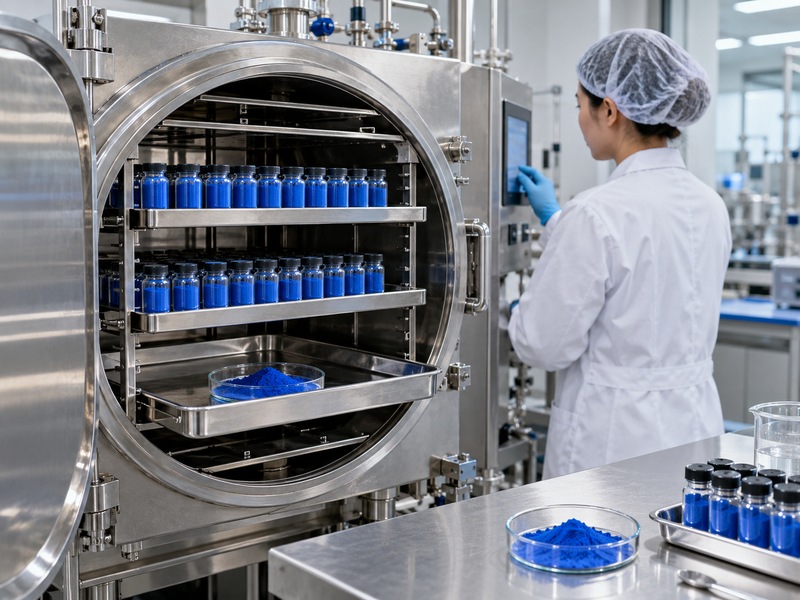
The liquid feed is frozen, then water is removed under reduced pressure by sublimation and further drying. That pathway avoids the same hot-air exposure as spray drying, but it brings its own risks: slow freezing, collapse, residual moisture, and handling after the dried cake is removed. A study of freeze-dried phycocyanin microcapsules compared wall materials rather than treating freeze drying as a single magic step.
Judge the final powder in its intended food. A cake may have good color retention but produce coarse particles after milling. An instant beverage needs quick dispersion; a dry confectionery mix may tolerate a different structure. The supplier's process description should clarify whether the offered material is a dried extract, a formulated microcapsule, or a blend. Those are not interchangeable when dosing by mass.
2. Why does the feed formula matter before freezing?
The composition of the liquid before freezing sets the structure of the dried cake. Pigment concentration, dissolved solids, salts, pH, and protective carriers can affect freezing and later rehydration. A comparison must control starting pigment. If one feed contains more wall material, a lighter-colored powder does not necessarily mean more degradation; it may simply contain less pigment per gram. Ask for carrier disclosure and compare candidates at equivalent starting blue in the finished formula.
Record whether the supplier uses an extract that has been clarified or concentrated before drying. That upstream step can change residue and reconstitution, although it should not be confused with the drying method itself. If the end product is acidified or heat treated, include those conditions in the test plan from the outset; a freeze-dried powder can still be vulnerable after it dissolves.
| Feed question | Why to ask | Pilot check |
|---|---|---|
| Pigment basis | Mass alone hides dilution by carrier | Match initial finished-food color |
| Carrier identity | Changes label and powder behavior | Review ingredient declaration |
| Feed pH | Can affect protein behavior | Record pH before and after drying |
| Solids and salts | Affect cake structure | Compare rehydration and residue |
| Clarification step | Affects visible particles | Inspect solution after a fixed mix |
3. Which wall materials should be compared?
Published work has tested maltodextrin, gum arabic, alginate, and carrageenan in freeze-dried phycocyanin systems. One conference study compared microcapsules made with different coatings, and another original study examined maltodextrin and gum arabic. Their results help build a screening list, not a ready-made commercial recipe. Choose candidates by the product's constraints. A carrier may improve the dried cake yet make the final drink cloudy or thick.
Check allergen and ingredient-statement implications early. Request samples with full carrier disclosure and avoid blind trials of anonymous powders. If the intended food is dry, watch blending and segregation; if it is liquid, watch cold-water dispersion and sediment. At equal starting shade, compare color after processing and storage to see whether the coating earns its place.
4. How is a useful drying cycle assessed?
Cycle settings depend on equipment and feed. Freezing rate, shelf conditions, chamber pressure, and the end point all shape the material, but a buyer rarely needs every proprietary setting. The buyer does need evidence that the supplier controls the cycle and tests its output. Ask for repeatability and a defined release test. Review powder moisture, water activity where relevant, color strength, and appearance across representative lots.
During a development run, sample from different tray positions if the process allows, because edge and center loads may experience different conditions. Keep feed and dried samples so losses can be traced to the drying step rather than the starting extract. Avoid transferring a numerical cycle from an academic paper to another dryer without validation. What matters commercially is whether the agreed powder specification can be reproduced at the intended scale.
| Cycle stage | Possible failure | Evidence to request |
|---|---|---|
| Freezing | Uneven cake formation | Batch observation record |
| Primary drying | Collapse or wet regions | Appearance and moisture samples |
| Secondary drying | Residual moisture variation | Defined end-point method |
| Unloading | Moisture pickup | Handling and pack procedure |
| Release | Shade or flow drift | COA against agreed methods |
5. What happens when the cake is milled?
A freeze-dried cake must often be broken down before it can be weighed and mixed at a food plant. Milling changes particle size, dusting, surface area, and how quickly the powder picks up moisture. The milled ingredient is the product the buyer uses. Test it after the same final sizing and packing that the commercial lot will receive. A photograph of a bright blue cake is not evidence that the powder will blend uniformly with sugar or dissolve in cold water.
Ask for particle-size information and observe whether the powder segregates from the rest of a dry premix. During a scale trial, record dust at charging and any material left on screens. If a finer grind improves dispersion but increases caking, assess both properties before deciding. The choice should reflect the customer's actual handling equipment.
6. How should rehydration be tested?
Use the customer's water or food matrix, not only a laboratory beaker of deionized water. Specify powder dose, water temperature, addition sequence, mixing device, shear, and observation times. Look at the first minute and the final hold. Some powders wet quickly but leave a fine sediment; others form floating lumps before dispersing. Compare visual blue, instrument color, turbidity, and visible residue.
An opaque filling may accept slight particles that a clear beverage cannot. Rehydrated powder can also be exposed to acid, minerals, or a heat step, so test after those additions. The result should be recorded against a control powder at matched initial color. This keeps a high-carrier product from appearing weak merely because the dose was set by total powder mass rather than pigment delivery.
| Rehydration observation | Time to record | Why it matters |
|---|---|---|
| Wetting and floating | Immediately | Predicts plant mixing time |
| Visible clumps | After defined mix | Screens charging problems |
| Blue intensity | After full dispersion | Normalizes dosage |
| Sediment | After planned hold | Screens appearance in pack |
| Color after other ingredients | After formula completion | Detects matrix interactions |
7. Does freeze drying give a longer shelf life?
The drying method alone cannot establish shelf life. Moisture barrier, oxygen exposure, temperature, light, carrier composition, and the final food all matter. A powder stored in a sealed opaque pouch may behave differently after a bag is opened repeatedly in a humid production room. Ask for the basis of the stated shelf life. Was color measured, or only microbiology and moisture?
Were the tests conducted in the offered pack and at relevant conditions? Put the trial powder through a storage study that reflects shipping and plant use, then assess color after rehydration at each time point. Record both powder appearance and finished-food shade. Do not carry a research paper's shelf-life finding into a new supplier's material; its matrix, process, and packaging could be different.
8. What is different at commercial scale?
Freeze dryers have limited shelf area and long cycle times compared with many continuous drying systems. Scaling the load can change heat transfer, uniformity, unloading time, and labor. Confirm that the quoted bulk volume is made by a qualified commercial process. Ask whether the sample came from the same equipment and final milling route as planned production. Review lot size, sampling plan, and how the supplier handles a batch that misses moisture or color limits.
If the business needs frequent deliveries, check capacity and lead time against the customer's forecast. Also discuss pack size: a large bulk bag may be economical on paper but create moisture exposure after opening. A good purchase plan connects process capability, package size, and the plant's actual consumption rate.
| Scale issue | Buyer question | Trial action |
|---|---|---|
| Shelf loading | Are color and moisture uniform? | Sample several locations |
| Cycle time | Can the schedule meet forecast? | Confirm production lead time |
| Milling | Is commercial sizing the same as pilot? | Compare particle distributions |
| Packaging | How long is powder exposed at unload? | Observe or review procedure |
| Lot release | What happens to out-of-spec material? | Review disposition process |
9. How should cost be compared with other powders?
Freeze drying may cost more per kilogram than another drying route, but bag price is only one part of the decision. Compare the dose needed for the same starting blue and the fraction of finished units that remain within the color standard after the real process and storage window. Use cost per accepted finished unit. Include freight, minimum order, lead time, protective packaging, powder handling, and any reformulation needed for the carrier.
If the product is a premium chilled dessert with short processing, a costly freeze-dried grade may offer no visible advantage. In a process where it prevents a measurable color failure, the premium could be worthwhile. The comparison must be based on the exact offered grades and current lot data, not generic assumptions that one drying method is always superior.
10. Which documents should accompany a bulk lot?
Ask for a product specification, current batch COA, ingredient composition, allergen statement, storage and packaging instructions, traceability information, and the method used for key quality results. The name “freeze dried” is not a substitute for any of them. Keep the trial linked to the commercial lot. Record sample lot numbers, the grade quoted, the carrier system, and the process version if the supplier discloses it.
When later lots arrive, verify identity and color with the same method used in qualification. Review applicable food-color permissions for the destination market and the proposed finished-food category rather than relying on a general claim. Any proposed health claim needs separate substantiation and review. For this buying decision, the defensible claims are about ingredient identity and measured performance in the buyer's recipe.
| Document | What it answers | Buyer use |
|---|---|---|
| Specification | What limits define the grade? | Approve incoming standard |
| Lot COA | What did this batch test at? | Release or hold receipt |
| Composition | What carriers are present? | Label and allergen review |
| Storage guidance | What conditions protect the powder? | Warehouse procedure |
| Trial record | Does it work in this food? | Commercial decision |
FAQ
Q1: Is freeze-dried phycocyanin always more stable than spray-dried material? No. Published comparisons depend on feed, carrier, processing, and storage. Test the actual offered powders at equal starting color in the target food.
Q2: Does freeze drying remove the need for a carrier? No. Some applications may use a dried extract, while others benefit from a disclosed wall material. Compare handling, color, and label fit.
Q3: What is the biggest issue in a clear drink? Rehydration and visible residue can matter as much as blue intensity. Test in the final bottle after the planned hold.
Q4: Can a laboratory cycle be copied to commercial equipment? It should be validated again. Equipment geometry, load, and unloading can change the outcome.
Q5: How should a buyer compare quotes? Normalize to the same finished-food color, add application waste and pack costs, and compare accepted finished units rather than price per kilogram.
Sources and next step
For related ingredient context, see the blue spirulina extract guide.
The freeze-dried microcapsule comparison and wall-material study show why the formulation entering the dryer matters. Request a representative bulk-grade sample and documentation, then run a rehydration and storage trial in the actual food matrix before locking a specification.