
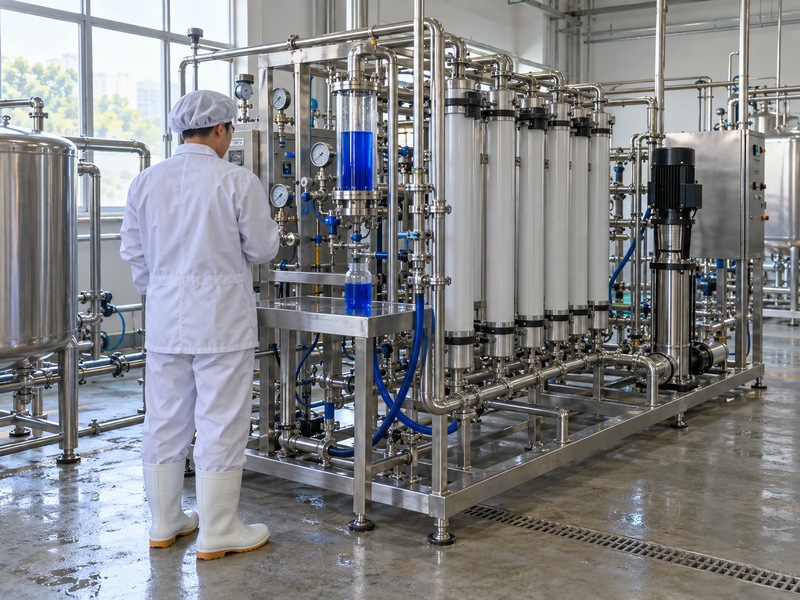
In phycocyanin ultrafiltration, after pigment has been released into water, the producer still has to separate it from unwanted solids and manage a large liquid volume. Membrane processing can help, but a membrane does not automatically make a blue extract pure or saleable. Ultrafiltration is a downstream control point with trade-offs in recovery, clarity, concentration, cleaning, and cost. This guide is for bulk blue spirulina buyers who want to understand what a supplier's membrane claim means and what documents and pilot tests can support a purchase. It does not repeat a general extraction guide or promise that one membrane cut-off works for every plant.
Contents
- Where does phycocyanin ultrafiltration sit in the process?
- What can a membrane separate in practice?
- Why is membrane cut-off not a purity guarantee?
- How should concentration and diafiltration be distinguished?
- Which process losses should a supplier track?
- What does fouling mean for a commercial lot?
- How can the liquid be turned into a useful powder?
- Which tests make a membrane claim meaningful?
- What changes when the skid is scaled up?
- How should a buyer qualify a membrane-processed grade?
1. Where does phycocyanin ultrafiltration sit in the process?
Ultrafiltration usually follows cell disruption and some form of clarification. The feed entering the membrane may still contain proteins, salts, fine solids, and other soluble material. Pressure drives some components through the membrane while larger or differently interacting components remain in the retentate. The membrane step is one part of a chain. A good upstream clarification can reduce fouling; poor clarification can shorten a run and change the material collected.
A published study combining aqueous extraction and ultrafiltration illustrates why these stages are considered together. For a buyer, the practical question is what the final commercial powder contains and how consistently it performs. Ask the supplier to identify the stage where membrane treatment occurs and whether the offered grade receives further concentration, drying, or blending afterward.
2. What can a membrane separate in practice?
Membranes are selected for a separation goal: concentrating a pigment-protein fraction, reducing some lower-molecular-weight material, or clarifying a stream. The result depends on membrane material and configuration, feed composition, pressure, flow, temperature, and how much material has already accumulated on the surface. Separation is not absolute. Two compounds of similar effective size may not separate cleanly, and a protein can interact with a membrane or with other proteins.
Ask for the supplier's measured before-and-after data, not only a flow diagram. If the purchasing need is better color strength, compare color delivered per gram of powder. If it is lower salt or improved clarity, request a method for those attributes. A membrane can support either objective, but the success criterion must be stated before the process is judged.
| Desired outcome | Useful measurement | Limitation to discuss |
|---|---|---|
| Concentrated blue fraction | Color strength and mass balance | Loss into permeate or equipment |
| Lower small-solute load | Conductivity or specified analytes | Incomplete removal |
| Clearer liquid | Turbidity or visual residue | Fine solids may remain |
| Better lot consistency | Repeated batch comparison | Feed variation can dominate |
3. Why is membrane cut-off not a purity guarantee?
A nominal molecular-weight cut-off is a membrane-selection guide, not a certificate that everything above one size stays and everything below it leaves. Proteins can aggregate, adsorb, or behave differently as the feed concentrates. Fouling also changes effective separation during a run. Ask what was measured in the final product. A supplier should identify the analytical definition of any quoted phycocyanin purity or color strength and provide a current COA for the offered lot.
Do not infer a numerical pigment concentration from an E-grade name or from a published membrane study. If the buyer needs a particular level for color dosing, build the specification around the supplier's validated method and the finished-food trial. A membrane cut-off belongs in a process discussion; it does not replace an agreed release limit.
4. How should concentration and diafiltration be distinguished?
Concentration reduces liquid volume while retaining the target fraction; diafiltration adds fresh liquid as permeate leaves to wash out selected smaller solutes. A supplier may use both, but the goals and cost are different. Ask which step addresses which quality attribute. A concentrated stream may dry more efficiently, while diafiltration may change salt load or other soluble components. It can also consume water and time and create additional pigment losses if the process is poorly controlled.
Request a simple mass balance and a description of the endpoints used by the producer. In a buying trial, compare the final powder's dispersion, taste, color strength, and residue rather than assuming more diafiltration must be better. The relevant question is whether a stated removal step produces a measurable benefit in the customer's food.
| Step | Main process aim | Buyer-facing check |
|---|---|---|
| Ultrafiltration concentration | Reduce liquid volume | Final color strength and yield |
| Diafiltration | Wash selected small solutes | Conductivity or target analyte |
| Clarification | Remove suspended matter | Turbidity and visible particles |
| Drying | Produce shippable powder | Moisture, flow, reconstitution |
5. Which process losses should a supplier track?
Pigment can be lost in the permeate, remain on the membrane or piping, degrade during a long hold, or be removed with solids upstream. A supplier that reports only the color of the retentate may miss the economic story. A mass balance makes performance interpretable. Ask how input, retentate, permeate, cleaning fractions, and final powder are sampled. The buyer need not receive confidential operating details, but it should know whether yield claims refer to extracted pigment, recovered protein, dry matter, or final saleable powder.
Those are different denominators. If the process is changed to improve purity, check whether the usable blue yield and price change. For a bulk order, consistent recovery helps keep cost and grade stable; it also helps the producer diagnose a lot that unexpectedly appears pale.
6. What does fouling mean for a commercial lot?
Fouling is material accumulating on or within a membrane and reducing flow or altering selectivity. In phycocyanin processing, proteins and residual fine solids can contribute, so feed preparation and cleaning matter. Ask about run-to-run control. A producer should know how it monitors flux or pressure trends, when it stops a run, and how it verifies cleaning before the next batch.
The buyer's concern is not the plant's exact cleaning recipe but the effect on product consistency and hygiene. Compare early- and late-run samples if a trial scale allows it. A long run that produces a different shade or composition at the end may need adjusted collection or blending controls. Supplier audit questions should cover documented cleaning and change control, with lot-specific COAs confirming the final output rather than assuming that a membrane always performs the same way.
| Fouling signal | Product concern | Supplier question |
|---|---|---|
| Falling flow | Longer hold time | What is the run end point? |
| Rising pressure | Changed operating conditions | How are excursions handled? |
| Changing permeate | Target loss or altered removal | Is composition sampled across the run? |
| Cleaning residue | Hygiene and cross-contact | How is cleaning verified? |
7. How can the liquid be turned into a useful powder?
The membrane often produces a concentrated liquid, while most bulk buyers require a dry ingredient. The subsequent drying method, added carrier, milling, and packing can influence color and handling more than the membrane alone. Keep downstream steps in the qualification record. Ask whether the powder is spray dried, freeze dried, or produced by another method, and whether any carrier was added before drying.
Compare the exact commercial powder in the finished food; do not rely on a paper that measured liquid retentate only. When reviewing a proposed supplier change, ask whether a membrane configuration or drying route changed. Even if analytical pigment concentration remains similar, differences in residue, dispersion, or color after storage may matter to the customer's process. A process map with basic stage identities is enough to keep those questions answerable.
8. Which tests make a membrane claim meaningful?
Useful evidence pairs process data with finished-product measurements. A 2026 study from an algal research team compares membrane-based and centrifuge-based approaches; it is relevant to process design, not a specification for another manufacturer. For purchasing, test the offered powder. Request identity and color strength, the method behind any purity ratio, moisture and microbiological limits as applicable, and batch traceability. In the finished food, test dispersion, shade, sediment, and storage behavior.
If a supplier claims lower salt or better clarity from diafiltration, ask for the before-and-after metric and a customer application trial. A process name without a measured effect is marketing shorthand, not a decision rule.
| Claim | Evidence to request | Customer trial |
|---|---|---|
| “More concentrated” | Lot color-strength method | Match starting shade at lower dose |
| “Cleaner fraction” | Defined purity assay | Compare taste and residue |
| “Lower salt” | Conductivity or analyte result | Check recipe interaction |
| “Better dispersion” | Fixed reconstitution method | Run plant mixing sequence |
| “Consistent” | Several lot COAs | Check incoming variance |
9. What changes when the skid is scaled up?
Commercial membrane area, crossflow conditions, hold time, and cleaning cycles differ from a laboratory device. A pilot can show that a separation is possible without proving the plant can make it consistently at volume. Ask for commercial-scale evidence. Review representative lot data, production capacity, hold times before drying, and the supplier's plan for membrane replacement or cleaning. If the feed source changes, the fouling and separation behavior may change too.
For a buyer with seasonal demand, check whether the supplier can maintain the same product specification across campaigns. A plant trial should use material from the intended commercial process, not only a small research sample. Keep a retained sample so incoming lots can be compared by the same color and application methods used during approval.
10. How should a buyer qualify a membrane-processed grade?
Begin with the intended food and the problem the ingredient must solve: stronger blue at lower dose, fewer particles, a different salt profile, or a more repeatable lot. Request a representative sample, specification, current COA, carrier declaration, allergen statement, and the methods supporting the claimed attribute. Approve the grade through a finished-food test. Run the same formula and process with a control ingredient at matched starting blue, then compare appearance and physical behavior through storage.
Confirm the destination market's applicable color-additive requirements before launch. If the membrane route changes after approval, ask the supplier to disclose the change and provide a bridging sample. Bulk price should be considered per accepted finished unit, including dose, process rejects, freight, and technical handling. This prevents a process label from substituting for measurable value.
| Approval gate | Evidence | Decision owner |
|---|---|---|
| Ingredient identity | Specification and COA | Quality |
| Process description | Stage map and change control | Technical procurement |
| Claimed improvement | Defined assay and method | R&D |
| Finished-food fit | Plant trial and storage check | Product team |
| Commercial fit | Total delivered cost | Procurement |
FAQ
Q1: Is ultrafiltration the same as extraction? No. Extraction releases phycocyanin into a liquid. Ultrafiltration is a later separation or concentration step applied to that liquid.
Q2: Does a smaller membrane cut-off always create a purer product? No. Protein interactions, fouling, and process conditions affect separation. Ask for measured final-product results.
Q3: What is diafiltration used for? It washes selected small solutes from a retained fraction while liquid is replaced. The value depends on the desired attribute and measured outcome.
Q4: Can a buyer infer pigment content from the E grade? No. Obtain the current specification and lot COA with the method used for any pigment or purity figure.
Q5: What should be retested after a membrane change? Color strength, composition claims, dispersion, finished-food appearance, and storage behavior, using a bridging sample from the revised commercial process.
Sources and next step
For related ingredient context, see the blue spirulina extract guide.
The aqueous extraction and ultrafiltration study and 2026 membrane-versus-centrifuge research summary support asking for a measurable downstream benefit. For a bulk inquiry, state the finished-food target and ask suppliers for the exact commercial grade, current COA, composition, and a trial quantity.