
Phycocyanin spray drying can produce a blue powder that is easy to ship and meter into a plant, but the route from liquid extract to powder matters. Spray drying exposes phycocyanin to several stresses at once: atomization, hot air, changing moisture, and powder recovery. A good-looking powder at dispatch can still disperse poorly or lose color in a customer's process.
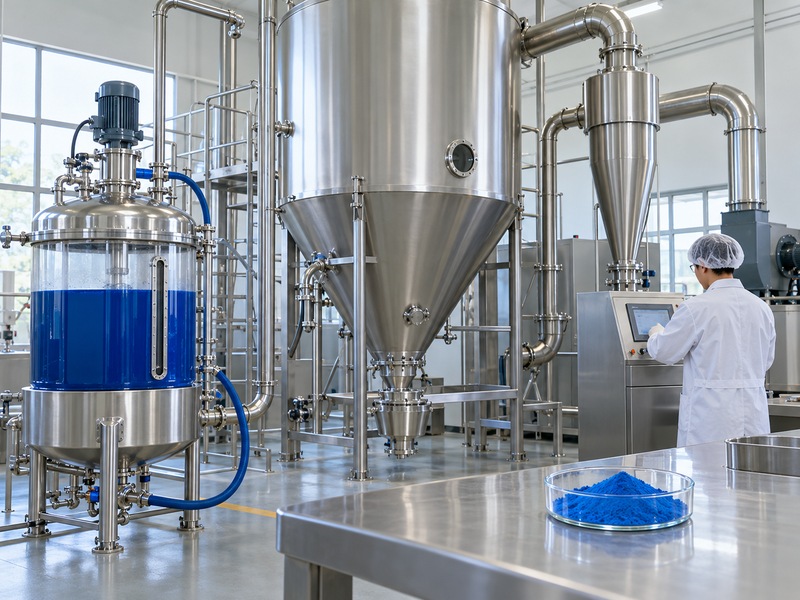
This article helps food and beverage teams ask better questions of a bulk supplier and run a pilot that measures the powder they actually intend to use. It does not prescribe a universal inlet temperature or claim that every spray-dried product has the same pigment loading.
Contents
- What happens during phycocyanin spray drying?
- Why is inlet temperature only part of the story?
- How does feed composition affect the powder?
- Which carrier materials deserve a trial?
- What makes a useful process trial?
- Which powder attributes should a buyer measure?
- How should color retention be compared?
- What changes when the process moves to a larger dryer?
- How can a customer handle the powder safely in formulation?
- What information belongs in a bulk purchase decision?
1. What happens during phycocyanin spray drying?
Liquid feed is broken into droplets and contacted with heated air. Water leaves quickly, solids form particles, and the powder is collected. That simple outline hides the part that matters to a color buyer: the pigment-protein complex sees changing moisture and temperature as the droplet dries. A technical review of phycocyanin microencapsulation describes both the practical scale-up appeal of spray drying and the possibility of color loss or variable particle size.
A short residence time is not a guarantee of preservation. The feed, dryer geometry, atomization method, and carrier system all influence the final material. For procurement, the right question is not “Was this spray dried?” It is “What color, handling, and dissolution performance does this lot deliver after our process?” Keep that question visible during supplier selection, trial design, and specification review.
2. Why is inlet temperature only part of the story?
Suppliers often quote an inlet temperature because it is easy to report. It is not the same as the temperature history of the pigment inside a droplet. Airflow, outlet conditions, feed rate, droplet size, solids content, and equipment design all affect drying. A setting transferred from a published study can be wrong for a different dryer or wall material. Ask for the process window and the measured powder result, not a single reassuring number.
If a supplier will not disclose proprietary settings, request a controlled comparison of lots produced under the candidate process and ask how each lot was tested. During an internal trial, change one factor at a time and keep feed composition constant. Also compare samples after the customer's own heating or mixing step. A powder can leave the dryer blue yet be unsuitable for a finished food.
| Variable | Why it matters | Buyer-facing evidence |
|---|---|---|
| Feed solids | Changes drying load and particle formation | Lot-specific moisture and color |
| Atomization | Changes droplet size distribution | Particle-size profile and dispersion |
| Air conditions | Changes drying path | Process-controlled batch record |
| Carrier ratio | Changes pigment fraction and matrix | Full composition disclosure |
| Powder collection | Can affect heat and oxygen exposure | Retention and storage trial |
3. How does feed composition affect the powder?
The feed is more than blue extract. Its solids, viscosity, pH, salts, and carrier level affect atomization and the particle that forms. A highly diluted feed demands more water removal; a concentrated feed may handle differently at the nozzle. Compare powder on a pigment basis. Increasing carrier can improve handling or protection in one study while lowering color strength per kilogram sold.
That trade-off matters to a factory that pays for bulk bags and dosing time. Ask the supplier whether the powder is a neat extract or a formulated ingredient and obtain its complete ingredient declaration. During a pilot, record how much of each candidate is required to reach the same starting shade. If one powder needs a higher dose, assess its effect on taste, solids, viscosity, and cost per finished unit.
Do not interpret a more vivid scoop photograph as a useful formulation result.
4. Which carrier materials deserve a trial?
Maltodextrin, trehalose, alginate, and other food-compatible materials appear in published spray-drying work, but there is no single wall system for every food. The Wiley study on spray-drying parameters and wall materials is useful because it treats the process and matrix together. Its findings belong to the tested material and conditions. Screen carriers against the intended food, beginning with allergen policy, label wording, and desired clarity.
A carrier that protects the powder may create haze in a clear drink. Another may dissolve slowly in cold water but be acceptable in a bakery premix. Request samples with their carrier composition, not anonymous “stable blue” codes. Formulation teams can then compare color retention and sensory or texture effects without guessing what changed between candidates.
| Carrier option | Potential reason to test | Watch in finished food |
|---|---|---|
| Maltodextrin | Dry powder formation | Dose and sweetness/solids contribution |
| Trehalose blend | Protection in selected research systems | Declaration and cost |
| Alginate blend | Matrix structure | Viscosity or visible particles |
| Other disclosed blend | Targeted process behavior | Allergen, clarity, and flavor fit |
5. What makes a useful process trial?
An effective trial starts with a named failure: fading during a process step, clumping in storage, slow dispersion, or lot-to-lot shade drift. Prepare the same feed with a control and a small set of process or carrier changes. Use one defined color method, one powder moisture method, and a fixed reconstitution procedure. Keep the rejected samples too. They show where the acceptable window ends and help the supplier diagnose a later variation.
A pilot report should identify material source, feed composition, batch size, settings that can be disclosed, powder yield, and post-drying appearance. Then put each powder through the customer's real application at equal starting color. Without that application check, a dryer trial is only a powder-making demonstration. It does not answer whether the blue ingredient is fit for the buyer's beverage, dessert, coating, or premix.
6. Which powder attributes should a buyer measure?
Color is central, but other powder properties can make an otherwise attractive lot difficult to use. Moisture and water activity inform handling and storage questions; particle size and flow affect charging and segregation; dissolution and sediment influence the finished product. Specify methods as well as numbers. Two suppliers can report “solubility” while using different water temperatures, mixing times, or criteria for residue.
Ask for a current COA for the exact lot, the stated test method, and a retained sample. Do not infer phycocyanin purity or potency from a trade grade name. The product catalog may list several E grades, but the actual pigment concentration, carrier composition, and acceptance limits require the supplier's current documentation. Compare trial material to commercial material before making a volume commitment.
| Attribute | Simple pilot check | Why it affects the order |
|---|---|---|
| Color strength | Standard solution or finished matrix | Determines actual dose |
| Moisture and water activity | Agreed analytical method | Informs storage and caking risk |
| Particle size | Sieve or laser method as appropriate | Predicts blend segregation |
| Cold-water dispersion | Fixed time and shear | Predicts plant charging behavior |
| Visible residue | Hold and inspect final food | Screens clear-product fit |
7. How should color retention be compared?
Use a consistent starting point. One powder may look stronger simply because it contains less carrier, not because its pigment survived drying better. Dose samples to equivalent starting color in a defined matrix, then measure after the intended process and during storage in the intended package. Record both absolute color and change over time. A formula can begin at the right shade but drift toward green or gray after exposure.
A fixed-light photograph can help a cross-functional team judge appearance, while instrument readings support repeatability. Include a control powder and repeat tests on more than one production lot when a purchase depends on consistency. A claim of “better stability” from a paper or brochure does not tell the buyer how much difference will be visible in their own food.
8. What changes when the process moves to a larger dryer?
Large equipment changes residence patterns, collection, cleaning, and the physical route from feed tank to packed powder. A pilot that met its color target can fail when feed holding time grows or when powder waits warm before sealing. Treat scale-up as a new validation stage. Run a commercial-scale sample, retain material from the beginning, middle, and end of the batch, and compare color strength, moisture, flow, and reconstitution.
Ask how the supplier controls cross-contact and how the powder is protected from humidity after collection. Review packaging closure and transit conditions as part of the process. A reliable supplier can explain which parameters are controlled, which tests release a lot, and how deviations are handled. That is more valuable than a single photograph of a large stainless tower.
| Scale-up stage | Question to ask | Evidence to keep |
|---|---|---|
| Feed holding | Does color shift before drying? | Timed feed samples |
| Dryer run | Is output consistent across the run? | Beginning/middle/end samples |
| Collection | Is powder exposed to heat or air? | Handling procedure |
| Packing | How is moisture pickup limited? | Pack specification |
| Transit | Does the received lot match release data? | Arrival sample and COA |
9. How can a customer handle the powder safely in formulation?
Start by protecting the powder from humidity and unnecessary light while weighing and premixing. Add it at the point that gives the intended dispersion without exposing it to more heat than necessary. Those are trial choices, not universal instructions: a dry blend, a chilled beverage, and a hot syrup behave differently. Write the addition sequence into the plant trial. Note water temperature, mixing shear, order of ingredients, hold time, and whether the blue changes after acids or minerals are added.
Inspect the mixer and packaging line for powder deposits. If operators see clumps, test a small premix or an alternative charging method and compare the final color. A recipe that works in a laboratory beaker may need a different dispersion step at production scale.
10. What information belongs in a bulk purchase decision?
The purchase case should contain the exact ingredient identity, carrier disclosure, current specification, COA, batch traceability, shelf-life basis, pack format, and trial results in the final food. Compare delivered color rather than bag price alone. Cost per accepted finished unit is the useful figure. A lower-cost powder that requires more dose or creates rejects may be the expensive choice. Add freight, storage, handling, and technical support to the comparison.
Confirm that the proposed commercial grade is the grade used in the pilot; changes in carrier or process need a documented review. Ask for a representative retention sample and a process for addressing shade drift between lots. If the supplier cannot provide enough information to replicate an approval test, delay volume ordering until the missing evidence is available.
| Decision record | Acceptable evidence | Owner |
|---|---|---|
| Ingredient identity | Specification and composition | Regulatory/procurement |
| Lot conformity | Current COA and retained sample | Quality |
| Application color | Plant trial in final pack | R&D |
| Handling | Production line observation | Operations |
| Commercial fit | Cost per finished unit | Procurement/finance |
FAQ
Q1: Is spray drying always too hot for phycocyanin? No. The outcome depends on the complete feed and drying system. A supplier must show data for its powder, and the buyer must test it in the intended food.
Q2: Is a higher carrier level always better? No. It can alter protection, but it also lowers pigment per kilogram and may change flavor, solids, and label wording. Compare at equal starting blue.
Q3: Can inlet temperature alone predict the final shade? No. Droplet size, feed rate, outlet conditions, and powder handling matter. Request finished-powder and application data.
Q4: Should a buyer ask for the exact proprietary dryer settings? A supplier may keep some settings confidential. It should still disclose composition, agreed specifications, methods, and lot results sufficient for qualification.
Q5: What is the best first application test? Use the customer's real formula and process with a control powder, matched starting color, and color readings after processing and storage.
Sources and next step
For related ingredient context, see the blue spirulina extract guide.
The technical review, its underlying peer-reviewed review, and the process-parameter study support a test-led approach. For a bulk project, request a representative spray-dried sample, composition, current COA, and application trial material before setting a volume specification.