
Phycocyanin encapsulation can help blue spirulina powder deliver a clean blue in one formulation and turn dull in another. The difference may come from acid, heat, light, dissolved oxygen, or the way the powder meets other ingredients. Encapsulation is a formulation tool, but a coated pigment is not automatically suitable for every product. Its wall material can change dissolution, shade, mouthfeel, labeling, and cost.
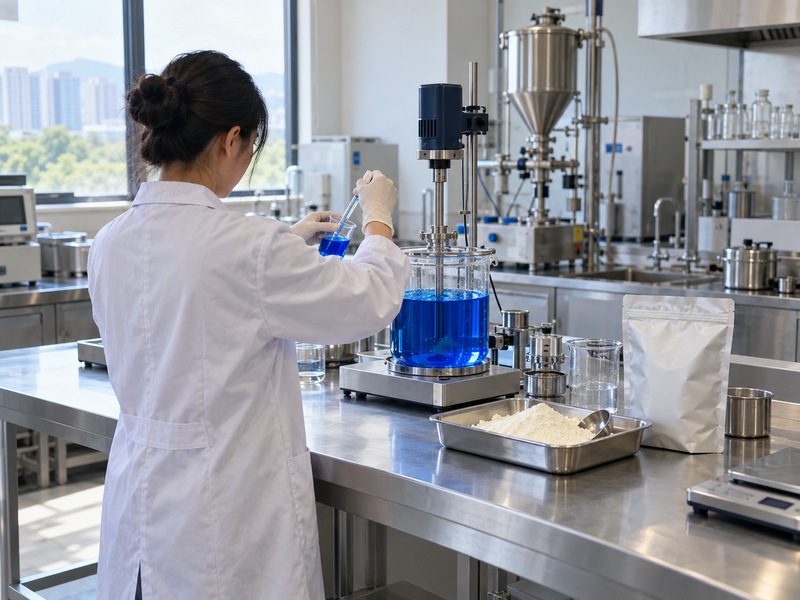
This guide is for development and procurement teams buying blue spirulina or phycocyanin in bulk and testing whether an encapsulated system solves a specific failure. It treats published studies as starting points for trials, not as specifications for any supplier's commercial powder.
Contents
- What problem should phycocyanin encapsulation solve?
- How do wall materials change performance?
- Which process fits the intended food?
- What belongs in a useful supplier brief?
- How should a pilot formula be built?
- Which measurements show whether the coating works?
- How can release behavior affect the finished product?
- What can go wrong during scale-up?
- How should labeling and regulatory review enter the project?
- When is an uncoated powder the better choice?
1. What problem should phycocyanin encapsulation solve?
Start with a failure that the team can reproduce. A blue beverage that loses color during refrigerated storage presents a different problem from a dry mix that fades on a lighted shelf. A bakery filling that sees heat for a few minutes is different again. If those conditions are not written down, suppliers may offer an attractive encapsulation technology without addressing the actual weak point.
Define the failure in the finished food, including the stage at which it appears and the acceptable visual difference. Keep the uncoated blue spirulina powder as a control, at equivalent pigment input rather than equivalent total powder mass. Encapsulation adds carrier, so a gram-for-gram comparison can conceal a lower active color load. Record whether the defect is fading, hue drift, sediment, delayed color development, or a visible coating residue.
Each points toward a different trial and sometimes toward a simpler fix such as changing the sequence of addition.
2. How do wall materials change performance?
Wall materials are part of the food, not invisible packaging. Maltodextrin can support a dry, dispersible matrix; alginate can form gel structures; gum arabic and protein-based systems create other interactions. A published study of maltodextrin and sodium alginate ratios found that one tested combination performed well under its own laboratory conditions. That result does not establish a universal ratio for dairy, acid drinks, bakery batters, or the supplier's commercial powder.
Ask what the wall is meant to do—shield the pigment during storage, survive a heating step, disperse rapidly, or release color at a defined point. Then check the carrier against the product's allergen policy, ingredient statement, texture target, and clean-label position. A technically protective carrier may still be commercially unsuitable if it creates cloudiness or an unwanted ingredient declaration.
| Wall system to screen | Why a developer might try it | First finished-food check |
|---|---|---|
| Maltodextrin-based matrix | Dry handling and dispersion | Compare color strength at equal pigment dose |
| Alginate-containing matrix | Protective gel structure | Check particles, viscosity, and release timing |
| Gum arabic blend | Emulsion and powder handling options | Inspect haze and flavor effect |
| Protein-based coating | Specific protein–pigment interactions | Review allergens and heat behavior |
3. Which process fits the intended food?
Encapsulation describes a family of processes, not a single commodity. Spray drying can produce free-flowing microcapsules, while freeze drying uses a different thermal path and often a different powder structure. Extrusion into alginate beads may make sense for a controlled-release concept but can be too coarse for a clear beverage. Particle form determines where the technology can be used. Ask the supplier for a process description and a representative particle-size profile before requesting a commercial quotation.
The information is especially useful when the base powder is expected to dissolve without visible flecks. A process that protects color in a dry powder may delay color release after reconstitution. If the food is opaque, that delay may be acceptable; in a clear drink it may be a launch blocker. Work backward from the finished food's appearance and preparation method rather than choosing a fashionable processing name.
4. What belongs in a useful supplier brief?
A good brief is short enough to answer yet detailed enough to prevent mismatched samples. State the food category, target shade, pH range, process sequence, temperature exposure, packaging format, and target shelf environment. Give the supplier a control formula or at least the ingredient families that could interact with pigment. Separate required information from preferences. Required items include carrier identity, allergen status, intended use, lot documentation, and a realistic sample quantity.
Preferred items may include powder flow or a particular declaration style. Do not ask a vendor to promise a color result in an undisclosed recipe. Instead, request enough material for a side-by-side pilot and a current batch COA. If the supplier offers several grades, compare them at a defined pigment basis and record the total powder addition needed to reach the same starting color.
| Brief field | What to provide | Why it changes sample selection |
|---|---|---|
| Finished-food matrix | Water, dairy, fat, acid, or dry mix | Drives dispersion and carrier choice |
| Process exposure | Addition point, heating, shear | Identifies the actual stress event |
| Pack and storage | Clear or opaque; ambient or chilled | Shapes light and oxygen trial |
| Declaration limits | Allowed carriers and allergens | Avoids unusable samples |
| Acceptance rule | Instrumental and visual color limits | Makes the pilot decision auditable |
5. How should a pilot formula be built?
Begin with a small matrix of conditions rather than one hopeful bench sample. Prepare an uncoated control and two or three encapsulated candidates in the same base formula. Match initial blue intensity using a defined color measure, then evaluate immediately, after processing, and at planned storage intervals. Hold the rest of the recipe steady. If sweetener, acidity, heat, and packaging all change at once, no one can tell which change produced the result.
Disperse powders using the same mixing order and water quality that the plant will use. Record mixing time and any visible specks. A capsule may seem stable because color has not yet fully released; check both early and later readings. Photograph samples under a fixed light box, with identical vessels and background. This gives procurement and operations a visual record that is more useful than a statement that one sample “looked better.”
6. Which measurements show whether the coating works?
Color retention is the central measure for a coloring project, but it should not stand alone. CIELAB values or a validated spectrophotometric method can track hue and intensity, while dispersion, sediment, turbidity, and particle visibility describe product quality. A coated powder can retain blue yet create a cloudy beverage. Use measurements tied to the user's experience. Test after the actual process step and in the intended package.
A published controlled-release bead study is useful for understanding release behavior, but its simulated digestion results are not a proxy for how a blue drink looks after filling. For an initial screen, write a pass/fail criterion for each attribute before looking at results. Keep raw readings and sample photographs with lot numbers, storage conditions, and dates so the trial can be repeated.
| Measure | Practical method | Decision it supports |
|---|---|---|
| Starting color | Fixed-light photo and colorimetry | Dose normalization |
| Post-process color | Same method after processing | Process survival |
| Dispersion and flecks | Visual check after defined mixing | Consumer appearance |
| Sediment or turbidity | Defined holding test | Suitability for clear products |
| Color during storage | Scheduled readings in final pack | Shelf-life planning |
7. How can release behavior affect the finished product?
Encapsulation can postpone contact between pigment and its surroundings, but it can also postpone the color the buyer wants to see. A powder for an instant drink must develop the intended shade within the customer's mixing time. A confectionery layer may benefit from a slower release if the color is meant to stay inside a phase. Test color at the moment the product is used.
That may be immediately after sachet mixing, after hydration in a plant tank, or after thawing. Release can shift with pH, ionic strength, temperature, and shear, so use the real formula rather than plain water alone. Look for rings, streaks, or uneven speckles as well as average color. Ask the supplier whether the carrier remains in the product or dissolves, and whether its function changes under your process.
Do not infer the answer from a microscopy image or an encapsulation efficiency figure.
8. What can go wrong during scale-up?
At plant scale, feed solids, viscosity, nozzle or atomizer settings, residence time, and powder collection conditions can change the capsule. Even when a supplier has produced the material successfully, the buyer's blending and filling line may impose new shear and humidity. Pilot the handling route, not just the chemistry. Ask for the granularity and flow behavior of the supplied powder and trial the same bag opening, weighing, premixing, and addition sequence planned for production.
Watch for dust, clumping, segregation with other powders, and powder left on equipment. If the encapsulated option needs more mass to reach the same blue, recalculate freight, storage, dosage, and packaging fill. A small color benefit may not pay for a large handling penalty. The commercial decision belongs after a plant-representative run, not after a single beaker test.
| Scale-up risk | What to observe | Practical response |
|---|---|---|
| Clumping in humid room | Sieve rejects and slow dissolution | Test closed handling and premix |
| Segregation in dry blend | Shade variation by pack | Check particle-size match |
| Excess dust | Loss at charging point | Review transfer method |
| Delayed color release | Pale product at fill | Adjust addition point or reject grade |
| Higher total dose | Cost and texture shift | Compare on color delivered per finished unit |
9. How should labeling and regulatory review enter the project?
The carrier is an ingredient with a legal and commercial identity. Ask for the exact composition and applicable declarations for the destination market before formula lock. Review whether the blue color source and any coating materials are allowed for the proposed food category; rules vary by jurisdiction and can change. Do the review on the actual use, not on a general claim that “spirulina is approved.” The supplier should provide identity, production and allergen information, and the buyer's regulatory team should decide the finished-product declaration.
Avoid carrying over health or bioavailability claims from academic encapsulation research into a colorant specification. A laboratory result about simulated digestion does not substantiate a consumer claim for a different powder in a different recipe. Keep that distinction in the product brief, marketing copy, and approval record.
10. When is an uncoated powder the better choice?
Encapsulation adds process cost and can dilute color on a total-weight basis. If the finished food has a mild pH, modest heat exposure, opaque packaging, and a short practical shelf window, uncoated blue spirulina powder may pass the same test with simpler handling and a shorter ingredient list. Make the choice by a controlled comparison. Buy representative bulk samples, normalize starting color, run the real process, and calculate cost per accepted finished unit.
If the coating prevents a clear failure, its added cost may be justified. If both options pass, the simpler route deserves consideration. Neither outcome should be assumed from a supplier's marketing sheet. Request the current COA and product specification for the exact lot and grade under review; do not treat academic percentages as promises about a commercial batch.
| Decision point | Encapsulated candidate | Uncoated control |
|---|---|---|
| Same starting color | Required for fair comparison | Required for fair comparison |
| Finished-food appearance | Check flecks and release | Check dissolution and haze |
| Process and storage result | Measure in final package | Measure in final package |
| Ingredient declaration | Include carrier components | Confirm color source wording |
| Total delivered cost | Include higher dose or handling | Include waste and color loss |
FAQ
Q1: Does phycocyanin encapsulation make blue spirulina heatproof? No. Performance depends on the carrier, process, food matrix, exposure time, and target color. Test the finished recipe after its actual heat step.
Q2: Is encapsulation efficiency the same as color retention? No. Encapsulation efficiency describes how much material is associated with the capsule in a given method. Color retention asks whether the finished food still has an acceptable blue after processing and storage.
Q3: Can an encapsulated powder be used in a clear beverage? Possibly, but particle visibility, haze, sediment, and release time become critical. Run the beverage in its intended bottle before approving a grade.
Q4: Should a buyer specify the wall material before contacting suppliers? Specify restrictions and the failure to solve first. A vendor can propose candidates, but it should disclose carrier identity so the buyer can assess labels, allergens, and texture.
Q5: What is the minimum useful bulk trial? A comparison at matched initial color, with an uncoated control, the actual processing step, final packaging, and scheduled color checks. Keep lot and method records with the samples.
Sources and next step
The maltodextrin–alginate research, controlled-release bead study, and review of microencapsulation methods show why carrier and process choice must be tested in context. For ingredient formats, consult the blue spirulina extract guide. For bulk buying, send suppliers the finished-food brief and ask for a representative sample, current batch COA, full carrier disclosure, and a pilot quantity. The decision should rest on your own process and package data.