
Blue spirulina popsicles are molded frozen treats colored with a phycocyanin-rich spirulina extract. They can look simple in a recipe photograph, yet a commercial pop has to release from the mold, survive wrapping and distribution, and still look appealing after freezer storage. A maker planning to buy blue spirulina powder in bulk should decide whether the color belongs in a water base, dairy base, or visible layer before specifying a dose. This guide focuses on individually molded frozen pops rather than scooped ice cream or sorbet.
Contents: 1. Definition · 2. Base · 3. Ingredient · 4. Premix · 5. Layers · 6. Freezing · 7. Storage · 8. Safety · 9. Cost · 10. Supplier brief.
1. What counts as a blue spirulina popsicle?
Specify the geometry and visual promise
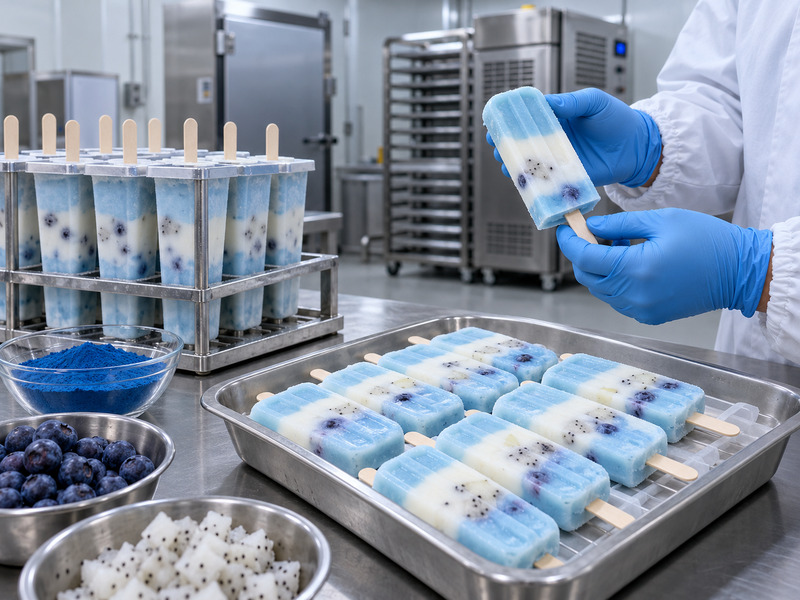
A blue pop may be uniformly tinted, striped with white yogurt, or built around a blue fruit layer. “Popsicle” is familiar consumer language, while product identity and naming rules vary by market. Draw the cross-section: state which layer contains the color, which side faces the consumer, and what the finished unit should look like after unwrapping. A thin blue ribbon can communicate the concept with less colored base than a whole blue pop, but it introduces a layering step.
The Blue Spirulina Yogurt Pops recipe is a real example of the ingredient in a molded frozen treat. A home recipe establishes application relevance, not manufacturing yield, commercial shelf life, or a universal use level. Make a plain control in the same mold and compare visual, bite, flavor, and melt behavior. Photograph the frozen pop after normal demolding, not only while it sits neatly in the mold. Customers experience the unwrapped unit, including any air pockets, frost, and color smears.
| Design | Color location | Production issue |
|---|---|---|
| Single-color water pop | Entire base | Even shade and ice texture |
| Yogurt swirl | One layer or ribbon | Layer boundary and acid response |
| Fruit-and-blue pop | Separate phase | Juice color and migration |
| Coated pop | Visible shell or interior | Phase compatibility and handling |
2. Which frozen-pop base should be tested first?
Match the matrix to the concept
Water, fruit, yogurt, and plant-based bases differ in acidity, fat, protein, solids, and opacity. Each can make the same blue powder look different. Choose one launch base: start with the formula the business can already make safely and consistently. A clear water base may show a bright hue but reveal pigment specks or ice defects. An opaque dairy or oat base may produce a softer blue. Fruit acids and native pigments can change the shade altogether.
Build a small comparison only if the product brief genuinely allows multiple bases. Keep sugar, solids, and flavor targets within each base’s intended commercial range; do not add water just to dissolve color without checking freeze behavior. Taste the colored and plain versions blind. A visual cue may lead tasters to expect berry, bubblegum, or mint even if none is present. Product development should decide whether a named flavor supports that expectation. The bulk ingredient decision is easier once the base, target shade, and sales channel are fixed.
3. What blue spirulina ingredient should procurement request?
Confirm identity and supporting documents
Blue spirulina usually means a phycocyanin-rich extract, not whole green spirulina powder. The two ingredients differ in appearance and cannot be substituted by name alone. Ask for the exact grade: specification, ingredient statement including carriers, batch certificate, microbiological documentation, recommended storage, and destination-market regulatory support. The confirmed catalogue includes E3, E6, E18, E25, E35, and E40 blue spirulina powders. Those code names do not state pigment content, legal permissions, dose, or frozen stability.
Request enough of the actual intended grade for a controlled pilot, plus the lot code. If a supplier proposes a concentration, treat it as a starting trial condition. The finished shade depends on the pop base, mold thickness, overrun or air, and viewing light. Compare powders at an equivalent finished appearance as well as by price per kilogram. Record the amount used in each batch, the number of acceptable pops, and whether color affects flavor or texture. Procurement needs those results to translate a sample into a bulk order.
| Document | Pilot use | Approval owner |
|---|---|---|
| Ingredient statement | Label and carrier review | Regulatory |
| Batch certificate | Lot traceability | Quality |
| Technical guidance | Trial conditions | Development |
| Current quotation | Unit economics | Procurement |
4. How should the color be dispersed before filling?
Control the premix rather than the powder scoop
An aqueous premix can help distribute blue spirulina in a water-compatible base, but the premix must fit the formula. Record the water source, powder and water weights, mixing method, hold time, and addition point. Check for undissolved particles, foam, or color sticking to the vessel. Strain only if the process permits it and document any powder lost. A clear base will reveal specks more readily than a creamy base.
Add the premix under conditions appropriate for the validated food process. If a dairy mixture needs heat treatment, do not move the color addition after that step without a safety review. If color is added before heat treatment, test whether the shade survives it. Avoid guessing from a glass of cold water: the actual product contains sugars, acids, proteins, fruit, or stabilizers. Collect samples from the start and end of the fill to see whether color settles or changes as the tank empties. An evenly blue mixer is useful only if the last mold receives the same base as the first.
5. How can a layered blue pop be built repeatably?
Design around the filling line
A yogurt-and-blue striped pop can avoid coloring the whole base, but layers need controlled fill weights and a clear freezing sequence. Write the layer order: how much blue base enters each mold, when the next layer is added, whether partial freezing is required, and where the stick is positioned. A kitchen spoon swirl can look appealing but vary from unit to unit. A depositor or measured pour may give a more reliable retail cross-section.
Inspect the first, middle, and last molds from a run. Check whether layers bleed, separate, or leave voids around the stick. If fruit is included, assess its own color and acidity at the boundary. Do not call an accidental streak a deliberate pattern unless the brand accepts natural variation and the packaging shows it honestly. A layered design also needs a sanitation and allergen plan when dairy, nuts, or other ingredients share a line. Production can choose a simpler single-color pop if the layered version loses too much yield.
| Layer defect | Check first | Likely decision |
|---|---|---|
| Blurred boundary | Fill temperature and timing | Change sequence |
| Uneven blue amount | Depositor accuracy | Reset portion controls |
| Stick off-center | Insertion point | Adjust mold operation |
| Voids | Fill and freezing conditions | Revise process |
6. What changes during freezing and demolding?
Evaluate the frozen unit, not liquid color
Freezing changes light scattering and can make a liquid blue base appear paler or more opaque. Ice crystal structure and air pockets also affect appearance and bite. Compare before and after: take a color reference photo of the mixed base, the frozen mold, and the unwrapped pop under controlled lighting. Record fill weight, freezing time, product temperature, and demolding method. A bright liquid is no guarantee of a bright, intact pop.
Demolding water or heat can create a wet surface that briefly looks glossy, then frosts in the freezer. Check whether blue transfers to the mold or the operator’s glove. Inspect stick security and breakage, especially if an added premix changed solids. Sample pops across the freezer, because edge and center positions may freeze differently. Keep the plain control and assess hardness, bite, and early melt. A color concept that increases broken units or leaves a blue residue on tooling can be expensive even if its ingredient dose is small.
7. How should freezer stability be evaluated?
Reproduce distribution and consumer use
Commercial pops experience storage, transport, retail display, and occasional temperature fluctuation. Use the proposed wrapper: pack pilot units in the intended film and carton, then inspect through the planned shelf-life study. Watch for frost, ice recrystallization, color migration between layers, wrapper transfer, and flavor changes. Evaluate the unwrapped pop after realistic handling, not only an untouched laboratory sample.
Frozen storage slows many changes but does not make appearance or quality permanent. Compare a plain control and colored version from the same run. Keep product and ingredient lot codes with photographs. If the brand plans a clear wrapper, assess exposure to case lighting; if an opaque carton hides the pop, check the product after opening. Define acceptable visual variation before looking at test results. Shelf life must also follow the complete food safety and quality program; a blue ingredient certificate cannot validate the finished frozen dessert.
| Checkpoint | Visual check | Other product check |
|---|---|---|
| After demolding | Shade and surface | Breakage and weight |
| After wrapping | Film contact and frost | Seal integrity |
| Distribution simulation | Cracks and layer shift | Stick security |
| Proposed end date | Saleable appearance | Flavor and texture |
8. Which food safety and labeling controls apply?
Review the specific formula and market
A frozen pop is still a food with ingredients, processing steps, and possible allergens. Preserve the validated process: use the plant’s controls for potable water, dairy or plant-based bases, heat treatment where required, hygienic filling, freezing, and storage. A color premix needs defined preparation and holding rules. Blue spirulina does not substitute for these controls or support broad health claims in the finished pop.
Regulatory staff should confirm whether spirulina extract is permitted in the exact product category and destination market. The FDA’s color-additives page notes that a 2026 expansion of permitted spirulina-extract uses had its effective date delayed; do not assume every frozen treat is covered by a new rule. Review the supplier’s full ingredient statement for carriers and the final label for dairy, soy, nuts, or other relevant allergens. Marketing terms such as “blue spirulina” should be checked against the required legal ingredient declaration. Claims need finished-product support, not a reference to a colorful recipe.
9. What is the true cost of a saleable pop?
Include yield and line time
Cost per kilogram of powder overlooks filling losses, layer labor, mold rejects, broken sticks, cleaning, and wrapper damage. Calculate per accepted unit: record base mass, color dose, molds filled, pops demolded, pops wrapped, and units released. A striped design may use less color but take longer and create more rejects. A single-color design may be simpler but need a larger dose for a visible effect.
Ask for a current quote at the likely order volume and calculate ingredient cost at the trial dose. Add process cost and packaging, then test sensitivity to a reasonable shade adjustment. Do not treat the E-series grade code as a potency or price ladder. If two acceptable grades require different doses to reach the same visual target, compare total cost per saleable pop. Include the channel’s expected retail appearance: a cheap pop that looks pale or frosted before purchase has poor commercial value.
| Cost driver | Trial record | Decision use |
|---|---|---|
| Color ingredient | Grams per accepted pop | Compare grades |
| Fill losses | Start versus accepted units | Estimate yield |
| Layer time | Minutes per mold batch | Compare designs |
| Packaging scrap | Rejected wrapped units | Set unit cost |
10. What must a supplier know before a production trial?
Send a brief that matches the frozen process
Share the base type, pH if known, heat treatment, ingredient addition point, mold size, target shade, sales market, storage temperature, packaging, and forecast volume. Request the exact grade’s specification, ingredient statement, batch certificate, regulatory support, sample quantity, and current commercial terms. Set a pass line: acceptable dispersion, repeatable fill color, intact demolding, attractive appearance after frozen storage, compliant labeling, and workable cost per accepted pop.
Run the pilot on representative equipment and keep a plain control. Collect units from several points in the fill and freezer, then use the proposed wrapper for stability checks. If a color route fails because it must be added after a required safety step, do not bypass that step. Redesign the pop or ingredient placement and repeat the trial. A bulk order should follow a documented production result, not a single photograph of a hand-poured sample.
FAQ
Q1: Is blue spirulina the same as whole spirulina powder? No. The blue extract and whole green biomass differ in composition and appearance.
Q2: Will a bright liquid base make a bright frozen pop? Not necessarily. Freezing changes opacity and light scattering, so inspect the finished unit.
Q3: Can yogurt pops and water pops use one dose? Not automatically. Their matrices and visual targets differ.
Q4: Does freezing remove the need for safety controls? No. Ingredients, premixes, processing, sanitation, and storage still require control.
Q5: How should suppliers be compared? Compare documented grades at an acceptable finished shade and cost per saleable pop.
Final thoughts
Choose the pop base and shape first, then test where blue belongs. The important evidence is a wrapped, demolded product that survives its intended freezer route and still meets the plant’s safety, labeling, and cost requirements.