
A private-label launch can look simple until three parties disagree over the ingredient grade, label statement or who may release a batch. As a result, Chlorella private label manufacturing works when the brand, biomass supplier and finished-product manufacturer define those decisions before production. This guide follows the handoffs from raw powder through approved retail pack. FDA’s dietary supplement CGMP guidance describes U.S. Part 111 controls for applicable operations; destination-market responsibilities must be checked separately.
Contents
- What model of private label production is offered?
- Who owns the Chlorella ingredient specification?
- How should finished format be selected?
- Who approves formula and artwork?
- Which manufacturing records are required?
- How are lots traced across partners?
- What release tests belong to each stage?
- How should shelf life and packaging be validated?
- What commercial terms prevent surprises?
- What launch gate should the brand use?
1. What model of private label production is offered?
Identify who actually performs each operation
Private label can mean applying a brand to an existing finished product, packaging bulk tablets or developing a unique formula from raw Chlorella. In practice, these routes have different change rights, timelines and evidence needs. Also, ask who cultivates the biomass, who dries it, who makes capsules or tablets, who packs retail units and who issues the finished COA. For example, a sales company may coordinate several sites. This can work if roles and custody are transparent. It is risky when the brand assumes one factory controls every stage without proof.
Map the handoffs. Next, request legal entity names, site addresses, regulatory roles and quality contacts. Determine whether the manufacturer may switch ingredient sources under a house SKU. If so, specify a brand approval gate. For U.S. dietary supplements, FDA’s Part 111 guide describes manufacturer, packer, labeler and holder controls where applicable. A foreign destination can allocate duties differently. The brand should know which partner owns records and which person can stop shipment. For example, a one-page responsibility matrix can prevent weeks of delay when the initial deviation occurs.
2. Who owns the Chlorella ingredient specification?
Lock species, grade and approved source
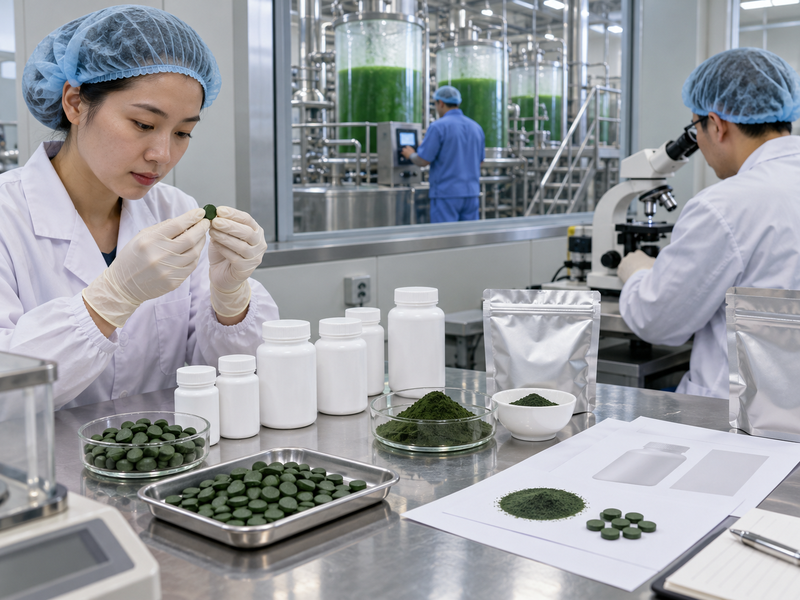
The raw-material specification should state species, form, processing, identity method, composition, contaminants, microbiology, physical attributes, pack and shelf life. Also, name the approved supplier and site where needed. “Green algae powder” is not enough. C. vulgaris and C. sorokiniana are distinct, and Chlorella should not be substituted with Arthrospira Spirulina. However, if a private-label factory buys the biomass on the brand’s behalf, the brand still needs visibility into what has been approved and what can change.
Use a three-way review. Brand, ingredient supplier and finished manufacturer should sign off on the same document or controlled cross-reference. Then, compare actual commercial COAs with the specification. Ask whether a processing claim such as broken cell wall is substantiated by method and lot evidence. FDA’s GRN 986 dossier concerns one particular C. sorokiniana product; it does not cover every Chlorella grade. The brand’s regulatory team should check the selected ingredient for the intended market. As a result, a substitute can affect color, filling, label and legal status, so it deserves a new decision rather than a quiet purchasing change.
| Specification field | Owner | Approval evidence |
|---|---|---|
| Species and grade | Brand/quality | Supplier dossier |
| Process | Supplier/quality | Change notice |
| Safety limits | Quality/regulatory | Market review |
| Physical targets | Manufacturer | Pilot data |
3. How should finished format be selected?
Compare the user experience with factory feasibility
Powder pouches, capsules and tablets solve different customer problems. Powder offers flexible serving size but requires taste and dispersion work. Meanwhile, capsules hide flavor yet depend on density, shell size and fill variation. Tablets can reduce shell material but need compression, breakage and disintegration testing. Next, define target serving, pack count, price and claim before choosing. The lowest manufacturing quote may use a format that cannot deliver the promised dose or consumer experience.
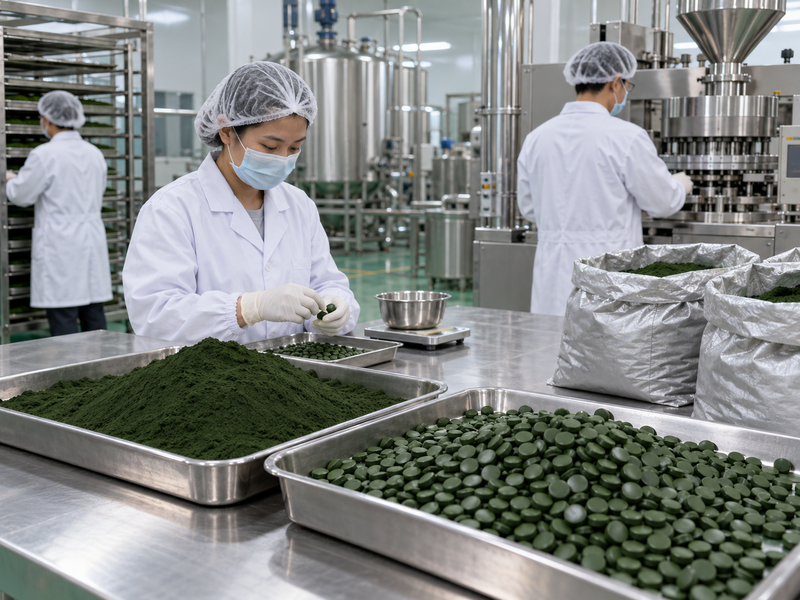
Request a production-equivalent sample. A hand-made capsule or tablet can look good without proving machine performance. Also, ask for fill-weight data, reject rate and finished stability for a pilot. For powder, test scooping, dust, dispersion and pack moisture barrier. The site’s Spirulina powder-versus-tablets article gives a related format comparison; Chlorella grades require separate evaluation. If the factory proposes an “equivalent” SKU, compare species, excipients and process in writing. Select the format after the actual biomass passes a trial at realistic scale.
4. Who approves formula and artwork?
Separate creative ownership from technical release
The brand may own messaging and visual design, while manufacturer and regulatory reviewers must confirm the formula, ingredients, serving and required statements. Next, define who approves each artwork version and who holds the final print file. For example, a formula change after artwork approval can make ingredient amounts or lists wrong. Check species naming, excipients, shell material, organic status, lot placement and expiry statement. Health claims need a market-specific evidence review; do not infer them from Chlorella’s nutrient profile.
Reconcile every number. If a capsule weighs 500 mg in total and includes 25 mg of excipients, a label cannot claim 500 mg Chlorella per capsule without another basis. If a tablet contains organic powder but a nonorganic binder, the finished organic claim needs certifier review. USDA’s U.S. organic labeling guide explains categories for applicable products. Then, keep an approved proof with signatures and revision date. The factory should reconcile printed labels issued versus used. A corrected digital file does not fix thousands of outdated labels already in a warehouse.
| Artwork item | Technical source | Approver |
|---|---|---|
| Ingredient list | Master formula | Regulatory |
| Dose | Fill/mass balance | Quality |
| Organic claim | Certification | Certifier/brand |
| Lot/expiry | Pack specification | Manufacturer |
5. Which manufacturing records are required?
Make every finished lot reconstructable
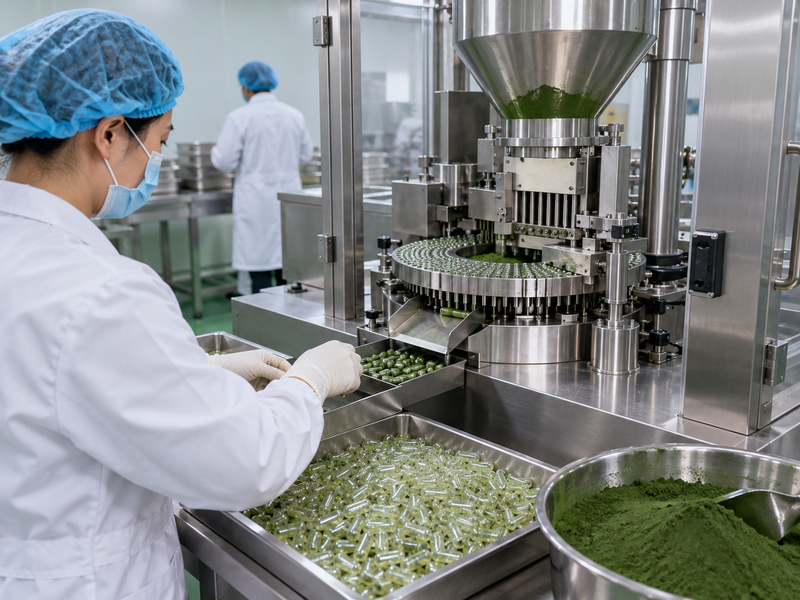
The contract manufacturer should maintain a master formula or manufacturing record for each unique product and size. For example, a batch record should show raw-material lots, weights, equipment, cleaning, in-process checks, yields, deviations, packaging components and quality disposition. Ask what summary the brand will receive and what records it may review during an audit or complaint. When a process is subcontracted, record which site owns that stage. Good records are not a paperwork burden added after a problem; they are the map used to solve it.
Walk through one sample batch. Can the manufacturer show which biomass lot entered a capsule batch and which bottles received those capsules? Can it identify labels used and reconcile leftovers? FDA’s Part 111 guide details master manufacturing and batch production records for applicable U.S. supplements. The exact legal obligations vary by role and market, but the operational question is universal: can the brand locate and assess affected units promptly? Also, agree on record retention, access and confidentiality before launch.
6. How are lots traced across partners?
Preserve parent-child links at every transformation
Raw Chlorella powder may be split into several manufacturing batches, and one finished run may use several powder lots. As a result, the traceability system should record both directions. If a co-packer applies brand labels to bulk capsules, it must link original finished-bulk lot to each retail pack lot. For that reason, do not allow a private-label SKU to hide manufacturer or source changes. At dispatch, cartons and pallets should identify finished lot and quantity, with COA and shipment references attached.
Run a mock complaint. Choose one retail bottle and ask all partners to identify its raw powder, shell or binder, production dates and other bottles from the same parent materials. Then, record how long the query takes. Then start from a suspect ingredient lot and trace forward. A mock exercise tests real coordination better than a policy statement. If a distributor or marketer cannot access manufacturer records promptly, write an escalation route in the agreement. Traceability should also survive repacking, returns and partial shipments. The brand needs a clear picture before a customer asks for one.
| Stage | Parent code | Child code |
|---|---|---|
| Biomass | Culture/harvest | Powder lot |
| Manufacture | Powder lot | Capsule/tablet batch |
| Retail pack | Bulk batch | Bottle/pouch lot |
| Dispatch | Pack lot | Shipment/pallet |
7. What release tests belong to each stage?
Avoid using one COA for the entire product chain
Raw powder testing may cover species identity, moisture, composition, microbiology and elemental contaminants. Meanwhile, manufacturing checks may cover fill weight, tablet hardness or blend uniformity depending on format. Then, finished-product release should address the specification and packaging or label checks. Also, define who samples, who tests, who reviews results and who signs release. A supplier’s powder COA cannot alone release capsules or tablets after they have been processed and packed.
Write the stage gates. A failing incoming lot should be held before manufacture. In-process drift should trigger defined line action, not a quiet final adjustment. A finished lot should stay quarantined until quality authorizes shipment. FDA’s supplement CGMP guidance describes quality-control release requirements where Part 111 applies. The brand should receive a lot-specific finished COA or agreed release packet and know what was actually tested. If the product is a conventional food powder, use the applicable food framework. Clear stage gates prevent a good raw ingredient from masking a later manufacturing defect.
8. How should shelf life and packaging be validated?
Study the finished product in its sold pack
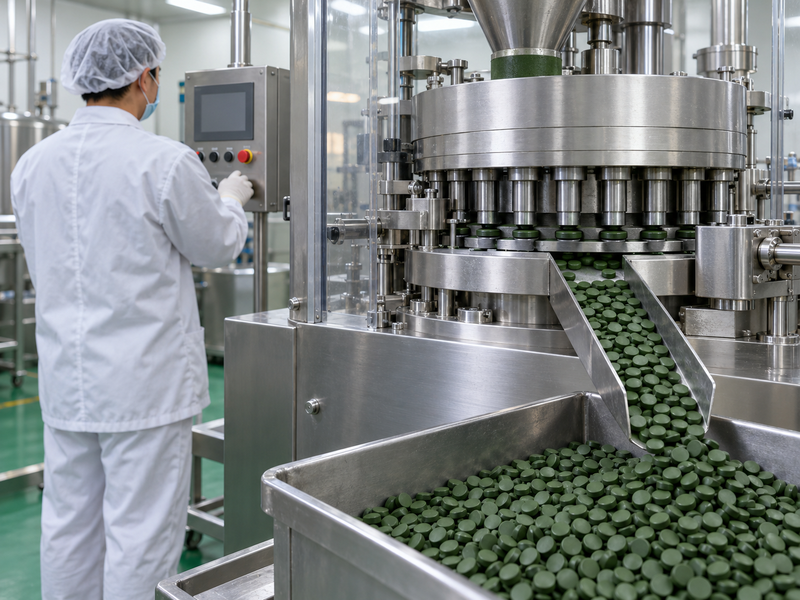
Raw powder stability supports ingredient control, but tablets, capsules and retail pouches can behave differently. For example, excipients, shell moisture, compression, headspace and packaging barrier may alter performance. Ask for a finished-product stability protocol covering commercial formulation, pack, storage condition and relevant endpoints. Test tablet disintegration and friability, capsule shell integrity and fill condition, and powder clumping, color and odor. As a result, the label date should come from that finished configuration rather than a generic bulk-powder claim.
Check changes after approval. Also, a new bottle vendor or pouch film can affect moisture protection. A promotional clear window can change light exposure. A supplier’s GRN 986 stability data belong to its described C. sorokiniana products, not your private-label pack. Agree on minimum remaining ingredient life at production and finished-product life at shipment. Inspect transport-damaged packs and retain a reference sample. The site’s Spirulina shelf-life guide offers an analogous planning method, while the Chlorella product needs its own measured data.
| Format | Stability concern | Test example |
|---|---|---|
| Powder | Moisture and shade | Pack-condition trend |
| Capsule | Shell and fill | Integrity/appearance |
| Tablet | Breakage and breakdown | Friability/disintegration |
| All | Label/date | Pack audit |
9. What commercial terms prevent surprises?
Price the complete released unit
Ask for a quote that separates biomass, manufacturing, excipients, shell or tooling, packaging, testing, artwork setup, freight and storage. Then, define minimum run and overage or underage tolerance. Also, agree who owns unused powder, printed labels and rejected units. Also, payment milestones should align with documented production and release, not only a promised production date. Clarify whether the brand may move its formula, artwork or tooling to another manufacturer.
Model a launch delay. If artwork approval slips, can the supplier hold approved biomass without losing shelf life? A failed finished lot also needs an owner for investigation, retesting and remake costs. For a seasonal demand peak, reserve realistic capacity with lead-time commitments. Use cost per accepted, saleable unit, including normal rejects and inspection, to compare offers. A cheap tablet quote can be expensive if breakage or slow release repeatedly ties up inventory. Put service contacts, change notice and dispute steps into the agreement. Commercial clarity makes quality decisions easier because no party must improvise the financial answer during a failure.

10. What launch gate should the brand use?
Approve a complete, representative pilot
Require a production-equivalent run using the approved raw Chlorella grade, formula, equipment and packaging. Next, check ingredient and finished COAs, batch record, yields, physical performance, artwork proof and traceability. Also, start finished-pack stability samples. Have regulatory, quality, operations and brand owners sign their parts of the decision. A beautiful prototype that cannot be tied to an approved lot or process is not launch-ready. Define what may change without a new pilot and what triggers full requalification.
Finish with a real handoff. Conduct a mock trace from one packed unit to biomass source and forward to other affected units. Then, inspect shipping cartons and test how the co-manufacturer communicates a late deviation. Keep a launch checklist with signed evidence and open items, then release only when blocking items close. After the initial commercial order, review customer complaints, rejects, delivery and COA trends. Private label succeeds when every partner can repeat the agreed product and answer for its part. A clear gate protects the brand’s claim and makes the next order more predictable.
| Launch gate | Evidence | Sign-off |
|---|---|---|
| Raw material | Approved grade/lot | Quality |
| Process | Pilot and batch record | Operations |
| Product | Finished tests/stability | Quality/regulatory |
| Commercial | Price and handoff | Brand/procurement |
What to do next. Chlorella private label manufacturing needs defined ownership from culture to retail pack. Lock the exact biomass grade, validate the chosen format, approve artwork against actual formula and require lot-level release records. A disciplined pilot gives your brand a product it can explain and reorder with confidence.
Frequently asked buyer questions
FAQ
Q1: Can a brand rely only on a private-label manufacturer’s ingredient choice? It should approve the exact species, grade and change policy.
Q2: Who owns the finished label? Define artwork and regulatory approval in the contract; the brand should review its claims and market obligations.
Q3: Does a raw-powder COA release capsules? No. Finished manufacturing and packaging need their own review.
Q4: Can a factory change Chlorella suppliers under the same SKU? Only under an agreed change-control and requalification process.
Q5: What proves launch readiness? A representative pilot, signed specifications, traceability, finished tests and approved pack artwork.