
Powder and tablets can carry the same whole spirulina identity while creating very different manufacturing and distribution costs. Spirulina wholesale powder vs tablets is a decision about the buyer’s business model, not a universal winner. This guide compares formulation control, dose, breakage, packing and saleable yield. The FAO review of spirulina production describes whole biomass in food and feed contexts; buyers still need current SKU specifications for either format.
Contents: 1 · 2 · 3 · 4 · 5 · 6 · 7 · 8 · 9 · 10
1. What exactly is being purchased in each format?
Check composition before shape
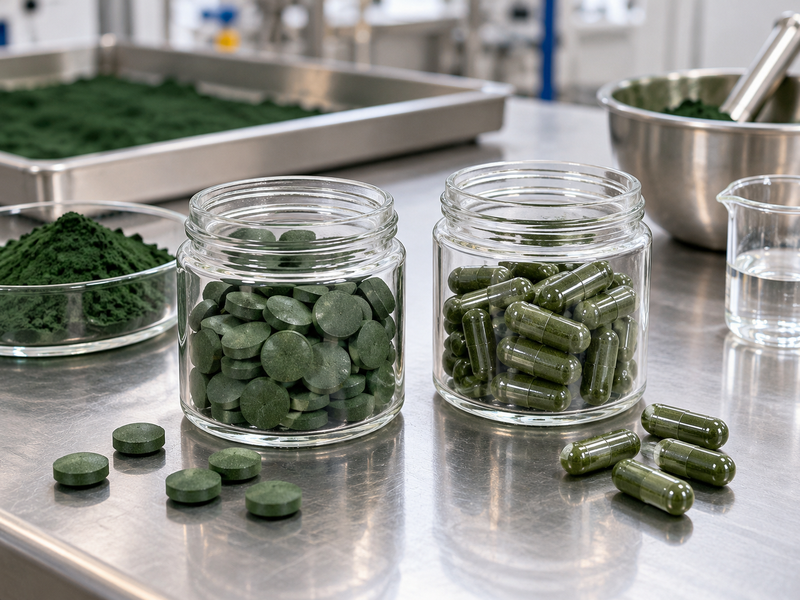
Whole spirulina powder is dried biomass supplied for blending, encapsulation, compression or food use. A tablet is a finished compressed unit that may contain only spirulina or may include processing aids, binders, coatings or other ingredients. For example, ask for a full composition statement, unit mass, tolerance and ingredient declaration. However, do not assume a tablet is 100% biomass just because its front label says spirulina. Also, a powder described as “blue spirulina” may actually be an extract rather than whole green biomass.
Set the buyer’s endpoint: a brand making its own capsules needs powder; a distributor selling preformed units may prefer bulk tablets. If a brand wants to change serving size or add ingredients, tablets remove some control. Then match the supplied form to the planned finished product and destination rules before a unit-price comparison. A specification should name identity, processing, pack, tests and label-relevant composition for the offered SKU.
| Purchase question | Powder | Tablets |
|---|---|---|
| What is the unit? | Net kilograms | Count and unit mass |
| Recipe control | Buyer formulates | Supplier may formulate |
| Handling | Dust and flow | Count and breakage |
| Label input | Ingredient composition | Full tablet composition |
2. How does dosage control differ?
Translate both offers into biomass per serving
Powder lets the buyer set inclusion in a food, beverage, capsule or sachet. By contrast, a tablet supplies a fixed unit mass, subject to manufacturing tolerance and any non-spirulina ingredients. Next, convert both quotations into actual whole-biomass grams per intended serving. For tablets, multiply tablets per serving by spirulina biomass per tablet, not merely gross tablet weight. Verify the number through the supplier’s formula declaration and batch controls.
An illustrative check: two 500 mg tablets do not necessarily provide 1,000 mg of biomass if the declared tablet contains other constituents. However, the numbers here describe arithmetic, not a supplier formulation. For powder, compare approved dose with expected line loss and pack residual. A distributor selling tablets may avoid an extra filling step, while a manufacturer of blended bars needs powder to control dispersion. As a result, the right format depends on the finished offer and the process used to make it.
| Input | Powder model | Tablet model |
|---|---|---|
| Serving basis | Grams issued | Units consumed |
| Biomass fraction | Specification | Formula declaration |
| Process loss | Dispensing and blending | Broken/rejected units |
| Label check | Formula and assay | Count, mass and composition |
3. Which format gives a brand more formulation control?
Match control to the product pipeline
Powder offers broad flexibility. For example, you can adjust inclusion level, combine ingredients, choose a capsule shell or use the biomass in a food matrix. In turn, that flexibility creates formulation and process validation work for the buyer. Meanwhile, tablets simplify a fixed serving format but may lock the brand into the supplier’s recipe, shape and tooling. Still, a custom tablet can restore control at the cost of development time and a larger minimum run.
Ask what may change later: if marketing plans a new serving size, will existing tablet tooling still work? If a food line wants a smaller particle size, will the same powder grade perform? Until that decision is settled, avoid a large inventory order. Request samples from the exact commercial SKU, then test them in realistic production or pack-out. Also, a switch between powder and tablets may change label, packaging, stability and regulatory review. Keep those workstreams visible before purchasing commits.
Brands should also decide who controls artwork and product-change notices. A bulk tablet made under a supplier’s standard formula may be available quickly, but its inactive ingredients and unit dimensions could constrain label and bottle choices. However, a private-label tablet may match the desired formula but need its own tooling, checks and stock commitment. By contrast, powder shifts more design work onto the buyer while preserving flexibility across several finished products. List these responsibilities next to the quote so a format decision includes work the company must fund after receipt.
4. How should handling losses be compared?
Measure loss in the actual operation
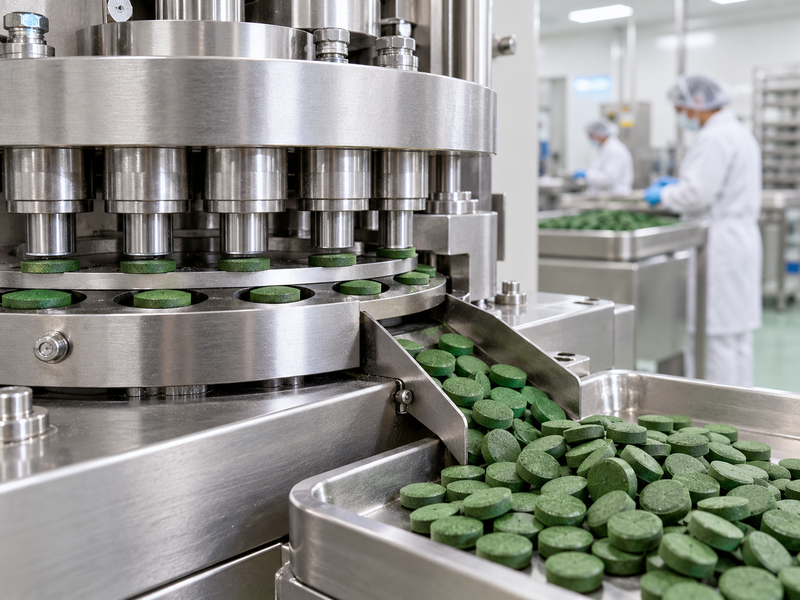
Powder can generate dust, cling to equipment, bridge in hoppers or remain in opened bags. Meanwhile, tablets can chip, crack or produce fines during counting and transport. However, neither loss rate has a universal value. Then run the candidate through your own line and count or weigh material at each step. Then record accepted input, output, rejects, rework and saleable units. However, a vendor’s factory demonstration may not mirror your filling machine or route.
The useful denominator: cost per accepted finished serving, not cost per invoice kilogram. If powder loses material during blending, include cleaning and downtime. If tablets break in bulk shipment, include sorting, replacement and customer-complaint exposure. The tablet-breakage guide explains how to agree an acceptance limit. Also keep trial records tied to lot, pack and conditions so a carton change can be checked against the same baseline.
| Loss source | Powder observation | Tablet observation |
|---|---|---|
| At opening | Residual dust | Fines in liner |
| At processing | Hopper or blender loss | Counting rejects |
| In transport | Leaking pack | Chipping and cracks |
| At customer | Spill or dose error | Broken units |
5. What does packaging do to economics?
Compare commercial and consumer packs
Bulk powder may arrive in sealed lined bags or cartons. By contrast, bulk tablets may arrive in inner bags, drums or cases that limit movement and rubbing. Next, count pack materials, pallet efficiency and the ease of receiving inspection. For a distributor, tablets may move directly into retail bottling or private-label pack-out. Meanwhile, a brand buying powder may face more capsule, sachet or food-processing cost. Then compare end-to-end cost for the intended finished unit.
Look for hidden waste: a large powder bag can be inexpensive but awkward when each batch uses little material. A large tablet liner may save packing cost but create breakage under vibration. Ask for pack qualification evidence on the proposed route and a minimum remaining shelf life at receipt. However, an unopened shelf-life statement may not cover the period after a buyer opens a bag. Run a realistic hold test where the downstream operation needs one. The warehouse-humidity guide can support opened-pack procedures.
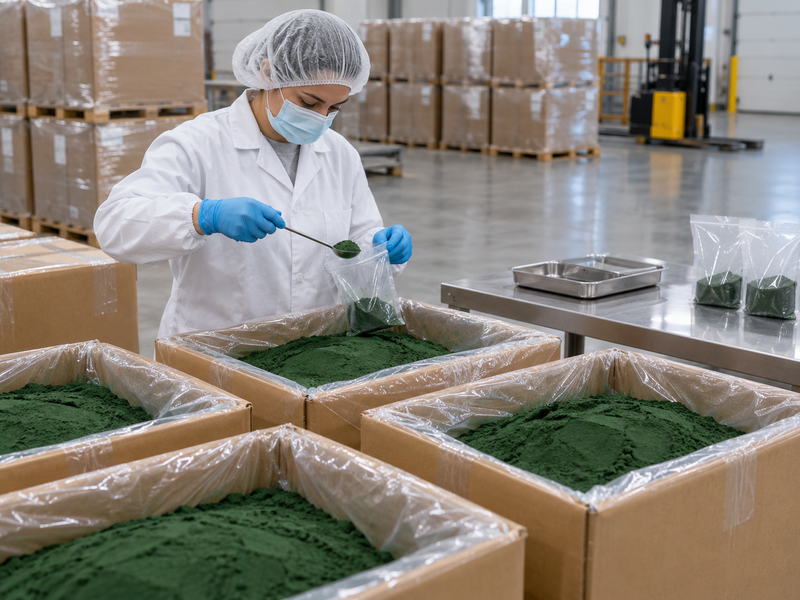
Next, ask receiving staff how they will inspect the chosen pack. Tablet cartons may need a defined sampling plan for broken units at different positions, while powder bags need seal and net-mass checks that preserve cleanliness. If a distributor repacks tablets into bottles, count the pieces lost during feeding and the labor needed to remove fines. If a manufacturer opens powder repeatedly, account for reclosure supplies and partial-bag identification. As a result, packaging belongs in the usable-cost equation before a supplier is chosen.
6. Which quality documents differ by format?
Keep shared safety checks and format-specific tests
Both formats need identity, composition and contaminant controls suitable for destination and use. For example, tablets add unit mass, hardness, breakage and disintegration checks when relevant. Meanwhile, powder adds particle size, bulk density, moisture or flow behavior as needed by your process. However, do not copy a tablet specification onto powder or assume a powder COA covers tablet performance. Ask the supplier which tests are performed on the actual commercial lot.
Check the analytical chain: bag or carton lot code should match the COA and sample. FDA guidance for dietary supplement CGMP discusses component and finished-product specifications for applicable U.S. supplements; conventional foods have different regulatory paths. ISO/IEC 17025 addresses laboratory competence, while the lab’s scope tells you whether the needed method is covered. Agree acceptance limits before the order, not after a shipment fails.

| Quality area | Shared or format-specific? | Evidence |
|---|---|---|
| Identity and contaminants | Shared | Lot report |
| Particle behavior | Powder | Test and line trial |
| Unit integrity | Tablet | Friability and receipt check |
| Pack seal | Both | Inspection and validation |
7. How do lead time and minimum runs differ?
Ask where the supplier’s bottleneck sits
Powder may be milled and packed from available dried biomass. Tablets add compression, tooling setup, inspection and pack-out, which can create a separate production queue. Yet a supplier may hold finished tablet stock while powder is made to order. As a result, neither pattern should be assumed. Then request a current lead-time breakdown for sample, pilot and repeat order, plus MOQ and pack multiple for each form.
Plan for release, not dispatch: buyer QA, transit and customs can add time after the seller finishes production. For example, a custom tablet formula may require more development and stability work than a standard powder. Ask whether a missed production slot pushes the shipment to the next campaign and whether the supplier can reserve capacity under an annual forecast. The lead-time planning guide turns those stages into a usable calendar. Compare that calendar with your finished-goods launch date before selecting the format.
8. How should a distributor compare unit margins?
Model the saleable item, not a raw kilogram
A distributor purchasing tablets might sell counted bottles, bulk containers or private-label stock. For example, its economics depend on good units per shipment, pack-out yield, labels, freight and retailer requirements. Meanwhile, a distributor purchasing powder may sell by kilogram or repack into tubs and sachets. Model each route through its own finished item and measure rejected packs. A tablet’s apparent higher ingredient cost can be offset by less local manufacturing, while powder may support more product variations.
Run three cases: expected demand, lower sales and a transit-damage case. Use current quotations only. Include unsold finished inventory and expiry, not just ingredient stock. Keep product claims within destination law and the evidence for the actual formulation. This guide does not imply any health benefit from spirulina. If a distributor changes seller or form, check regulatory labels and customer agreements before using old artwork. The landed-cost guide provides a consistent cost base for each route.
For each case, show both gross margin and cash tied up before sale. A tablet line may produce saleable bottles quickly but force a large single-SKU commitment. By contrast, powder may enter several products and spread demand risk, yet require more local processing and quality release. If customers return broken tablet bottles, assign the credit and handling cost to that route. If powder tubs leak in distribution, assign the same type of customer cost there. A fair model follows the finished unit through sale and returns instead of stopping at warehouse receipt.

| Margin driver | Powder route | Tablet route |
|---|---|---|
| Local operations | Repacking or formulation | Counting or bottling |
| Reject measure | Kilograms and packs | Units and bottles |
| Product flexibility | High | Fixed shape/dose |
| Customer complaint | Leaks or sensory | Chips or count |
9. When is a hybrid buying plan sensible?
Separate each SKU and its forecast
For example, some businesses need powder for manufacturing and tablets for a distributor channel. That can be sensible if each line has a clear customer, specification, forecast and margin. However, do not combine both formats in one inventory number just because they originate from whole spirulina. Powder cannot become finished tablets without further manufacturing, and bulk tablets cannot be treated as unrestricted ingredient powder. So give each SKU its own reorder point, quality documents and shelf-life clock.
Keep supplier links visible: ask whether both forms use the same biomass lot or different raw materials, sites and manufacturing dates. Still, a shared supplier name is not proof of shared traceability. If the business plans to convert powder into its own tablets later, run a formulation trial and compare total cost with purchased tablets. For example, a small pilot can reveal compression or breakage problems early. The trial-order guide provides a framework for both formats.
10. How should the final format decision be signed off?
Compare controlled, saleable outputs
Write a decision sheet for the intended finished product. Include composition, dose flexibility, approved tests, process yield, transit loss, pack cost, release time, minimum order and cash at risk. Then quality should approve the offered SKU. Operations should confirm trial performance. Commercial staff should check the sales channel. If the two offers support different products, avoid forcing them into a single “cheapest per kg” ranking.
The decisive question: which format yields the required saleable units at acceptable cost and reliability? State what evidence is still missing and whether a limited pilot can close the gap. Spirulina wholesale powder vs tablets becomes straightforward when the team compares the same customer promise at the end of each path. Keep the chosen specification and sample reference under change control. Also review the decision if the supplier changes formula, pack or site, or if the brand changes serving size.
Keep evidence for the next format review
For a decision that survives handover, attach the actual receiving photos and a short reconciliation of ordered, accepted and saleable units. For example, record whether rejected tablets were counted by weight or by piece. Those measures can tell different stories. Note the powder’s open-pack interval and cleaning labor if small batches are expected. Ask customer service whether complaints from a similar format already reveal a handling problem. These details make a future price review far more useful than a simple comparison of quotations.
If both formats remain viable, approve a limited commercial run for each and review returns after distribution. A bench trial cannot always predict how customers handle a finished pack. Until then, keep the decision provisional.
| Decision field | Buyer evidence | Sign-off |
|---|---|---|
| Customer format | Product brief | Commercial |
| Formula and dose | Approved recipe | Development |
| Lot quality | Specification and COA | Quality |
| Saleable cost | Trial yield and quote | Finance |
Next step: request exact powder and tablet specifications, then run the offered commercial formats through your own receiving and pack-out process. Choose on saleable output, not shape or invoice rate alone.
FAQ
Q1: Are spirulina tablets always pure biomass? No. Obtain a full composition statement for the exact tablet SKU.
Q2: Is powder always cheaper? Invoice rate alone cannot answer. Include local processing, yield and packaging.
Q3: Can a tablet COA release powder? No. Each format and lot needs applicable evidence.
Q4: What is the main tablet transit risk? Chipping, cracks and fines can reduce saleable units; measure them on receipt.
Q5: Can a buyer use both formats? Yes, with separate specifications, forecasts and inventory controls.