
A blue sample can pass a bench review and still fade or streak on the factory line. Blue spirulina extract production scale up translates an approved laboratory color into a controlled commercial process. The work covers exact SKU, addition method, exposure history and finished-product release. Research on phycocyanin stability identifies pH, heat and light as relevant factors; it does not supply one temperature or acidity limit that fits every food matrix.
Contents
- What exactly was approved at the bench?
- How should the commercial extract be identified?
- Which scale-up variables should be mapped?
- How should a blue preblend be prepared?
- Where should the extract enter the line?
- How should thermal and pH exposure be assessed?
- What measurements show dose uniformity?
- How should the first plant trial be sampled?
- What qualifies packaged color stability?
- What must be locked before commercial release?
1. What exactly was approved at the bench?
Freeze the reference formulation
Retain the accepted bench sample and record the entire recipe: base ingredients, extract dose, ingredient addition order, pH, mixing method, temperatures, hold times and packaging. State how color was judged and when after preparation it was viewed. The hidden gap: a sample prepared cold and viewed immediately cannot represent a commercial batch that waits in a warm tank or spends months under retail light. Define a finished-color target with an instrument method and visual standard if both matter.
Identify the product attribute that can move: hue, intensity, clarity, sediment or flavor. The site’s blue spirulina sample testing protocol can help document sample handling. A product-development sign-off should name a specific extract lot and SKU, not merely “blue spirulina.” Plan the plant trial around departures from those bench conditions.

2. How should the commercial extract be identified?
Match sample to purchasable stock
Request the signed SKU specification, full ingredient and carrier list, grade, color-value method, lot COA, storage instruction, pack format and manufacturer identity. Confirm whether the commercial material comes from the same formulation and site as the approved sample. Do not accept a grade name alone: E-value indicates method-defined optical strength, and products with similar names may have different carriers. The supplier’s blue-spirulina product page explicitly asks buyers to confirm composition and method by SKU.
Reserve enough qualified material for line trial plus repeat and stability samples. Check pack opening practices because moisture pickup or prolonged warm exposure can alter handling. If a substitute lot arrives, compare it with the retained approved lot before running a full batch. Keep the supplier’s change-notification process connected to formula change control.
| Identity item | Match required | Consequence of mismatch |
|---|---|---|
| SKU and carrier | Bench to plant | Label or dispersion change |
| Grade method | COA to spec | Invalid strength comparison |
| Lot | Trial to retain | Weak traceability |
| Pack/storage | Receipt to use | Handling variation |
Make a small-scale transfer map for the dosing system. Calculate the minimum extract mass the production scale must weigh, then verify that its routine resolution and check-weight procedure support that amount. If the dose falls below reliable direct weighing, specify a preblend with a known concentration and a controlled transfer volume. Record whether the product can tolerate the added liquid. Compare the extract lot in the pilot with the approved bench lot using the same color assay and a brief food-matrix test.
That step separates a change in purchased material from a change introduced by plant equipment.
3. Which scale-up variables should be mapped?
Compare laboratory and line exposures
Draw a simple flow from extract weighing through premix, main mixing, hold tank, processing, filling and packed storage. For each point, record scale, temperature, pH, residence time, light, mixing intensity and contact materials where relevant. Where can the color wait? A low-volume bench blend may take minutes; a plant tank may hold for hours or face a restart. Identify the longest plausible hold and the worst realistic thermal exposure.
Note dilution sequence because concentrated extract may encounter local acid or heat before the batch is homogeneous. Compare vessel geometry and recirculation, not only nominal mixer speed. This map establishes the trial’s sampling points and helps explain deviations. Published phycocyanin stability experiments show behavior under specific pH and storage conditions, but the actual plant matrix must determine its operating range.
4. How should a blue preblend be prepared?
Make the small dose controllable
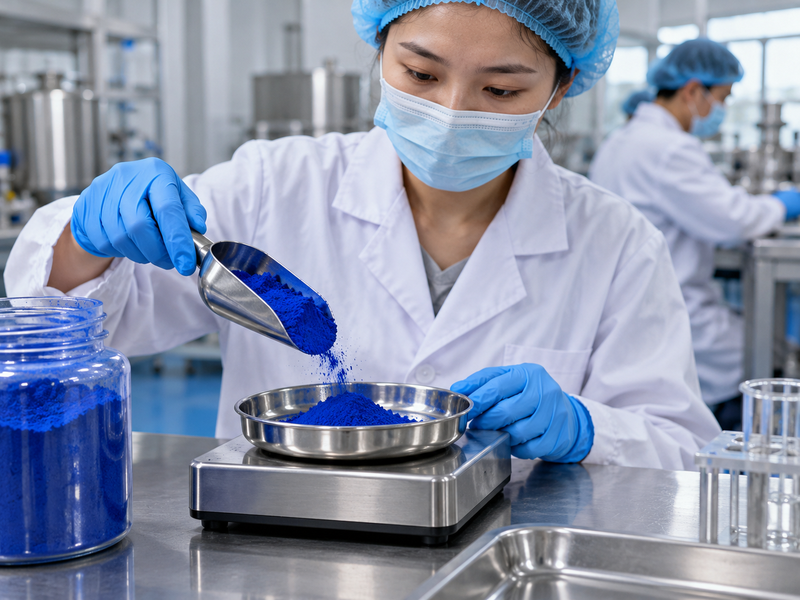
At low inclusion levels, direct addition can challenge scale resolution and even distribution. Test a defined preblend using compatible water or base, then record powder-to-liquid ratio, mixing time, water temperature, hold and transfer method. Check whether the extract fully dissolves or leaves visible particles under the actual process. Measure transfer loss: blue residue in the preblend vessel or hose means weighed input differs from delivered dose. Rinse only if the extra liquid belongs in the recipe and the rinse is controlled.
A dry premix may work in powders but should be assessed for segregation during hopper feeding. Compare the first and last delivered portions for color strength. The site’s solubility versus dispersibility guide provides useful terminology; the plant must still validate its own preparation method and maximum hold.
| Preblend control | Record | Failure to watch |
|---|---|---|
| Weighing | Scale ID and net mass | Dose error |
| Liquid | Type, volume, temperature | Wrong dilution |
| Mixing | Time and tool | Clumps or foam |
| Transfer | Residue and rinse | Unaccounted loss |
5. Where should the extract enter the line?
Compare realistic addition points
Screen addition before and after thermal steps where the plant design permits and where hygiene and process controls remain valid. Early addition may simplify mixing but lengthen exposure; late addition may protect color but require an aseptic or otherwise controlled post-process route. There is no free late-addition option: any change after a validated lethality step requires a food-safety review. Record local temperature and pH at the injection point, not only final batch values. Test mixing time and tank turnover to find when color becomes uniform.
For products with multiple phases, inspect both phases separately. A phycocyanin thermal-stability study supports testing exposure, but does not authorize a universal “safe” addition temperature. Manufacturing and quality must jointly approve the point of addition on the actual line.

6. How should thermal and pH exposure be assessed?
Test time and matrix together
Use the product’s actual heating or cooling profile, pH range and hold time. Measure color before treatment, immediately after and following storage. A brief high-temperature event may differ from a long warm hold, and acidity can interact with both. Do not transfer a lab threshold blindly: phycocyanin studies vary in protein concentration, carrier, buffer and exposure method. The review of physicochemical degradation details this dependence.
If the formula contains acid, test local mixing conditions to avoid exposing a concentrated pigment stream to an undiluted acid pocket. For a cold-fill route, still evaluate sanitation, light and storage conditions. If color changes, compare extract before and after preblending, tank holding and final processing to locate the step. Regulatory suitability of the finished product remains a separate market-specific review.
| Challenge | Sample point | Outcome |
|---|---|---|
| Preblend hold | Start/end | Color and sediment |
| Plant heating | Before/after | Immediate loss |
| pH range | Formula extremes | Hue change |
| Storage | Packed intervals | Long-term retention |
7. What measurements show dose uniformity?
Combine mass balance and product color
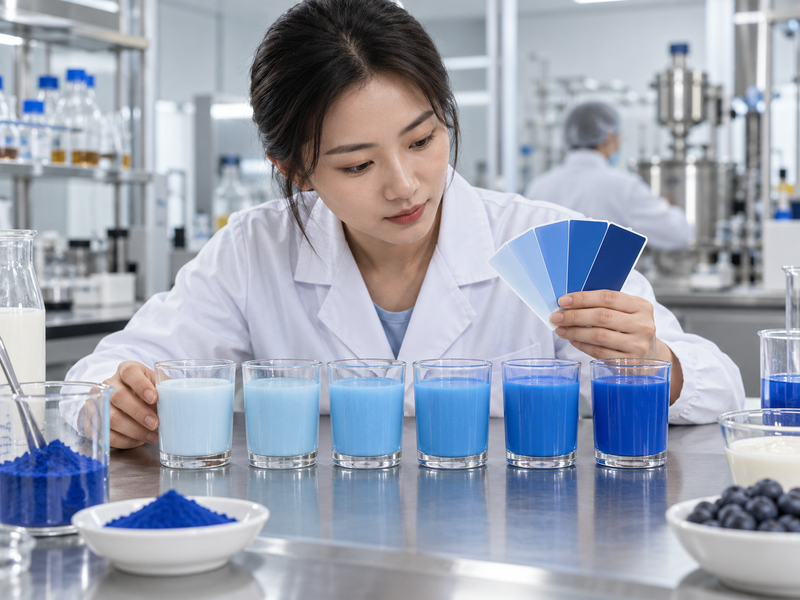
Reconcile extract issued, weighed, added, left in vessels and consumed per finished batch. Pair that calculation with color measurements at multiple locations and times. A correct total mass can still be unevenly distributed. Follow the line: sample top and bottom of a tank where feasible, then early, middle and late filled units. Use consistent container, background and instrument setup. For clear products, monitor haze or sediment as well as color. For opaque matrices, compare cut surfaces and product texture.
The site’s color measurement in food guide can frame a repeatable method. When color instruments yield low variability but people see streaks, inspect spatial distribution rather than averaging whole samples. Define an acceptance range from the approved reference and process capability, not from a generic E-grade number.
8. How should the first plant trial be sampled?
Capture line events rather than one composite
Take time-coded samples at startup, steady operation, after a hold or restart, after extract refill and at run end. Record tank levels, process readings and exact lot at each point. Keep separate retains from the extract, preblend, bulk product and packed units. A composite can hide the failure: good average color may conceal a pale startup interval that reaches customers. Include any rejected or reworked material in the yield balance.
If the trial follows a change in co-packer or equipment, compare the same formulation on both lines under equivalent measurement methods. Document operator actions such as extra mixing. A useful plant report shows raw measurements, photographs, deviations and disposition of all produced units, not only an attractive end-of-run sample. Predefine which deviations trigger a second trial. Also record the volume remaining in the tank after the last saleable unit. That heel can hold more or less pigment than the average if mixing is weak.
If the line recirculates, compare a sample before and after the return point. These details turn a visual difference into a process hypothesis and help calculate the true extract cost per accepted unit.
| Trial phase | Sample | Linked record |
|---|---|---|
| Startup | First accepted units | Stabilization log |
| Stable | Mid-run units | Tank and fill trends |
| Restart | Post-hold units | Time/temperature history |
| End | Final units | Residue and yield |
At each sampling time, record which extract container was in use and whether the premix was newly made or near the end of its hold. A change in color after a refill may come from reconstitution or transfer rather than the main tank. If several filling heads operate in parallel, identify the head on every retained unit and inspect cross-head variation. Preserve a unit from each significant stop or restart, even if the line later discards that interval, because it helps define future hold rules.
Reconcile saleable volume, rejects and tank heel before calculating actual colorant use per unit. Note the elapsed time between sampling and measurement; delayed readings can disguise process-stage differences.
9. What qualifies packaged color stability?
Test the proposed commercial pack
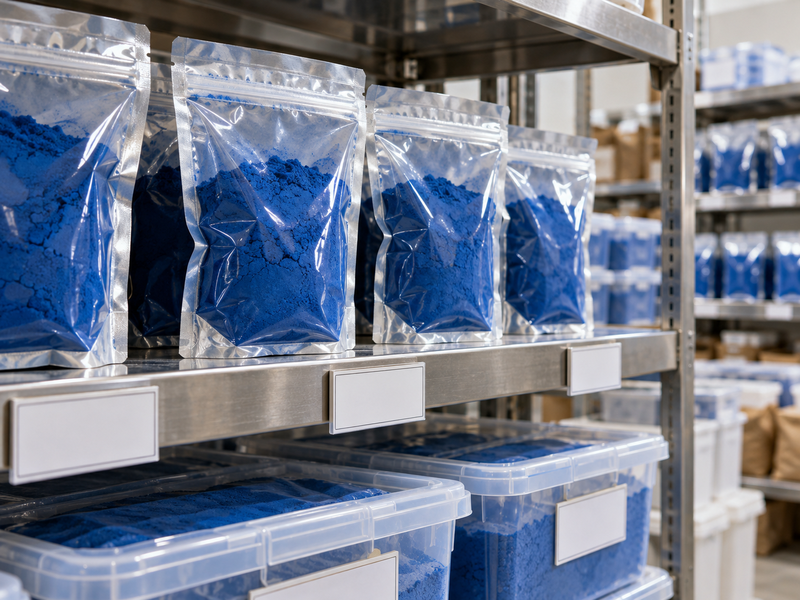
Fill product into the intended container with the planned headspace and closure. Compare light-exposed and protected samples if the retail route includes display light; include realistic shipping and storage conditions. Measure color, appearance, sediment and any product quality attributes at planned intervals. A first-day match is not shelf-life approval: the selected blue must remain acceptable at the point a customer uses it. If the pack changes, repeat relevant stability work.
The site’s blue spirulina light-stability packaging guide supports exposure questions, but final shelf life must come from the finished product. Check seal integrity and temperature history when a drift occurs. Preserve both an unopened retain and a deliberately opened use-condition sample if the product will be consumed over multiple openings.
10. What must be locked before commercial release?
Sign the transfer specification
Approve exact SKU and carrier, dose range, preblend recipe, addition point, process window, sampling plan, color method, packaging and shelf-life basis. Link each specification limit to a trial result and identify who can authorize an adjustment. Make the next batch reproducible: an operator should know what to do when color is pale after mixing or when a hold exceeds the approved time. Include a quarantine and escalation rule rather than encouraging unrecorded extra dosing.
Confirm current destination-market permissions and labeling for the exact extract and food category; the U.S. spirulina extract regulation is one jurisdiction-specific example. Any later carrier, equipment or thermal-process change needs an impact review. Release the first commercial batch only after its actual results are compared with the approved pilot and retained standard. Put a dated review point on the transfer packet so early commercial batches can reveal a drift that the single pilot missed.
Keep any dose adjustment tied to a measured finished-color result.
| Locked item | Evidence | Change trigger |
|---|---|---|
| Extract SKU | Specification and COA | Source or carrier change |
| Addition | Plant trial record | Equipment change |
| Color | Approved sample and method | Formula change |
| Shelf life | Packed stability study | Pack change |
FAQ
Q1: Can the bench dose simply be multiplied by batch size? It is a starting mass balance, but line losses and mixing require a measured plant trial.
Q2: Is later addition always better? It may reduce exposure but can introduce food-safety and uniformity questions that need approval.
Q3: Does a higher E-grade prevent fading? No. Test the complete SKU in the actual process and pack.
Q4: How many plant samples are enough? Sample distinct line phases and events; a single composite cannot detect time-linked drift.
Q5: What should trigger requalification? Changes in carrier, supplier site, formulation, process, package or color-test method may require it.
Next action
Map the bench and plant exposure sequence, then run one time-coded pilot with exact commercial extract. Approve the scale-up only after uniformity and packaged stability meet the documented target.