
A brand may approve a blue formula in its own laboratory, then find that a co-packer used another extract lot, addition order or heat profile. A blue spirulina extract co-packer handoff makes the approved product reproducible through a shared technical packet, named responsibilities and first-run evidence. Published phycocyanin stability research supports attention to pH, heat and light, while the actual food and line must set acceptance limits.
Contents
- What must the brand transfer?
- How is the approved extract identified?
- Which samples should travel with the packet?
- How should responsibility be divided?
- What processing details need a line walk?
- How should incoming material be released?
- What happens during a first production run?
- How should blue color be judged?
- How are changes and deviations handled?
- What closes the handoff?
1. What must the brand transfer?
Send a controlled technical packet
Provide the signed formula revision, target extract dose, full process flow, intended pack, finished specification, shelf-life basis and regulatory review for the destination market. Include a plain description of what blue appearance customers should see and when it should be assessed. The overlooked item: a brand’s approved lab sample may have been prepared under cold, short-hold conditions. The co-packer needs the exact bench preparation and known limits before choosing a plant route.
Name the document owner and revision date so old instructions cannot circulate beside new ones. The packet should include a bill of materials with exact product codes, not generic “spirulina color.” List critical decision points: ingredient substitution, extra heating, rework and product hold. Give the co-packer enough information to flag an infeasible step before production is booked, then record its proposed alternative for technical approval.

2. How is the approved extract identified?
Link name, SKU and lot
Include supplier legal identity, product SKU, grade, form, full ingredients and carrier, signed specification, color-value method, storage conditions and approved sample lot. The supplier’s blue spirulina page warns that commercial names alone do not settle formulation or analytical details. A practical control: require a three-way match among purchase order, received label and COA before the co-packer opens the material. Verify manufacturer and manufacturing-site information where relevant.
If the brand supplies extract, define who owns receiving inspection and who contacts the supplier about a discrepancy. If the co-packer purchases it, the brand still approves the exact SKU and any change. The site’s blue spirulina specification-sheet checklist can help identify missing fields. Keep the approved powder retain under stated storage conditions so future shipments can be compared fairly.
| Identity field | Brand provides | Co-packer verifies |
|---|---|---|
| Exact SKU | Signed approval | Receipt label |
| Carrier | Full ingredient list | COA/spec match |
| Grade method | Specification revision | Lot result |
| Storage | Written condition | Warehouse log |
Add a supplier-document review before the co-packer creates its material master. Confirm that the item description, unit of measure, pack size and storage code in its system match the brand-approved specification. A wrong unit conversion can create a severe dose error even when the written formula is correct. Check whether purchasing can substitute an alternate material automatically and disable that route unless a technical approval exists. Identify the approved laboratory and color method in the material master or linked quality plan.
This turns the signed packet into working controls at receiving and batching, where most handoff errors actually occur.
3. Which samples should travel with the packet?
Create a reference set with custody
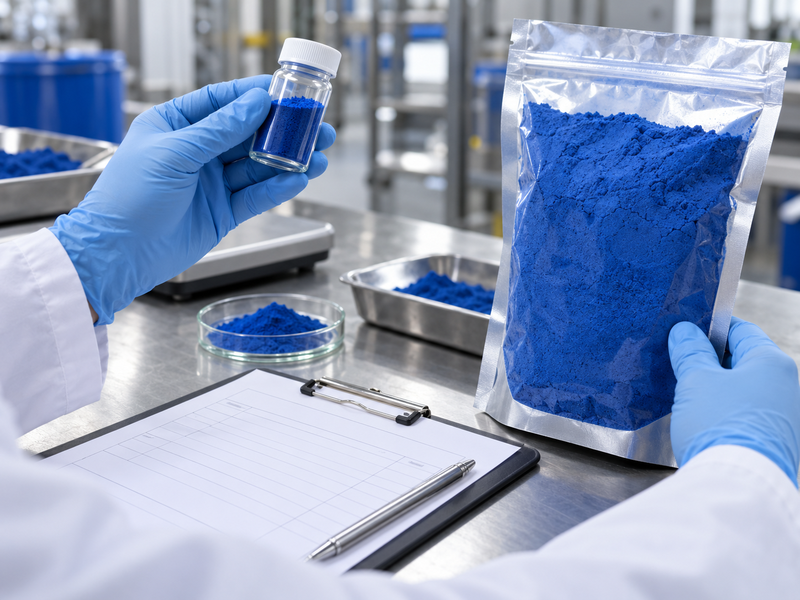
Transfer a sealed extract retain, an approved preblend where stable and practical, a finished-product standard and any known acceptable boundary samples. Label each with source lot, preparation date, storage condition and intended comparison. Photographs may supplement the set but should use consistent lighting and never replace a physical reference. Think about aging: a fresh blue sample and an aged shelf-life sample serve different purposes. State when each was made and whether it represents release or end-of-life appearance.
The co-packer should acknowledge receipt and condition, then store references as instructed. If a sample changes in transit, do not silently use it as an acceptance standard. The site’s sealed-samples guidance supports custody planning. Retain an identical set at the brand or supplier so disagreements can be investigated without relying on memory of an earlier color.
4. How should responsibility be divided?
Write a decision matrix
Name who approves the ingredient, receives and samples it, checks labels, sets line parameters, performs in-process testing, releases finished goods and investigates complaints. A brand may own formula intent while the co-packer owns safe line execution; neither role cancels the other’s need for information. The escalation test: if a received COA shows an out-of-range result one hour before production, who can hold the lot and who can approve an alternative? Write the answer before scheduling the run.
Define who owns destination-market regulatory review, including specific food-category restrictions where applicable. For U.S. products, the current spirulina extract listing gives a jurisdiction-specific starting point; other markets need their own check. Set communication contacts and response times. Make the matrix part of the quality or manufacturing agreement, not an informal email thread. Include named backups for weekend production and an escalation rule when brand approval is unavailable.
Define who may stop the line, who can segregate material and who can authorize rework. A responsibility table is useful only if each person can act during the actual shift. Review it with production, quality and procurement together before the first ingredient arrives.
| Decision | Brand | Co-packer | Supplier |
|---|---|---|---|
| Formula approval | Accountable | Consulted | Informed |
| Incoming release | Informed | Accountable | Provides evidence |
| Line deviation | Approves product impact | Leads containment | Consulted if ingredient-related |
| Complaint review | Leads customer response | Supplies records | Supplies lot data |
5. What processing details need a line walk?
Compare the plant route with the bench route
Walk through weighing, preblending, transfer, tank mixing, any heating, filling, packaging and storage. Record real equipment capacities, minimum batch, hold volumes, surface exposure to light and likely line-stop conditions. Look for a local shock: a small pigment premix poured into concentrated acid or hot syrup may see harsher conditions than the final batch pH or temperature suggests. Agree on an addition point that the line can control safely.
A later addition could protect color but may require a validated hygiene route; do not change it casually. Note whether the co-packer’s scale can measure the intended low dose accurately. The phycocyanin stability review explains why process conditions matter, but the co-packer must verify its own food matrix. Translate the line walk into a revised process flow and sampling map.

6. How should incoming material be released?
Check receipt against the agreed SKU
The co-packer should inspect seals, lot code, quantity, packaging condition and storage evidence, then match COA and label to the approved specification. Define which tests are performed at receipt and which rely on supplier qualification. Do not confuse COA presence with approval: a COA for a different lot, method or carrier cannot release the scheduled material. If a color-value result is near a limit, follow the agreed method and retest rule rather than making an improvised visual judgment. Preserve a sealed retain from the receipt.
The site’s blue spirulina wholesale receiving inspection offers a practical inspection sequence. Record location and conditions between receipt and use. If the brand supplies stock directly, both parties should agree when custody transfers and who bears loss from damaged or mismatched material.
| Receipt check | Acceptance evidence | Hold trigger |
|---|---|---|
| Identity | SKU and lot match | Unknown or substituted item |
| Seal | Intact pack | Damage or exposure |
| Documents | Matching COA and spec | Wrong revision or lot |
| Storage | Required conditions logged | Unexplained excursion |
7. What happens during a first production run?
Run a documented confirmation batch
Agree on batch size, exact ingredient lots, line settings and samples before startup. Record actual extract mass and additions, preblend loss, mixing time, pH, temperature, hold periods, fill start and line stops. Use time-coded sampling: take startup, stable, restart and end-of-run units instead of one composite that hides variation. The brand’s technical representative should know when it must review color before the co-packer continues. Capture rejects and rework in the mass balance.
If the first run differs from the approved lab reference, hold product and compare it under the agreed color method before changing dose. The site’s blue spirulina wholesale sample approval guidance helps separate a sample sign-off from a production release. Keep raw line data, not only a summary certificate, with the transfer record.

8. How should blue color be judged?
Define visual and instrumental checks
Specify sample temperature, container, fill level, background, illuminant and time after processing for release comparison. For clear liquids, examine hue, haze and sediment; for opaque foods, compare surface and cut face. An instrument can quantify movement while trained observers decide whether a visible change matters in context. Avoid the photo trap: a phone image sent across two offices may shift color because of lighting and screen settings. Send physical retained references and use a documented method.
Compare first-run units with the accepted lab product and across run intervals. Evaluate packaged color at relevant storage points as well. The site’s phycocyanin color measurement in food guide can help write a repeatable procedure. A raw extract E-value cannot substitute for finished-food color acceptance.
| Product type | Visual check | Quantitative support |
|---|---|---|
| Clear beverage | Hue, haze, sediment | Defined color method |
| Opaque dessert | Surface and cross-section | Controlled image or CIELAB |
| Coating | Uniformity and streaks | Multiple sample locations |
| Packaged product | Shelf-life appearance | Repeated time points |
Run a joint reference session before the first batch. Brand and co-packer analysts should view the same standard under one lighting setup and perform the same instrument preparation on a common sample. Record any normal observer or method variation before setting an acceptance range. Decide whether a slight hue movement can be handled by documented dose adjustment, or whether it triggers a hold. For products with multiple colors or fruit bases, make separate reference sets because matrix color can change apparent blue.
After production, send each party coded retained units from early and late run intervals and compare judgments before final release. Archive the agreed observations with the batch record so a later dispute has a common reference.
9. How are changes and deviations handled?
Set hold and approval rules before production
List changes that require brand review: extract supplier or carrier, grade, formula, addition point, heat treatment, pack and color-test method. Define a limited range of routine operating adjustments supported by the trial. No silent correction: an operator should not add extra blue extract to rescue a pale tank without a documented decision, because dose, label and uniformity may change. For a deviation, isolate affected intervals, preserve samples, record process readings and notify named contacts. Agree on investigation time and product disposition authority.
The site’s blue spirulina wholesale change-notification framework can support supplier-side controls. If a new line is used, assess whether a fresh pilot is required. Keep revisions synchronized across brand, co-packer and supplier rather than relying on a copied email attachment.

10. What closes the handoff?
Release a controlled manufacturing standard
The brand and co-packer should sign the final packet after the first run demonstrates acceptable ingredient identity, process performance, color uniformity, finished quality and a justified shelf-life plan. Archive deviations and explain whether each was resolved or remains under monitoring. The real proof: a later batch should be reproducible from the controlled documents without asking the original developer how much powder to add or which blue sample to copy. Store physical references under defined conditions and schedule replacement before they age out.
Record the first commercial lot as the baseline for future complaints. Review commercial economics and supply continuity before increasing volume, since an approved color can still fail if the correct SKU is unavailable. Release authority must remain explicit in the signed responsibility matrix. Schedule a brief post-launch review after the first several shipments. Compare complaints, retained samples and color results with the original standard, then update the packet only through joint revision control.
| Handoff output | Evidence | Sign-off |
|---|---|---|
| Formula and SKU | Revision-controlled packet | Brand technical |
| Process | First-run record | Co-packer production |
| Quality | Sample and test results | Both quality teams |
| Supply | Approved order route | Procurement |
FAQ
Q1: Is a bench-approved photo enough for a co-packer? No. Transfer physical references, formula details, method and storage history.
Q2: Who approves a carrier substitution? The brand and co-packer should use their written change-control matrix; substitution needs technical and label review.
Q3: Should the co-packer retest every extract lot? Set testing frequency through supplier qualification, risk and the signed quality agreement.
Q4: Can the co-packer adjust dose during a pale run? Only within an approved procedure with documentation and product-impact review.
Q5: What is the first-run release evidence? Identity match, complete batch record, time-coded color samples, finished tests and agreed disposition.
Next action
Send one controlled packet and sealed reference set, walk the actual line, then schedule a confirmation run with named decision owners. Approve routine production only after both teams sign its evidence.