
Spray dried vs freeze dried spirulina compares two ways to turn wet whole biomass into a shelf-stable ingredient. Buyers may assume one method always preserves more quality, then find that grades differ in color, odor, particle behavior and cost for reasons beyond the dryer.
A better decision uses matched samples, method-specific records and tests in the finished formula. Primary research on processed Spirulina biomass shows that drying can affect phycocyanin extraction; its experimental result cannot predict every commercial powder.
Contents: 1 · 2 · 3 · 4 · 5 · 6 · 7 · 8 · 9 · 10
1. What happens in each drying method?
Identify the product leaving the dryer
Spray drying feeds a pumpable suspension into a chamber, creates droplets and removes water with moving air. Freeze drying freezes material and removes ice under low pressure, usually leaving a porous dry structure that may need milling. Both can produce whole-biomass powders, but the incoming material, additives, residence time and later milling matter.
Start with the specification: confirm whether the offered item is whole spirulina biomass or a formulated extract. The same dryer name can appear on very different products.
Ask the manufacturer for a process outline from wet biomass through pack. Spray drying may involve concentration, atomization, cyclone collection and sieving. Freeze drying may involve tray loading, freezing, vacuum drying, breaking and milling. The FAO review covers harvesting and processing as linked steps.
A buyer should apply that logic to each offer and request a matching batch record. Without a defined input and post-dryer treatment, “spray dried” and “freeze dried” are incomplete product descriptions.
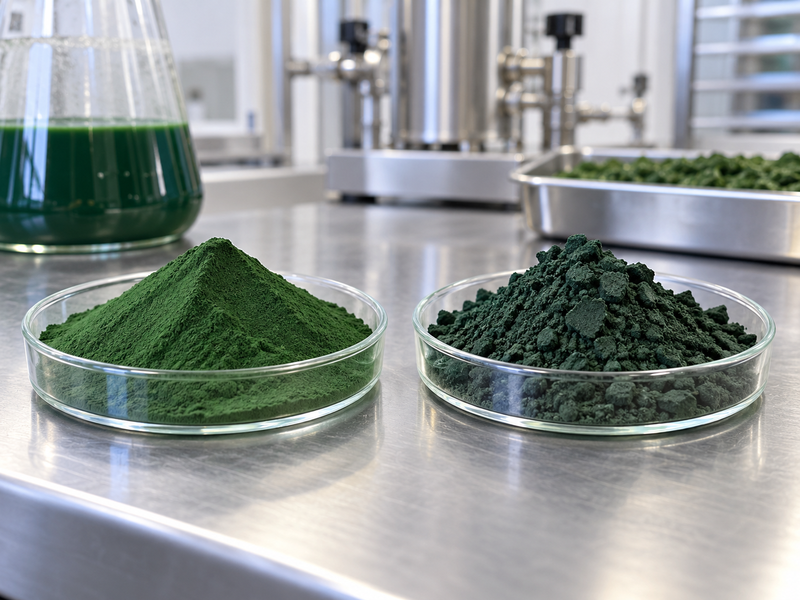
| Stage | Spray drying | Freeze drying |
|---|---|---|
| Feed | Pumpable suspension | Frozen wet biomass |
| Water removal | Heated air and droplets | Sublimation under vacuum |
| Product form | Collected fine particles | Porous cake or pieces |
| Later step | Sieve or blend | Break and often mill |
2. Which method better preserves color and pigments?
Measure the proposed grade
Heat and process history can affect pigments, but dryer type alone does not determine final color. In a 1999 primary study, several biomass processing methods reduced recoverable phycocyanin under that study’s conditions.
More recent work on Refractance Window drying provides another controlled comparison of process and product properties. These studies show why process choices matter without supplying a universal ranking for all suppliers.
Ask for measured color under a named method, plus a retained reference sample. Compare hue after your own process, particularly if your product sees heat, acidity or long storage. Here is the trap: a greener dry powder might not produce the preferred shade after mixing into a bar or pasta. Measure at the same inclusion level and lighting.
If pigment content supports a label or functional claim, request a validated analytical result on the as-sold lot, not a generic “cold processed” statement.
3. How can drying change odor and taste?
Test sensory fit in the intended food
Volatile compounds can form, disappear or become more noticeable during drying and storage. A primary sensomics study identified odor-active compounds at different Spirulina processing stages. Another comparative study of spray and freeze dried Spirulina examined odors from different cultivation environments.
The findings support sensory testing but do not imply that all spray dried powders taste alike or all freeze dried powders avoid marine notes.
Use coded samples and a standard dose in the real formula. Evaluate dry aroma, aroma after hydration and final-product flavor after processing. If the product is a capsule, odor on opening the bottle may matter more than flavor on the tongue.
Let the application decide: the lowest odor sample may not be the best when cost or flow is considered. Ask how the supplier controls oxidation and packaging exposure, since a well-made powder can change during poor storage. Record sample date and pack condition before drawing conclusions about dryer effects.
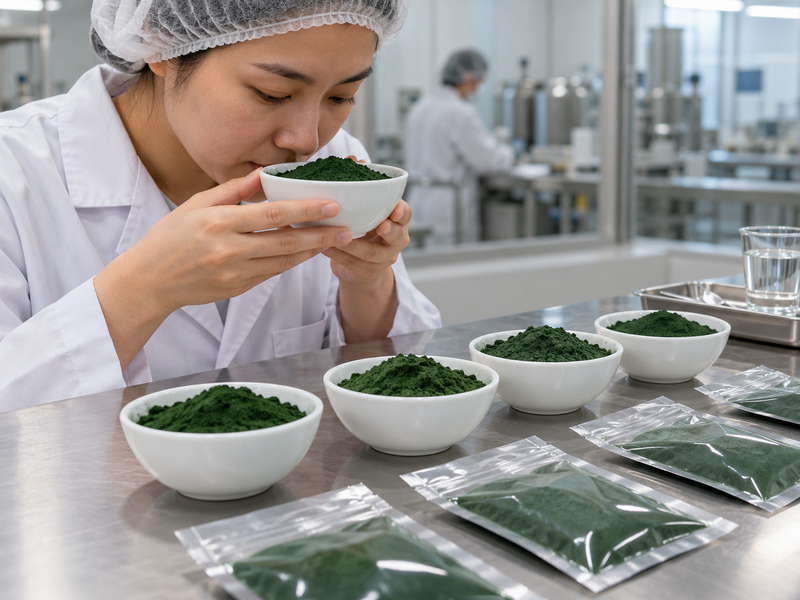
| Sensory check | Sample condition | Business decision |
|---|---|---|
| Dry odor | Freshly opened pack | Receiving acceptability |
| Hydrated aroma | Standard water dose | Preparation experience |
| Formula flavor | Intended process | Product fit |
| Aged sample | Target package | Shelf-life fit |
4. Do the powders disperse and flow the same way?
Distinguish particle structure from species
Spray-dried droplets can form particles with a different size, shape and density from a milled freeze-dried cake. Milling, sieving and agglomeration can alter either grade after drying. Ask for particle-size distribution, bulk density, flow assessment and a dispersibility test relevant to your process.
A quick bench check: add equal masses to the same liquid under the same mixing conditions and record wetting, lumps and sediment at set times.
For dry blends, compare segregation risk and dust. For tablets, compare die filling and compression in a pilot. A 2025 primary study of spray-dried Spirulina formulations evaluated feed and powder properties under research conditions, illustrating that dryer settings and formulation influence particle behavior.
Do not borrow its particle values for an unrelated grade. The supplier’s current specification and your line trial should decide whether either powder works without extra milling or blending aids.
5. How should moisture and water activity be compared?
Ask for both measurements
Moisture is the amount of water measured under a specified method. Water activity describes the availability of water and helps explain stability. The FDA water activity guide explains why drying and storage must manage water activity.
A spray-dried and a freeze-dried sample with similar moisture percentages may have different physical behavior, depending on structure and composition. Use a matched report: ask for actual lot values, methods, sample dates and package conditions.
Also test caking, flow and color during storage. A low reading at packaging does not prove the chosen bag protects the powder through humid transport. Ask the supplier about barrier packaging, seal checks and conditions behind its shelf-life statement. Neither drying method eliminates the need for microbial control.
A low-water-activity ingredient can carry surviving organisms, so receiving and finished-lot microbiology remain part of the food-safety review where appropriate.
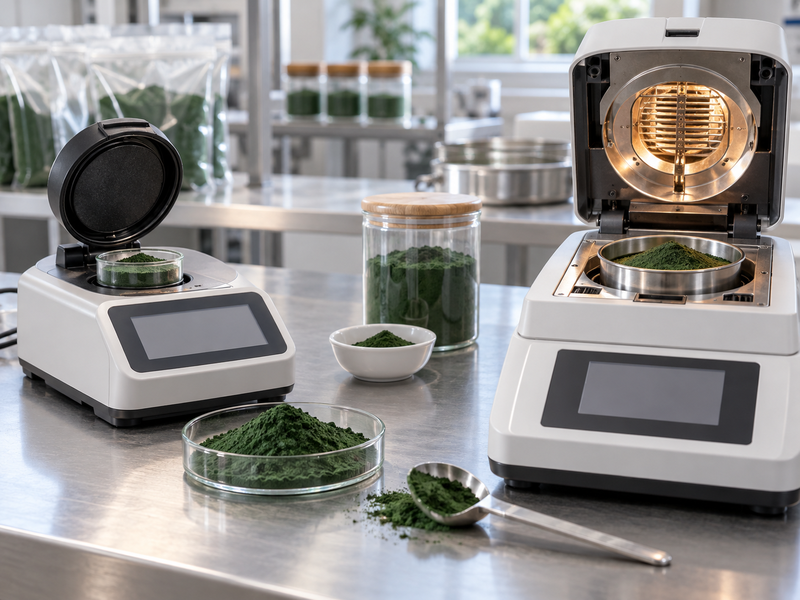
| Test | What it answers | What it cannot answer alone |
|---|---|---|
| Moisture | Water by method | Microbial safety |
| Water activity | Water availability | Absence of pathogens |
| Caking | Handling after storage | Nutrient content |
| Seal check | Package integrity | Initial powder quality |
6. Is freeze drying always a higher-quality option?
Define quality against the purchase brief
Freeze drying often appeals when a buyer wants low-temperature processing and a particular porous texture. Yet it can add cost, require more handling and produce a powder that needs milling. Spray drying may offer high throughput and consistent fine particles, but feed composition and thermal exposure require control. Neither description establishes superior quality without an agreed target.
Make the word specific: quality might mean lower odor, greener color, better blend flow, lower moisture or better cost per finished unit.
Build a weighted scorecard before seeing sales claims. Put safety, legal suitability and identity as gates; then compare performance and economics. Ask for multi-lot data, not only a showcase sample. A study of different drying techniques for Spirulina describes process-dependent powder properties, but the proposed commercial grades still need direct testing. A supplier may use process settings that outperform assumptions drawn from generic labels.
7. What belongs in a fair cost comparison?
Price the accepted ingredient in use
Compare the same product form, contaminant specification, packaging, delivery term and order volume. Freeze drying may have a different energy and capacity profile from spray drying, but current prices vary by facility and grade. Do not cite an unsupported price premium. Ask for a quote and calculate landed cost per kilogram of conforming powder. Then include dose required in the formula, additional milling, reject risk and the impact of shelf life on inventory.
A better example: if one grade is cheaper per kilogram but needs a higher inclusion level for the chosen color, compare cost per finished unit. If a porous powder requires extra blending time or creates waste, include that operational cost. Use the same pilot protocol for both. A short trial can reveal differences that a unit price hides.
Keep financial assumptions in a spreadsheet with dates and currencies so procurement can update them when terms change.
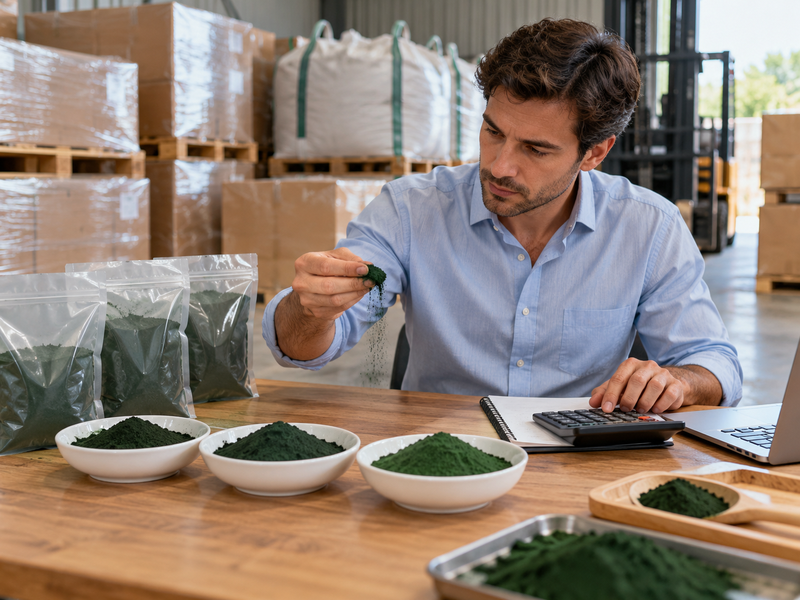
| Cost item | Evidence | Unit to compare |
|---|---|---|
| Ingredient | Current quote | Accepted kilogram |
| Dose | Formula trial | Finished unit |
| Rework | Pilot output | Batch |
| Freight and duty | Delivered terms | Landed kilogram |
8. Which supplier records make drying claims credible?
Ask for process and lot linkage
Request a process flow, dryer identification, lot definition, final moisture and water activity results, color and sensory criteria and actual COA for the sample. The batch record should connect wet-biomass lot to drying run and packaged units. For freeze drying, ask how cake is milled and whether the mill introduces heat or cross-contact. For spray drying, ask whether any carrier or anti-caking agent is added; a whole-biomass specification should disclose formulation changes.
Test the claim: “low-temperature” needs a defined measurement point, and “preserved pigment” needs a named analytical method and actual result. A marketing statement on Spirulina CN should be attributed to the site until current SKU and lot records support it. Avoid repeating supplier claims as measured facts.
When specifications change, require notification and a comparison sample. A drying change can shift performance even if the ingredient name and species stay the same.
9. How should a product trial be designed?
Separate powder screening from formula approval
Start with sealed, representative samples and verify their COAs. Measure dry color, odor, moisture and particle properties. Then make matched pilot batches at the same inclusion level, mixing order and process settings. Record finished color, sensory response, texture, flow and shelf-life behavior. Keep the comparison controlled: changing dose and mixer at the same time makes the drying-method inference weak.
Use a blind review when practical and retain photographs under fixed lighting. If one powder performs better, repeat with another lot before writing a narrow specification. In beverages, monitor sediment after preparation. Snack trials should track color after processing. Tablet trials need fill and compression checks. An attractive sample can fail once scaled up.
Tie acceptance to measurable finished-product criteria and lot-to-lot tolerances. The pilot should answer whether this grade works on this line, not proclaim a universal winner among drying technologies.
Build a small repeatability challenge into the pilot. Ask each supplier for another production lot, ideally made on a different day, and run it against the same formula settings without telling operators which drying route it represents. Compare both lots with the originally approved sample and keep the recorded deviations, even when every result passes.
If a candidate only performs after extra mixing, screening or dose adjustment, calculate that work as part of its cost in use. Request the dryer and post-milling change history between samples; a shift in particle behavior may come from a later process step rather than drying alone.
This exercise turns a favorable single demonstration into evidence that procurement can use for a standing specification and that manufacturing can reproduce during normal scheduling.
| Trial stage | Hold constant | Measure |
|---|---|---|
| Bench | Dose and water | Wetting and sediment |
| Pilot | Recipe and process | Color and sensory fit |
| Storage | Pack and conditions | Caking and drift |
| Repeat lot | Acceptance method | Consistency |
10. When should a buyer choose either method?
Approve a grade, not a drying slogan
Choose when the supplier’s actual lot passes safety and identity gates, its powder fits your manufacturing process and cost per finished unit meets the business case. Record the dryer route and post-drying operations in the approved specification. Require change notification for feed preparation, dryer type, milling, additives or packaging. The closing check: compare the initial commercial lot with the pilot reference before relying on long-term supply.
There may be sound reasons for either route. A brand prioritizing a particular sensory profile may accept higher cost, while a high-volume blend may value reproducible particle flow. Let your trial and batch evidence set the priority.
Drying research can help frame questions, but it cannot substitute for a current COA, a retained sample and a performance test in your own product. Those three pieces turn a process story into a purchasing decision.
FAQ
Q1: Does spray drying destroy all phycocyanin? No. Retention depends on the material and process; test the proposed lot with a defined method.
Q2: Is freeze-dried powder always finer? No. Final size depends on breaking, milling and sieving after drying.
Q3: Can both methods make whole spirulina powder? Yes, provided the product is dried whole biomass rather than a formulated extract.
Q4: Which test matters most for storage? Use moisture and water activity alongside packaging, sensory and microbiological checks.
Q5: What is the fairest price basis? Compare landed cost per accepted ingredient use in the finished product.
Trial both before committing
Request matching lot documents, run both powders in the intended formula and compare performance after storage. Choose the grade whose measured behavior and supply controls fit your product. That decision will stay useful even when dryer claims change.