
The spirulina biomass dewatering process removes liquid from harvested whole Arthrospira before drying. Buyers see a finished powder and may never see how wet biomass was handled, even though this step shapes drying load and hygiene exposure. A useful sourcing review follows measured solids, residence time and sanitation through each transfer. A primary study of Arthrospira harvesting with membranes shows how biomass condition affects separation behavior; no single machine setting applies to every production line.
Contents: 1 · 2 · 3 · 4 · 5 · 6 · 7 · 8 · 9 · 10
1. What is dewatering after spirulina harvest?
Define the wet intermediate
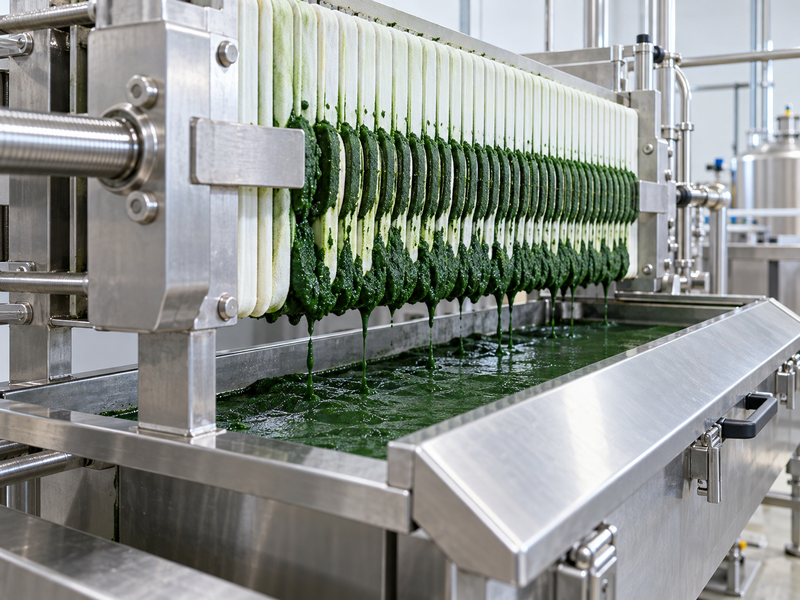
Harvesting captures biomass from culture; dewatering increases its solids concentration before a dryer receives it. The two functions can share equipment or occur in separate stages. A wet cake, paste or concentrated slurry can each be legitimate intermediate forms, but those names lack meaning without a solids measurement. Ask for the actual process flow and define where each stage starts and ends. Begin with a number: what is the dry-solids content of material entering the dryer, and how is it measured?
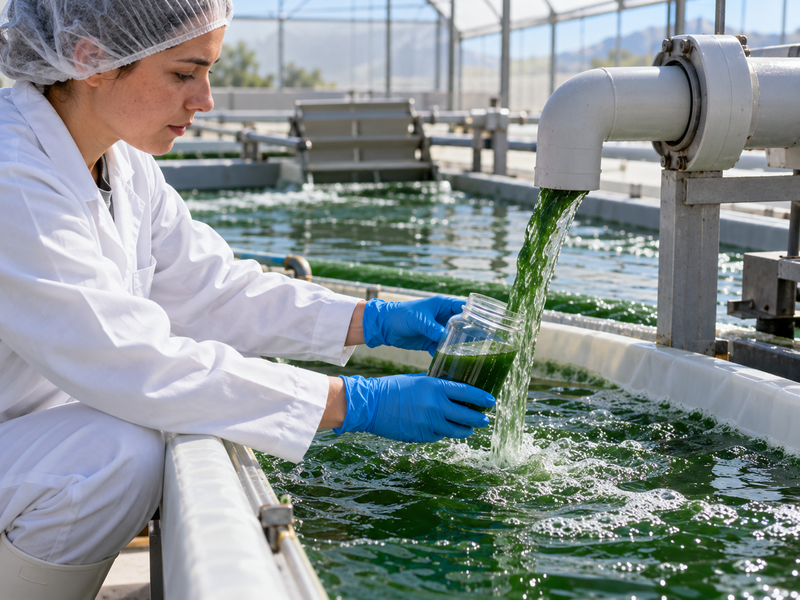
The FAO production review discusses harvesting and processing as a connected sequence. For a buyer, this means dewatering must link back to culture and forward to drying rather than appear as an unlabeled tank in a diagram. Request sample batch records that identify input lot, equipment, output lot, mass and time. If several harvests are mixed, ask how their different ages and solids contents are reconciled before drying. A steady final powder can conceal a variable wet stage until a process problem occurs.
| Intermediate | What to measure | Why it matters |
|---|---|---|
| Harvest slurry | Solids and volume | Starting load |
| Concentrate | Solids and residence time | Next-stage consistency |
| Wet cake | Solids and mass | Drying demand |
| Filtrate | Solids loss and destination | Yield and recycle |
2. Which dewatering methods might a supplier use?
Compare functions, not machine names
Screens and cloth filters can retain filaments while liquid passes through. Belt systems provide continuous separation. Membranes can concentrate a suspension but may foul. Centrifugation may be used for some layouts, although suitability depends on biomass condition and desired output. A study of membrane harvesting examined flux under different Arthrospira suspensions; a separate settling experiment studied gravity concentration. These are options to evaluate, not evidence that one commercial line is superior.
Ask the supplier which operation performs initial capture, which raises solids and whether wash water is added. Equipment capacity, cleaning access and batch size all affect the result. Make the comparison fair: request dry-solids output, loss to filtrate, typical processing time and deviation rules for the actual proposed grade. A machine brochure’s throughput may have been measured with another material. An independent trial with the supplier’s own biomass offers a stronger answer.
3. Why is solids content a more useful measure than wet weight?
Use mass balance on a stated basis
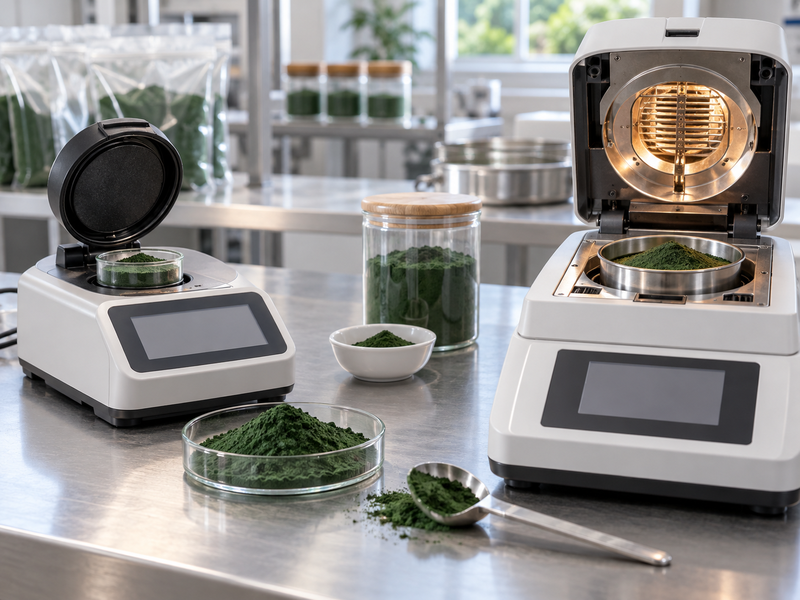
Wet biomass can gain weight simply by retaining more water. That extra mass does not mean more saleable spirulina and will require more drying. Define solids as dry material divided by total wet mass under a stated test method. Check sampling location because a tank can stratify or a belt cake can vary across its width. The purchasing insight: a consistent solids range helps the dryer run consistently and reduces uncertainty in yield estimates.
Ask for individual lot values, not only an average. Pair solids with water activity and moisture in final powder, since those are different measures. A supplier might present a high cake-solids number but then add wash water before drying; the dryer feed value is the more relevant one. Request the mass balance from slurry to wet cake to dry powder, including discarded or reworked material. The numbers should be internally plausible even if the supplier redacts proprietary quantities. That review can identify an undocumented transfer or a weak sampling point.
| Figure | Reporting basis | Misreading to avoid |
|---|---|---|
| Wet cake weight | Total mass | Treating all mass as biomass |
| Dry solids | Defined test | Ignoring sample location |
| Powder yield | Released product | Ignoring rejected batches |
| Filtrate loss | Solids in liquid | Assuming clear means no loss |
4. How does dewatering affect the drying step?
Deliver a predictable feed
The more water a dryer receives per kilogram of solids, the more water it must remove. Feed viscosity, solids distribution and particle condition also influence how material spreads, atomizes or passes through a dryer. A dewatering change can alter color, odor and final moisture even if the drying set points stay unchanged. Ask the supplier how it controls feed solids and what happens when a lot falls outside the validated range. Read the handoff: where does quality approve wet material for drying?
Do not infer exact energy savings from a generic diagram. Equipment, evaporation load and heat recovery differ across plants. A useful buyer comparison measures the finished grade: moisture, water activity, color, sensory profile and physical properties across several lots. Research on different Spirulina drying methods shows that processing can affect phycocyanin recovery, but its experimental outcomes do not predict a supplier’s result without matched samples. The dewatering specification should support the approved dryer, not stand alone.
5. What hygiene risks appear while biomass remains wet?
Set a time and temperature window
Wet biomass offers more opportunity for change than a properly dried, sealed powder. Every collection vessel, pump and hold tank needs a cleaning and status procedure. Ask when the dewatering clock starts, how long paste may remain before drying and how temperature is monitored. A 2026 experimental study of fresh Spirulina biomass evaluated quality and microbiological change at specific storage temperatures. Its findings support controlling holding conditions, not adopting its times as universal factory limits.
Request one routine batch and one delayed batch as examples. In the latter, did the site segregate material and record a disposition? The revealing question: who has authority to stop the line when the dryer is unavailable? A validated maximum hold time only helps if operators know and enforce it. Add transfer hose sanitation, tank cleaning and environmental controls to the review. Finished powder testing is necessary but cannot retrospectively explain every wet-stage deviation.
| Wet-stage control | Evidence | Action after failure |
|---|---|---|
| Start time | Harvest ticket | Correct missing record |
| Temperature | Logged measurement | Hold affected material |
| Tank hygiene | Released cleaning check | Clean and investigate |
| Maximum hold | Validated limit | Assess or reject lot |
6. Does more aggressive separation always help?
Balance concentration with product condition
Higher solids may reduce dryer load, yet more mechanical force, longer filtration or repeated handling can change biomass structure and process time. The Arthrospira membrane study found that suspension condition influenced fouling behavior, a reminder that equipment performance depends on the real culture. Ask the supplier for its operating window and how it detects damage, excessive fines or unexpected changes in filtrate. A sensible decision: optimize the whole route rather than maximizing one solids reading.
Product developers should test the dried output from proposed settings. Compare flow, color, odor, dispersion and any nutrient measure central to the label. If a higher-solids trial needs a longer wet hold or harsher transfer, its apparent process advantage may not survive a finished-product review. Keep the experiment controlled: use comparable biomass, same dryer and documented sampling. A supplier can protect proprietary settings while sharing the resulting quality data and change rationale.
7. How should filtrate, wash water and losses be handled?
Account for every stream
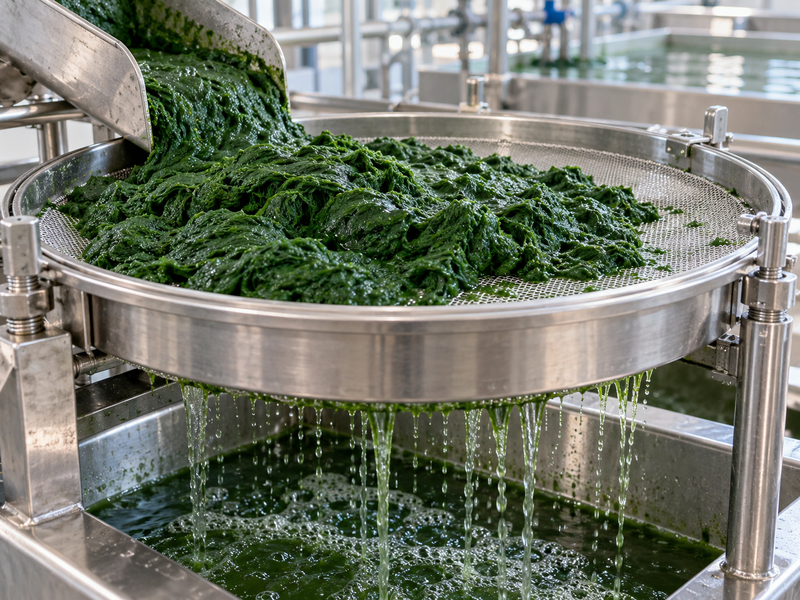
Water removed during dewatering may be discharged, treated or returned to cultivation. Wash water may contact biomass before or after concentration. Ask for each stream’s destination and the rule that determines reuse. A visually clear filtrate can still contain fine biomass or dissolved material; a solids test gives a more useful recovery measure. Follow the liquid: unexplained return lines can hide both yield losses and water-quality risks.
The buyer should request a process map, a representative mass balance and any recycle monitoring summary. If the supplier changes filtration media or water source, review the effect on downstream powder. A review of microalgal mass production discusses separation as a substantial process choice; its general discussion cannot replace facility records. The objective is not to prescribe a universal wastewater solution. It is to verify that food biomass remains separated from uncontrolled streams and that the lot record captures any relevant contact water.
| Stream | Buyer request | Related risk |
|---|---|---|
| Filtrate | Solids and destination | Hidden biomass loss |
| Wash water | Source and quality | Unexpected contact input |
| Recycle | Treatment and approval | Accumulation |
| Waste | Segregation record | Cross-contact |
8. Which records show a controlled dewatering batch?
Link conditions to the finished bag
The record should identify incoming harvest lot, equipment, cleaning release, start and end times, input and output masses, measured solids, wash events and destination dryer batch. If lots are pooled, list all contributing codes. Where a machine stops, capture the duration and disposition of material held inside. Test the trace: take one sealed bag and ask the supplier to show the wet intermediate from which it came.
The finished COA should match that bag’s lot definition. A supplier may test a broader batch or split a dryer run into packaging lots; those boundaries should be explicit. Ask quality staff how they handle a missing solids measurement and whether a product can be released when a dewatering deviation remains open. A neat COA with no batch trail leaves the buyer unable to investigate a later complaint. The right record set is concise but complete enough to explain what happened in production.
9. How can buyers compare two dewatering proposals?
Use a small matched evidence pack
Request comparable product samples, actual lot COAs, wet-solids trends and a process outline from each supplier. Run both grades in the intended formula and packaging route. For a powder blend, assess flow, dust and distribution. For flakes, review breakage and texture. Avoid a false comparison: a vendor’s percent solids and another vendor’s wet-cake weight do not describe the same property.
Score consistency, sanitation evidence, maximum wet hold, change control and delivered price on one basis. The supplier need not disclose every operational secret to show that its process is controlled. Where the Spirulina CN website describes a process or grade, attribute it as a site statement and ask for current batch records before using it in a purchasing decision. An approved sample and an agreed specification should govern commercial delivery.
| Comparison | Common basis | Evidence |
|---|---|---|
| Wet solids | Same definition | Lot trend |
| Hold time | Same start and stop | Timestamp record |
| Hygiene | Same audit criteria | Cleaning verification |
| Finished fit | Same formula | Pilot test |
10. When is a dewatering process ready for qualification?
Approve the route and its outputs
Qualification requires a documented flow, tested solids range, hygiene program, wet-hold rule and culture-to-powder trace. Review several lots and one handled exception. Then confirm the powder works in your manufacturing trial. If the supplier proposes a new press, filter, holding vessel or dryer feed method, treat it as a change requiring comparability data. The decision point: can the site deliver the same physical and safety profile repeatedly under its stated operating controls?
Write the agreed finished specification into the purchase file. Include sample retention, notification of material process changes and a response for off-spec lots. Dewatering may be an internal factory operation, but its consequences appear in color, flow, moisture and supply reliability. A buyer who reviews those connections can choose a grade with evidence rather than with machine descriptions alone.
FAQ
Q1: Is a drier wet cake always better? Not automatically; assess wet hold, handling and finished-powder quality as well as solids.
Q2: Can the same filter harvest and dewater? Yes, depending on equipment design and the supplier’s validated process.
Q3: What does dry-solids percentage exclude? It excludes removable water under the stated test method; it does not measure product safety.
Q4: Should a buyer ask for exact machine settings? The buyer needs validated ranges, actual lot values and change control, though proprietary settings may be summarized.
Q5: What is the main traceability link? Harvest-lot code through wet intermediate and dryer run to sealed finished bags.
Make wet handling part of approval
Ask suppliers for a dewatering map, solids trend, wet-hold example and a matching finished-lot COA. Trial that lot in your product. These steps turn an unseen wet stage into a clear, reviewable manufacturing decision.