
When a greens brand compares spirulina vs wheatgrass, the useful question is what each ingredient contributes at the proposed dose in a real formula. They come from different organisms, have different flavors and pigments, and may create different sourcing and labeling work. Neither can be judged from a per-100-gram marketing panel if the stick pack uses only a fraction of that amount.
This buyer guide sets up a fair comparison: define the product promise, buy representative lots, calculate nutrients per serving, and test color and taste after the intended process. The USDA FoodData Central can provide general food composition context, while commercial label values require suitable ingredient and finished-product evidence.
Contents
- What are buyers actually comparing?
- How should nutrition be compared per serving?
- Which ingredient gives the desired green shade?
- How do the flavor profiles affect formulation?
- What changes with powder format and particle size?
- How should gluten risk be addressed?
- Which quality specifications matter?
- What should a side-by-side trial include?
- How does cost change at finished-product level?
- When is a blend better than either alone?
1. What are buyers actually comparing?
Define ingredient identity before discussing benefits
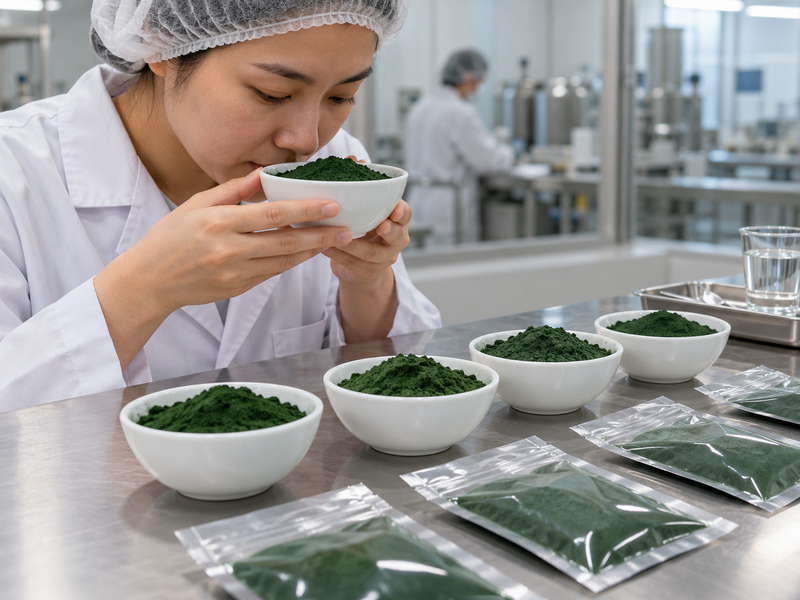
Spirulina powder is dried microalgal biomass sold under the familiar name for Arthrospira material. Wheatgrass is young wheat growth sold as dried grass powder, juice powder or a processed concentrate. Those wheatgrass formats are not interchangeable: drying and juicing change solids, flavor and the concentration of what remains. A comparison must name the exact format, carrier and lot. Ask for current specifications rather than treating a product-category name as a fixed chemical profile.
If a seller says “wheatgrass extract,” learn what was extracted and what was discarded.
Start with a one-sentence product brief. A high-protein supplement, a mild greens drink and a vivid green bakery inclusion will rank the same two ingredients differently. Put intended market, serving mass, allowed flavor impact and color target in the brief. A supplier’s ingredient page may help shortlist options: whole spirulina formats include grades with different particle and sensory targets.
2. How should nutrition be compared per serving?
Translate bulk assays into the formula dose
Request lot-specific protein, iron and other nutrients relevant to the intended claim, using consistent units and methods. The arithmetic is simple but often omitted: a powder with 60 percent protein contributes 0.6 grams of protein at a one-gram dose, before considering analytical and rounding rules. Do the same calculation for the proposed wheatgrass material. If one candidate is a juice powder with a carrier, calculate on the purchased ingredient, not on an idealized fresh grass equivalent.
Ensure moisture basis is consistent, because dry-basis percentages cannot be compared directly with as-sold label values.
Use FDA guidance on nutrition-labeling records when translating formulation data into a US finished-food label. Also consider what is being displaced: a one-gram inclusion may remove one gram of a different nutrient source without changing the declared nutrient appreciably. Record both the ingredient contribution and the full recipe calculation. Claim review should occur only after the serving size and final formula are fixed.
| Comparison | Spirulina powder | Wheatgrass candidate |
|---|---|---|
| Identity | Confirm Arthrospira and additions | Confirm grass, juice or extract format |
| Nutrient basis | Lot assay on as-sold powder | Lot assay including any carrier |
| Formula dose | Calculate grams per serving | Calculate grams per serving |
| Label decision | Review finished food | Review finished food |
3. Which ingredient gives the desired green shade?
Measure the shade in the intended matrix
Spirulina biomass typically creates a dark blue-green appearance in a dry powder and a green to teal impression when dispersed, depending on the matrix. Wheatgrass often gives a grass-like green that can look lighter or more yellow, but format and lot matter. Neither description predicts the result in an acidic lemon drink or opaque oat base. Prepare both at the intended use level and measure Lab* color against a target sample under consistent lighting.
Retain photographs only as supporting evidence; camera settings can change hue and saturation.
Track shade immediately after mixing, after processing and throughout proposed shelf life. Pigments can respond to heat, light, pH and oxygen, so the initial bench appearance is only one checkpoint. An original study on phycocyanin stability demonstrates how temperature and pH can alter a spirulina-derived pigment under controlled conditions; whole biomass and finished formulas still require their own trials. In bakery, compare crumb and surface separately. In beverages, check both liquid color and sediment.
Set an acceptable numerical or reference-standard window before sales and R&D look at the samples, so a preferred shade does not become a moving target.

4. How do the flavor profiles affect formulation?
Test perception at equal finished-product impact
Spirulina can bring savory, marine, mineral or earthy notes; wheatgrass can taste grassy, vegetal or hay-like. These are descriptors for sensory screening, not guarantees for every supplier lot. Evaluate samples blind in the finished base, then repeat after any sweetener, acid or flavor adjustment. A strongly flavored smoothie may tolerate a dose that a clear water beverage cannot. Ask panelists to score aroma, first sip, aftertaste and overall liking separately. One total score hides the reason a candidate fails.
Look for interactions, not just single-ingredient preferences. Citrus can brighten a grassy note but also expose an off-aroma; cocoa can mask green character yet change the product concept. Test a range of inclusion levels and record the dose at which the desired nutrition or color contribution becomes unacceptable. A manufacturer can ask for a milder spirulina grade, but a “low odor” description still needs a paired-lot trial. Shelf-life tasting matters because volatile notes and oxidation can change after filling.
Use the same sensory protocol for both ingredients, with water and the intended product base as separate screens.
| Sensory check | Why it matters | Record |
|---|---|---|
| Dry aroma | Flags obvious lot differences | Blind descriptors |
| First sip | Drives immediate acceptance | Intensity score |
| Aftertaste | Reveals lingering vegetal notes | Time and score |
| Aged product | Tests commercial relevance | Storage condition |
5. What changes with powder format and particle size?
Treat dispersibility as a product attribute
A fine spirulina powder, a larger spirulina flake, whole dried wheatgrass and wheatgrass juice powder can behave very differently in water. Ask for particle-size distribution, bulk density, water activity or moisture and a defined wetting test. The word “instant” is not an analytical method. In a stick pack, powder flow may affect fill weights; a shaker bottle may reveal floating clumps. For a ready-to-drink beverage, settling and ring formation may matter more than rapid initial dispersion.
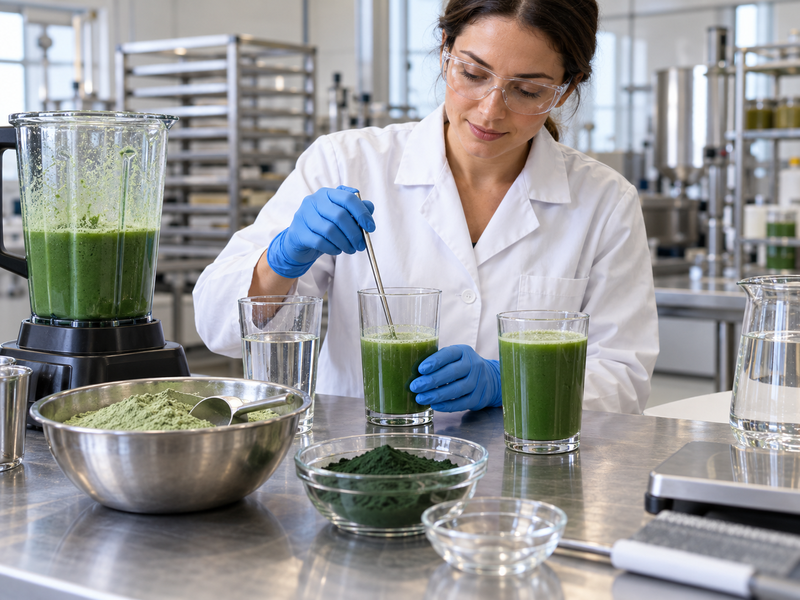
Run a timed protocol using the same liquid temperature, mixing energy, dose and container. Measure clumps after mixing, sediment height after hold and appearance after redispersion. If the base contains protein, minerals or hydrocolloids, test those interactions too. A wheatgrass juice powder may dissolve more readily because it contains fewer insoluble plant solids, but it may also carry a higher cost or added carrier; verify the actual sample. Whole spirulina biomass brings insoluble solids as part of its normal format.
An extraction or filtration step can improve smoothness but changes the ingredient and possibly the label story.
6. How should gluten risk be addressed?
Assess wheatgrass as a commercial ingredient
The word “wheat” in wheatgrass raises an understandable question. The product may be made from young grass rather than wheat grain, but a buyer needs evidence about seed contamination, harvest maturity, processing, shared equipment and the finished formula. Spirulina has no inherent wheat ingredient, yet it too can encounter gluten through shared handling or later formulation. Do not conclude that one ingredient automatically establishes a gluten-free claim while the other automatically prevents it. Both need an assessment appropriate to their supply routes.
For US foods, the FDA gluten-free labeling rule requires qualifying products to meet its ingredient conditions and keep unavoidable gluten below 20 ppm. Ask the wheatgrass supplier how it separates grass from grain or seed and what test method suits its product. Ask both suppliers about shared milling, blending and packing. Then review the finished SKU, including flavors, cereal ingredients and co-packer. Keep claim approval separate from procurement’s preference for a particular green ingredient.
A credible claim needs a traceable decision, not a screenshot of a competitor’s label.
| Risk point | Buyer question | Possible evidence |
|---|---|---|
| Harvest | Could grain or seed enter? | Harvest specification |
| Milling | Is wheat flour handled? | Shared-line assessment |
| Ingredient lot | Was it tested if needed? | Method-linked result |
| Finished blend | What else is present? | Complete formula review |
7. Which quality specifications matter?
Connect the certificate to the intended use
Identity, microbiological criteria, contaminant results, moisture and traceability are important for either powder. Add sensory and color standards when those attributes are part of the product promise. For spirulina, discuss microbial and contaminant testing with the supplier in the context of source water, cultivation and drying. For wheatgrass, ask about agricultural sourcing, harvest and drying. The receiving company’s hazard analysis should decide which hazards need supplier control or verification; do not copy another brand’s certificate limits without checking use and market.
Each specification should name units, method, sampling plan and decision rule. “Deep green” alone is not a release criterion unless a reference sample and viewing conditions are defined. A typical certificate may show a single lot, while marketing material shows a best-case range. Request commercial lot history to understand variability. Use sealed retain samples for production matching. If the chosen material is imported, reconcile the certificate, drum labels and invoice to the same lot code.
The FDA supply-chain guidance helps frame supplier verification when a US facility identifies a supply-chain-controlled hazard.
8. What should a side-by-side trial include?
Run one matrix, several doses and a clear scorecard
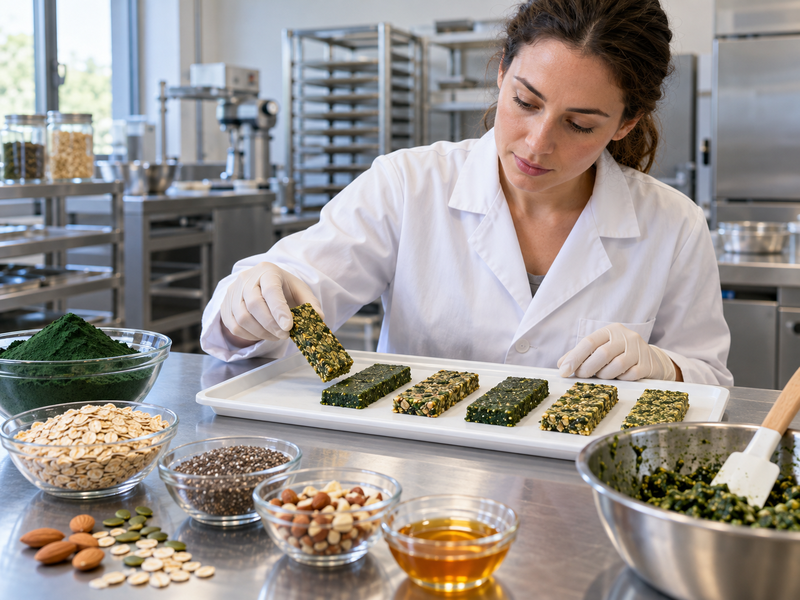
Design a small trial that holds the base recipe, mixer, temperature and packaging constant. Test each ingredient at two or three practical doses, including the intended label dose. Prepare an uncolored control and, if relevant, a mixed-ingredient option. Measure color immediately and after processing; score aroma, flavor, mouthfeel, dispersion and sediment. If the product will be heat treated or acidified, use that process in the trial. A cold bench sample cannot represent a hot-filled beverage or baked bar.
Agree on pass/fail criteria before receiving samples. For example, a green shade might need to fall inside a specified color range, sediment must redisperse within a defined mixing time, and aftertaste must not exceed the approved reference. Capture photos under fixed lighting and preserve physical retains. Use at least two commercial-source lots when possible, since an exceptional lab sample may not describe normal supply. Write the trial report so operations can repeat it during first production.
Do not use a single blind taste preference to overrule a safety or label problem; keep those gates separate in the scorecard.
| Trial metric | Method | Decision use |
|---|---|---|
| Color | Lab* or reference standard | Shade acceptance |
| Sensory | Blind panel with descriptors | Dose ceiling |
| Dispersion | Timed mixing and hold | Format choice |
| Aged sample | Target storage condition | Shelf-life risk |
9. How does cost change at finished-product level?
Compare cost to achieve the same outcome
Price per kilogram is a starting point. Calculate cost per serving at the dose needed to reach the accepted color, flavor and nutrient contribution. Include formulation changes: sweetener, acid, flavor masking, stabilizer or a different package can cost more than the powder difference. Include manufacturing yield and waste if a material bridges in the feeder or requires extra filtration. A more expensive powder may be cheaper at the finished SKU level if it works at a lower dose; the reverse is equally possible.
Supply risk belongs in the economic model. Ask for minimum order quantity, lead time, lot size, secondary source and change-notification terms. A contract based on a particular color reference should specify how future lots will be judged. Freight, customs and testing costs may matter for imported powder. The contact route for grade samples can help obtain comparable spirulina quotations, but the buyer should provide the same application brief to every supplier.
One spreadsheet can then show the cost of a compliant, acceptable serving instead of a misleading raw-material unit price.

10. When is a blend better than either alone?
Use blending to solve a measured gap
Combining the ingredients can create a shade or flavor profile that neither achieves alone. It can also complicate supply, testing and the ingredient statement. Trial a blend only after identifying the gap: for example, spirulina may give the desired depth but too much savory aftertaste at the target dose, while wheatgrass may add a preferred vegetal note. Test several ratios at a fixed total inclusion so the comparison is fair.
Record both ingredient contributions to nutrition; do not count the same nutrient twice or imply a medical benefit from the combination.
A blend adds a second supplier and another chance for lot variation. Decide whether a single-source premix or in-house blending gives better control and traceability. Check compatibility in both dry storage and the prepared product, including caking, segregation and color drift. If the finished product makes a gluten-free claim, review both supply routes and the final process. The best decision may be one ingredient, a deliberate combination or neither if the brief cannot be met at an acceptable cost.
Close the trial with a specification and retain samples, not merely a favored visual mockup.
| Choice | Best reason to select | Main control |
|---|---|---|
| Spirulina alone | Meets target at acceptable dose | Lot color and flavor |
| Wheatgrass alone | Desired grass profile and format | Harvest and identity |
| Combination | Solves a measured tradeoff | Blend ratio and supply |
| Neither | No candidate passes | Revise product brief |
Frequently asked questions
Is spirulina more nutritious than wheatgrass? The answer depends on the actual materials, tested nutrients and doses. Compare the grams contributed to the complete serving instead of headline values per 100 grams.
Will wheatgrass always taste milder? No. Its grassy profile can be prominent, and powder and juice formats differ. Blind trials in the finished base are more useful than category descriptions.
Can both be used in a gluten-free product? Possibly, if the finished product satisfies the applicable rules and cross-contact is controlled. Assess each ingredient and the final manufacturing route.
Which ingredient works better in a beverage? The specific grades, dose, pH, process and shelf life determine the answer. Compare dispersion, sediment, flavor and aged color in the intended beverage.
Should a greens blend include both for marketing? Only if the combination earns its place in the formula and the resulting claims are supportable. An extra ingredient should solve a defined consumer or production need.
Conclusion
For spirulina vs wheatgrass, choose by measured per-serving contribution and finished-product performance. A fair trial controls dose, matrix and process, then weighs nutrition, shade, sensory, gluten controls, supply and true cost together. The resulting specification is more valuable than a broad “superfood” ranking.