
The phrase chlorella vs chlorophyll compares unlike things. Chlorella is an entire microalgal ingredient; chlorophyll is a family of green pigments found in many photosynthetic organisms. A product labeled “chlorophyll” may contain a chlorophyll preparation, a water-soluble derivative or a formulated color blend, each with a different composition and regulatory status. This guide turns the comparison into a procurement decision for tablets, drink powders and foods.
It also keeps nutrition and coloring claims distinct; the FDA’s color-additive overview explains why intended coloring use needs its own regulatory review in the United States.
Contents
- What is the actual ingredient in each quote?
- Which formula goal is driving the purchase?
- How should nutrition be compared?
- How do the color effects differ?
- Which declarations require regulatory review?
- What quality tests belong in the specification?
- How do flavor and texture change the choice?
- What should a fair pilot trial measure?
- How should cost per serving be modeled?
- When might both ingredients belong in one SKU?
1. What is the actual ingredient in each quote?
Ask for identity, composition and process
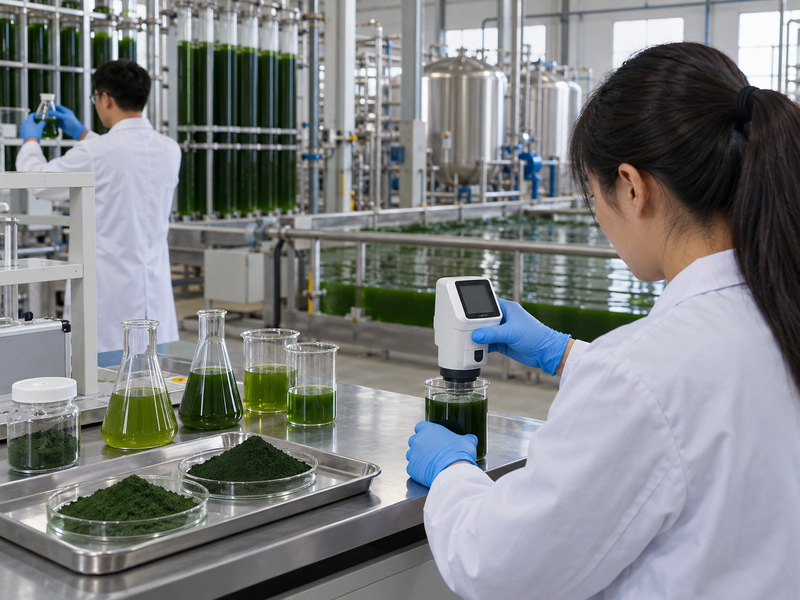
Chlorella powder is dried biomass from a named Chlorella species, often processed to disrupt the cell wall. It contains proteins, lipids, carbohydrates, minerals and several pigments. Chlorophyll is not a species or a single standardized commercial powder. A seller might offer plant-derived chlorophyll, chlorophyllin, or a green color blend with carriers.
Ask whether the quoted material is intended as food, dietary supplement ingredient, or color additive in the destination market. A whole-food biomass can be chosen for its ingredient identity and composition; a concentrated pigment preparation is often chosen to change shade at low dose. The chlorella ingredient portfolio describes whole-biomass formats useful for a shortlist, but each purchase still needs a lot-specific specification. Hold marketing wording until the team has the precise commercial identity.
This first distinction prevents a nutrition calculation from being applied to a purified color that contains little of the original biomass.
2. Which formula goal is driving the purchase?
Write a product brief with measurable endpoints
If the objective is to add an identifiable microalgal ingredient, whole chlorella is the relevant candidate. If the objective is a specific shade without adding much texture or vegetal flavor, a legally suitable color preparation may be more efficient. A greens tablet might need a powder that compresses and contributes measurable nutrients. A clear beverage might prioritize hue, clarity and shelf stability.
Write down the target appearance, maximum flavor impact, serving size, process, storage condition and claim strategy before requesting samples.
Avoid vague goals such as “more chlorophyll benefits.” The team should decide whether chlorophyll content is a measured compositional attribute, a coloring function or a consumer-facing nutrient claim. Those paths need different evidence. A study quantifying chlorophylls in green teas shows that pigment profiles can vary among plant materials; it does not make a finished-product health claim. For a formula, ask what measured contribution the selected ingredient makes at its actual use level.
If the objective is merely visual, do not buy excess biomass and then try to hide its taste without first comparing appropriate approved color options.
| Goal | Likely starting material | Primary evidence |
|---|---|---|
| Named microalgal ingredient | Chlorella biomass | Identity and composition |
| Concentrated green shade | Suitable pigment preparation | Color and legal status |
| Tablet nutrition | Chlorella grade | Dose and finished label |
| Clear beverage color | Application-specific color | Clarity and shelf trial |
3. How should nutrition be compared?
Calculate what reaches one serving
Whole chlorella powder can contribute protein and minerals, but the relevant amount depends on the dose and lot. Ask for as-sold analytical values, not an undated average table. A pigment preparation may contain only a small fraction of the whole-cell nutrients, especially if it is diluted with a carrier or chemically modified. Do not attribute chlorella’s general nutrient profile to that preparation.
Calculate nutrient mass as ingredient grams per serving multiplied by the measured concentration, then compare the result with labeling thresholds and the full recipe. An ingredient present at 100 milligrams may have negligible contribution even when its per-100-gram chart looks impressive.
Use USDA FoodData Central as a reference point for food composition terminology, while requiring supplier data and appropriate finished-product review for declarations. Confirm whether protein is measured by a nitrogen conversion method and whether values are dry basis or as sold. These details can move calculations enough to alter a proposed claim. Keep a separate sheet for color strength; color value is not a nutrient. If the brand wants to mention chlorophyll content, ask for an appropriate analytical method, units, lot range and stability evidence.
The word “chlorophyll” alone is not a therapeutic promise.

4. How do the color effects differ?
Test hue, opacity and persistence separately
Chlorella biomass generally creates an opaque green suspension because it adds particles as well as pigments. A concentrated pigment preparation may achieve a target shade at a lower mass, but its solubility, opacity and stability depend on the exact chemistry and carrier. In a beverage, the biomass may settle or form a ring; in a bakery filling, the particulate effect might be welcome. A green colorant can fade, shift or react with acid and heat.
Do not choose by looking at powders on a white card alone; finished-product matrix matters.
Measure Lab* values in the intended formula immediately after mixing, after processing and during storage. Record the visual reference under fixed illumination as well. A matcha beverage study found relationships between chlorophyll content and measured green color in its own tested tea samples, illustrating why pigment content and hue should be measured rather than assumed. Its results cannot be transferred directly to chlorella or a prepared chlorophyll color.
If a candidate changes from vivid green to olive in an acidic shelf-life test, the response may be a different color system or package, not simply more powder.
| Color parameter | Chlorella biomass | Pigment preparation |
|---|---|---|
| Opacity | Often particulate | Formula-dependent |
| Dose | Nutrition and color linked | Color may need lower mass |
| Settling | Requires evaluation | Depends on carrier |
| Heat and acid | Test finished product | Test finished product |
5. Which declarations require regulatory review?
Classify the ingredient by intended use and market
In the United States, the FDA explains that a substance used to impart color to food generally falls within color-additive requirements unless a specific statutory exception applies. The approval of one color does not grant permission for a different source, use or chemical form. A green material sold as “natural” is not automatically allowed in every food category. Ask regulatory staff to identify the exact listed additive, permitted foods, limitations and labeling name when a concentrated pigment is being used primarily to color.
Also check whether a food standard of identity limits added colors.
Whole chlorella selected as a substantive ingredient brings a different intended-use analysis; it still requires accurate labeling and suitability for the food. Do not try to avoid color rules by renaming a concentrated coloring preparation as “chlorella extract” when its purpose is color. The FDA color-additive summary is a starting index, and the specific regulation controls. Export products need separate destination-market checks.
Keep a legal opinion or regulatory sign-off tied to the exact supplier specification and formulation, not a generic email saying “green algae is allowed.”
6. What quality tests belong in the specification?
Set different release criteria for different materials
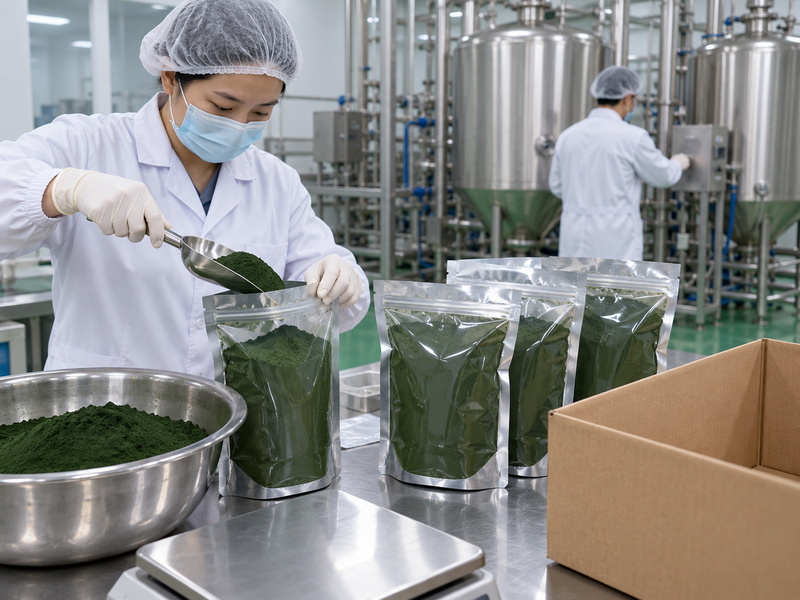
For whole chlorella, specify species identity, moisture, particle distribution, microbiology, contaminants, sensory and any nutrient or pigment marker used in claims. Where cell-wall disruption is sold as a grade feature, define its measurement and decision range. For a chlorophyll preparation, specify exact chemical identity, color strength, carrier, solvent residues where relevant, contaminants, microbiology and the stability parameters that matter in the intended matrix. A test list without methods and units is not a release specification.
The receiving plant should also understand sampling, batch size and retained-sample policy.
The FDA’s supply-chain guidance emphasizes verification matched to identified hazards where US preventive-control requirements apply. A lot certificate is one part of that system. Compare certificate values with agreed limits and investigate a change in facility or carrier even when the printed numbers still pass. Keep a sealed reference sample for appearance and odor. For a color ingredient, test a quick standard application solution or food matrix from every new commercial lot when shade consistency matters.
Release and application suitability should be distinct decisions.
| Specification item | Biomass focus | Pigment focus |
|---|---|---|
| Identity | Species and whole-cell status | Exact pigment form |
| Functional marker | Nutrient and particle data | Color value and hue |
| Safety | Risk-based contaminants | Approved-additive specifications |
| Application | Flavor and flow | Solubility and stability |
7. How do flavor and texture change the choice?
Use sensory data to define a dose ceiling
Chlorella can bring a concentrated green, vegetal or marine flavor and visible particles. The strength changes among lots and products. A pigment preparation may have less biomass flavor at a color-matched dose, although carriers and processing can contribute their own notes. Evaluate both candidates blind in the final base rather than in plain water only. Ask panelists to rate aroma, flavor onset, lingering aftertaste, grittiness and visual appeal.
For a dark chocolate bar, a vegetal note may be absorbed by the recipe; for a delicately flavored water, it may dominate.
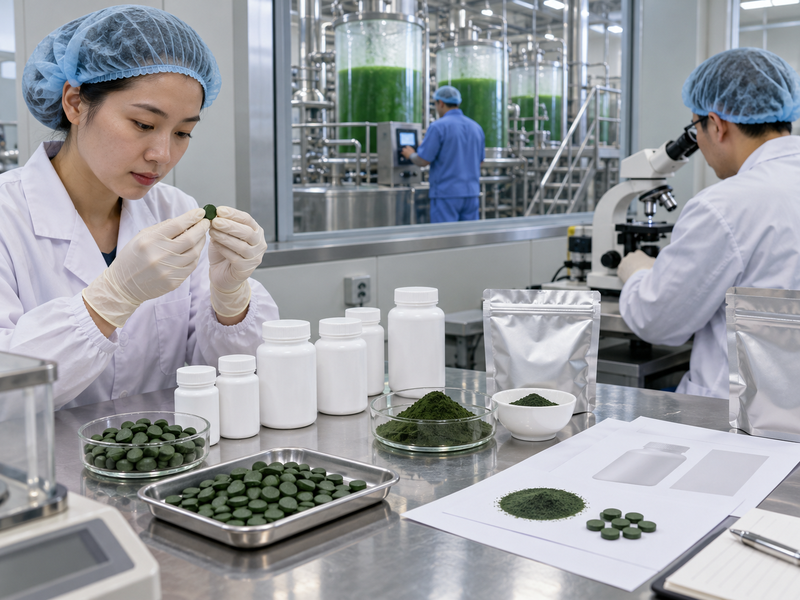
Run at least three doses around the proposed use level. This establishes a sensory ceiling and shows whether the target color is reachable below it. Record mixing energy and hold time because particle texture and sediment often appear after the first minute. In a tablet, flavor matters chiefly during chewing or aftertaste, while powder flow and compression may be more important.
The chlorella sourcing page lists application formats, but acceptability must be verified with the actual commercial grade and finished formula. Do not bury a sensory failure under a health claim that the brand cannot substantiate.
8. What should a fair pilot trial measure?
Compare equivalent business outcomes
Equal grams are usually the wrong comparison because a concentrated color and whole biomass serve different functions. Establish one target shade and test each candidate at the dose needed to reach it, then record how much flavor, texture and cost that dose adds. If the goal is a nutrient contribution, establish a nutrient target and compare only ingredients capable of providing it. Use the same base recipe, processing temperature, pH and packaging for each trial. Include an uncolored control to show the ingredient’s actual contribution.
For beverages, assess wetting, clarity, ring formation, sediment, heat exposure and light exposure. Tablet trials need flow, compression, disintegration and color-uniformity checks. Bakery teams should compare pre-bake and post-bake color. Write the sample protocol before selecting the most attractive beaker. Use at least one commercial lot, not merely a sales sample. Note whether the proposed colorant is legally appropriate for the food in the destination market before spending heavily on a pilot.
The first production trial should have acceptance criteria and a fallback route if the supplier lot differs from the sample.
| Trial output | Practical measurement | Owner |
|---|---|---|
| Shade | Instrument and reference photo | Product development |
| Sensory | Blind panel at matched shade | Sensory lead |
| Process loss | Before and after color | Operations |
| Legal fit | Exact use and declaration | Regulatory |
9. How should cost per serving be modeled?
Include the materials and controls needed to launch
Compare cost at the approved use rate, not price per kilogram. A pigment can be expensive by weight but cheap at a low inclusion; whole chlorella can be valuable when it supports the central ingredient story and measured nutrition. Add costs for flavor masking, stabilizers, milling, filtration, extra testing, freight, minimum orders and waste. If an ingredient darkens unpredictably, a wider quality range can lead to shade adjustment or rejected batches.
Include those expected costs in the model rather than treating them as an R&D surprise.
Record which goal each option satisfies. Buying chlorella to create a “chlorella greens” SKU is not economically equivalent to buying a pigment solely for visual green. A useful model includes ingredient cost per serving, additional formulation cost, process yield, approved label position and supply reliability. Ask the supplier for annual-volume pricing and lot-to-lot color data. A direct sourcing inquiry should describe the target food, serving mass, process and market so the quotation covers a usable grade.
Recalculate when the formula or packaging changes.

10. When might both ingredients belong in one SKU?
Combine functions only when each earns its place
A greens blend may use whole chlorella for ingredient identity and a separate approved color to achieve a repeatable shade. That can be sensible if the biomass dose needed for taste and nutrition does not create the desired appearance. It also adds another specification, supplier, label line and regulatory review. Test whether adjusting the chlorella grade or dose solves the problem before adding a second material.
If color is the only goal, an extra pigment may be the simpler route; if whole-food positioning is central, additional color may conflict with the intended product story.
For a dual-ingredient formula, set separate release decisions for chlorella identity and pigment strength. Validate the mixture under processing and shelf conditions; two green materials do not necessarily produce a predictable combined hue. Check whether one changes the other’s solubility or settling. Review claims at finished-product level, including the precise declaration of the color additive. The final purchasing file should state why both were chosen and what happens if either is unavailable. Without that discipline, “more green” can become an expensive and confusing formula choice.
| Decision | Evidence required | Stop condition |
|---|---|---|
| Chlorella only | Dose meets identity and sensory goal | Unacceptable texture |
| Pigment only | Shade and legal use fit | Missing nutrition story |
| Both | Distinct measured functions | Redundant complexity |
| Reformulate | Neither meets brief | Revise target and retest |
Frequently asked questions
Is chlorophyll the same thing as chlorella? No. Chlorella is a whole organism sold as an ingredient; chlorophyll is a pigment family that can come from different sources and commercial forms.
Does a chlorophyll preparation provide chlorella’s protein? Do not assume so. Ask for its composition and calculate the actual dose; a concentrated color may contribute little whole-biomass nutrition.
Will chlorella color a clear drink? Whole powder may add opacity and sediment. Test the exact grade in the intended drink before promising a clear green appearance.
Can every natural green color be used in US food? No. Intended coloring uses require a specific applicable legal basis and must follow restrictions and declaration rules.
Can a brand use both materials? Yes, when each serves a documented function and the final product passes sensory, quality and regulatory review.
Conclusion
The decision in chlorella vs chlorophyll starts with exact identity. Choose whole chlorella for a measured biomass contribution, or evaluate an appropriate pigment when the aim is color. Compare each route at its functional dose, then confirm quality, sensory performance, cost and market-specific legality before launch.