
Is spirulina gluten free? A finished-product claim depends on ingredients and manufacturing controls. Pure spirulina biomass is not a wheat, rye or barley ingredient. That simple observation does not, by itself, establish that a commercial powder or a finished greens product qualifies for a gluten-free label. An importer may buy spirulina through a repacker; a blender may handle wheatgrass and barley grass; a beverage brand may add a malt-based flavor. Each handoff changes the evidence needed.
In the United States, the FDA gluten-free labeling rule and guidance place responsibility for compliance on the finished-food manufacturer.
Contents
- Is pure spirulina inherently free of gluten grains?
- Where can gluten enter a spirulina supply chain?
- What does a US gluten-free claim actually require?
- Which supplier records should a buyer request?
- When is ingredient testing useful?
- How should a shared packing line be assessed?
- What changes for tablets and flavored blends?
- How should an importer qualify overseas lots?
- How can a team write careful consumer copy?
- What is the final release checklist?
1. Is pure spirulina inherently free of gluten grains?
Separate biological identity from commercial assurance
Spirulina is the commercial name commonly used for dried Arthrospira biomass. A single-ingredient powder made only from this material does not contain wheat, rye or barley as an intentional ingredient. The identity statement on a technical sheet should name the organism and list any carriers, processing aids or standardization ingredients. Do not infer purity from a front-panel photograph of a green powder.
For procurement, ask the supplier to identify the actual manufacturing and packing sites, since the route after drying can matter as much as cultivation.
The FDA’s rule allows a gluten-free claim on inherently gluten-free foods when the other conditions of the rule are met, including a limit on unavoidable gluten in the finished food. That is a claim about the product placed on the market, not a permanent property of an ingredient category. A brand can accurately describe the composition of an approved spirulina ingredient yet still need to investigate a co-packer’s shared mixer or a flavor system.
Start with a bill of materials and a process map rather than a supplier’s marketing claim.

2. Where can gluten enter a spirulina supply chain?
Map the points of physical contact
Cross-contact can occur when equipment, utensils, air handling, containers or staff practices allow residues from gluten-containing ingredients to reach spirulina. The cultivation pond is only one stage. Review harvest, drying, milling, sieving, blending, drum filling, warehousing, repacking and final manufacture. Ask which steps are dedicated and which are shared, and identify the previous products on shared equipment.
The FDA’s gluten labeling guidance states that cross-contact can defeat a gluten-free claim even for a food whose ingredients are inherently gluten free. Build a simple material-flow diagram: receiving door, storage location, transfer equipment, open handling, rework and packing line. Note the controls at each point. A well-managed shared line can sometimes be suitable, but a declaration without cleaning records, scheduling and verification is weak evidence.
Investigate any change in facility, line or subcontractor before accepting the next lot under the same approval.
| Supply stage | Evidence to request | Specific question |
|---|---|---|
| Milling or sieving | Line map and cleaning procedure | What ran immediately before this lot? |
| Packing | Container and liner specification | Is filling dedicated or shared? |
| Warehousing | Segregation and spill procedure | Can open wheat powders reach this stock? |
| Repacking | Subcontractor identity and controls | Who verifies the final packed lot? |
3. What does a US gluten-free claim actually require?
Apply the rule to the food that consumers buy
For US foods under FDA jurisdiction, “gluten-free,” “free of gluten,” “without gluten” and “no gluten” carry the rule’s conditions. The food cannot contain a prohibited gluten-grain ingredient, and unavoidable gluten must be below 20 parts per million. The FDA explains that this is a concentration limit, not a promise of absolute zero. A manufacturer is responsible for a truthful, compliant label; the agency does not require a particular universal testing schedule.
Testing, supplier records and process controls are tools for meeting that responsibility, not substitute definitions of the claim.
Check the destination jurisdiction separately. Ask regulatory staff to confirm the applicable definition and declaration requirements for the actual SKU. For US use, a 19 ppm result on one incoming sample does not guarantee all future lots or the finished food remain compliant. Conversely, a single non-detect result has meaning only alongside its method and reporting limit.
Use a documented decision rule that includes ingredient review, cross-contact assessment and representative verification appropriate to risk.
4. Which supplier records should a buyer request?
Build an evidence packet that can survive a supplier change
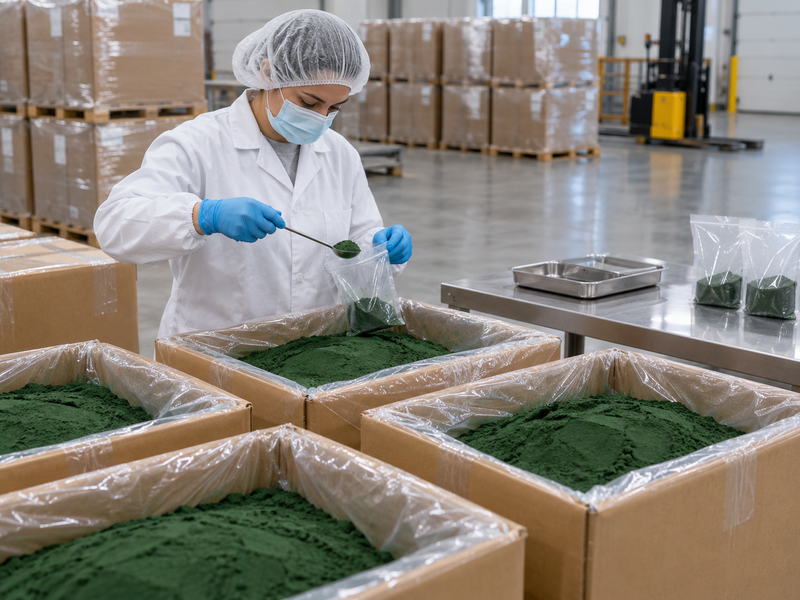
Request an ingredient statement, manufacturing flow chart, site addresses, allergen and gluten cross-contact questionnaire, cleaning controls for shared equipment, a current specification and representative lot certificates. Ask whether the product is ever mixed with carriers, maltodextrin, flavors or anti-caking agents; any such additions require their own ingredient review. Establish how the supplier tracks each commercial lot to a production day and packing line. A signed statement is useful, but its scope and date must be clear.
A statement covering a cultivation site does not necessarily cover a later repacker.
For whole spirulina grades, request the grade’s exact composition and sample matching; ask the OEM and packing team whether the proposed pack format changes the handling route. Match all documents to one item code and approved revision. If a distributor supplies the powder, document the underlying manufacturer and any transfer or repacking steps.
Put change notification into the purchase agreement: new line, new shared ingredients, altered sanitation, new carrier or a new subcontractor should trigger review before the next purchase order.
| Document | What it should identify | Review trigger |
|---|---|---|
| Composition declaration | Organism and every added material | New formulation or carrier |
| Process flow | Open handling and packing sites | New line or contractor |
| Cross-contact assessment | Shared gluten materials and controls | New neighboring product |
| Lot certificate | Lot number, method and result | Every received lot if specified |
5. When is ingredient testing useful?
Choose a method for the material and decision
Testing helps verify a risk assessment, especially after a supplier change or where shared equipment presents a plausible route. Define the purpose before ordering a test: qualifying a site, checking a commercial lot, validating cleaning, or confirming a finished-food claim. The laboratory should know whether it is testing plain dried biomass, a tablet, a fermented ingredient or a complex food matrix. Obtain the method, detection and quantitation limits, sampling plan and result units.
The FDA notes that its gluten-free rule does not mandate testing and recommends scientifically valid methods when a firm elects to test. It also explains why hydrolyzed or fermented foods need a records-based approach: available methods may not adequately detect and quantify gluten after such processing. Ordinary spirulina powder is usually tested as a non-hydrolyzed matrix, but a finished formula can be more complicated.
Agree whether the supplier or buyer takes retained samples, how many packages represent a lot, and how an out-of-specification finding is investigated. Never average a positive hotspot away by retesting only a convenient clean sample.

6. How should a shared packing line be assessed?
Examine controls under normal production pressure
Ask the packer for its product-family list, scheduling policy, validated cleaning instructions and verification records. Are gluten-containing powders handled as open material on the same line? Can operators remove and clean augers, gaskets and hoppers where dust collects? How are brushes and scoops stored? What happens when there is a spill or an unplanned product changeover? The question is not simply whether the site has a gluten-free certificate; it is whether this product’s route is covered by effective controls.
The buying team should examine a realistic worst case: a gluten-containing blend followed by a spirulina run after the shortest approved changeover. Review how the packer validates that cleaning removes relevant residues and how it verifies routine execution. A visual inspection is useful but cannot alone prove the absence of small gluten residues. Include rework and returned material in the assessment. If the plant cannot explain the material flow, request a different line or another packer.
Record the decision and reassess when volumes, products or equipment change. Site controls also need to keep correct labels and lot codes attached to the right product.
| Control | Strong evidence | Weak evidence |
|---|---|---|
| Scheduling | Recorded sequence and changeover | Verbal “we run it separately” |
| Cleaning | Written procedure and completed logs | Undated general policy |
| Verification | Matrix-appropriate checks | One old generic test |
| Rework | Traceable, restricted use | Unidentified green powder bins |
7. What changes for tablets and flavored blends?
Rebuild the assessment from the complete formula
A pure spirulina tablet can contain binders, coatings, lubricants or anti-caking ingredients. A flavored greens drink can contain cereal extracts, malt flavor, cookie inclusions or vitamins carried on complex excipients. Review every sub-ingredient and processing aid, not only the largest line in the ingredient statement. Ask each supplier about its own cross-contact controls. A finished SKU made with a compliant spirulina powder can fail because of a different component or a shared final blender.
For tablets, check the granulation route, coating line and contract packer. Powder products also need a review of premix creation and shared ribbon blenders. Ready-to-drink products bring flavor houses and the beverage plant’s batching system into scope. Create a second, finished-product hazard and claim assessment after the bill of materials is frozen. The FDA’s answers on gluten-free labeling make clear that the finished food must satisfy the definition. A supplier declaration about one component cannot approve a multi-ingredient claim.
8. How should an importer qualify overseas lots?
Tie documentation to actual shipment identity
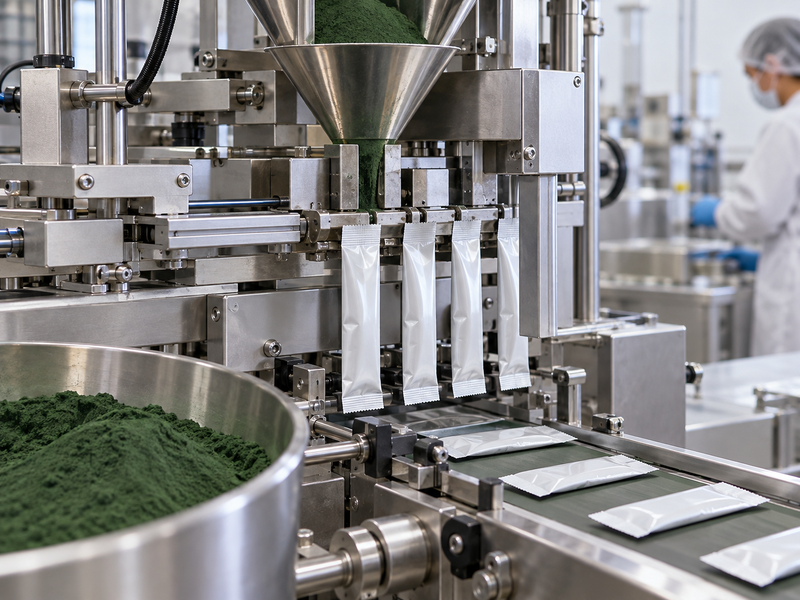
An importer should identify the legal manufacturer, factory address, export packer, trader and any consolidation warehouse. Request the exact lot code on the commercial invoice, cartons, certificate of analysis and retained sample. For each shipment, inspect seals and liners, reconcile package counts and confirm that the approved production route was used.
Preserve samples according to a defined retention plan; they may be needed if a customer reports a problem months later.
US importers and receiving manufacturers may also have distinct food-safety obligations. The FDA’s explanation of supply-chain and importer programs is useful when assigning those responsibilities. Do not assume a gluten-free claim is satisfied merely because a shipment cleared customs. Ask whether the lot was repacked after the original certificate was issued, and whether a new test or process statement is needed for that step.
Where a brand uses a domestic contract manufacturer, include that plant’s receiving and line controls in the same approval file.
| Shipment checkpoint | Match against | Action if inconsistent |
|---|---|---|
| Factory name | Approved source record | Hold and investigate |
| Lot code | Drum, invoice and certificate | Reconcile before use |
| Packed quantity | Purchase order and receipt | Check missing or mixed units |
| Route changes | Change-notification agreement | Requalify affected controls |
9. How can a team write careful consumer copy?
Make the claim fit the evidence and jurisdiction
“Spirulina contains no gluten grains as an ingredient” describes a well-defined pure powder when the composition record supports it. “Gluten-free” on a finished US food invokes the FDA rule and should be supported by the entire product file. Avoid saying “safe for everyone with celiac disease” or “zero gluten”; such statements overpromise and obscure the role of manufacturing controls. If a brand uses third-party certification, identify the certified product and certifier accurately rather than implying every product from the supplier shares that status.
Marketing should work from the same approved SKU, specification revision and lot route as quality. Keep claims on websites, marketplace listings, sales sheets and packages aligned. A powder purchased as spirulina biomass may later enter a blend made at a different site; copying the raw-ingredient statement to the new product page would skip the finished-formula review. Have regulatory staff approve an exact claim text and destination market, then log any material or site changes that reopen it.
Consumer questions can be answered plainly: the label claim refers to the product as sold under the applicable rule and backed by the maker’s controls.

10. What is the final release checklist?
Close the loop at both ingredient and SKU level
Release should begin with an approved supplier and item code, then verify that the received lot follows the qualified route. Confirm composition, package integrity, lot identity, current certificate, required testing and any open deviation. Review finished-product ingredients and site controls separately. If any part of the chain changes, pause the claim decision and decide what evidence must be refreshed.
Give quality authority over material release, product development over formula suitability and regulatory staff over the exact label claim. Keep a decision record that names the relevant market and product version. That record should include why testing was or was not selected, since the FDA does not mandate a single test protocol. Revisit the file at a defined interval and whenever the supplier, process, formula or packer changes.
The goal is an auditable decision that a new team member can reconstruct, rather than a pile of unrelated declarations. For sourcing questions, the supplier contact page can be used to request the specific grade and production-route documents needed for evaluation.
| Final gate | Owner | Minimum record |
|---|---|---|
| Ingredient identity | Procurement and quality | Approved composition and source |
| Cross-contact controls | Quality | Route assessment and verification |
| Finished formula | Product development | Current bill of materials |
| Label claim | Regulatory | Market-specific sign-off |
Frequently asked questions
Is all spirulina naturally gluten free? Pure Arthrospira biomass contains no intentional wheat, rye or barley. A commercial powder still needs its added ingredients and manufacturing route checked before a label claim is made.
Does a non-detect gluten result prove every lot is gluten free? No. It describes the tested sample under a particular method and reporting limit. Sampling, process controls and changes in production determine how much confidence it provides.
Is gluten testing mandatory under the US FDA rule? The FDA does not require a specified test to make the claim. Manufacturers must ensure the finished food complies and may use appropriate testing, records and controls.
Can a wheatgrass blend be labeled gluten free? It depends on ingredient sourcing, processing and the finished food’s compliance in its market. The name of one component is not a substitute for a complete assessment.
Should a supplier’s certificate be copied onto a finished label? No. The brand must review all ingredients and the final manufacturing route before approving finished-product wording.
Conclusion
The practical answer to is spirulina gluten free is yes for the identity of pure biomass, with a separate proof obligation for every commercial powder and finished SKU. Map the route, evaluate cross-contact, request lot-linked records and make the label decision under the destination market’s rules. That creates a defensible claim without promising more than the evidence shows.