
Spirulina tablets vs capsules for brands is a practical launch decision, not a contest with one winner. A format can look economical on a price sheet yet demand an awkward daily count or produce high reject rates. Choose with a defined serving, named ingredient lot, packaging concept and pilot results. FDA’s dietary supplement manufacturing guidance provides a useful documentation frame for US products; other markets need their own review.
Contents: 1 · 2 · 3 · 4 · 5 · 6 · 7 · 8 · 9 · 10
1. What dose must each format actually deliver?
Start with the intended serving
Put the proposed daily spirulina amount on a worksheet before requesting either format. Divide that amount by a realistic count of units per serving and work backward to target ingredient mass per tablet or capsule. A small capsule may be attractive in a photo but might require several units once actual powder density and headspace are measured. A very large tablet can reduce count while creating a swallowing objection. Both are product decisions that need trial units, not catalogue dimensions alone.
Ask a contract manufacturer for filled or compressed samples with the same approved ingredient lot. Weigh units, record actual spirulina content after allowances for excipients and compare the proposed labeled serving. For US supplements, FDA explains that serving size follows the maximum amount recommended per eating occasion on the label, with a tablet or capsule as a unit when directions are absent (FDA labeling guide). The practical test: can customers follow the directions without an unwieldy unit count?

2. How do tablets and capsules change ingredient lists?
Account for every non-spirulina component
A tablet may need a binder, flow aid, lubricant or disintegrant to run reliably. A capsule adds a shell and may also need a flow aid or filler. Neither format is inherently free of other ingredients. Have the manufacturer give a quantitative formulation, not a marketing phrase such as “pure spirulina.” Document the source and function of each component, including shell material, color and any coating. A vegetarian claim needs the actual shell specification and applicable market review.
Compare ingredient mass on a finished-unit basis. A 500 mg unit does not automatically contain 500 mg of spirulina when shell or tableting aids contribute mass. Request both target and measured fill or tablet weight, plus the intended declared amount per serving. Review component identity and contamination specifications under the applicable quality system. US 21 CFR Part 111 requires component and finished-product specifications for dietary supplements. The useful question: what does each ingredient do, and what happens if it is removed?
| Format component | Ask for | Decision effect |
|---|---|---|
| Spirulina biomass | Lot COA and identity | Same base for comparison |
| Tablet aids | Formula and function | Label and process fit |
| Capsule shell | Material and supplier specification | Diet, moisture and label fit |
| Coating or color | Full composition | Claim and appearance review |
3. Which format fits the proposed production line?
Compare actual process routes
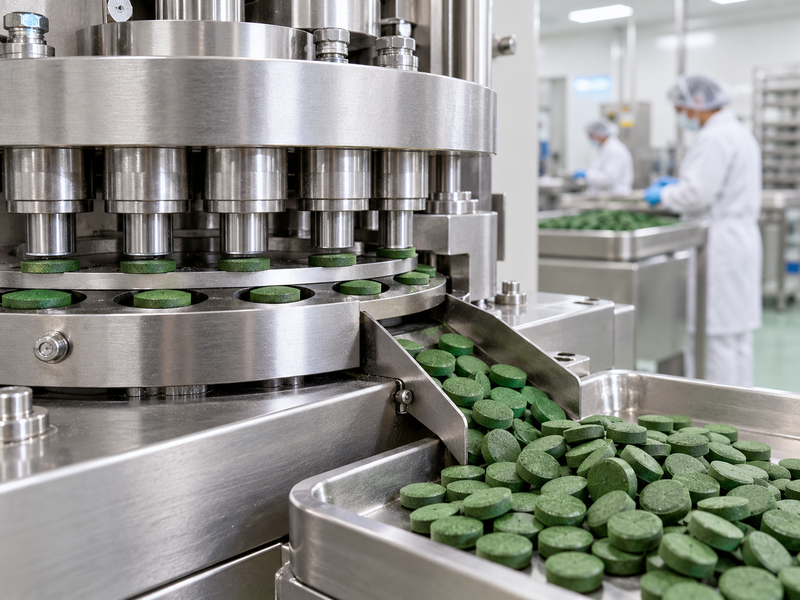
Tablet production involves blending and die filling, followed by compression and often dedusting or coating. Capsule production involves blending, shell feeding, filling, closing and inspection. For some powders, direct compression works. Others need granulation or formulation changes. A research paper on spirulina-containing food tablets measured hardness, friability and disintegration; it supports testing those properties, not assuming one formula will transfer to another factory.
Ask the manufacturer for a pilot run at a rate representative of the proposed line. Record stops, material loss, dust, rejected units and cleaning effort. A capsule that fills smoothly in a hand jig may bridge in a high-speed hopper. A tablet that looks sound from a single punch can laminate during scale-up. Compare qualified production routes, not theoretical equipment capacity. Where brands lose time: they approve an appearance sample before the manufacturer proves that the formulation runs within agreed in-process limits.
4. What should buyers measure beyond unit weight?
Build a format-specific release sheet
Both formats need ingredient identity, composition and contamination controls. Tablets then need mechanical checks suited to their use: appearance, weight variation, breaking force, abrasion or friability and a relevant disintegration method. Capsules need fill-weight distribution, intact seams, shell condition and a relevant disintegration method. Select limits with the manufacturer and target market rather than copying a medicine standard without context. A pass on average weight does not show that every individual unit contains an acceptable amount.
Define sample timing during the run, especially at startup, after stops and near the end of a lot. Pair unit measurements with blend and process records. If spirulina content is inferred from mass, show why the blend is sufficiently uniform; otherwise choose an appropriate analytical check. Quality staff should approve the sampling and disposition plan. FDA’s Part 111 guidance describes master records, batch records and in-process controls for US supplements. One useful rule: test the failure modes that each format actually creates.
| Check | Tablet emphasis | Capsule emphasis |
|---|---|---|
| Unit mass | Die fill stability | Net fill stability |
| Physical integrity | Chips and abrasion | Split or unclosed shells |
| Use behavior | Disintegration | Disintegration and shell response |
| Batch evidence | Press settings and rejects | Filling settings and rejects |
5. How does powder behavior affect either choice?
Measure the commercial lot
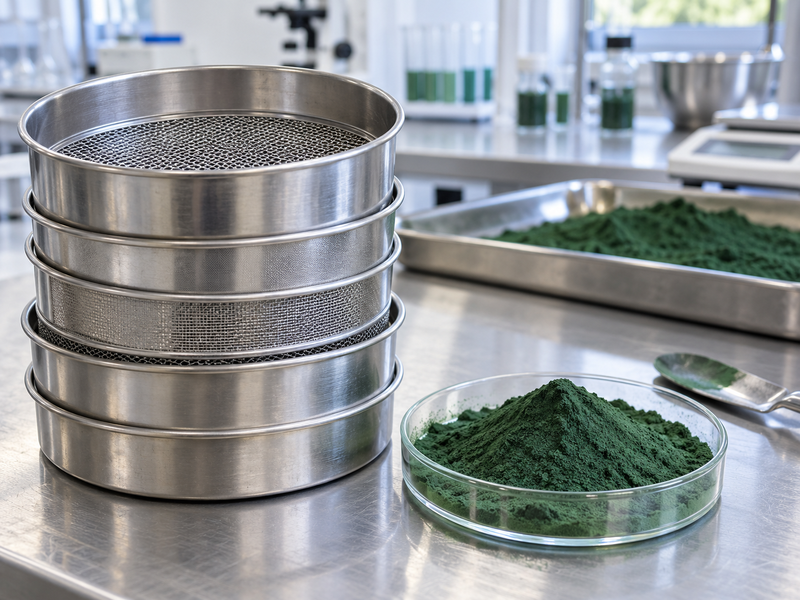
The same green powder can behave differently after milling, drying or a change of harvest lot. Particle size, bulk density, cohesiveness and moisture influence both die fill and capsule fill. Measure with stated methods, and compare several incoming lots before locking a formulation. USP’s bulk and tapped density chapter notice underlines why a named method matters when density numbers are exchanged.
Keep a retained sample from the approved trial. During pilot work, record powder flow, hopper level, dust accumulation and weight drift across time. Do not solve a low capsule fill by merely tamping harder without checking shell deformation and weight spread. Do not solve weak tablets by increasing force without checking disintegration and defects. If the supplier proposes a new mesh grade, treat it as a material change and repeat the comparison. A useful handoff: give procurement a powder specification tied to demonstrated machine performance, not an isolated “fine powder” description.
6. Which package suits each product?
Test the finished unit in its retail pack
Bottle, blister and sachet decisions interact with unit strength and moisture exposure. A brittle tablet can shed dust in a large bottle during shipping. Capsules may show shell changes under an unsuitable humidity profile. Count, headspace, desiccant choice, seal integrity and opening frequency all matter. Request stability samples in the intended commercial package, including transport exposure where distribution could be rough. Treat packaging selection as part of product design rather than a late artwork step.
Set observable endpoints: appearance, unit integrity, odor, moisture-related changes and any declared composition marker that matters for the label. Compare a control retain and packed units over the intended shelf-life study. Do not borrow another brand’s shelf-life period. A manufacturer can propose a study protocol, but your brand must approve conditions and acceptance limits for the destination market. The key comparison: estimate cost per usable labeled serving after breakage and rejects, not merely container price.
| Pack choice | Tablet question | Capsule question |
|---|---|---|
| Bottle | Does transport create chips? | Are shells stable after repeated opening? |
| Blister | Can tooling protect edges? | Does cavity fit the capsule? |
| Desiccant | Is it justified by data? | Does humidity control suit the shell? |
| Count | What is the daily pill burden? | What is the daily capsule burden? |
7. What experience will the end user notice?
Use a realistic home-use trial
Visual appeal alone is a weak format decision. Ask a small, relevant user panel to handle the proposed daily serving in the planned package. Have participants comment separately on unit size, mouthfeel, odor on opening, swallowing comfort and whether directions make sense. A capsule can hide direct taste yet carry a shell preference. A tablet can avoid a shell yet leave powdery residue or require several swallows. Avoid medical claims from a preference study.
Observe actual behavior rather than asking only which format sounds better. Participants may say they prefer a capsule while struggling with a high unit count. A person might like a small tablet but dislike dust left in a bottle. Provide an option to report difficulty rather than pushing a favorable score. Record the panel’s composition and limitations so marketing cannot turn a narrow internal test into a population claim. What to take forward: a format should meet dosage, manufacturing and user expectations at once.
8. How should brands compare real costs?
Price the serving and its losses
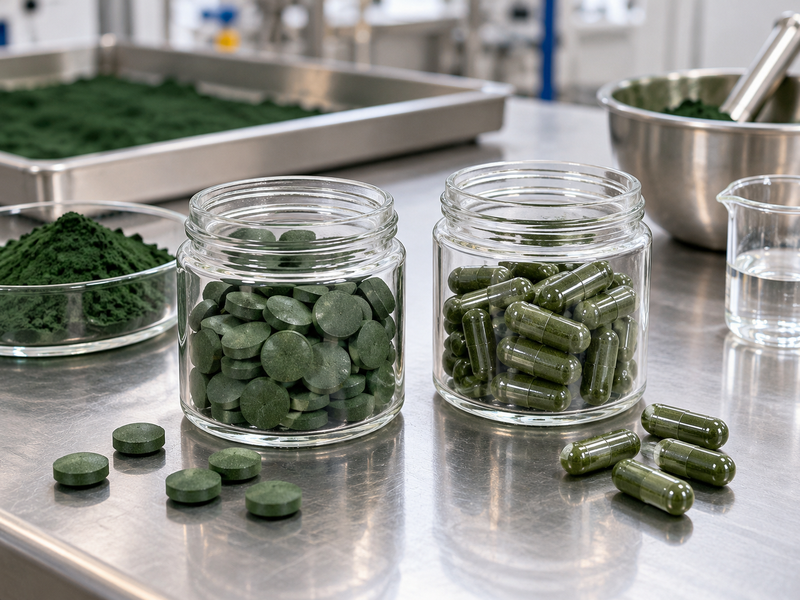
Ask for a cost model with ingredient, excipients, shells, processing, line setup, quality testing, pack, rejects and freight. Tablet tooling and capsule shell supply can change the economics. So can minimum run size and packaging speed. Request a quote against a fixed approved formula and package; otherwise two quotations may describe different products. Include the daily serving count because a lower unit price can hide a higher cost per consumer day.
Check lead time separately. A format with available equipment might still depend on an imported shell or custom bottle. Clarify who buys components and who bears obsolete stock after a formula or artwork change. During negotiation, keep quality limits and release tests in the specification rather than moving them into optional fees. A sound decision sheet: show total landed cost per labeled serving beside reject rate and launch timing, with assumptions visible.
| Cost line | Evidence to request | Why it changes choice |
|---|---|---|
| Components | Quantitative bill of materials | Reveals true ingredient use |
| Conversion | Pilot yield and line rate | Shows realistic throughput |
| Quality | Approved test schedule | Prevents omitted release costs |
| Packaging | Final count and material | Connects format with retail SKU |
9. What must the label review cover?
Review directions and claims together
The unit count, serving size and declared spirulina amount must reconcile. Check ingredient listing, shell or aid declarations, net quantity, directions and any nutrition or structure/function claim under target-market rules. FDA’s general supplement labeling guide describes required statements for US dietary supplements. It does not clear a product for every country. Keep promotional copy separate from tested specifications; a high protein description on a powder COA does not automatically support a claim on a small daily serving.
Run an artwork reconciliation using the approved master formula, actual unit fill, recommended serving and proposed pack count. Ask regulatory staff to sign off before printing. If marketing changes directions from two capsules to three, the serving size, servings per container and declarations may all change. If the tablet form switches to coated units, the ingredient list may change too. The avoidable mistake: releasing attractive packaging while product development still adjusts unit mass.

10. How can a brand make the final format call?
Use a gated decision record
Run a small pilot for both formats from the same qualified spirulina lot when neither has a clear constraint. Set minimum acceptance criteria before trial results arrive: achievable serving, acceptable ingredient list, process yield, unit integrity, user handling and package stability. Then score each format against those gates. A cost advantage should not override a failed release criterion. If only one format can meet the intended serving within an acceptable count, document that as the reason.
Keep supplier samples, batch records, test methods, package drawings and approved artwork versions together. A future ingredient-lot or equipment change should trigger a documented impact review. Launch teams often use the word “equivalent” too loosely; equivalent total powder mass does not prove equivalent user experience or manufacturing control. The next move: request two matched pilot proposals and ask each manufacturer to state its likely failure modes, test plan and decision date.
| Gate | Evidence | Owner |
|---|---|---|
| Serving | Measured units and directions | Product team |
| Runability | Pilot report and rejects | Manufacturer |
| Quality | Approved release results | Quality |
| Market fit | Artwork and user trial | Regulatory and brand |
FAQ
Q1: Are spirulina tablets always cheaper than capsules? No. Compare cost per labeled serving after tooling, shell or aid use, rejects and packaging.
Q2: Can a capsule contain only spirulina? Some formulas may contain only spirulina as fill, but the shell remains a component. Confirm the complete specification.
Q3: Does a heavier tablet mean more spirulina? Not necessarily. Tablet aids or coating can contribute mass. Check quantitative formulation and declared content.
Q4: Which format is easier to swallow? Size, shape and individual preference matter. Test finished units with a relevant panel.
Q5: Can the same shelf life be used for both? Only if suitable stability evidence supports each finished unit in its intended package.
Next step
Choose spirulina tablets or capsules only after matched pilot units pass a pre-agreed scorecard. Begin with a realistic serving, then connect ingredient composition, manufacturing controls, packaging and label review. Ask prospective manufacturers for a quantitative formula, pilot records and current lot documents. That evidence gives a launch team a defensible decision and a product customers can use as directed.