
Spirulina powder for savory cracker manufacturers has to survive a thin, sheeted dough process and produce a cracker people will finish eating. A green ingredient that looks promising in a mixing bowl can make dough harder to sheet, change baked color, soften the snap or introduce an aftertaste. The purchasing decision should therefore follow a controlled line trial tied to a named ingredient lot and finished-pack criteria, rather than a generic claim about the nutritional value of algae.
A published bakery study tested microalgae in particular cracker and grissini recipes. Its flour-substitution levels are useful examples of experimental design, not a recommended dose for every cracker. Ask the spirulina supplier for the exact food-grade powder offered, then set the trial around your own flour, seasoning, oven and package.
Contents
- What must the cracker deliver?
- Which lot documents belong in the brief?
- How should the inclusion ladder be built?
- Will the dough run through the sheeter?
- What does the oven do to color?
- Does the finished cracker still snap?
- How should off-notes be judged?
- What moisture checks belong in the pack trial?
- How do production yield and quote compare?
- What evidence releases a purchase order?
1. What must the cracker deliver?
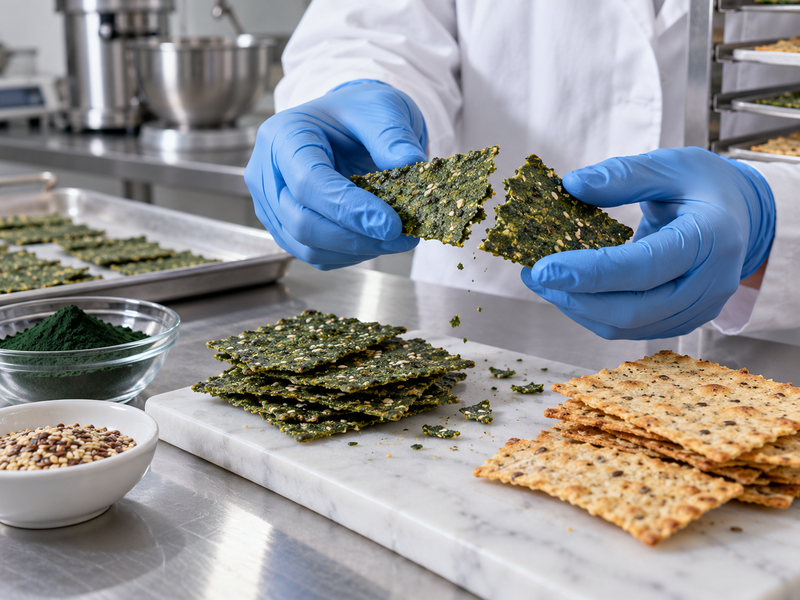
Write a finished-product brief before ordering samples. Decide whether spirulina is intended to produce a visible green cue, support a measured ingredient statement, or contribute to a particular nutrient declaration. These goals need different acceptance tests. A deep green dough is not evidence that the baked cracker will retain an attractive shade, and an ingredient’s protein percentage cannot be transferred directly to a finished-pack claim. Assess the complete recipe and the rules in the destination market.
Make a plain cracker control from the same flour lot and process it beside the proposed variant. Record target sheet thickness, dimensions, breakage allowance, seasoning coverage, flavor profile and pack shelf life. That reference prevents a change in oven conditions from being blamed on spirulina. If the visual goal is subtle, agree on a color window using the finished cracker under standardized lighting before anyone sees the supplier’s price.
| Product goal | Finished-product evidence | Decision owner |
|---|---|---|
| Green appearance | Color of baked face and center | Brand and sensory team |
| Crisp eating quality | Snap and fracture comparison | R&D and quality |
| Ingredient statement | Actual addition and label review | Regulatory team |
2. Which lot documents belong in the brief?
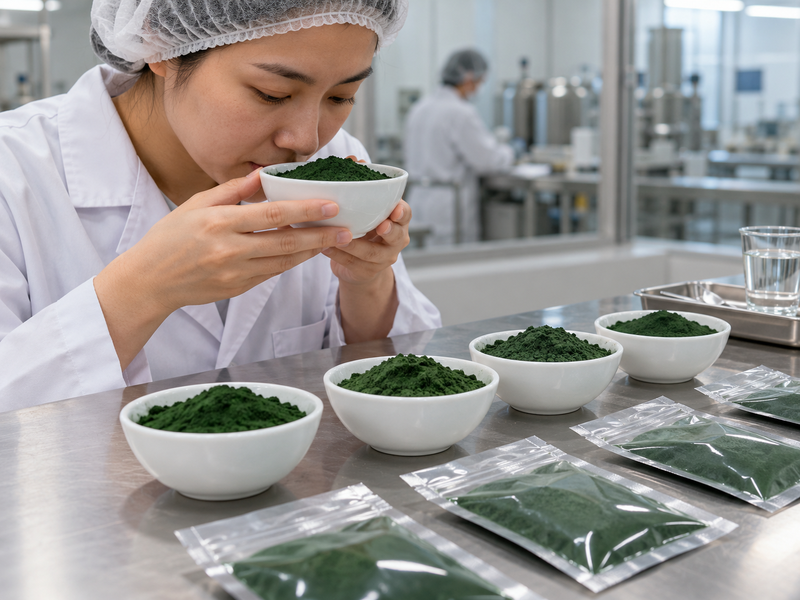
Request a sample from an identifiable lot, a technical data sheet, the current lot’s certificate of analysis, an ingredient declaration and the proposed commercial specification. Confirm the organism or material identity, processing description, particle-size distribution, moisture, storage conditions and packaging format. The supplier’s spirulina page is a starting point for an inquiry, not proof that any particular mesh size, certificate or contaminant result accompanies your shipment.
For a thin dough, the fine and coarse tails of particle size matter more than a single average. Coarse particles may create visible spots or local tears, while very fine dust can alter handling and dosing. Agree on a sieve or laser-diffraction method and retain the sample used in the trial. Request microbiological and contaminant reports appropriate to food use and the destination, with methods, units and lot linkage. Resolve missing information before a successful bake becomes a commercial commitment.
| Supplier item | Question it answers | Internal check |
|---|---|---|
| Lot-linked COA | What was tested on this batch? | Match lot, method and limit |
| Particle-size data | Will it disperse in dry flour? | Check spots and sheeting |
| Microbiology and contaminants | Does evidence fit the hazard plan? | Review applicable limits |
| TDS and declaration | What exactly is being purchased? | Compare against label brief |
3. How should the inclusion ladder be built?
Build a small ladder around a control and several measured additions chosen by R&D for the intended sensory and visual goal. Keep flour, fat, salt, seasoning, water method, mixing energy and oven settings constant in the first pass. Document whether spirulina replaces flour or is added on top of the dry formula; those approaches change hydration and composition differently. If dough water must be adjusted to restore machinability, make that a separately recorded second experiment.
The 2024 cracker study used specific microalgae substitutions in its own formula. It cannot nominate the correct commercial dose for a different wheat or rice cracker. Judge the lowest addition that meets the brief, because stronger green color may come with stronger taste or process penalties. Randomize tasting order and code samples so panelists do not treat the darkest cracker as automatically best. Repeat the preferred level with another ingredient lot before locking the specification.
| Trial arm | What changes | Gate |
|---|---|---|
| Control | No algae | Reference process |
| Low addition | Powder only | Detectability and handling |
| Mid addition | Powder only | Sensory and color balance |
| Upper screen | Powder only | Identify failure boundary |

4. Will the dough run through the sheeter?
Observe the dough at mixing, rest, first reduction, final gauge and cutting. Record torque or operator observations, water addition, sticking, edge cracking, holes, shrinkage and the percentage of usable cut pieces. A bench dough that can be rolled by hand may still fail at production width and speed. Use the actual line, including its scrap rework loop, for the deciding trial. Take photographs at fixed gauge settings and collect samples before and after rework.
Compare the candidate powder with the control at equal target thickness. If the green dough needs more water, evaluate whether that correction affects oven energy, blistering or final moisture. If edges tear only at higher additions, the procurement team should not solve it by accepting a vague supplier promise of a finer powder. Obtain a second documented size grade only if one is actually available, and rerun the comparison.
Record practical adjustments in the approved process sheet so purchasing knows which powder specification the result depended on.
5. What does the oven do to color?
Check raw dough, oven exit, cooled crackers and packed crackers under the same light source. Photograph both face and broken cross-section with a neutral reference card; record instrumental color if equipment is available. A green raw sheet can become olive, brown or uneven after baking. Surface browning, thickness, oven zone, dwell time and recipe pH can all affect the final appearance, so keep those variables documented rather than attributing every difference to powder quality.
Use the line’s normal settings first. Then, if the product otherwise passes, run a controlled oven adjustment and evaluate its effect on moisture and snap. Do not claim that a supplier powder will retain a particular pigment percentage without lot and process testing. A color threshold should be tied to what consumers see in the package, not a photograph of wet dough.
Recheck appearance near the end of the intended shelf life because the saleable product, rather than the first laboratory batch, is the buying target.
| Observation point | Record | If it fails |
|---|---|---|
| Dough sheet | Uniformity and dark specks | Review dispersion and particle size |
| Oven exit | Face color and hot defects | Review heat profile |
| Cooled pack | Color after equal cooling | Review exposure and packaging |
6. Does the finished cracker still snap?
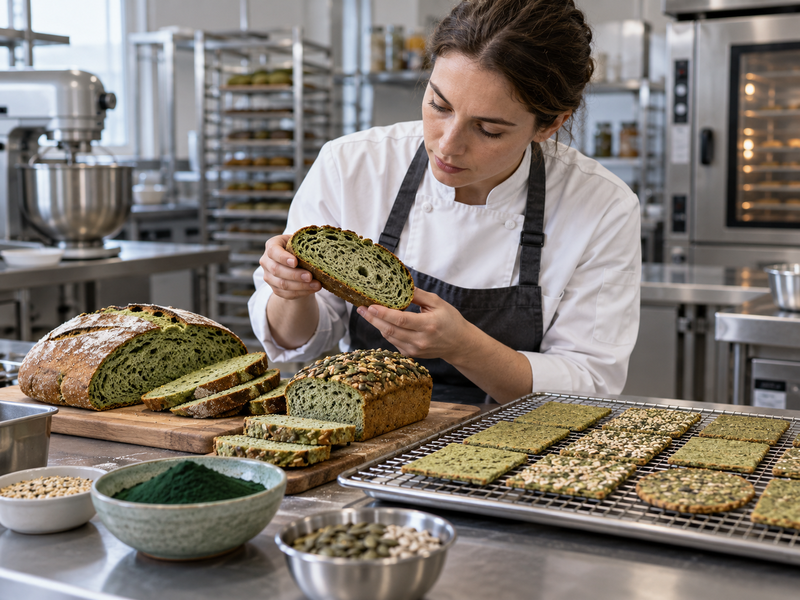
Evaluate fracture at the same thickness and final moisture, or the comparison will be misleading. A simple bend test can screen large differences, but record force and break distance with a texture instrument when available. Pair measurements with a trained sensory assessment of initial bite, crumbliness and residual chew. Sample across the oven belt; edge pieces and center pieces may differ. Keep packaging damage separate from eating texture by tracking breakage after handling and transport simulation.
If a variant is soft, inspect its final water content and water activity before blaming the algae. Dough water changes or a shorter bake can explain a weak snap. If a darker variant is brittle and breaks in the pouch, consider whether reduced thickness or process adjustment is driving the loss. Define a permissible range relative to the control, plus a commercial pack breakage limit.
The successful candidate should meet both: a cracker can feel crisp on the bench and still create unacceptable crumbs in distribution.
7. How should off-notes be judged?
Taste a control and blinded spirulina variants without revealing the dose. Evaluate first aroma, initial bite, seasoning integration, aftertaste and willingness to eat a normal serving. Test the final savory seasoning, not plain pilot dough, because garlic, herbs, cheese or spice can change both masking and consumer expectation. Use a defined panel and consistent serving temperature. Record descriptors instead of reducing every reaction to a single liking score.
When a dose fails on algal or earthy notes, determine whether the note comes from the ingredient lot, the level, baking, or interaction with a seasoning oil. A second lot is a useful check only after the supplier provides its identity and relevant documentation. Avoid creating a health message from a sensory study: the bakery research investigated specific formulations, and a consumer’s acceptance of one cracker does not validate another.
A purchase gate should require acceptable flavor at the lowest effective visual level.
| Sensory stage | Prompt | Action on failure |
|---|---|---|
| Aroma | Detect algae before tasting? | Check lot and bake aroma |
| First bite | Does seasoning fit? | Reformulate seasoning or level |
| Aftertaste | Does note persist? | Reject or reduce addition |
8. What moisture checks belong in the pack trial?
Measure finished moisture and water activity at cooling, sealing and planned shelf-life checkpoints. Crackers lose their intended snap when they absorb water, while an insufficiently dried batch can enter the pouch already weak. Record room humidity, cooling duration, pack material, seal settings and any desiccant or barrier system used in the current product. Do not use the shelf life of a plain cracker as automatic evidence for the spirulina version.
Test production packs, not only open bench trays. Sample from different positions in the run and store under conditions representing the intended market. At each point examine seal integrity, moisture, water activity, color, odor, texture and visible defects. If the ingredient is added after a validated heat step in an unusual process, its microbiological status needs explicit review in the facility hazard plan. Establish acceptance criteria before storage begins; otherwise teams tend to reinterpret a gradual loss of snap after seeing the results.
| Checkpoint | Sample | Decision |
|---|---|---|
| After cooling | Unpacked cracker | Baseline moisture and snap |
| After sealing | Production pouch | Seal and initial quality |
| Storage intervals | Unopened pouches | Trend versus agreed limits |
9. How do production yield and quote compare?
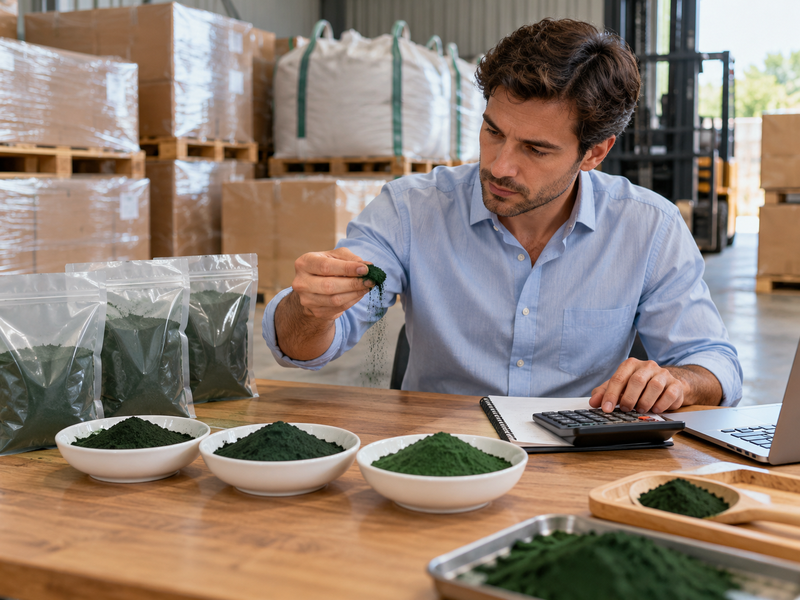
Ask for a quote against a defined grade, anticipated quantity, destination, packaging and delivery basis. A lower powder price is not cheaper if it creates more scrap, requires slower sheeting, produces greater pack breakage or needs extra seasoning to cover flavor. Calculate cost per saleable pack after yield, not just cost per kilogram of ingredient. Include the cost of additional quality tests and any label or packaging changes required for the chosen market.
Compare suppliers on the same trial protocol and the same commercial specification. If a supplier provides a small laboratory sample from one lot but quotes a different grade or pack format, the comparison is incomplete. Ask how the offered commercial lot will be matched to the approved sample and which changes would trigger requalification. Keep nutritional positioning separate from the cost calculation until the finished formulation and legal review substantiate any claim.
An R&D preference can become a procurement choice only when it survives line economics.
10. What evidence releases a purchase order?
Create a signed acceptance sheet that identifies powder grade and lot, approved inclusion, particle-size method, relevant food-safety limits, process settings and finished-product targets. Attach the line trial, sensory record, moisture and pack results, and the current lot documents. The specification should state what happens if a future lot falls outside the approved color or size range. A good photograph of a single green cracker is not an adequate release record.
Before scale purchase, repeat the winning treatment on the intended line and with the commercial packaging. Confirm that purchasing, quality, R&D and regulatory teams all review the same version of the product brief. Keep a retain sample of the approved powder and finished cracker for later comparisons. Set a receiving plan for incoming lots that includes identity, documents and practical checks against the approved reference. If any result relies on a process adjustment, place that adjustment in the manufacturing instructions before signing the order.
| Release element | Required evidence | Hold if missing |
|---|---|---|
| Identity and safety | Lot-linked documents reviewed | Yes |
| Line performance | Yield, gauge and oven data | Yes |
| Consumer quality | Color, snap and flavor | Yes |
| Pack stability | Moisture and storage protocol | Yes |
FAQ
Q1. Can a research inclusion level be copied into our cracker? No. Published levels belong to a particular flour, recipe and oven process. Use them only to inform a controlled internal ladder.
Q2. Is blue spirulina the same ingredient? No. This brief concerns green whole-biomass powder. A blue extract has a different composition and application decision.
Q3. Which matters more, raw dough color or baked color? The packed baked cracker is the commercial product. Measure its color after cooling and during storage.
Q4. Does a supplier COA prove the cracker is safe? It supports ingredient review for a named lot. The manufacturer must validate its own process and finished product.
Q5. When should a second powder lot be tested? Before locking a commercial specification, especially when color, flavor or particle size determines acceptance.
To evaluate spirulina powder for savory cracker manufacturers, contact SpirulinaCN with your cracker application, target powder and finished-product specifications, anticipated quantity, destination, and line-trial needs. Request a lot-matched sample, technical sheet, current COA and an application-specific quotation.