
Chlorella powder for fresh cream cheese manufacturers must work in a cultured, chilled dairy matrix. Green color alone is not enough: a candidate that disperses well in a beaker may leave specks after filling, stiffen the cheese or create an earthy finish after several days in the cold case. The buying decision is a comparison of documented food-grade lots in the actual quark or cream-cheese process, with refrigerated texture, taste and microbiological controls defined before the trial.
A 2023 fresh-cheese study examined Chlorella vulgaris in particular quark and cream-cheese formulations and measured composition, structure and sensory acceptance. Its results establish a reason to test, not a performance guarantee for another biomass or dairy line. Start with the supplier’s chlorella category and request identity and current lot documents for the exact grade offered.
Contents
- What is the cheese’s purchase brief?
- Which chlorella identity and documents are needed?
- Where should powder enter the dairy process?
- How will dispersion be measured?
- Does firmness remain in range?
- Will consumers accept spreadability?
- How should green color be judged?
- What happens through refrigerated storage?
- How should suppliers be compared commercially?
- What releases a commercial specification?
1. What is the cheese’s purchase brief?
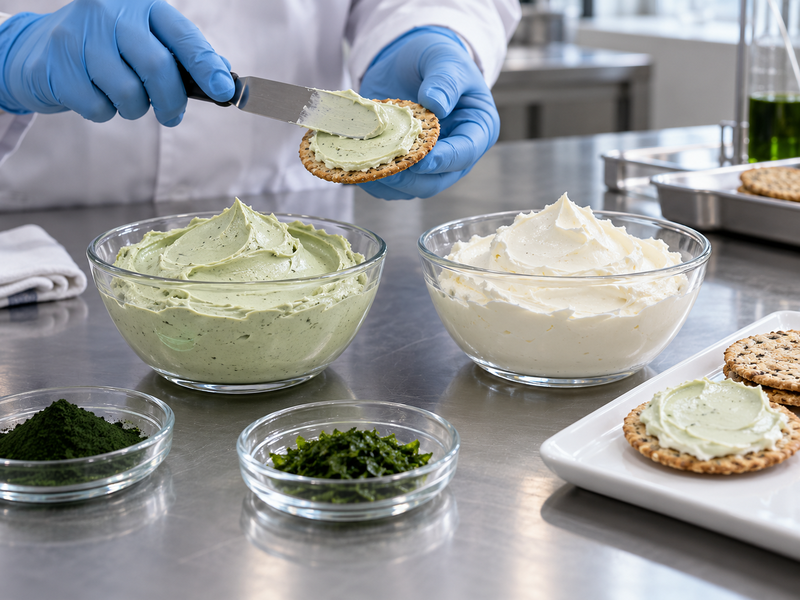
Specify whether the target is quark, whipped cream cheese, a dense tub spread or another fresh cultured product. Their fat, protein, water and shear histories differ, so one successful sample cannot cover them all. Record the control product’s pH, moisture, spread force, firmness, visible whey separation and serving temperature. Decide how green the brand wants the product to look and which flavor notes are unacceptable. A consumer may accept a herb-flavored green cheese while rejecting the same color in a plain version.
Identify the intended shelf life and packaging before evaluation. A shallow tasting cup and a filled retail tub expose the cheese to different air, light and handling. Set acceptance against the existing formulation rather than against an abstract claim that algae improves nutrition. Any nutrient or health statement requires finished-product calculation, testing where needed and destination-specific legal review. The research cheese is useful context, but your own cheese’s process and label are the release target.
| Brief element | Baseline to record | Failure signal |
|---|---|---|
| Cultured matrix | Recipe, pH and fat level | Trial uses the wrong base |
| Texture | Firmness and spread force | Outside consumer target |
| Appearance | Color and speck allowance | Uneven or unattractive green |
2. Which chlorella identity and documents are needed?
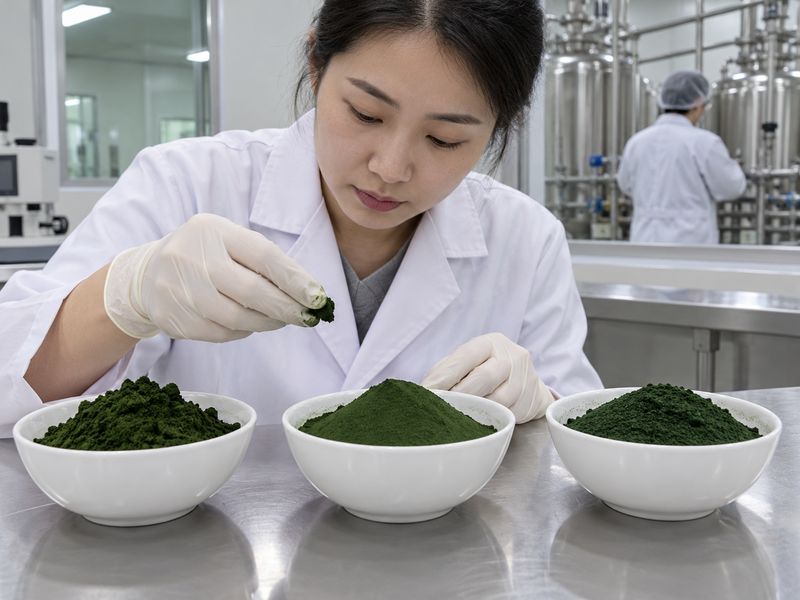
Request a lot-matched sample, species identification, full ingredient declaration, technical data sheet, actual-lot COA and proposed commercial specification. Ask whether the biomass is whole, processed or blended and whether any carrier or other ingredient is present. Particle-size distribution and moisture matter to dispersion and to the powder’s storage behavior. If the brand requires a particular organic status or origin, request evidence for the offered SKU and intended destination rather than assuming a category page establishes it.
Food-safety review should cover microbiology and relevant contaminants with methods, limits, units and lot numbers. Fresh cheese may have no subsequent kill step after addition, so incoming-material control and hygienic addition are central. The dairy site’s hazard analysis must decide what evidence and handling are required. Compare supplier documents to the finished-cheese specification, not just to the supplier’s generic pass/fail box. Retain the powder sample and record its packaging condition when received so a later lot can be compared on equal terms.
| Requested record | Buying question | Review action |
|---|---|---|
| Species and composition | What is in the tub? | Match label policy |
| Lot COA | What was tested on this lot? | Check method and limits |
| Size and moisture | Will it disperse predictably? | Test in actual cheese |
| Storage guidance | How is quality maintained? | Align warehouse controls |
3. Where should powder enter the dairy process?
Map culturing, drainage, homogenization, flavor addition, filling and cooling. Choose candidate addition points with the plant’s food-safety and process teams. Adding powder before fermentation could affect culture behavior or acidification; adding it after fermentation may protect a target texture but changes the hygiene control point. Neither placement should be chosen by a generic rule. Record ingredient temperature, hold time, mixing speed and the pH curve for each pilot.
Use the current line settings for the first comparison. Pre-wetting powder in a measured portion of the dairy phase may reduce dry clumps, but that step introduces extra handling and must be included in the process and hygiene review. If the candidate requires additional shear, test whether shear thins or overworks the cheese. Document the final addition sequence, not only the bench formulation, because commercial operators need a repeatable instruction.
Recheck product after filling: smoothness at the tank outlet does not guarantee uniformity in the first and last tubs.
| Addition stage | Potential benefit | Gate to validate |
|---|---|---|
| Before culture | Early distribution | Acidification and culture performance |
| After culture | Direct final flavor control | Hygiene and mixing uniformity |
| Premixed dairy slurry | Fewer dry agglomerates | Added handling and hold time |

4. How will dispersion be measured?
Take samples from the top, center and bottom of the mixing vessel and from early, middle and late retail tubs. Spread each sample in a thin, standardized layer on a white plate and count visible dark specks or streaks. If color measurement is available, record variation across positions, but do not mistake a uniform average color for absence of gritty particles. Taste the same locations because a clump can deliver a concentrated earthy note even when the overall recipe is mild.
Test realistic residence times. A slurry that disperses at minute one may settle or aggregate before the filler reaches the last tub. Record the powder feed method, addition rate, mixer geometry and batch size. Compare the accepted sample to a dry-add control only when both are safe and practical for the line. If a finer grade is proposed, require a documented commercial sample of that grade and repeat the test; a supplier’s promise that milling can be adjusted is not evidence of the delivered material.
5. Does firmness remain in range?
Measure firmness at a controlled chilled temperature and after a defined equilibration period. The fresh-cheese paper reported that its chlorella additions affected firmness, which is a reason to quantify the effect in each new formula. Use a texture analyzer or a documented penetration method and compare repeated packs from the same run. Pair the number with a practical check: can the consumer remove a clean spoonful without the cheese crumbling or turning runny?
Separate formulation effects from temperature effects. A cheese tested warm after filling may seem softer than one tested after cold storage. Likewise, a pH shift can change protein structure independent of algal particle properties. Record pH, product temperature, moisture and fat alongside each texture result. If firmness is outside range, adjust the cheese formulation or addition level as a new trial, not as an undocumented rescue. A procurement specification is only defensible when the powder and the process that delivered acceptable texture are both defined.
| Measurement | Controlled condition | Commercial relevance |
|---|---|---|
| Penetration force | Same depth and temperature | Spoonability |
| pH | Same storage time | Cultured structure |
| Visible whey | Unopened retail tub | Case appearance |

6. Will consumers accept spreadability?
Firmness and spreadability are related but not interchangeable. Test the amount of force needed to spread a fixed mass on the intended carrier at a defined serving temperature. A spoonable quark can still drag and tear bread; a very soft cheese can spread easily yet leak whey. Ask a small blinded panel to score smoothness, graininess, mouth-coating and aftertaste as well as overall preference. Use the finished recipe, including salt and flavoring, because those can change perception of algal notes.
Do not use the study’s sensory response as a purchase prediction. The 2023 trial involved its own dairy bases, chlorella material and panel. For your decision, compare at least a control and a practical inclusion ladder selected by R&D. Preserve sample order randomization and consistent temperature. When a high level delivers an appealing color but reduced spreadability, the correct commercial choice may be a lower level or no purchase.
Record the threshold before the sales team sees a favorable single photograph.
7. How should green color be judged?
Define a color target under the lighting in which the product will be sold. Compare freshly filled tubs and refrigerated samples using the same container, fill depth and light source. A thin smear on a white plate can look much darker than the full tub. Record surface and interior color separately; oxygen and light exposure can make the top look unlike a spoonful from the center. Photograph with a neutral reference card, and use colorimeter readings if the team has a validated method.
Check whether herbs, pepper or other visible inclusions make the green shade credible to consumers. Do not hide uneven chlorella dispersion by choosing a darker photograph. If the powder lot changes color materially, the finished cheese may drift even when the dosing system is accurate. Set an incoming color comparison against the approved powder retain and a finished-tub color range. The aim is a product that looks consistent at purchase and consumption, not merely a green batch in the process tank.
| View | What to compare | Risk |
|---|---|---|
| Tub surface | Color and any whey | Display rejection |
| Spread layer | Specks and streaks | Poor dispersion |
| Interior spoonful | Uniformity through depth | Fill inconsistency |
8. What happens through refrigerated storage?
Run the intended storage schedule in the actual retail package, with samples from multiple fill positions. At each agreed interval, assess pH, firmness, spreadability, whey release, color, odor, taste and microbiology as determined by the facility’s plan. Include temperature excursions only when they represent a defined distribution scenario and quality and safety teams approve the protocol. A stable first-day texture cannot establish shelf life. Neither can the life of the uncolored control be copied automatically to the revised product.
Use unopened packs for primary checks so repeated sampling does not create its own contamination or drying. Record seal quality, headspace and light exposure. If deterioration appears, distinguish a formulation issue from a packaging or cold-chain issue before switching suppliers. The published cheese work investigated a specific system; it does not provide a storage guarantee for this SKU. Set the commercial date from your finished-product evidence and applicable requirements, then define how future ingredient lots will be monitored.
| Storage check | Why it matters | Hold signal |
|---|---|---|
| Whey release | Consumer sees separation | Above agreed limit |
| Firmness and spread | Eating quality | Outside target range |
| Sensory and color | Brand consistency | Unacceptable change |
| Microbiology | Product safety | Fails facility criteria |
9. How should suppliers be compared commercially?
Quote the same named grade, quantity range, destination, package size and delivery basis from each candidate. Compare cost per accepted retail tub after mixing loss, rejected specked packs and added processing time. An inexpensive powder can become costly if it needs extra dispersion steps or produces inconsistent texture. Conversely, a high laboratory preference may not justify a premium if the finished cheese is indistinguishable in blind testing. Keep the quality threshold fixed while evaluating price.
Request the proposed specification and change-control practice. If the laboratory sample and commercial shipment are from different lots, require a bridging comparison before launch. Clarify who supplies updated COAs and which incoming tests will be performed by the dairy plant. Any special claims, including organic or nutrient messages, should be costed only after SKU-specific evidence and destination review. The purchase order should reference the accepted grade and documentation, not the vague label “green chlorella.”

10. What releases a commercial specification?
Approve the material only when the incoming specification, dairy process and finished-product targets agree. The file should identify species, grade, lot, particle-size method, microbiological and contaminant criteria, addition point, mixing procedure, inclusion level and acceptable refrigerated texture and color. Include the signed sensory and storage reports. Where regulations or labeling differ by destination, document that review for the actual finished cheese. The supplier’s technical sheet and COA are requested records, not proof that the buyer already has an approved lot.
Run a confirmation batch at intended scale and retain powder and finished-cheese references. Train receiving staff to identify the approved grade and alert R&D when a future lot differs in color, odor, size or paperwork. Define requalification triggers for supplier, process or package changes. This converts a favorable pilot into a repeatable buying decision. It also prevents a team from approving one quark recipe and silently using the same acceptance in a different fresh-cheese matrix.
FAQ
Q1. Can the study’s chlorella level be used directly? No. Its additions belong to specific quark and cream-cheese formulations. Set your own ladder against sensory and texture criteria.
Q2. Is processed cheese the same trial? No. Fresh cultured cheese has different pH, water, texture and cold-storage behavior.
Q3. Is a smooth tank sample enough? No. Check samples across the filler and through the retail tub.
Q4. Does a COA establish finished-cheese shelf life? No. Shelf life requires evidence from the filled cheese and its storage protocol.
Q5. Should color be measured on the powder? Yes, as an incoming reference, but final approval depends on cheese color at filling and during storage.
For chlorella powder for fresh cream cheese manufacturers, contact SpirulinaCN with your dairy application, target ingredient and finished-cheese specifications, anticipated quantity, destination, preferred addition stage and cold-storage trial plan. Request a lot-matched sample, technical sheet, current COA and an application-specific quotation.