
A bench formulation proves that a product can look promising in a small vessel. It does not predict bag emptying, feeder behavior, heat exposure or variation across thousands of packs. Spirulina powder production trial planning turns those uncertainties into measured questions before commercial scale. The FAO guidance on validation and verification calls for evidence under production conditions when controls must work consistently. Use that principle to design a trial with a decision, not merely a demonstration run.
Contents
- What decision should the trial answer?
- Which bench results must transfer?
- How should trial lots and controls be chosen?
- Which process settings need a planned range?
- How should powder be introduced to the line?
- Where should samples be collected?
- How should quality and sensory results be judged?
- What belongs in the mass balance?
- How should deviations be investigated?
- What makes a trial ready for scale-up?
1. What decision should the trial answer?
Write a pass rule before the run
Specify whether the plant trial will approve a supplier, an addition rate, a mixing sequence or a new equipment setting. If the team tries to answer all four without a hierarchy, an attractive finished sample may conceal a fragile process. Define one primary decision and a short set of secondary observations. Ask the hard question early: what result would stop a commercial launch? Examples include visible clumps above the product’s agreed defect definition, unacceptable fill-to-fill color variation, excess line loss or failure against a safety requirement. Every criterion needs a method, sample point and owner.
Record the intended product, serving size, powder lot, target dose and expected production duration. Note what is outside scope, such as shelf-life approval or a second flavor. Avoid treating a successful one-hour run as proof of a six-month storage claim. The trial protocol should be signed before material is staged, with quality authorized to hold finished goods while results are reviewed. A useful final report states the decision reached, its evidence and the conditions under which it remains valid.
2. Which bench results must transfer?
Preserve the reference conditions
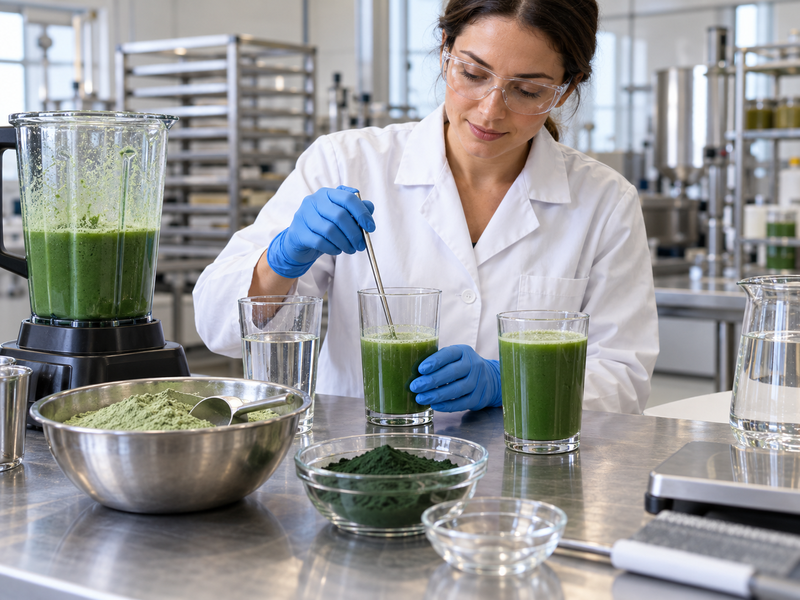
Bring the approved bench formula, powder lot identity, mixing order, liquid temperature, mixing energy or time, pH when relevant, and the sensory reference into the plant. These inputs are often omitted from a product brief even though they shaped the accepted sample. Run a small bench repeat with the commercial powder lot before the line trial if a development lot was used originally. The useful comparison: place bench and plant samples side by side under the same lighting and at the same product age. Differences may reflect material, process or both; record enough context to separate them.
Create a transfer sheet that states which variables can change during scale-up and which must remain fixed for the experiment. For example, vessel shape and impeller size will change; ingredient identity and intended mass fraction should not drift without an approved amendment. The Codex hygiene text stresses checking the actual process flow and documenting controls. Applied to product development, a clear flow diagram prevents a bench step such as prewetting from vanishing in the production schedule.
| Bench reference | Plant equivalent | Evidence |
|---|---|---|
| Powder identity | Receiving lot code | Released-lot record |
| Addition order | Operator instruction | Batch event log |
| Mixing endpoint | Measured plant criterion | Time and sample result |
| Color reference | Same-age finished sample | Controlled comparison |
3. How should trial lots and controls be chosen?
Build a comparison that can isolate causes
Use a released production lot of powder in its actual shipping pack. A hand-filled laboratory jar will not reveal bag opening, dust control or liner handling. Keep a sealed retained sample and document its storage. If feasible, include a control product without spirulina and a previously accepted formula. A revealing design: run the control before the spirulina trial, then follow with an ordinary sanitation or changeover cycle. This exposes both formula effects and residual green carryover to subsequent production. Keep trial size large enough to reach stable operating conditions; a short startup-only batch can misrepresent steady performance.
Avoid changing ingredient supplier, flavor system and mixer setting simultaneously. If several changes are unavoidable, label the trial as a screening run and plan confirmation. Identify all contributing raw-material lots, not just spirulina, because a stabilizer or base powder can alter dispersion. Sample from multiple bags when the trial uses several packages. A lot may be uniform on its certificate yet still display handling variation after transport. The site’s supplier onboarding guide helps frame trial-order records, but the plant protocol must name its own controls.
4. Which process settings need a planned range?
Observe the limits around the target setting
Record mixing speed, time, batch fill, temperature, hold duration and transfer route when they can affect the product. For a dry blend, note blender load, discharge order and screen use. For a beverage, note wetting sequence, recirculation and downstream thermal step. Set a planned operating window based on equipment capability and prior development data, then test the edges that can reasonably occur. One setting is not a window. A single good batch at the exact target says little about minor drift during routine production.
Do not impose a universal spirulina mixing time. Research on agglomerated spirulina powder shows that powder processing changes wetting and flow properties, so another supplier’s setting may not transfer. Identify measurement tools and calibration status for any setting used in an acceptance decision. Note ambient conditions if humidity can affect powder handling. Keep actual readings, not only setpoints: a jacket target of 20°C does not prove product temperature stayed there. Annotate each intervention and its time on the sample map.
| Variable | Planned observation | Decision link |
|---|---|---|
| Addition rate | Actual charge over time | Dosing variation |
| Mixing energy | Speed and duration | Uniformity and clumps |
| Temperature | Product temperature trace | Color and process effect |
| Hold time | Start and end timestamps | Settling or flavor shift |
5. How should powder be introduced to the line?
Test the real charging route
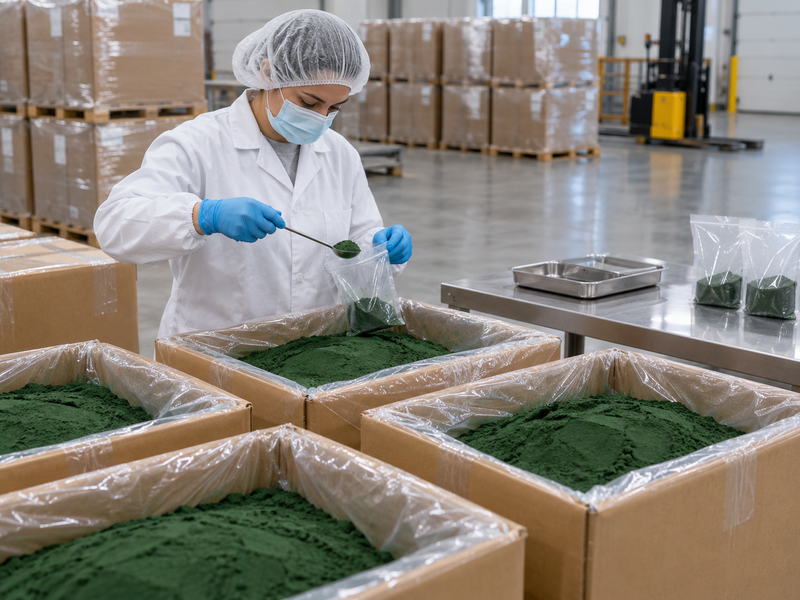
Map powder movement from the bag through any sieve, feeder, vacuum line, premix vessel and main tank. Decide whether the trial will use direct addition or a controlled predispersion. The route changes wetting, dusting and material loss. Watch the first bag: powder can stick to the liner or bridge at the hopper throat, and operators may compensate with an undocumented water addition. Record these events as data. A development method that depends on improvised scraping will be difficult to reproduce across shifts.
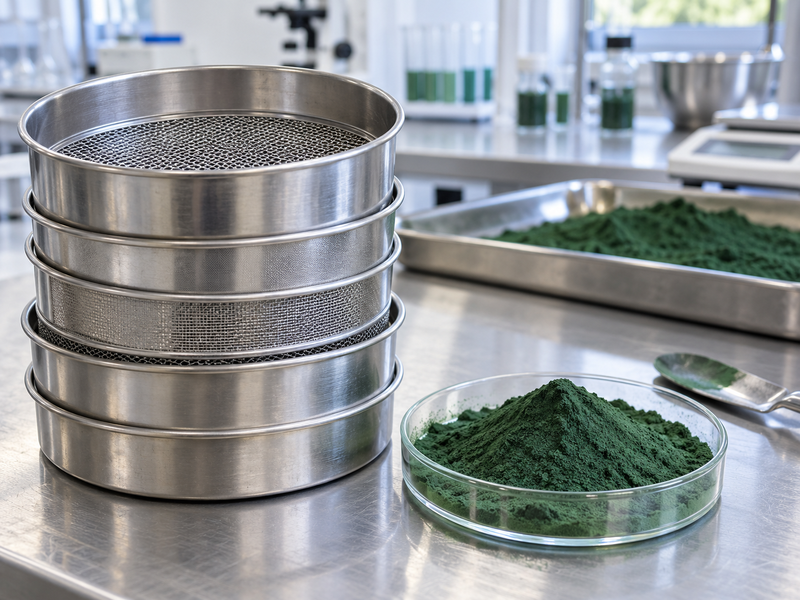
In a liquid product, compare the appearance of the surface immediately after powder addition, after mixing and after a defined rest. Whole spirulina biomass is particulate; visible wetting does not mean it has dissolved. The original spirulina agglomeration study evaluated wetting separately from flowability, which supports distinct checks. In a dry blend, sample at discharge rather than assuming the center of a loaded blender represents every pack. Record any screen residue and its color. A growing green deposit may indicate that the nominal recipe dose differs from the mass reaching finished product.
6. Where should samples be collected?
Connect time, location and batch phase
Build a map before production begins. Collect at least a startup sample, one or more stable-run samples and an end sample, adapting frequency to line residence time and trial purpose. Where practical, sample before and after a vulnerable step such as a screen, heat treatment, homogenizer or filler. Trace the sample backwards: each container should point to a production timestamp, ingredient lot and equipment condition. If a color result drifts, the team can then compare it with a refill, temperature rise or stoppage.
Specify sample mass, container, light protection if relevant, storage temperature and maximum time before assessment. For sensory tests, use coded samples and comparable serving conditions. For particulate beverages, define how bottles are mixed before sampling and whether sediment after rest is part of the test. The FAO verification guidance lists sampling, calibration and record review among verification tools. It does not prescribe a sampling frequency for spirulina products; that frequency belongs in the plant’s risk-based plan.
| Location or phase | What it can reveal | Record with sample |
|---|---|---|
| Premix outlet | Incomplete wetting | Mix time and temperature |
| Main tank after hold | Settling or drift | Hold duration |
| Filler startup | Displaced or diluted product | Filler transition time |
| End of run | Concentration or residue | Remaining tank mass |
7. How should quality and sensory results be judged?
Use controlled comparisons and explicit thresholds
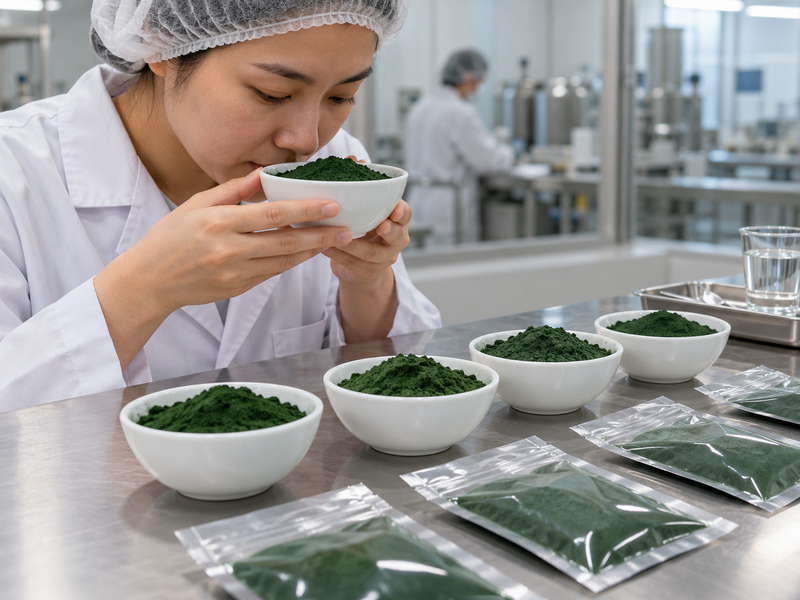
Evaluate color, odor, flavor, texture and appearance against a retained target and the product’s written acceptance criteria. If the colorimeter is used, specify geometry, container, sample preparation and temperature. If a panel is used, blind codes reduce expectation bias. Separate three outcomes: food safety release, technical process suitability and market-facing sensory acceptance. Passing a microbial result does not rescue a gritty product; a pleasing shade does not release a held lot. A product may also meet launch criteria but need a narrower process window before routine production.
Judge results at relevant ages. Freshly mixed beverage, refrigerated day-one product and shelf-life endpoint can look different. Save enough controlled samples for the planned storage study. For a dry format, assess water activity or caking where applicable rather than equating appearance with stability. The site’s powder color and odor guide gives related material-level questions. The trial report must still connect those attributes to actual finished-product performance and record why the accepted range serves customers.
8. What belongs in the mass balance?
Account for purchased powder and saleable output
Reconcile opening inventory, charged mass, material retained in packaging, dust collection, screen residue, tank or blender hold-up, spills, rework and remaining stock. Compare theoretical finished-product yield with actual good units and total produced units. A small loss matters: a few percent of spirulina trapped upstream changes both ingredient cost and intended dose. Distinguish ordinary startup waste from unusual trial loss. Weigh losses where practical rather than assigning them all to an unexplained balancing line.
If powder enters as a premix, record its liquid mass separately. A concentration calculated from powder charge divided by nominal tank volume may be wrong if top-up water or transfer loss changed the denominator. Preserve the signed batch record and calculations so finance can assess cost in use and quality can assess dose consistency. The Codex hygiene guidance emphasizes records that support review and corrective action; a reconciled material trail supplies that practical evidence.
| Mass item | Measurement source | Why retain it |
|---|---|---|
| Charged powder | Verified scale | Nominal dose |
| Bag and screen residue | Weighed collection | Delivery loss |
| Rework | Batch-coded record | True yield |
| Good finished units | Line count and checkweigh | Cost per saleable unit |
9. How should deviations be investigated?
Hold the result, then locate the change
Mark any off-target sample, equipment interruption, unplanned ingredient addition or sanitation concern on the trial timeline. Hold affected product according to the plant’s procedure. Compare adjacent samples to narrow the affected interval. Start with the event sequence: if clumps appeared after a feeder refill, inspect refill behavior, powder condition and mix energy before blaming the entire lot. If color shifted after a heat step, compare pre-heat and post-heat samples under the same method. Seek one explanation supported by evidence, then test it.
Document corrective action and whether a confirmation run is needed. A failed pilot can still be useful if it reveals a reproducible limit. Do not quietly remove failed startup samples from the report because routine plants have startups. Likewise, do not claim an industrial limit from a research paper conducted in a different matrix. The FAO HACCP guidance advises re-examining controls after changes that affect safety. For purely sensory issues, a similarly disciplined technical review prevents repeated trial cycles.

10. What makes a trial ready for scale-up?
Sign off the specific operating envelope
A trial is complete when the team can state the accepted ingredient lot or specification, dose, equipment path, process window, sampling plan, finished-product criteria and unresolved risks. Quality signs food safety disposition, development signs product fit, operations signs repeatability and finance records observed yield. The scale-up question: would another shift make the same product using the written instructions? If the answer depends on the developer standing beside the tank, write down the missing decisions and repeat the vulnerable step.
Do not equate trial approval with shelf-life proof. Assign stability studies, packaging checks and further commercial lots as separate milestones when needed. Set triggers for re-trial, such as a supplier process change, a new powder grade or a different mixer. Compare the next routine lot with retained pilot samples and process data. A concise one-page decision record, backed by raw results, is more useful than a long narrative that never says what was approved. It also gives the supplier a precise brief if material handling needs improvement.
| Approval element | Record | Re-trial trigger |
|---|---|---|
| Powder specification | Signed revision | Material or process change |
| Plant parameters | Trial report | New line or mixer |
| Finished criteria | Method and reference | Formula or packaging change |
| Stability plan | Study protocol | New storage condition |
FAQ
Q1: Can a bench trial replace a plant trial? No. It cannot measure line losses, startup variation or actual equipment behavior.
Q2: Must every variable be tested at both limits? Prioritize settings likely to drift and those connected to product or safety decisions.
Q3: Is one production lot enough? It can screen feasibility; repeatability may require another lot or run.
Q4: What should happen to trial product? Follow the site’s documented quality disposition and any applicable sale restrictions.
Q5: Who approves the final report? Quality, development and operations should sign their respective decisions.
Next step
Draft the protocol around one clear launch decision, reserve representative powder and map samples before scheduling the line. After the run, publish the operating envelope and unresolved tests so routine production starts from evidence.