
Spirulina powder for processed cheese manufacturers is a decision about a specific base and its required melt, spread, color and chilled flavor. A 2020 study of a processed-cheese analogue found differences in meltability, oil separation, color and sensory acceptance after adding Spirulina maxima. That is useful evidence for choosing trial measurements, but it cannot predict the behavior of every whole green spirulina powder or a different dairy or vegan base.
A food manufacturer should approve a named lot only after matched processing and refrigerated-hold tests against a control.
Contents
- Which cheese product is actually being qualified?
- What whole-biomass grade belongs in the brief?
- How should the formula ladder be built?
- Where does the heat and mixing sequence matter?
- How do you test melt and spreadability?
- What color result should pass?
- How do you screen odor and flavor?
- What changes during refrigerated storage?
- Which quality and label checks matter?
- When is a bulk approval justified?
1. Which cheese product is actually being qualified?
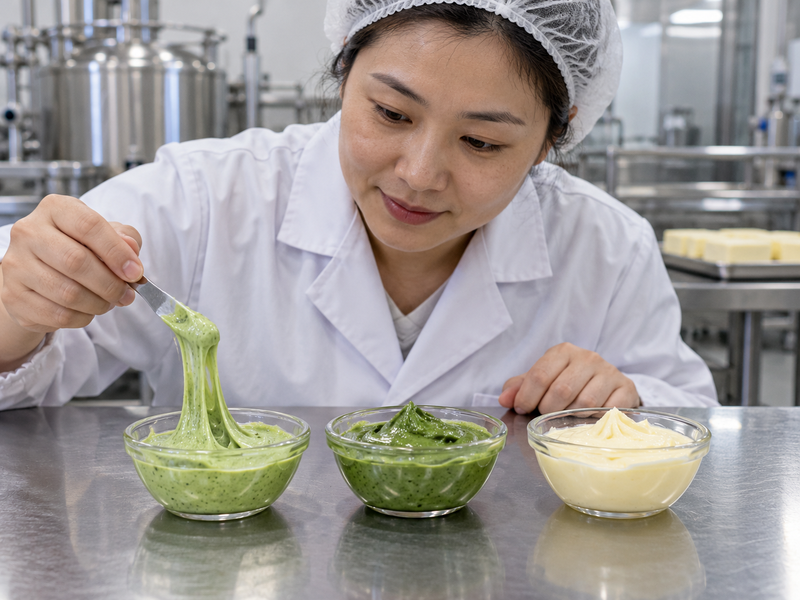
Write the product identity before the ingredient specification. A dairy processed-cheese spread, an analogue made with dairy proteins and vegetable fat, and a plant-based cheese alternative have different fat, protein, emulsifier and starch systems. Their heat treatments and permitted names also differ by market. A green powder may disperse easily in a soft spread yet make slices brittle or reduce melt in a hot sandwich.
State whether the product is intended to spread cold, shred, slice, brown or melt, and identify the consumer use that controls acceptance. The published analogue study tested one S. maxima formulation and three addition levels; it does not establish that a vegan coconut-fat slice will behave similarly. Make a control product under identical conditions and compare each candidate to that control, not to an abstract “good cheese” description.
| Product type | Functional target | Key comparison |
|---|---|---|
| Dairy spread | Smooth cold spread and stable fat | Penetration and oiling-off |
| Processed analogue | Controlled melt and texture | Melt area and separation |
| Plant-based block | Sliceability or grateability | Fracture and hot use |
2. What whole-biomass grade belongs in the brief?
Ask for a food-grade single-ingredient spirulina powder suitable for the chosen processing route, with identity, particle size, moisture, color, odor description, microbiology and relevant contaminant results. Describe “low odor” as your sensory requirement, not an unverified supplier promise. Obtain the TDS and actual sample-lot COA. Fine particles can reduce visible specks, but particle size alone does not guarantee smooth mouthfeel in a fat-and-water emulsion. Examine a heated sample under normal eating conditions.
Confirm whether the candidate is whole green biomass or a blue pigment extract; those are different materials and should not share a purchase specification. If the product must meet organic or another voluntary claim, request documentation for the exact supply chain and destination. Avoid accepting a general company certificate as evidence for the ingredient lot.
| Supplier field | Buyer question | Verification point |
|---|---|---|
| Identity | Which species and format? | TDS and label declaration |
| Physical | Fineness, moisture, color? | Lot result and incoming check |
| Safety | Relevant microbes and contaminants? | Lot COA and risk plan |
| Claim | Organic or other status needed? | Valid scope and traceability |
3. How should the formula ladder be built?
Use a control and several internally selected additions that cover a plausible sensory range. Keep the intended cheese base, total batch mass, process and pack identical. Document which ingredient is displaced as spirulina rises; otherwise an apparent viscosity change may be a solids change rather than a spirulina effect. If the formulation contains colorants, run a version without them or keep them fixed so the green effect can be interpreted. Make coded samples and randomize the tasting order.
The processed-cheese study used 1%, 2% and 3% S. maxima, observed changes in melt and color, and reported better sensory acceptance at its lower levels than at 3%. Those are research conditions, not default commercial doses. Set a narrower or lower ladder if the brand’s flavor brief requires it.
| Arm | Controlled variable | Measurement purpose |
|---|---|---|
| Reference | No spirulina | Baseline melt, taste and color |
| Trial A | Lower buyer-selected dose | Detect first visible effect |
| Trial B | Middle buyer-selected dose | Check useful window |
| Trial C | Upper buyer-selected dose | Reveal failure threshold |
4. Where does the heat and mixing sequence matter?
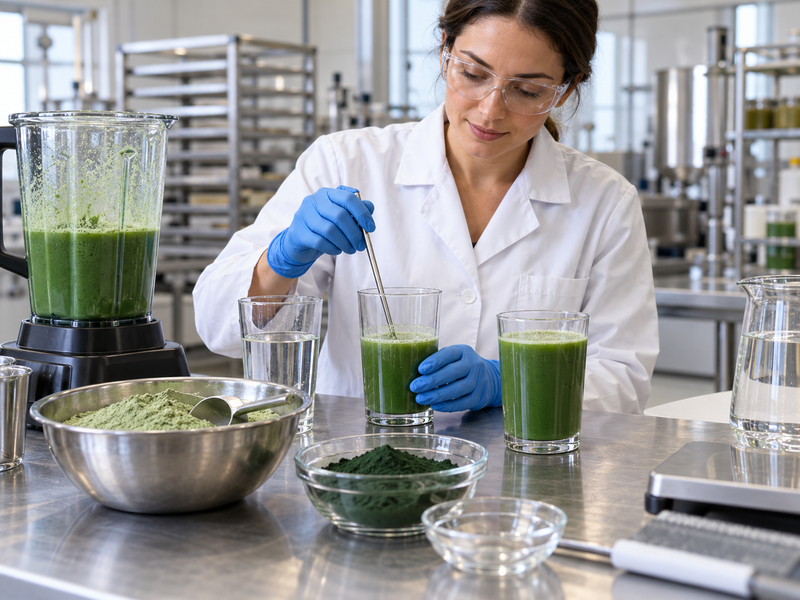
Record the temperature of the cheese mass, heating time, shear or rotor speed, powder addition point, hold time before filling and final cooling profile. An ingredient added into cold fat may form dry pockets; the same powder pre-dispersed in a compatible aqueous phase may distribute more evenly. That is a process option to test, not a guaranteed fix. Inspect for specks and sediment at the kettle, filler and finished pack.
If powder is added after the principal heat step, review microbiological controls with the plant’s hazard team; a late addition changes the process’s risk profile. If a hot mix shifts color or odor, compare a later addition that the equipment and food-safety system can actually support. Record batch size and mixing energy, because a beaker trial rarely reproduces a production cooker.
5. How do you test melt and spreadability?
Choose tests that match the promised use. For a cold spread, measure firmness at a set temperature with a defined probe and assess spread on bread. A meltable slice needs an expansion or melt-area measure under one time-temperature method, plus an oil-separation score. Blocks call for fracture and slice-quality checks alongside any hot application. Compare the same-aged samples, since fat crystallization and hydration change texture after filling.
Use photographs under fixed light, instrument readings where practical and a trained panel; no single measurement captures consumer performance. The 2020 analogue study observed lower meltability and oil separation in its spirulina treatments. That directional finding reinforces the need for both tests, not a claim that every spirulina powder will stabilize fat. Determine which trade-off your product can accept before pricing a lot.
| Performance gate | Example method | Failure to watch |
|---|---|---|
| Cold spread | Fixed-temperature penetration | Too stiff or grainy |
| Melt | Standard heated-disc test | Poor flow or excessive oil |
| Slice | Defined blade and pack temperature | Cracks and tearing |
| Mouthfeel | Blind tasting at serving temperature | Particles or waxy finish |
6. What color result should pass?
Decide whether the product is deliberately green or whether only a subtle tint is acceptable. Photograph the freshly made surface and cut interior against a standard background. Record instrumental color if the brand has a shade tolerance; use the same sample thickness and light source for every reading. Check whether dairy whiteness, starch opacity or added flavor pieces change the perceived green. Follow the color through the intended heat use and storage, not just at the kettle.
A product called “blue cheese” is a flavor or style name and says nothing about use of isolated blue spirulina extract. Whole spirulina is green biomass, so the buyer should not expect a bright blue hue. If color is unacceptable at a nutritionally meaningful dose, reformulate the product brief rather than assuming an invisible high addition is possible.
7. How do you screen odor and flavor?
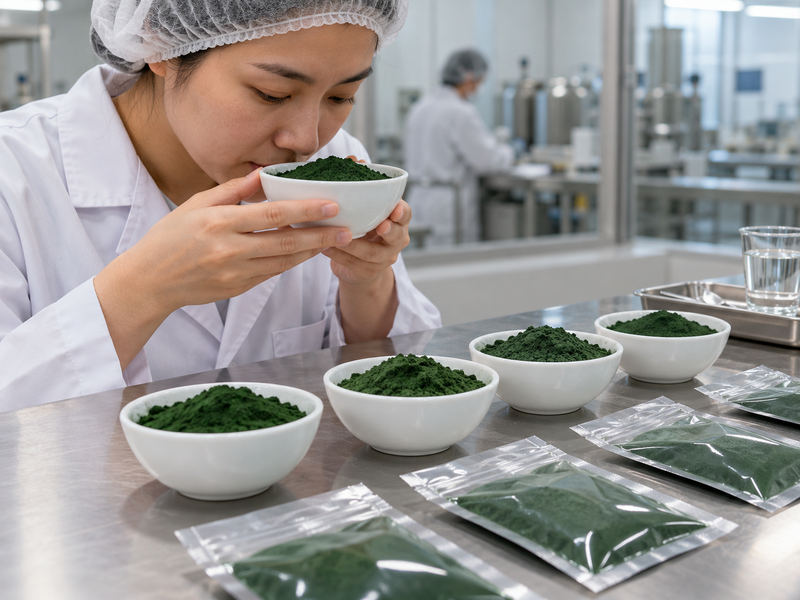
Evaluate opening odor, flavor on a plain cracker or bread, aftertaste and any change after melting. Use the finished salt, acid, fat and flavor system: a powder sniff test cannot predict performance in cheese. Make coded comparisons with identical serving temperature and time out of refrigeration. A strong smoky or herb flavor may mask one note but create another purchasing cost; record any extra flavoring required to keep acceptance.
Ask tasters to distinguish “too green visually” from “too algal in flavor” so the team knows whether the problem is dose, color positioning or raw-material quality. Include the intended consumer group or a sensory panel trained to the product category. Avoid inferring a universal taste threshold from the published analogue study; its recipe and panel were specific.
8. What changes during refrigerated storage?
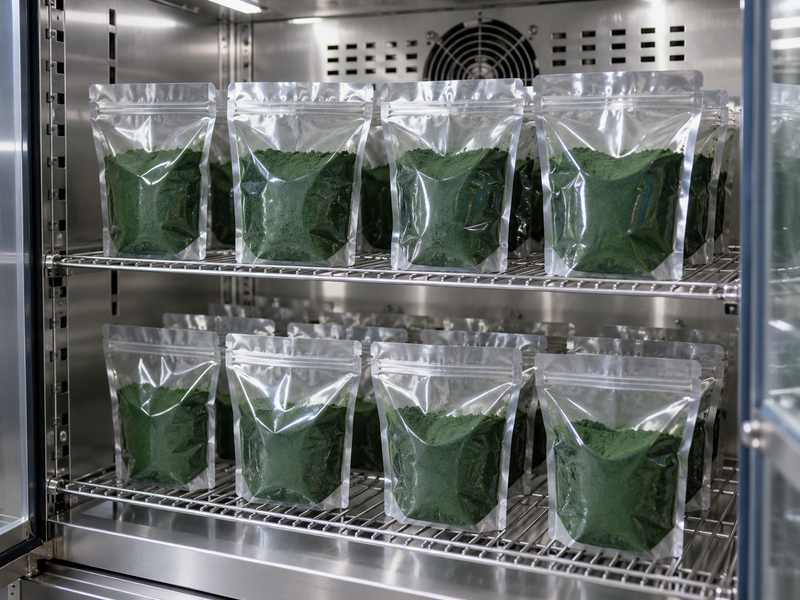
Define a hold schedule covering release, midlife and the proposed end of shelf life. Check surface color, oiling-off, water separation, firmness, package appearance, odor and flavor. Include a retail temperature scenario justified by the product’s distribution plan. If a slice or spread is likely to be used after opening, add an opened-pack handling evaluation within the approved consumer instructions. Test microbiology according to the product’s hazard analysis.
The research paper followed its analogue during cold storage, but a buyer’s shelf-life decision belongs to the actual base, thermal process and package. A fresh sample can pass while a later sample turns bitter or separates. Keep lot and batch identifiers in every hold sample so failures can be traced to ingredient, process or packaging changes.
| Hold checkpoint | Physical result | Sensory or quality result |
|---|---|---|
| Release | Melt and spread | Initial flavor and color |
| Midlife | Separation and firmness | Odor and taste drift |
| End of life | Texture and pack integrity | Acceptance and microbiology |
9. Which quality and label checks matter?
Confirm lot-linked species identity, ingredient and processing declarations, microbiological limits, relevant contaminants, and any destination-specific requirements. The finished-food maker should approve the material against its own raw-material specification and not assume a supplier COA alone covers a ready-to-eat refrigerated product. Label naming rules may differ for dairy processed cheese and plant-based alternatives; review the finished product category and claims in each destination. Nutritional statements require serving-level calculation and, where necessary, finished-product testing. Do not transfer a study’s antioxidant or health outcome to a commercial package.
Request a current quote only after the application parameters are clear, including required packaging, expected monthly call-offs and delivery destination. Confirm whether a pilot sample and later commercial lots share the same grade specification.
| Evidence | Release use | What it cannot prove |
|---|---|---|
| Ingredient COA | Incoming quality | Cheese shelf life |
| TDS | Target grade | Every future lot result |
| Pilot record | Formula and process fit | Different cheese base |
| Finished-product tests | Label and shelf-life review | Other markets automatically |

10. When is a bulk approval justified?
Approve only when a named powder lot passes the cheese base’s melt or spread gate, color range, chilled sensory score, microbiological and contaminant requirements, and shelf-life plan. Record the approved addition point, temperature range, mixing time, ingredient dose and packaging. If the purchasing team changes from a dairy analogue to a vegan base, require a new formula qualification. If a later lot changes color or odor, use retained reference samples and agreed acceptance methods.
Calculate delivered cost per sellable cheese unit after any extra flavoring or yield loss; a low per-kilogram powder price is not enough. For a narrow sensory range, test a second supplier lot before annual commitment. The purchase order should reference the signed specification and deviation process, not merely “food-grade spirulina.”
Prepare a decision packet with photographs of cold and heated product, instrument or panel results, oil-separation observations, and the storage timeline. Note where each sample was taken in the cooker and filling sequence. If the pilot’s first tubs pass but later tubs show green streaks, the ingredient may be acceptable while the addition or mixing procedure is not. Resolve that distinction before signing a volume contract.
Likewise, if the cheese passes cold spread but fails a hot sandwich test, decide whether hot use is actually promised on pack. The answer changes the gate; it should not be retrofitted after seeing an unfavorable result.
Keep ingredient and product approvals separate
Keep separate approvals for ingredient quality and finished-cheese performance. Incoming quality may accept a powder lot that matches its COA, while production can still reject its use in a specific recipe because of a sensory or process issue. Write both outcomes into the supply agreement, including who pays for a replacement sample or retest. If color is a differentiating feature, maintain a physical finished-product reference under controlled storage and review it alongside numeric color readings.
This makes a repeat order easier to manage when different staff or plants evaluate the next shipment.
FAQ
Q1. Does a processed-cheese study prove this grade will melt well? No. Its S. maxima analogue results identify useful tests; your base and lot need their own pilot.
Q2. Can whole spirulina produce a bright blue cheese color? Whole biomass is green. A blue extract is a different ingredient and requires separate review.
Q3. Should low odor be part of the specification? Yes, define a sensory method and tolerance using the actual cheese.
Q4. Is a fresh-pack taste test sufficient? No. Test through the intended refrigerated life and hot use, if relevant.
Q5. Can one approval cover dairy and vegan cheese? No. The bases and functional targets differ.
Next step: Contact SpirulinaCN with your dairy or plant-based cheese base, heat sequence, target color, shelf-life period, anticipated quantity and destination. Request a food-grade sample, TDS, lot COA and bulk quote after a matched melt, spread and chilled sensory pilot.