
An attractive green composite sample can hide pale or dense pockets elsewhere in a production lot. Spirulina powder blending uniformity means each intended portion meets agreed product attributes within justified limits. Food buyers need a sampling map, suitable test and control of segregation after mixing. A powder-mixing research review explains why measuring mixture content matters; the plan below applies that principle to commercial spirulina powder.
Contents
- What does uniformity mean for this powder?
- Which incoming differences challenge mixing?
- How should a trial blend be designed?
- Where should samples be taken?
- Which measurements can represent uniformity?
- How can mixing time be qualified?
- Why can a good blend segregate later?
- How should acceptance limits be agreed?
- What evidence should the supplier give a buyer?
- How should deviations and changes be handled?
1. What does uniformity mean for this powder?
Define the attribute and the sample scale
Uniformity is not a claim that every particle is identical. For example, a commercial spirulina blend may combine several biomass lots to meet color, protein, particle-size or sensory targets. Instead, ask whether portions taken at the scale used by your manufacturing process stay inside agreed limits. A 20-kilogram sack used as one batch poses a different exposure than a small sachet filled from the same blend. Then, write down the attribute, sample mass and decision rule before testing. “Even color” without a method invites inconsistent visual judgments.
Make the specification operational. If the buyer needs consistent color in a snack, state a controlled color method and sample preparation. If the goal is a labelled ingredient amount per tablet, the finished dosage process needs its own uniformity checks; a blended bulk result alone cannot prove tablet content. The manufacturer should identify whether it is blending pure spirulina lots or adding permitted carriers and other ingredients. That distinction affects labels, calculations and test markers. Ask for a blend map from input containers to output packs. A meaningful claim about spirulina powder blending uniformity rests on that defined process and scale.
2. Which incoming differences challenge mixing?
Check size, density, moisture and color
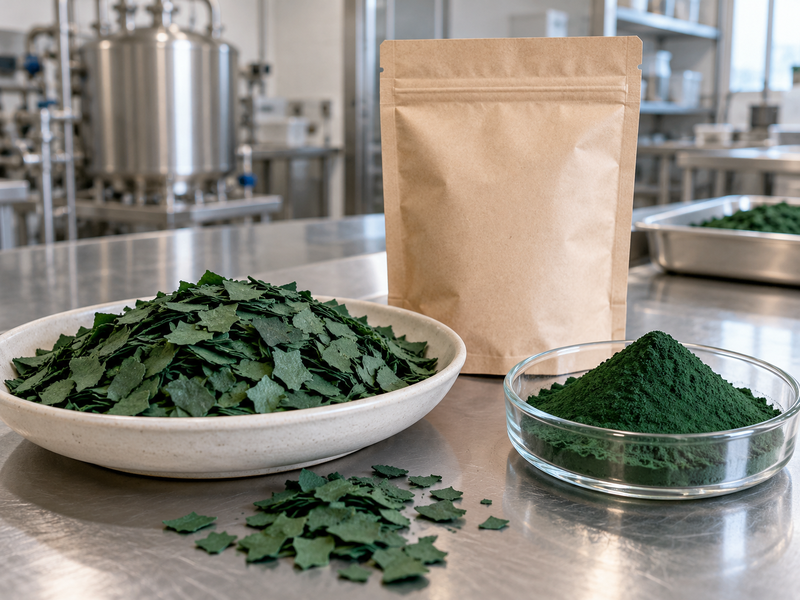
Two spirulina powders may carry the same ingredient name yet move differently through a blender. For example, fine particles can form agglomerates. A denser fraction may collect in a hopper. Powder with more available moisture can adhere to walls while a dry fraction flows. Different milling settings can create broad particle-size distributions. As a result, record these properties for each input lot and compare them before charging the blend. If one lot is visibly clumped, breaking lumps under a defined procedure may be needed before mixing. Do not assume a long run will erase large physical differences.
A small example helps. One drum of fine, dark powder may make a composite look evenly green even though later packs contain too much of that fraction. Ask for input weights and pre-blend observations. A published powder-mixing study found that sample position and sampling technique can affect a homogeneity assessment; it studied another powder system, so use the concept rather than its numerical results for spirulina. Define a supplier trigger for unusual input properties. Hold the lot or trial it separately when an input lies outside the proven operating range.
| Input property | Possible blend effect | Practical check |
|---|---|---|
| Particle size | Percolation and uneven flow | Sieve profile |
| Bulk density | Layering in hopper | Density test |
| Moisture condition | Lumps and wall adhesion | Moisture or water activity |
| Color | Visible variation | Standardized color reading |
3. How should a trial blend be designed?
Test the actual batch and equipment
Next, use the intended blender, fill level, loading order, mixing speed and discharge method. However, a tabletop trial cannot establish that a full vessel works the same way. Next, record the exact input lots and weights. If a low-dose ingredient or carrier is present, assess whether premixing is needed. Mark points in the run where samples will be taken before seeing the results. Include start-up and full-load conditions that can differ from a steady demonstration. Change only one major process factor at a time when diagnosing a problem.
Do not chase a perfect composite. The purpose is to find a reliable operating window: enough mixing for distribution without excessive handling, dust generation or clumping. Run a baseline, then planned shorter or longer trials if evidence calls for them. Also, record cleaning status before each trial to prevent previous material from biasing the outcome. Retain samples and instrument settings so a result can be checked later. For a buyer, a concise trial report should show why the chosen process represents future production rather than one carefully prepared sample. Food production and process controls sit within the broader FDA CGMP framework for applicable U.S. facilities.
4. Where should samples be taken?
Sample places that could disagree
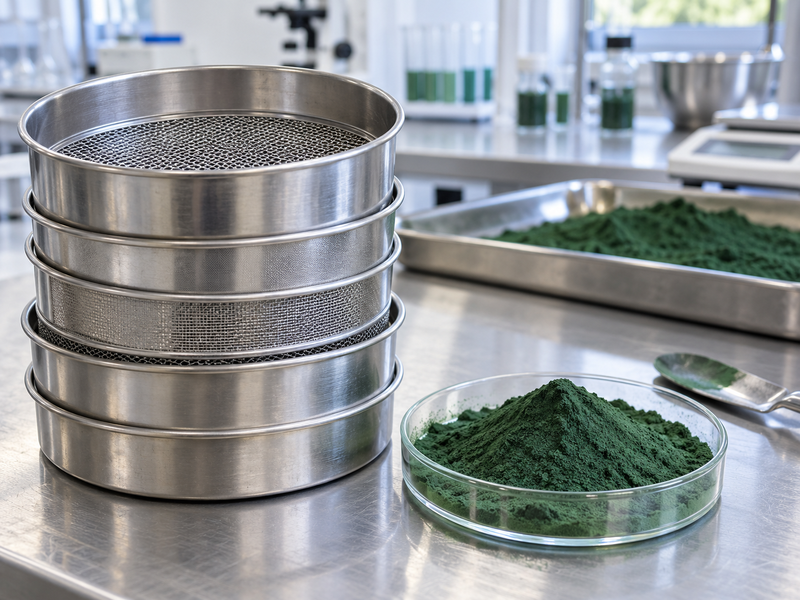
Next, collect from several defined locations in the blender or at discharge across time. Near the top hatch, at a wall, near the shaft and at the outlet may behave differently. The exact map depends on equipment design and safe access. Otherwise, a single composite can average a rich pocket with a lean pocket. If the method samples flowing powder, record whether you collected an entire cross-section or a scoop from the surface. Use the same sample mass and technique at every location. Invasive probes can themselves cause sampling bias, so qualify how they are used.
Follow the material out. Samples taken only before discharge miss possible separation in a chute or packing hopper. Include early, middle and late packs where feasible. If a batch fills small containers over several hours, compare both time and location. Then, keep each sample separate for analysis before considering a composite. Label sample IDs with vessel position, time, operator and parent batch. A research paper on powder blend monitoring illustrates how location can influence results, though its specific test system differs from food spirulina. Your own sampling map should match the blender and commercial pack path being qualified.
| Sample point | What it may reveal | Record needed |
|---|---|---|
| Top or wall | Dead zone | Vessel location |
| Outlet start | Early discharge bias | Time and mass |
| Outlet end | Late concentration | Time and mass |
| Packed units | Post-blend segregation | Pack code |
5. Which measurements can represent uniformity?
Pick a marker tied to the buyer’s purpose
For example, color measurement can be useful for a color-driven application, provided lighting, sample depth and instrument calibration are controlled. A composition marker may better represent a labelled ingredient or a blend with a carrier. Particle-size distribution or microscopy can reveal physical segregation even when chemical composition appears steady. For pure spirulina blended from several similar lots, a single marker may lack enough contrast to show mixing defects. Build the method around the actual difference you need to detect, then document precision and sample preparation.
Do not confuse a pretty result with a useful one. An image of green powder cannot quantify spread across packs. Also, a certificate reporting one average protein value cannot demonstrate within-batch variability. Use an appropriate analytical or physical method, then compare individual observations rather than hiding them in a grand mean. If multiple attributes matter, measure more than one. For example, use color alongside particle size when a product both colors a beverage and feeds a filling machine. The FDA method-validation resources provide broader principles for analytical methods; the supplier should demonstrate fitness for this powder and its chosen marker.
6. How can mixing time be qualified?
Look for a stable region, not a magic minute
Then, take planned samples at several mixing times while keeping fill, speed and input properties controlled. Compare spread among locations, not just the average result. Early samples may show poor distribution; later samples may improve until the process reaches a stable region. Still, more mixing is not automatically better. Fragile particles may break, heat can build in equipment and fine fractions can later segregate more readily. The chosen time should sit inside a workable operating window, with tolerances that staff can follow on every shift.
Ask what happens after an interruption. A power stop, maintenance pause or late ingredient addition may change the effective mix history. Define how the operator resumes and when a fresh sample is required. Record load time, actual run time, discharge duration and any alarms. For that reason, qualify different batch sizes rather than extrapolating from one volume. Test a realistic worst case, such as the maximum fill or most dissimilar input lots. A supplier can provide a summary of its study without handing over proprietary recipes. Buyers need enough detail to see that the process was tested at the scale they will purchase.
| Trial variable | Hold constant | Decision signal |
|---|---|---|
| Time | Batch size and input lots | Spread across points |
| Fill level | Speed and recipe | Dead-zone behavior |
| Loading order | Input composition | Early pockets |
| Restart | Documented pause | Repeatability |
7. Why can a good blend segregate later?
Check transfers after the blender
After mixing, powder can separate during discharge, vibration, pneumatic transfer, hopper residence or bag filling. Different sizes and densities move at different rates; a fine fraction may also stick to a wall. As a result, a good vessel sample does not guarantee that the last carton resembles the initial one. Observe the complete route from mixer outlet to sealed package. Note drop height, transfer method, holding time and whether operators top up a partially empty hopper with a new batch. Avoid commingling unlinked lots during that top-up.
This is the buyer’s blind spot: a supplier may show blending data but no packed-unit checks. Ask for start, middle and end pack results from a qualification run. Compare those with blend samples. If spread grows after discharge, revise handling rather than simply extending mix time. Potential controls include reducing long free-fall transfers, using a suitable feed system and setting a maximum hopper hold. Any change should be verified with the same measurement method. The published food-powder flowability study addresses how powder properties affect mixing and flow; its measured materials differ, so verify the actual spirulina system before adopting a process setting.

8. How should acceptance limits be agreed?
Make the decision rule measurable
The buyer and supplier should agree the measured attribute, method, sample size, number and location of samples, allowed spread and treatment of outliers. Otherwise, a percentage chosen without method precision or product-use context can mislead both parties. Start with the buyer’s application and the instrument’s repeatability. Then inspect trial data across representative production lots. Set a limit that protects the finished product and can be checked reproducibly. If the specification requires individual pack compliance, do not substitute a batch average. Include the revision and effective date on each released production instruction.
Keep statistics in their place. Relative standard deviation can summarize a sample set, but it does not reveal a systematic high result at the end of filling. Show the individual values and sample positions beside any summary statistic. Define how a failed point triggers investigation, hold and resampling. Still, a failed result should not vanish because additional samples later lower the average. If the method changes, compare old and new results before claiming improved performance. Distinguish a process-action threshold from a final product acceptance limit. That separation helps teams intervene early without rewriting the sales specification after a difficult run.
| Agreement element | Write down | Common ambiguity |
|---|---|---|
| Attribute | Color or composition marker | “Consistent” only |
| Sampling | Point and mass | Composite only |
| Limit | Individual and spread rules | Average alone |
| Failure response | Hold and investigation | Ad hoc retest |
9. What evidence should the supplier give a buyer?
Request the study summary and routine controls
Ask for a process flow, qualified batch-size range, selected blending time, sampling map, method summary, acceptance criteria and representative data. The supplier need not disclose every proprietary machine detail, but it should show how it knows the process works. For each commercial lot, a COA can report release attributes while the batch record captures actual time, fill, inputs and deviations. Keep the supplier’s internal and buyer’s product codes aligned. A photo of an empty mixer or a generic food-safety certificate does not answer whether this SKU is uniform.
Ask for one real lot: compare its charged inputs with released quantity and the sample IDs on its test report. If the lot combines several source lots, confirm the genealogy. Request records for a nonconforming blend too, if available; the response reveals how the supplier controls failure. Also, a buyer making a sensitive finished product may need independent verification during onboarding or after major changes. Match that activity to the known risk and intended use. The FDA preventive-controls guidance outlines verification concepts for regulated U.S. food facilities, though your supplier review should use the actual contract and market requirements.

10. How should deviations and changes be handled?
Hold the affected lot and requalify meaningful changes
If results fail, quarantine the blend and its packed units. Examine sample handling, method performance, charge weights, equipment condition and transfer behavior before deciding whether reblending or rejection is appropriate. Then, any reblend needs a controlled instruction and a complete parent-to-child record. Do not erase the original result. If a supplier changes blender, batch size, mill screen, carrier, site or sampling method, ask whether the change falls outside the qualified range. As a result, a change-control notice should arrive before commercial stock from the revised process ships.
Finish with application feedback. A blend that meets a laboratory color rule may still streak in dough or settle in a beverage. Then, record those observations and decide whether the bulk specification or downstream process needs work. Spirulina powder blending uniformity is a property of the full route from inputs through packing, not a single mixing time. Ask the supplier for a location-based study and compare it with your finished-product needs before approving the next volume order.
| Change | Review focus | Possible response |
|---|---|---|
| New blender | Geometry and discharge | New qualification |
| New input grade | Size and density | Trial blend |
| Bigger batch | Fill and mixing window | Range study |
| Failed result | Scope and root cause | Hold, investigate |
FAQ
Q1: Does a composite sample prove blend uniformity? No. It can mask differences between vessel locations or packed units.
Q2: Is longer mixing always safer? No. Test the selected window because extra mixing and handling may change particles or later segregation.
Q3: Which marker should a buyer choose? Select a validated measure tied to the finished application’s risk, such as color, composition or particle size.
Q4: Should the supplier test packed bags? Yes, qualification should assess whether transfer and filling change the distribution seen in the blender.
Q5: What happens after a failed point? Hold affected material, investigate method and process, then approve any rework under a documented plan.