
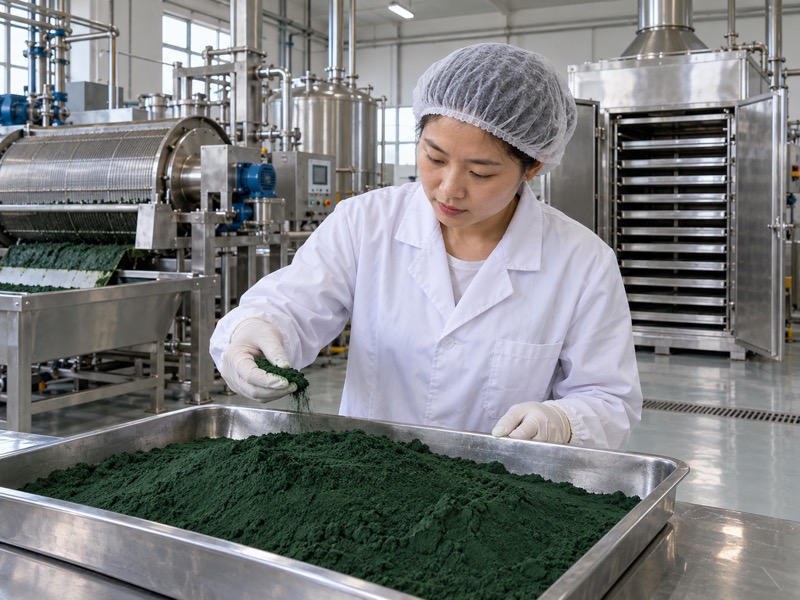
A spirulina powder making process starts with cultivated Arthrospira biomass and ends with a dry, traceable whole-green ingredient. Buyers often see a powder sample without knowing how its culture, harvest, drying, and packing were controlled. This guide follows that complete production route and shows which records to request at each handoff. It concerns whole green biomass, not extracted blue phycocyanin.
Contents: identity · culture · water · harvest · dewatering · drying · milling · testing · traceability · buyers
1. What does the spirulina powder making process produce?
Define whole biomass before reviewing a process
The commercial name spirulina commonly refers to cultivated Arthrospira species. In this article, spirulina powder means dried and milled whole biomass. It retains the green color and the broad mixture of components present in the algal material. Blue spirulina is usually a phycocyanin-rich extract and follows a different separation route after biomass production. A buyer should ask which material a flow chart describes before comparing yields, prices, or test results. The distinction also prevents a blue-extract specification from being attached to a green whole-powder shipment. See our blue versus green spirulina explanation for a form-level comparison.
Start with one definition. Ask for the scientific identity, commercial form, ingredient statement, and a current specification. Record whether the finished material is pure whole biomass or contains a carrier, flow aid, or other declared ingredient. The supplier’s current catalog includes whole spirulina as powder and tablets; it does not establish a particular strain, farm design, drying method, certification, or assay. Those details require product-specific records. The FAO production review describes Arthrospira cultivation, harvest, and processing as linked operations, which is why a finished-powder sample alone cannot explain process control.
| Product description | Main physical route | Buyer should request |
|---|---|---|
| Whole green spirulina powder | Culture, harvest, dewater, dry, mill, pack | Identity, batch history, powder specification |
| Whole spirulina tablet | Whole powder plus tablet-forming steps | Powder lot link, formulation, tablet controls |
| Blue spirulina extract | Biomass plus extraction and purification | Extract composition and separate specification |
2. How does the spirulina powder making process start a culture?
Follow seed material into the production unit
A spirulina powder making process begins before a pond or reactor is filled. The producer maintains a defined culture, expands it through inoculum stages, and transfers it into a larger unit under controlled conditions. The buyer does not need proprietary media recipes. They do need assurance that the culture identity, source, transfer dates, and contamination checks are recorded. A culture that drifts or becomes mixed with other organisms may change color, composition, odor, or downstream separation behavior. Ask how the team decides that inoculum can enter production, and what happens when that decision fails.
The growing system may be an open raceway or an enclosed photobioreactor. Neither label proves powder quality by itself. Open systems require environmental surveillance; enclosed systems still depend on cleaning, incoming water, and operator practices. The peer-reviewed cultivation review describes how production approaches lead to different quality outcomes. Trace the culture backwards. A harvest record should link to its cultivation unit and seed-culture record.
3. Which water and nutrient controls shape the biomass?
Examine inputs and the environment together
Spirulina grows in an aqueous medium and takes up material from that environment. Water quality, nutrient inputs, light, mixing, temperature, and pH therefore affect both productivity and risk. A buyer should ask how source water is qualified, which inputs are approved, how additions are logged, and whether changes in a water source trigger review. The specific operating set points depend on the strain and facility. Copying numbers from a general article into a purchase specification would give false precision. Ask the producer for its validated ranges and action limits instead.
Water and nutrient checks should connect to contaminant management. If a source changes seasonally, a historical analysis may no longer describe current exposure. Ask whether growing medium, harvest water, and final powder were reviewed separately. Clean incoming water cannot substitute for a finished-lot result. Ask where the number came from. A chart should identify the unit, date, method, result, and response to an out-of-range value.
| Input or condition | Routine question | Evidence to inspect |
|---|---|---|
| Source water | Has the source or treatment changed? | Source approval and current analysis |
| Nutrient inputs | Are additions approved and logged? | Material identity and addition record |
| Mixing and light | Is exposure reasonably consistent? | Equipment and monitoring log |
| Culture condition | What triggers investigation? | Trend chart and deviation record |
4. When and how is spirulina harvested?
Connect harvest timing to powder quality
Harvest begins when the culture meets the producer’s release criteria for biomass collection. Concentration, culture health, and contaminant observations should inform that decision. During collection, filtration or screening separates filamentous biomass from much of the culture medium. Equipment selection and screen condition matter because damaged or poorly captured biomass changes yield and may raise losses. The FAO review describes harvest and processing as a critical stage for commercial spirulina; it also notes that pumping and filtration can damage filaments. A buyer can ask for the harvest method without demanding machine settings that belong to the producer’s process know-how.
Look at the handoff. Request the time between harvest and the next controlled step, equipment cleaning, and the harvest batch identifier. Wet biomass is less stable than dry powder, so a recorded hold time and condition beats “same day.” If several cultivation units feed one dewatering batch, list them. Preserve any split into multiple dryer runs.
5. How does wet biomass become a drying feed?
Control washing, concentration, and temporary holds
After harvest, a producer may wash biomass, drain it, or use mechanical dewatering to concentrate it before drying. Each step changes how much water and residual medium enter the dryer. The exact sequence differs across plants, and a buyer should avoid assuming all spirulina powder follows an identical recipe. Ask what water contacts the biomass, whether that water is qualified for its intended use, and how the producer prevents recontamination during transfer. Note any intentional additions; whole biomass powder should not quietly acquire an undeclared carrier at this stage.
A practical audit follows mass balance. Harvested wet mass, dewatered mass, and dryer input should be plausible against measured solids content. Unexplained losses may signal a broken filter, transfer residue, or poor records. A hold before drying needs a defined maximum time and condition. Follow the wet lot. Its identifier should stay visible through wash, dewatering, and dryer charging. The Frontiers review contrasts conventional powder production with fresh spirulina.
| Handoff | Buyer question | Record that answers it |
|---|---|---|
| Harvest to wash | Which water touched the biomass? | Water and wash record |
| Wash to dewatering | How was contamination avoided? | Equipment cleaning and transfer record |
| Dewatering to dryer | How long was wet material held? | Time, condition, and lot log |
| Dryer charging | Were multiple harvests combined? | Charge sheet and mass balance |
6. How is spirulina dried without losing control of quality?
Judge the method against an agreed specification
Drying removes water so biomass can be milled, packed, and handled as a powder. Producers use different systems, including spray, convective, vacuum, or other controlled drying methods. A method name alone does not predict every pigment, nutrient, or microbiological result. Feed solids, residence time, air quality, surface exposure, outlet conditions, and equipment cleaning all contribute. Rather than requesting a marketing claim such as “low temperature,” ask which finished attributes the facility measures and what operating records support them. The FAO review discusses spray drying and other process choices; the Frontiers review compares fresh and conventional forms.
Moisture and water activity deserve separate attention. Moisture measures total water by a specified method; water activity describes water available for microbial growth and chemical change. They are related but not interchangeable. Ask for the finished limits, method, and trend across lots rather than borrowing a universal threshold. Check the exit, not just the dryer setting. Color, odor, moisture, microbial findings, and yield should be reviewed at the finished material stage. If a dryer run is reworked or blended, the record must show where that material went and how it was released.
7. What happens after drying and before packing?
Keep powder handling visible in the batch record
Dried spirulina may be milled, sieved, blended for uniformity, and checked for foreign material before packing. Particle size affects flow, mixing, appearance, and dust generation. A drink or sachet maker may need a different target from a tablet maker. The producer should state the method and range used for the offered grade. Trial powder in the intended application rather than treating a sieve number as proof of performance.
Protecting the dry powder from moisture and cross-contact now matters as much as the dryer. Ask how mills and contact surfaces are cleaned, whether sifter screens are inspected, and how metal detection or another foreign-material control is verified. Watch the open-powder interval. The batch record should tell reviewers how long product was exposed, whether material was reworked, and which packaging lot received it. An end-of-line certificate cannot reconstruct a missing post-drying step. These checks make the spirulina powder making process auditable rather than merely plausible on paper.
| Post-drying control | Why it matters | Evidence |
|---|---|---|
| Milling and sieving | Determines physical grade and removes oversize material | Settings, screen integrity, particle test |
| Foreign-material control | Limits metal or other intrusion | Challenge checks and reject log |
| Cleaning | Prevents residue and cross-contact | Line clearance and cleaning record |
| Packing | Protects a released lot | Pack identity, seal and weight checks |
8. Which tests release a finished powder lot?
Separate process checks from lot release evidence
The finished specification should identify the tests that matter for the agreed application and market. Common groups include identity, appearance, moisture or water activity, microbiology, heavy metals, and physical properties. The exact analytes, limits, methods, and sampling plan belong in a written specification. A certificate of analysis should name the actual lot, result, unit, method where relevant, and release decision. A generic “passed” sheet without a method or lot link is hard for a buyer to verify. The FDA dietary supplement CGMP guide describes specification and batch-record requirements for U.S. dietary supplement manufacturing; requirements differ for other product uses and markets.
Read the result column. A heavy-metal result below the laboratory reporting limit still needs the limit shown, or the buyer cannot compare it with a purchase threshold. A microbial result from a composite or retained sample should state the sampling basis. An independent lab report can strengthen confidence, but the buyer must confirm it covers the offered production lot. No certification, specific assay, or plant capability is assumed from the supplier’s general product list. A useful contract names who releases a lot when results are late or conflicting.
9. How should records follow one lot through production?
Build a forward and backward trace
A buyer should be able to start with a finished pouch or drum and trace backwards to a packaging run, dryer run, dewatering batch, harvest, cultivation unit, and approved inputs. The same system should trace forward from a suspect input to all affected finished lots. This does not mean every detail belongs on a label. It means each change of material identity is captured somewhere in controlled records. If a batch is split, combined, or reworked, the relationship should be explicit. The FDA CGMP guide lists batch production record elements for supplements, including component identifiers, equipment, monitoring, testing, and quality release.
Run a paper exercise. Give the supplier a sample lot number and ask for its one-page genealogy, packaging code, and COA. Then ask which other lots would be affected if a named water source or dryer run were questioned. Speed matters, but completeness matters more. The exercise reveals whether records are merely filed or can actually support a withdrawal, complaint investigation, or change review. A photograph of a tidy facility cannot answer this question.
| Trace direction | Starting point | Expected endpoint |
|---|---|---|
| Backward | Finished package lot | Harvest units and approved inputs |
| Forward | Input or cultivation unit | Every linked powder and tablet lot |
| Complaint | Customer package code | Retained sample and investigation record |
| Change control | New source or process setting | Affected products and requalification plan |
10. How can a buyer audit a spirulina powder making process?
Ask for a lot-sized evidence pack
Start with one real lot, not a brochure. Request a process flow, specification, lot COA, representative batch genealogy, sampling plan, packaging description, and a summary of deviations affecting that lot. Ask whether the material sold is whole green powder or a blue extract, and confirm that the documents use the same identity. Then test one application sample against the production-lot specification. If the formulation demands fine dispersion, define the trial method. If it will be pressed into tablets, request data on physical handling and any proposed tablet ingredients.
An audit can proceed in stages. Review documents before a remote meeting, use that meeting to resolve missing links, and visit or commission an audit when the purchase risk justifies it. Make the question specific. “Show the harvest-to-pack trail for lot X” yields more than “Are you GMP?” A supplier may hold certifications, but those must be verified for the exact site and activity; none is established by this article. Close the review with written acceptance criteria, a change-notification rule, and a named contact for deviations. Those terms make the spirulina powder making process relevant to a purchase rather than a factory tour.
The practical sequence is culture, controlled growth, harvest, dewatering, drying, milling, testing, and packing. Ask the seller for one linked production record and compare its results with your intended use before placing a bulk order. A documented lot gives your team a defensible starting point for formulation and quality approval.
FAQ
Q1: Is whole spirulina powder the same as blue spirulina powder? No. Whole green powder is dried biomass; blue spirulina usually denotes a phycocyanin-rich extract. Confirm composition for each offered grade.
Q2: Is spray drying required to make spirulina powder? No. Several drying methods are used. Evaluate finished attributes and validated controls for the actual method.
Q3: Can a sample prove that production lots will match? A sample supports a trial. Compare it with a defined specification and production-lot results before approving volume supply.
Q4: Which production record matters most to a buyer? A lot genealogy linking culture, harvest, dryer run, packing, and release data is a strong starting point.
Q5: Does a clean final COA replace an audit? No. A COA reports selected tests for a lot. An audit examines how the process produces and controls those results.