
A green powder may look normal when its pigments have faded, or it may clump after a humid shipment despite an intact printed date. A buyer cannot set chlorella powder shelf life by borrowing a number from a tablet package or a different algae ingredient. This guide shows how to evaluate an unopened powder’s proposed life through product-specific stability data, packaging, storage conditions, and release limits. A study of dried *Chlorella vulgaris* under domestic storage documents why storage conditions matter. Your purchase specification still needs evidence from the actual commercial formulation and pack.
Contents: definition · failure · evidence · packaging · conditions · testing · acceleration · opened · receiving · approval.
1. What does chlorella powder shelf life cover?
Define the product and conditions behind a date
A date is a conditional claim. Shelf life is the period during which a particular powder, in a specified pack and storage environment, remains within defined safety and quality limits. It is not a timer attached to the word “chlorella.” Whole chlorella powder differs from compressed tablets, a finished blend, and blue phycocyanin extract. This supplier’s catalog confirms chlorella powder and tablets, but no lot-specific expiry period or pack barrier specification has been supplied for this article. The date must connect to manufacturing or packing date, and the evidence should match the marketed material. A consumer chlorella storage guide gives general duration estimates for different formats; do not copy them into a B2B ingredient specification. Ask whether the proposed period assumes an unopened original package, how deviations are handled, and whether a distributor has repacked the product.
| Scope question | Needed answer | Why it matters |
|---|---|---|
| Material | Whole chlorella powder or another form | Different stability behavior |
| Pack | Original sealed barrier and closure | Controls exposure |
| Date basis | Manufacture or packing date | Defines the clock |
| Storage | Temperature, humidity, light | Determines study relevance |
2. Which quality attributes can fail during storage?
Track safety and functional quality separately
Appearance alone is incomplete. Chlorella powder contains pigments, lipids, protein, minerals, and other constituents. Color can fade through pigment change; odor can shift as lipids oxidize; moisture uptake can cause clumping and change water activity. A package breach can introduce contamination risk. Protein mass may stay relatively stable while color or flavor no longer meets the buyer’s specification, so one nutrient result cannot carry the whole shelf-life claim. The study on dried *C. vulgaris* storage examined antioxidant activity and lipid profiles under tested conditions, illustrating that different endpoints respond differently. For a product used in a beverage, dispersion and sensory acceptance may be as important as a lab assay. Define failure before collecting data: for example, an agreed color difference, odor threshold, moisture limit, microbial criterion, or functional performance result. Each limit should have a test method and a justified link to finished-product requirements.
3. What stability study should support the date?
Use representative commercial lots and packs
Ask for the study design, not only the final month. A real-time study stores representative production lots in the final packaging under stated conditions, then tests predetermined endpoints at planned intervals through the proposed shelf life. A protocol should identify lot count, pack construction, seal method, sampling schedule, test methods, pass limits, and handling of outliers. Prefer lots that reflect normal process variability. Compare results with initial release values, because a late result that passes a broad limit may still show meaningful drift for a sensitive application. Record any packaging or supplier changes during the study. If the commercial pack is larger than the study pack, ask how headspace and barrier differences were evaluated. Evidence from a different algae, a tablet, or an unpacked laboratory sample does not establish an independent chlorella powder date. An extension beyond the tested interval needs a written scientific rationale and continued real-time confirmation, not a sales assertion.
| Protocol element | Buyer question | Red flag |
|---|---|---|
| Lots | Do they represent production? | Single hand-picked lab batch |
| Pack | Same material and closure? | Unspecified test container |
| Timepoints | Through proposed date? | Early results extrapolated silently |
| Criteria | Set before testing? | Limits chosen after results |
4. How does packaging protect the powder?
Inspect barriers, seals, and headspace
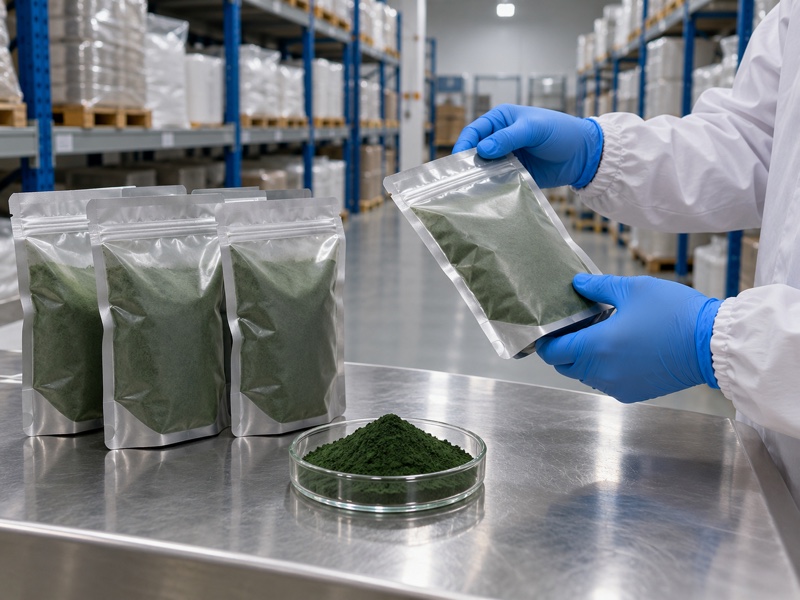
Packaging is part of the product. An opaque moisture-barrier pack can reduce light and humidity exposure, while an intact heat seal or closure keeps the protected environment in place. Oxygen barrier may matter for lipid and pigment stability, but a material name alone does not prove performance. Ask for the pack specification, applicable water-vapor and oxygen transmission data, sealing controls, and results of integrity checks. Consider how the material behaves after pallet stacking, transport vibration, and temperature changes. A zip closure used by a consumer after opening is not automatically equivalent to the original factory seal. The final shipping configuration should match the stability study as closely as possible. Check whether an inner liner, outer carton, desiccant, or headspace control was included in the actual test; do not assume such features exist in a supplier’s offer. If your operation repacks into smaller pouches, perform a separate assessment for that new package and handling process.
5. Which storage conditions belong on the specification?
Write conditions that can be monitored
“Store properly” is too vague. Define an allowed temperature range, humidity controls where relevant, protection from direct light, and the requirement for dry intact packaging. The exact values should come from the product-specific stability study and the buyer’s logistics reality. Avoid assigning a universal room-temperature number without evidence. Warehouses can experience warm loading docks, wet floors, and sunlit staging areas even if their average climate looks acceptable. Decide whether short transport excursions are permitted, how long they may last, and which records will trigger a quality review. A cold store may reduce some chemical change but can create condensation when a package moves into warmer air; evaluate that transition rather than treating refrigeration as a universal solution. Include handling instructions for opened samples and retained lots. A storage condition is useful only if both supplier and buyer can actually maintain and document it.
| Exposure | Possible effect | Control record |
|---|---|---|
| Humid air | Clumping or raised water activity | Warehouse humidity and seal check |
| Heat | Faster chemical change | Temperature log and excursion review |
| Light | Pigment change | Opaque pack and storage location |
| Damaged seal | More air and moisture exposure | Receiving inspection |
6. Which tests should a stability plan include?
Choose endpoints that govern release and use
Use a balanced panel. At a minimum, consider appearance and odor, moisture or water activity, microbiological status, and any nutrient or pigment marker that the product specification promises. Where lipids are relevant to flavor, choose a suitable oxidation measure and a sensory assessment rather than relying on color alone. Test the powder’s intended performance, such as dispersion, if that attribute drives customer acceptance. Each method should state its sample preparation, units, detection capability, and acceptance limit. Stability endpoints need not be identical for every application, but safety criteria should never be dropped because a product is intended for a small inclusion rate. Keep initial and end-of-life results on the same basis. If a test is destructive, store enough unopened units to avoid repeatedly opening one sample. If a consumer complaint cites mustiness or clumping, compare the returned unit with a retained unit from the same lot under controlled conditions before deciding whether storage or manufacture caused the defect.
7. Can accelerated tests set an exact expiry date?
Treat stress data as supporting evidence
Fast tests have limits. Higher temperature or humidity may reveal weak packaging, pigment change, or oxidation pathways sooner than a real-time study. The stress conditions can also change the dominant mechanism, so a simple conversion from “weeks hot” to “months normal” is often unjustified without validated kinetics and comparable endpoints. Ask what model was used, whether it fits the observed data, and whether real-time lots are still being followed. Use accelerated results to compare packaging candidates, screen risk, and decide which markers deserve closer attention. A proposed commercial date should be supported by a product-specific program and followed by confirmation under the labeled conditions. Record any uncertainty rather than presenting an exact day as if chemistry changes at midnight. If a batch fails an interim timepoint, hold the extension and review affected inventory. A short consumer blog estimate cannot replace this evidence.
| Evidence type | Strength | Limitation |
|---|---|---|
| Real-time commercial-pack study | Directly relevant to labeled storage | Takes time |
| Accelerated stress study | Finds vulnerabilities quickly | Needs validated interpretation |
| Packaging barrier test | Checks pack performance | Does not measure powder quality |
| Literature study | Explains mechanisms | Usually different lots and packs |
8. How should opening and repacking change the plan?
Start a new exposure history
The original date no longer tells the whole story. Opening a bulk bag exposes powder to air, light, utensils, and warehouse humidity. Repacking changes surface area, headspace, seals, and possibly contamination controls. Set an in-use period for opened material based on a documented handling study or conservative validated procedure; do not borrow the unopened date. Record when a container was opened, who handled it, the remaining quantity, and the closure used after sampling. Use clean dry utensils and avoid returning sampled powder to the original pack. A distributor who subdivides material should assess the new packaging and label dates under the applicable market rules. A laboratory retention sample stored in a small vial may age differently from a bulk bag. If opened powder is destined for a beverage or bar, run a functional check before production after a long hold. Include disposal criteria for moisture, off-odor, visible contamination, or seal failure.
9. What should a buyer check at receiving?
Confirm the lot’s remaining life and condition
Receiving is a second gate. Match purchase order, lot, manufacturing or packing date, stated expiry, and COA. Calculate remaining life against your production and distribution schedule; a technically in-date ingredient may still be too old for a finished product’s planned launch. Inspect outer cartons and inner seals for punctures, wetting, leakage, or signs of heat exposure. Check powder appearance and odor through a controlled sample rather than opening every pack. Review transport temperature or humidity records if the contract requires them. Record any excursion and place suspect units on hold pending quality review. Ask the supplier for its deviation assessment and relevant retained-lot results. Do not extend a date because the powder “looks green.” If the product is repacked, confirm the repacker’s documentation before accepting the new date. A clear receiving record protects both sides when an issue emerges months later.
| Receiving check | Pass evidence | Hold trigger |
|---|---|---|
| Lot and dates | Match order and COA | Missing or conflicting identity |
| Packaging | Intact dry inner seal | Tears, wetness, or leakage |
| Remaining life | Meets agreed minimum | Insufficient production runway |
| Storage record | Within agreed conditions | Unassessed excursion |
10. What should a supplier provide before approval?
Tie the date to real powder and packaging
Request the complete basis. Ask for the current chlorella powder specification, lot-linked COA, manufacturing or packing date rule, proposed shelf life, labeled storage conditions, commercial-pack description, stability protocol, timepoint results, and any accelerated-study rationale. Request an unopened retention sample and change-control notice for package or process revisions. Agree on minimum remaining life at delivery and how temperature or seal deviations will be handled. If a seller gives only “24 months” on a sales sheet, ask what real-time evidence and pass criteria support that number; do not treat it as this supplier’s standard. Keep chlorella powder separate from the existing blue spirulina shelf-life page, which concerns a different ingredient. Once quality and formulation teams have reviewed the actual evidence, put the accepted conditions and date basis into the purchase specification.
For the next request, tell the supplier your pack size, expected warehouse conditions, and minimum remaining life needed at receipt. Ask for the underlying stability summary and a sample in the proposed commercial packaging. That gives both teams something testable before a date appears on a contract.
FAQ
Q1: Is every chlorella powder good for two years? No. A valid period depends on the specific powder, pack, study, and storage conditions.
Q2: Can a tablet shelf-life study support loose powder? No. The exposed surface and packaging differ; test the loose powder in its own commercial pack.
Q3: Does a green color prove the powder remains within specification? No. Check all relevant safety, chemistry, and functional criteria.
Q4: Should an opened bulk bag keep its original expiry date? The printed date may remain on the pack, but an in-use handling period must address exposure after opening.
Q5: What if a shipment experienced heat or moisture? Hold affected units and review actual conditions, package integrity, and supplier stability evidence before release.