
Spirulina powder for low fat mayonnaise manufacturers is a whole-biomass inclusion in an oil-in-water emulsion. It may color the product and alter its body, but buyers should never assume the powder itself will replace the emulsifier or preserve the dressing. The purchase gate is a pilot in the actual acidified recipe, with controlled oil fraction, mixing order, droplet stability, pH, sensory quality and shelf-life testing for the planned chilled or ambient distribution.
A published low-fat emulsion study evaluated microalgae biomass in particular experimental formulations. Its results support a test plan, not a performance claim for every spirulina powder or mayonnaise-style product. Ask about the specific food-grade spirulina powder being offered and compare a named lot with your current emulsion control.
Contents
- What product and label are being developed?
- Which powder attributes belong in the RFQ?
- How should the pilot ladder be organized?
- Where should powder enter the water phase?
- How does viscosity compare?
- Are droplets and phases stable?
- Do pH and process safety remain valid?
- What color, flavor and storage tests pass?
- How should quotes be compared?
- What is the approval rule?
1. What product and label are being developed?
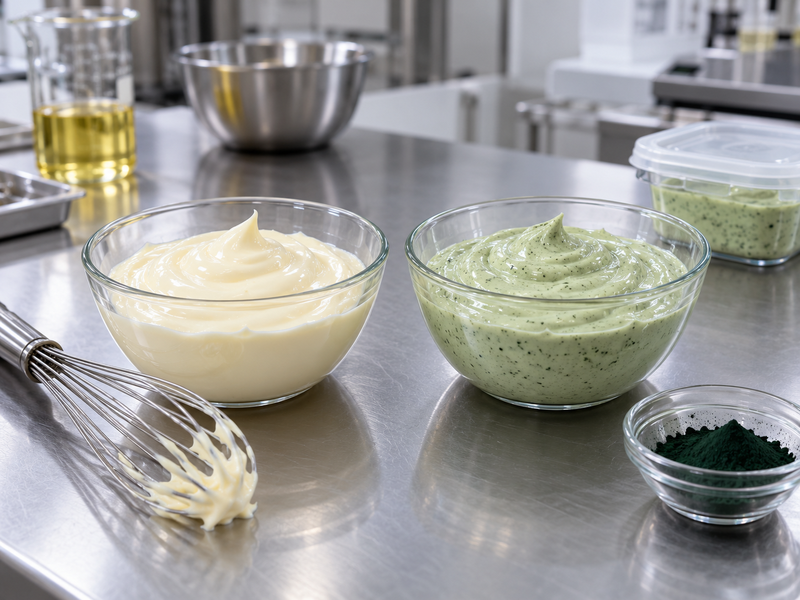
Define whether the product is legally named mayonnaise in the destination market or a mayonnaise-style dressing. Record the control’s oil content, acid system, emulsifier, stabilizer, pH, salt, viscosity, package and distribution temperature. The word “low fat” may have a destination-specific regulatory meaning, so label and nutrition teams should review the finished recipe before marketing uses it. Ingredient purchasing cannot establish the claim by itself.
Write the desired spirulina role plainly: visible green shade, ingredient story or measured nutritional contribution. These are not interchangeable. A stronger color may require an inclusion that damages flavor, while a modest addition may contribute little to a finished nutrient statement. Set the acceptable color and flavor window in the actual condiment, with its acid and seasoning. Maintain a control processed on the same equipment and day.
A line trial should seek a saleable emulsion, not simply prove that a green powder can be mixed into oil and water.
| Brief item | Control record | Candidate gate |
|---|---|---|
| Oil and water balance | Formula percentages | Same intended category |
| Spoonable body | Viscosity and spread | Consumer target |
| Safety design | pH and process | Validated plan |
2. Which powder attributes belong in the RFQ?
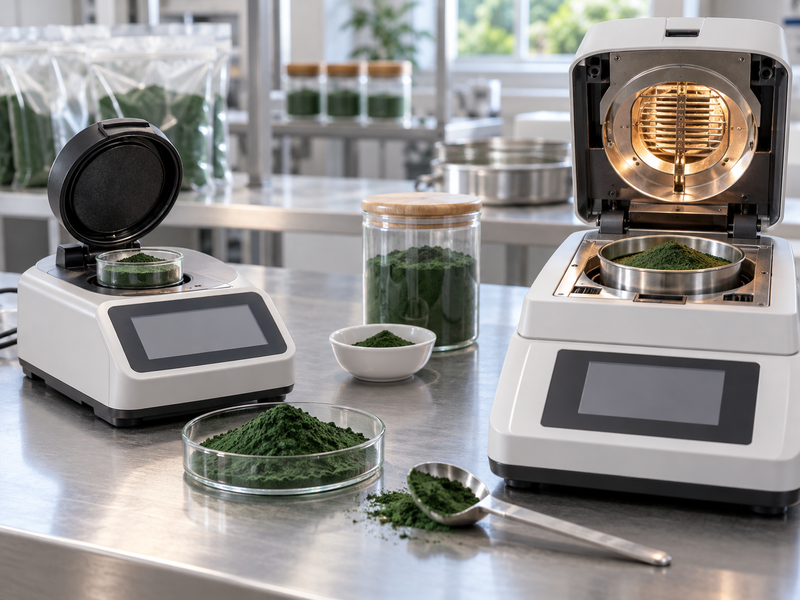
Request a lot-matched sample, species and ingredient identity, technical data sheet, current COA, particle-size distribution, moisture, storage guidance and proposed commercial specification. Confirm whether the sample is whole biomass, a protein concentrate or an extract; these materials can behave differently. The supplier category page is a route for inquiry, not evidence that a particular processing grade or certificate has been supplied. Do not let the word spirulina substitute for a documented material definition.
Review lot-linked microbiology and contaminant results against the product and destination’s requirements. Check methods, units and limits. Fine particles may disperse more easily in the aqueous phase, but they can also affect color intensity and viscosity; a single average size is insufficient for a detailed process brief. Inspect powder aroma and color before the pilot. If the manufacturer requires a particular certification, ask for current SKU-specific evidence. Keep a retain sample to compare against the proposed production shipment.
| Attribute | RFQ request | Pilot check |
|---|---|---|
| Material form | Whole biomass or other | Match recipe premise |
| Size and moisture | Method and distribution | Dispersion and dosing |
| Lot COA | Actual test results | Hazard-plan review |
| Color and odor | Reference sample | Sensory fit |
3. How should the pilot ladder be organized?
Build a plain control and several measured powder additions chosen around the product’s visual and sensory objective. Keep the oil fraction, emulsifier, acid, stabilizer, salt, process energy and package constant in the first series. Specify whether powder replaces part of another dry ingredient or is added to the total formula. Record mass balance so any apparent change in viscosity is not merely due to a different water content.
The research emulsions are formulation-specific and do not supply a universal addition level.
Randomize the test order where practical and measure immediately after manufacture and after a defined rest. If a promising sample needs more acid, stabilizer or homogenization, run that as a separate controlled experiment and recheck safety and storage. Do not describe spirulina as the emulsifier unless a product-specific experiment isolates and proves such a role. The most useful output of the first screen is an acceptance range and a clear failure boundary for taste, color or stability, not a single hand-picked green jar.
| Arm | Fixed variables | Question |
|---|---|---|
| Control | Current formula | Reference |
| Low | Same oil and acid | Can target be reached? |
| Mid | Same process | What shifts first? |
| Upper screen | Same process | Where is failure? |

4. Where should powder enter the water phase?
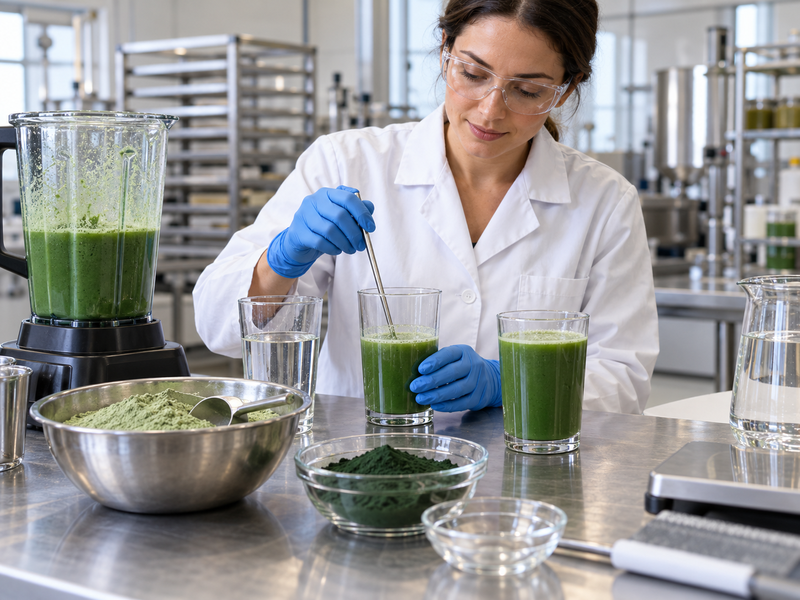
Test a defined predispersion into a measured aqueous fraction before emulsification, then compare it with the process’s simplest feasible dry addition if safe and practical. Record liquid temperature, mixing time, shear and hold time. Powder placed directly into a thick finished emulsion may form dark specks that later shear cannot remove. Conversely, adding it too early may expose it to a long acidic hold or a heat step that alters color and aroma. The correct stage is the one validated on the actual equipment.
Sample top, middle and bottom of the predispersion and early and late filler output. Check for clumps by spreading a fixed mass in a thin layer, and inspect through a microscope if available. If a supplier offers a different particle-size grade, compare it as a separate documented material; do not assume it is equivalent in taste or safety. Put the chosen addition sequence in the manufacturing instruction.
A successful laboratory beaker is not enough if the production tank cannot maintain uniformity until the final container is filled.
5. How does viscosity compare?
Measure viscosity or flow at defined temperature, shear history and time after manufacture. Low-fat emulsions are especially sensitive to the water phase and stabilizer system, so changing powder addition can make a dressing too thin, too pasty or stringy. Pair instrument data with a spoon, dip and spread evaluation. A sample that appears thick in the bottle may collapse when stirred, while another may resist pouring but feel unpleasantly gummy in the mouth.
Record pH, total solids and oil fraction with every result. If viscosity changes, determine whether the cause is powder concentration, water displacement, altered emulsification or storage. Do not attribute the change to a special property of all spirulina. The published study measured physicochemical and rheological responses for its own low-fat formulations. Your procurement test should set an acceptable viscosity band based on the current product and its intended use, then confirm it in the commercial package.
| Test | Controlled condition | Buyer decision |
|---|---|---|
| Flow or viscosity | Temperature and shear | Dispensing fit |
| Spoon spread | Fixed portion | Consumer texture |
| Rested sample | Defined storage time | Structure recovery |
6. Are droplets and phases stable?
Inspect freshly made emulsions and stored samples for droplet-size distribution, creaming, free oil and water release using methods the plant can repeat. A microscope can show whether the candidate has coarse droplets even when the bulk jar looks smooth. Sample from the top and bottom of a filled container. A green color may mask early separation, so use quantitative or photographic criteria as well as a quick visual glance.
Compare at the same oil, emulsifier and processing settings. If a sample separates, investigate mixing energy, order of addition and stabilizer interaction before concluding the ingredient is unusable. Any correction requires a new storage trial. Do not represent whole-biomass powder as a replacement for a dedicated emulsifier based on one research emulsion. A distinct protein-concentrate mayonnaise study used a different material; its behavior should not be transferred to ordinary green powder.
Accept the candidate only when the final formulation remains stable in the intended distribution system.
| Observation | What it suggests | Follow-up |
|---|---|---|
| Free oil | Emulsion failure | Review homogenization |
| Water layer | Network or phase issue | Review solids and stabilizer |
| Coarse droplets | Process mismatch | Recheck shear and order |
7. Do pH and process safety remain valid?
Measure pH after mixing, after equilibration and through planned storage. The safety of an acidified mayonnaise-style product depends on the validated whole formulation and process, not simply on an ingredient COA. If powder addition changes buffering, water activity or the acid distribution, the site must re-evaluate its safety controls. Record acid type, mixing order, fill temperature and package. Do not assert that spirulina is antimicrobial or preservative in this product without direct validated evidence.
The planned distribution may be refrigerated or ambient; each needs its own stability and safety program. Follow the facility’s hazard plan and destination requirements for microbiology, challenge or shelf-life testing as appropriate. A successful sensory panel on day one cannot establish ambient stability. Likewise, a supplier’s microbiology result concerns the powder lot, not the filled emulsion. Have quality and regulatory teams set release limits before production testing, then use the same limits for all candidate lots and any reformulated controls.
8. What color, flavor and storage tests pass?
Assess green tone under retail lighting in the actual bottle or jar, then taste blind at the intended serving temperature with a typical food carrier. Record aroma, acidity balance, algae note, mouthfeel and aftertaste. A strong vinegar or mustard note may initially mask algae but leave an earthy finish. Compare samples at fill, intermediate intervals and the intended end of shelf life. The consumer opens a stored pack, not a fresh mixing bowl.
Use unopened production packs for primary storage checks and record light, temperature, headspace and seal conditions. Measure color, viscosity, pH, separation and safety indicators required by the site. Do not use the low-fat emulsion paper’s observations as a finished-product shelf-life guarantee. If a formulation changes to improve flavor, repeat stability because seasoning, acid and oil balance can affect the emulsion. Define rejection thresholds before reviewing the results; this prevents an attractive green photograph from overriding evidence of late oiling off.
| Time point | Quality measures | Safety measures |
|---|---|---|
| Fill | Color, taste, droplets | pH and plan checks |
| Mid storage | Flow, separation, flavor | Required microbiology |
| End target | Consumer quality | Validated limits |
9. How should quotes be compared?
Ask each supplier to quote the exact grade, anticipated quantity, pack size, destination and delivery basis. Compare total cost per accepted bottle, including extra predispersion time, rejected specked containers, viscosity corrections and testing. A low powder price may not offset additional homogenization or lost line speed. Conversely, a higher-cost grade needs a demonstrated gain in dispersion, flavor or stability. Keep the quality criteria fixed across candidates.
Confirm that the quoted commercial lot matches the approved sample or has a documented bridging test. Request change notification for size, process or formulation attributes that affect the emulsion. Review any marketing claim separately against the finished recipe and destination rules. Do not equate whole powder with blue spirulina extract, which is a separate color ingredient and regulatory decision. The purchasing comparison should identify material, process, quality and packaging costs together rather than rank powders by unit price alone.
10. What is the approval rule?
Create a signed file with the accepted powder identity, lot documentation, incoming size and color limits, approved addition level, predispersion method, mixing and homogenization settings, and finished-product criteria. Include pH, viscosity, droplet or phase-stability data, blind sensory and storage results. The actual packaged product must meet the site’s safety program for the intended distribution. A supplier COA and a green bench beaker cannot replace that evidence.
Run a confirmation batch at intended scale, retain powder and finished-pack samples and define what changes trigger requalification. A new oil fraction, acid system, emulsifier, powder grade or package can change the result. Receiving should verify lot and documents before use and compare practical attributes with the approved retain. If a later lot drifts, hold it for review instead of silently adjusting the recipe. This makes the emulsion trial a repeatable procurement control rather than a one-time demonstration.
| Approval element | Evidence | Owner |
|---|---|---|
| Powder identity | TDS and lot COA | Quality |
| Emulsion function | Viscosity and phase data | R&D |
| Safety | pH and validated plan | Quality/regulatory |
| Commercial repeatability | Scale batch and spec | Production/procurement |

FAQ
Q1. Does spirulina powder replace the emulsifier? Do not assume so. Test the entire emulsion with its chosen emulsifier and process.
Q2. Is a spirulina protein concentrate equivalent? No. Concentrate studies concern a different material from whole green biomass.
Q3. Can a refrigerated result support ambient distribution? No. Validate the intended distribution and finished pack.
Q4. Why measure pH after equilibration? The final product may differ from a quick tank reading, and pH is part of the safety design.
Q5. Is a green color enough to approve a lot? No. Dispersion, taste, texture, phase stability and safety all need to pass.
For spirulina powder for low fat mayonnaise manufacturers, contact SpirulinaCN with your emulsion application, target powder and finished-product specifications, anticipated quantity, destination, oil fraction and distribution conditions. Request a lot-matched sample, technical sheet, current COA and application-specific quotation.