
Chlorella powder for date spread manufacturers must disperse through a concentrated fruit-and-oil matrix without making the product gritty, bitter or unstable. A green powder that blends easily in water may form dark agglomerates in date paste; a pleasant first-day spoonful may develop oil separation or a stronger earthy note in storage. The purchase decision is therefore a lot-specific formulation and shelf-life trial in the brand’s own recipe and pack.
A 2025 Khalas-date study investigated date spreads containing Chlorella vulgaris powder alongside other ingredients. It is feasibility evidence for that formulation, not a universal addition level or a shelf-life promise. Ask about the exact food-grade chlorella product offered and qualify it against the recipe to be sold.
Contents
- What date-spread outcome matters?
- Which powder facts should the supplier document?
- How should the recipe ladder be designed?
- What dispersion method works in date paste?
- Will the spread remain spoonable?
- How should green-brown color be judged?
- Will the flavor remain acceptable?
- How do you test oil separation and storage?
- What does the commercial comparison include?
- What evidence releases the selected grade?
1. What date-spread outcome matters?
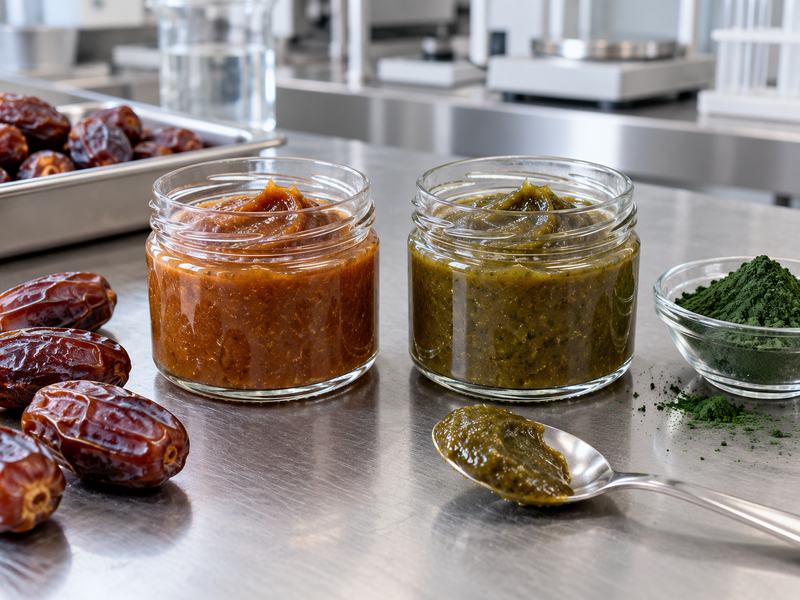
Define the control spread’s date variety, date solids, oil type, added water, fibers or stabilizers, particle size and target sweetness. Decide whether the product is a smooth spoonable spread, a firmer filling or a topping. These uses require different flow and oil-separation limits. Record the intended package, serving temperature and shelf life before buying powder. A bench jar without the final closure or headspace will not reveal every distribution problem.
Set acceptance in practical terms: an even appearance when the lid opens, a spoonful that holds or flows as intended, no gritty particles, no visible oil pool and flavor consistent with the brand. If chlorella is intended to support a nutrition message, assess the complete finished recipe and destination rules. Do not assume a supplier’s powder composition translates directly into a finished-product claim.
Use an uncolored control processed on the same day so differences in date moisture or mixing are not mistaken for an algae effect.
| Product objective | Finished-pack measure | Reject signal |
|---|---|---|
| Smooth spread | Specks and particle feel | Persistent graininess |
| Spoonable body | Flow or spread test | Too stiff or runny |
| Stable appearance | Surface oil and color | Pooling or streaking |
2. Which powder facts should the supplier document?
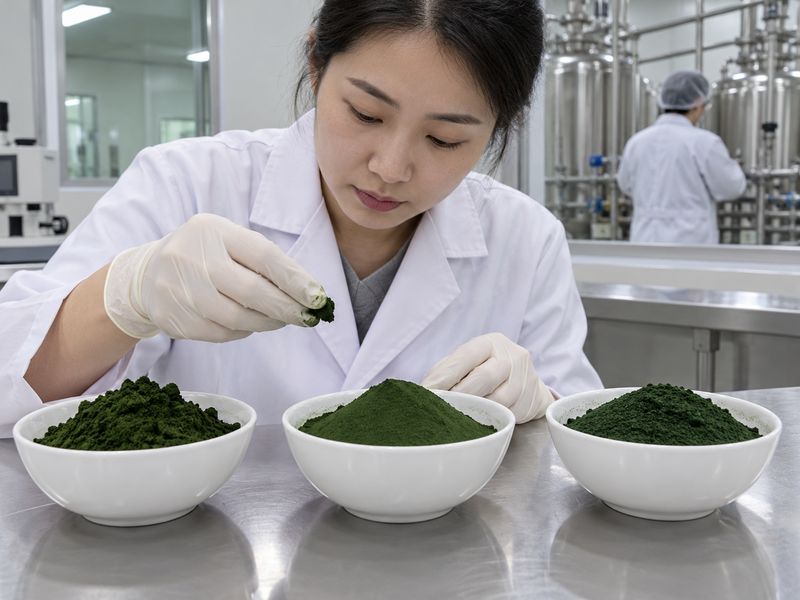
Request a sample from a named lot, technical data sheet, current lot COA, ingredient declaration, proposed commercial specification and information on particle size, moisture, color and storage. Confirm species and whether the powder is whole biomass or a processed or blended ingredient. If there are carriers or processing aids relevant to the label, identify them before the bench trial.
The supplier page invites an inquiry; it is not evidence that a specific grade, certificate or lab result has been issued for your lot.
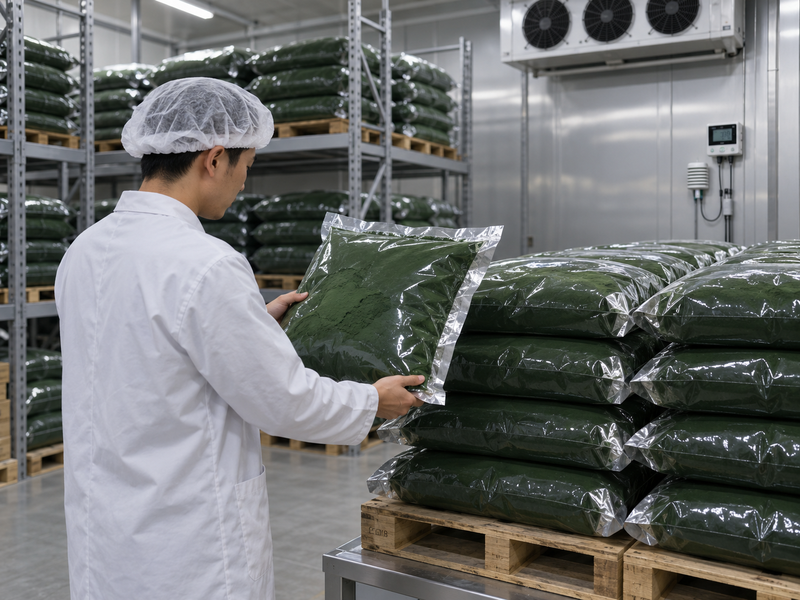
Screen powder aroma and color against an agreed reference. In a date matrix, a pronounced algae note may become more noticeable after the initial sweet impression fades. Review microbiological and contaminant results with the product’s hazard plan and destination requirements. Ask for units, test methods, reporting limits and lot linkage rather than accepting a generic “food grade” statement. Keep a retained sample in its original pack, because later complaints about color or taste can only be investigated if the approved material is identifiable.
| Supplier record | Why it matters | Buyer check |
|---|---|---|
| Identity and declaration | Label accuracy | Confirm offered grade |
| Size distribution | Smoothness and specks | Test in date matrix |
| Lot COA | Safety and composition evidence | Review methods and limits |
| Storage instructions | Powder stability | Align warehouse practice |
3. How should the recipe ladder be designed?
Make a control and several measured chlorella additions selected to bracket the intended color and flavor target. Keep date paste, oil, added water, cocoa or coffee, mixing energy and batch size fixed in the first series. The Khalas-date paper combined chlorella with a particular recipe; copying its dose into another date variety or oil ratio would confound the decision. If viscosity changes, run a documented adjustment series after the unadjusted comparison.
Specify whether powder mass replaces dates or is added to the total formula. That choice affects sweetness, solids and cost per jar. Randomize blinded tasting and use the same serving temperature. Do not advance a level only because it looks nutritionally impressive on a formulation spreadsheet. The best commercial level is the lowest one that meets the brand’s genuine purpose while satisfying texture and sensory gates. Repeat the finalist with a second powder lot or the commercial-scale lot before locking a specification.
| Trial | Constant factors | Decision |
|---|---|---|
| Control | Current recipe and process | Baseline |
| Low addition | Same matrix | Detectability |
| Mid addition | Same matrix | Balance of color and flavor |
| Upper screen | Same matrix | Failure boundary |

4. What dispersion method works in date paste?
Compare direct powder addition with a practical preblend only if both methods fit the production line. A small preblend in oil, water or a fraction of date paste may reduce dark pockets, but each option changes handling and can alter texture or microbial risk. Record order of addition, temperature, mixer speed and mixing time. Sample at the vessel wall, center and discharge. Smear a fixed mass in a thin layer and count visible particles or streaks under consistent lighting.
Check distribution across the filling run, including the first and last jars. High solids can prevent agglomerates from breaking even under prolonged mixing; more shear may change date particle size or warm the oil phase. If a candidate needs an impractical mixing step, its low quoted price should not rescue it. A finer documented supplier grade may be tested, but do not assume it exists or that it has the same flavor and safety documentation.
The approved process must be reproducible by production operators without laboratory improvisation.
5. Will the spread remain spoonable?
Measure viscosity or flow with a repeatable method appropriate to the product, alongside a simple spoon and bread-spread test at the intended serving temperature. Date paste naturally varies with variety and moisture, so use a control from the same fruit lot. Observe whether the candidate stiffens over time, drags on a spoon, tears bread or becomes pasty. A single viscosity value does not capture particle feel or consumer use; include a trained tactile assessment.
Check temperature sensitivity. A refrigerated sample can seem too firm while the same formulation is acceptable at room temperature, or oil may separate when the pack warms. Record test temperature, rest time and sample history. If texture is outside range, change one formulation or process variable at a time and repeat stability tests. Do not assign a universal functional thickening effect to chlorella. The purchase question is whether this particular powder and recipe deliver the desired body throughout the product’s saleable life.
| Texture test | Record | Commercial question |
|---|---|---|
| Spoon pickup | Mass and shape | Easy serving? |
| Spread test | Force and smoothness | Easy use on bread? |
| Temperature repeat | Warm and cool behavior | Consistent distribution? |

6. How should green-brown color be judged?
Set an appearance target using the actual dates and pack. Chlorella green mixed with dark brown dates may yield olive or nearly black tones rather than a bright green consumer cue. Photograph a standard spoonful and the jar surface with a color reference under fixed lighting. Compare at filling, after temperature equilibration and at planned storage intervals. If there is cocoa or roasted coffee in the recipe, evaluate its contribution separately so the powder is not blamed for every darkening effect.
Show blinded samples to the brand and sensory team without explaining which has the highest addition. Ask whether the color suggests the intended flavor and whether streaks look like a defect. A smooth dark appearance may be acceptable if the ingredient story is clear, but a patchy green-brown surface can signal poor mixing. If a new powder lot differs from the approved retain, repeat the finished-spread comparison. Color acceptance should describe the retail jar, not merely a pure-powder swatch.
| View | Compare | Risk |
|---|---|---|
| Jar top | Uniformity and oil | Poor shelf impression |
| Spoonful | Brown-green tone | Brand mismatch |
| Thin smear | Dark particles | Agglomerates |
7. Will the flavor remain acceptable?
Taste coded control and candidate spreads at equal temperature, using the intended serving carrier as well as a direct small spoonful. Score date aroma, sweetness, algal or earthy note, bitterness, mouthfeel and finish. The 2025 study evaluated its own formulation and preference; that result should not be represented as acceptance of a different brand’s dates, oil and powder.
If cocoa or coffee masks notes, confirm that those ingredients are part of the real label and not an artificial pilot rescue.
Repeat sensory at storage checkpoints, because oxidation or flavor redistribution can expose a note that was unobtrusive on day one. Use a consistent portion and palate-cleansing protocol. A panel should distinguish a pleasant date flavor that remains from a strong first sweetness followed by an unpleasant finish. Set rejection criteria before unblinding dose or supplier. If two powder lots differ, investigate identity, storage and particle size rather than immediately increasing flavoring. The chosen grade must work in the intended commercial recipe.
8. How do you test oil separation and storage?
Fill the intended jars or pouches using the planned process and store unopened samples under the product’s defined conditions. Measure visible surface oil, free liquid, color drift, spreadability, aroma, taste, water activity and microbiological status as required by the hazard plan. Record fill temperature, headspace and seal or closure quality. Do not infer a commercial shelf life from a short bench observation or the plain control’s existing date. The ingredient may alter phase behavior or sensory stability even if total water and oil appear unchanged.
Track both upright and distribution-relevant handling where appropriate. Photograph the surface before stirring, then measure separation using a consistent method rather than hiding it by mixing the jar. A change in oil separation could result from date solids, oil type, mixing energy or powder; use a same-day control to identify the cause. Set a maximum acceptable separation and texture drift before the trial. If a formulation adjustment solves one problem, rerun flavor and stability because the full matrix has changed.
| Storage measure | Sample method | Hold signal |
|---|---|---|
| Surface oil | Unopened pack image and mass | Above agreed threshold |
| Texture | Standardized spoon or flow test | Outside range |
| Flavor and odor | Blind stored-sample panel | New off-note |
| Water activity | Finished pack | Fails safety plan |
9. What does the commercial comparison include?
Request a quote for the exact grade, anticipated quantity, pack format, destination and delivery basis. Calculate cost per acceptable jar, including mixing time, scraped-off agglomerates, rejected appearance and any new quality tests. Compare candidates using identical date and oil lots. A cheaper powder with poor dispersion may cost more after longer mixing or rework. Conversely, an expensive grade needs demonstrable consumer or process value, not merely a deeper green in the raw powder.
Ask how the commercial lot will be matched to the sample and what changes will be communicated. Check whether the proposed specification controls the attributes that actually drove the trial: odor, size, moisture and color. Keep claim value out of the calculation until finished-product testing and destination labeling review are complete. Document any new storage or packaging expense required to protect the revised spread. The final buying comparison should be a quality-adjusted total cost, not a list of powder prices.
10. What evidence releases the selected grade?
Approve a grade only after the file identifies species, lot, documentation, incoming acceptance limits, addition level, mixing sequence, finished color, texture, sensory and storage results. Include the oil-separation method and threshold. Retain powder and finished-spread samples. Where a nutrient or health claim is proposed, document separate finished-product and destination review; the cited study is not a substitute. Sign-off should include production, quality, R&D, procurement and labeling owners.
Run a confirmation batch at intended scale and package it as sold. Define requalification triggers for a different date variety, oil, powder grade, mixer, package or shelf-life target. A successful small jar made with one lot does not authorize substitutions. Receiving staff should check documents and compare new lots to the approved retain before production. The release record should state what to do if color or odor differs, including a hold and targeted pilot rather than silent adjustment of the formula.
| Release item | Evidence | Hold if missing |
|---|---|---|
| Ingredient identity | TDS and lot COA | Yes |
| Dispersion | Fill-run samples | Yes |
| Product quality | Blind sensory and texture | Yes |
| Storage | Phase and safety results | Yes |
FAQ
Q1. Can the Khalas-date study set our chlorella dose? No. Its recipe and powder were specific; build a ladder in your own dates and oil.
Q2. Is dark green powder necessarily better? No. Dispersion, taste and final jar color matter more than a powder swatch.
Q3. Can oil separation be judged after stirring? No. Assess the unopened surface before disturbing the sample.
Q4. Does a powder COA establish spread shelf life? No. Finished-pack stability and safety need their own trial.
Q5. Should we test at serving temperature? Yes. Spoonability and aroma can change markedly with temperature.
For chlorella powder for date spread manufacturers, contact SpirulinaCN with your spread application, target ingredient and finished-jar specifications, anticipated quantity, destination, date/oil matrix and storage plan. Request a lot-matched sample, technical sheet, current COA and application-specific quotation.