
Spirulina powder for chocolate milk premix manufacturers has two jobs: remain uniform and free-flowing as a dry cocoa mix, then disperse acceptably when the customer adds milk. Cocoa may moderate the algae note, but it cannot be assumed to hide every lot’s flavor or prevent sediment. The buying decision should test the offered green powder in the actual dry blend, package and reconstitution instructions, with separate checks for moisture pickup, suspension and consumer taste.
A 2021 chocolate-milk powder study investigated microencapsulated Spirulina sp. LEB-18 using specific carriers and formulations. Its findings do not describe ordinary unencapsulated spirulina powder. Compare standard powder with an encapsulated option only if that option is genuinely available and its carrier, composition and lot documents have been disclosed.
Contents
- What premix is the buyer qualifying?
- Which ingredient format is actually offered?
- How should a dry-blend ladder be designed?
- Will the powder distribute evenly in cocoa?
- Does the mix resist moisture pickup?
- How should reconstitution be tested?
- Will particles stay suspended?
- Does cocoa-masked flavor really pass?
- How should commercial options be compared?
- What evidence approves the grade?
1. What premix is the buyer qualifying?
Define the base powder: cocoa type and level, sugar or sweetener, milk powder if present, stabilizers, flavor, serving size and intended liquid. A dry mix sold for cold milk faces a different dispersion challenge from one prepared with hot milk. Record the control’s flow, bulk density, color, wettability, preparation time, sediment and flavor. If there are sachets and bulk foodservice packs, test both the dose and the pack geometry that consumers will use.
Clarify whether spirulina is meant to provide an ingredient story, change nutrition or simply distinguish the product. A cocoa-brown dry mix may conceal a green powder, but the prepared drink could take an unintended muddy shade. Any nutrition or health statement requires finished-product calculation and destination review. Establish a plain cocoa control from the same ingredient lots and preparation protocol.
The selected powder should meet the complete dry and prepared-drink brief, not only show that algae can be stirred into chocolate milk in a laboratory cup.
| Product goal | Dry-mix measure | Prepared-drink gate |
|---|---|---|
| Uniform dose | Blend and sachet sampling | Consistent color/flavor |
| Convenience | Flow and caking | Fast wetting |
| Consumer acceptance | Pack appearance | Taste and sediment |
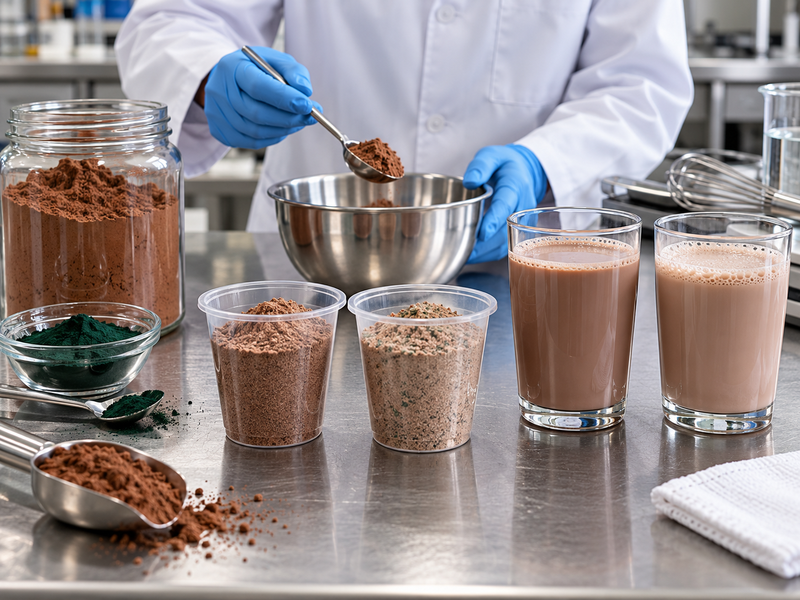
2. Which ingredient format is actually offered?
Request a named-lot sample, technical sheet, current COA, species and ingredient declaration, particle-size distribution, moisture, water activity where relevant, bulk density and storage guidance. Determine whether the offered material is whole green biomass, microencapsulated powder or another processed form. For an encapsulated option, ask for every carrier and processing aid, the fraction of active biomass, allergen implications, and the basis on which the price and dose are quoted.
Do not infer that the supplier’s ordinary spirulina category includes an encapsulated SKU.
Review microbiological and contaminant results for the exact lot and destination. Compare ingredient declarations before running a sensory trial because a carrier can alter label, nutrition and religious or allergen suitability. The LEB-18 research used maltodextrin and soy lecithin in its microencapsulation system; those materials cannot be silently attributed to or omitted from a different offered product. If only standard powder is available, test that material honestly rather than describing research performance as supplier performance.
| Format question | Standard powder | Encapsulated candidate, if offered |
|---|---|---|
| Composition | Whole biomass declaration | Biomass plus each carrier |
| Dose basis | Powder mass | Active-biomass fraction |
| Label review | Species and origin | Carriers and allergens too |
| Evidence | Lot COA and TDS | Separate lot COA and TDS |
3. How should a dry-blend ladder be designed?
Make a cocoa control and several measured spirulina additions chosen around the intended flavor and nutritional purpose. Keep cocoa, sweetener, milk solids, anti-caking system, mixer fill and mixing time constant in the first screen. State whether spirulina replaces another powder or is added to the total formula. For an encapsulated candidate, compare on both total ingredient mass and actual biomass delivered; otherwise the apparent advantage may simply reflect dilution by a carrier.
The chocolate-milk study tested its own encapsulated material and dose series. Do not copy those concentrations as universal targets for ordinary powder. Run the same dry-blend and reconstitution protocol for each candidate. If cocoa or flavor level must change to make a sample palatable, evaluate that as a separate recipe revision with its own cost and label. Choose the lowest level that meets the real product goal while preserving flow, prepared-drink taste and uniformity.
Record a failure boundary as well as a favorite sample.
| Trial arm | Fixed factors | Question |
|---|---|---|
| Control | Cocoa base and mixer | Reference |
| Low biomass | Same process | Detectability |
| Mid biomass | Same process | Flavor/functional balance |
| Upper screen | Same process | Failure boundary |
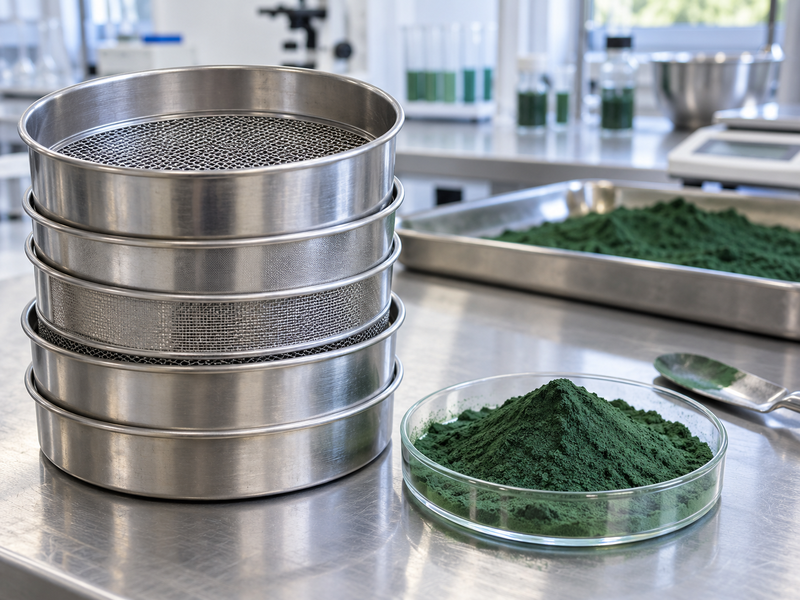
4. Will the powder distribute evenly in cocoa?
Compare particle size, bulk density and flow of spirulina with cocoa, sugar and milk powder. Components with very different physical properties can segregate during transfer, vibration or filling even after a uniform mixer discharge. Take fixed-mass samples at the top, middle and bottom of the blender and from early, middle and late sachets. Use a validated marker or assay for the algae fraction if the dose claim requires it; visual color alone may be masked by cocoa.
Check both mixing time and overmixing. A longer run does not always solve segregation after the blender; it may increase fines or break agglomerates. Photograph a thin spread of each sample under standard lighting to spot green streaks and cocoa clumps. Test the actual hopper and pack size, not just hand-stirred beakers. If a preblend improves uniformity, specify the ratio, order and equipment for production. An approved ingredient grade is tied to a repeatable dry blending process and an acceptable range across finished packs.
| Sampling point | Main question | Failure signal |
|---|---|---|
| Mixer positions | Was distribution achieved? | High variability |
| Transfer/hopper | Did segregation occur? | Concentration drift |
| Finished sachets | Is the serving consistent? | Pack-to-pack variation |
5. Does the mix resist moisture pickup?
Measure initial powder moisture and water activity, then examine blend flow, clumping and caking after exposure to the intended packaging and storage conditions. Cocoa, sugar, milk solids and any encapsulation carrier may absorb water differently. The research paper examined properties of its own microencapsulated system; it does not establish the hygroscopicity of another powder or finished premix. Use the actual sachet or bulk liner, with seal integrity checks, for the deciding test.
Record fill-room humidity, pack barrier, headspace and storage temperature. Weigh sealed packs at intervals if the method can detect moisture ingress, and examine pourability and visible lumps before opening the drink test. If an alternative powder format appears less prone to caking, confirm its carrier and active-biomass content before concluding it is better value. Do not treat a short open-bowl exposure as a commercial shelf-life study. Set a reject threshold for clumps or flow failure that reflects the customer’s preparation experience.
| Moisture check | Method | Commercial consequence |
|---|---|---|
| Initial state | Lot and finished-blend testing | Baseline |
| Pack integrity | Sealed-package review | Moisture ingress |
| Flow after storage | Standardized pour | Dosing and convenience |
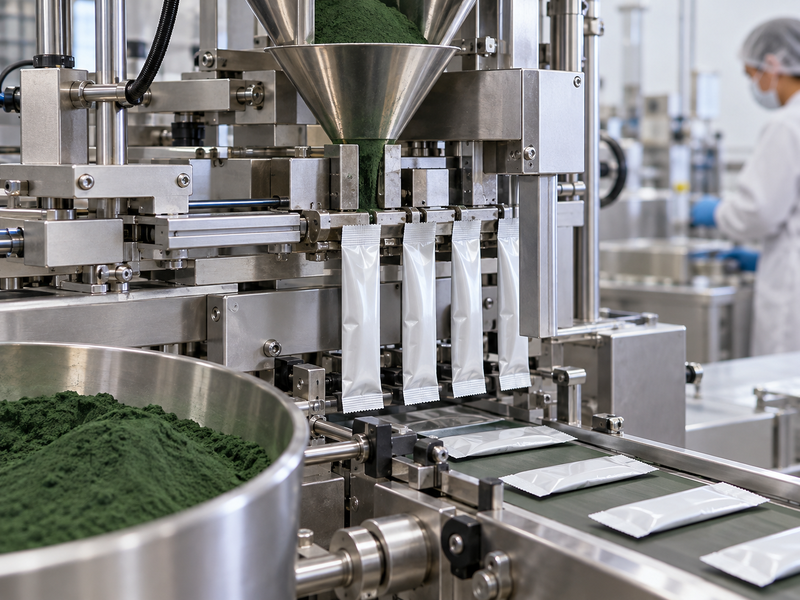
6. How should reconstitution be tested?
Prepare each finished mix using the exact serving mass, liquid volume, temperature and stirring instructions proposed for the package. Repeat with cold and warm milk only if both uses are intended; water may be a separate application. Measure wetting time, floating powder, lumps, total mixing time and prepared color. Check whether an apparent “solubility” gain is actually improved wetting of an encapsulation carrier while biomass particles remain suspended. Whole spirulina powder is a particulate ingredient, so complete molecular dissolution should not be assumed.
Use an ordinary spoon or shaker appropriate to the consumer, not only a high-shear laboratory mixer. Photograph the surface immediately and after a defined rest. If a sample performs only with a blender, its suitability for an instant premix is questionable. Record milk fat and temperature because they can change foam and flavor perception. Repeat reconstitution after package storage: a fresh blend can wet well while a slightly caked blend forms stubborn lumps. The purchase gate is reliable consumer preparation, not laboratory convenience.
| Reconstitution measure | Consumer meaning | Reject signal |
|---|---|---|
| Wetting time | Ease of preparation | Persistent floaters |
| Lumps | Smoothness | Undispersed pockets |
| Color | Expected drink appearance | Unwanted muddy tone |
7. Will particles stay suspended?
Observe prepared drinks immediately, after the normal drinking interval and after a longer defined rest. Record sediment height or mass, color gradient, grainy mouthfeel and whether gentle stirring restores uniformity. Cocoa itself can sediment, so compare against a control and keep milk, cup shape and mixing method the same. A powder that appears evenly dispersed at minute one may leave a dark green layer at the bottom before the consumer finishes the serving.
Microscopy or particle-size analysis can help identify whether the sediment is primarily cocoa, algae or an agglomerate, but do not overstate what a simple visual test proves. If a stabilizer adjustment is proposed, run it as a new formula and recheck flavor, labeling and dry flow. A carrier in an encapsulated ingredient may change wetting yet still leave particulate sediment. Define the acceptable interval based on real consumption and package claims.
A successful sample must pass both the dry-mix uniformity gate and the prepared-drink suspension gate.
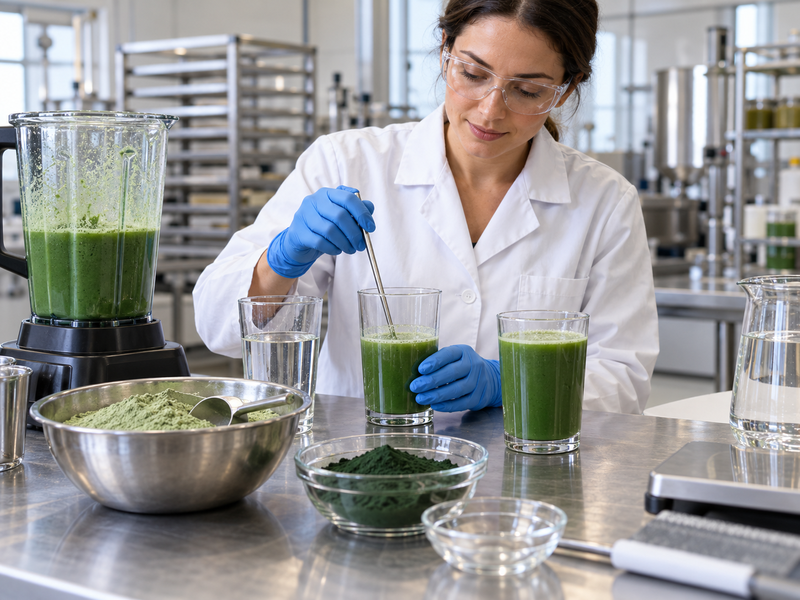
8. Does cocoa-masked flavor really pass?
Taste coded drinks at the intended serving temperature using the actual preparation method. Score cocoa aroma, sweetness, algae or earthy notes, bitterness, mouth-coating and aftertaste. Cocoa can dominate the first sip while an algae finish appears later, so ask the panel to record both. Compare fresh and stored premix. Oxidation, moisture pickup or a changed cocoa lot can alter flavor balance; the approved powder must work in the commercial product, not a best-case laboratory recipe.
Do not attribute the 2021 study’s sensory or functional findings to unencapsulated supplier powder. That work used its own microencapsulated Spirulina strain and carrier system. If a candidate only passes when cocoa or sugar increases, calculate the cost and finished nutrition of that revised recipe. Choose flavor thresholds before revealing dose and supplier. A consumer’s willingness to drink a full serving matters more than whether the product can be described as algae-fortified on a formulation sheet.
| Sensory stage | Prompt | Action if weak |
|---|---|---|
| Aroma | Is cocoa still recognizable? | Review formula/lot |
| First sip | Smooth chocolate flavor? | Review dose and wetting |
| Finish | Earthy or bitter persistence? | Reduce or reject candidate |
9. How should commercial options be compared?
Request a quote for the exact named grade, anticipated quantity, packaging, destination and delivery basis. Compare cost per serving at equal active biomass, especially if one material contains encapsulation carriers. Include extra testing, blend losses, sachet rejects, pack-barrier changes and any reformulation needed to achieve flavor. A lower price per kilogram may be more expensive per acceptable serving when uniformity or reconstitution is poor.
Ask how the commercial lot will match the approved pilot and what change notification covers particle size, processing, carriers and ingredient origin. Review allergen and label implications of any carrier before putting it in a commercial comparison. Do not infer that an encapsulated product is available unless the supplier quotes and documents one. If only ordinary powder is offered, evaluate it fairly on its own results.
The winner should meet dry-flow and prepared-drink gates with a repeatable specification, not simply resemble the research paper’s ingredient description.
10. What evidence approves the grade?
The approval file should identify powder format and lot, full composition, current COA and TDS, incoming size and moisture limits, blend process, package, active-biomass dose and finished-premix criteria. Include blend-uniformity results across the fill, moisture-pickup data, reconstitution method, timed sediment and blinded flavor scores. For an encapsulated candidate, specify carriers and the calculation that converts supplied powder mass to biomass mass. Obtain labeling and destination review before claiming nutritional benefits.
Run a confirmation batch at commercial throughput and retain powder, dry mix and prepared-drink reference records. Define triggers for requalification: changed cocoa, milk powder, carrier, powder grade, mixer, sachet or preparation instructions. Receiving should compare each new lot with the approved specification and retain. If a later shipment cakes or tastes different, hold it for investigation rather than silently changing the cocoa dose. A defensible purchase order links the supplier grade to a tested consumer preparation and a controlled dry-pack process.
| Approval area | Evidence | Hold if missing |
|---|---|---|
| Identity | Format, carrier disclosure, COA | Yes |
| Dry performance | Uniformity and moisture | Yes |
| Drink performance | Wetting, settling and taste | Yes |
| Repeatability | Scale batch and receiving plan | Yes |
FAQ
Q1. Did the cited paper test ordinary spirulina powder? No. It used a specific microencapsulated LEB-18 biomass and carrier system.
Q2. Is an encapsulated grade available from this supplier? Confirm directly with a named SKU and documents; availability is not assumed here.
Q3. Does cocoa guarantee flavor masking? No. Test aroma, first sip and aftertaste in your actual formula.
Q4. Is reconstitution the same as dissolution? No. Whole biomass remains particulate even when it wets and disperses well.
Q5. Why test sachets from across the fill? Segregation can make early and late servings differ despite an initially uniform mixer sample.
For spirulina powder for chocolate milk premix manufacturers, contact SpirulinaCN with your cocoa-premix application, target powder and prepared-drink specifications, anticipated quantity, destination, package and preparation method. Request a lot-matched sample, technical sheet, current COA and application-specific quotation; ask about an encapsulated option only if you genuinely need one.