
Phycocyanin for carbonated soft drinks is a finished-formula decision, not a color-chip purchase. A carbonated soft drink can look bright blue at filling yet fade, haze, or form sediment after weeks in a sealed package. The buyer should approve a specific blue spirulina extract lot only after testing the actual sweetener, acidulant, carbonation, preservative, package and storage conditions together.
A 2024 carbonated-beverage experiment found substantially different phycocyanin retention across commercial drink matrices held at 4 °C; its observations are a reason to run a product-specific pilot, not a shelf-life claim for a new soda.
Contents
- Which finished drink is the purchase brief for?
- What extract specification should suppliers answer?
- How should the carbonation pilot be designed?
- Why test the sweetener and acid system together?
- Where should the pigment enter the process?
- Which color and clarity measures matter?
- How should sealed packs be stored and sampled?
- What US use and labeling gate applies?
- Which documents belong in the RFQ?
- When is a production order justified?
1. Which finished drink is the purchase brief for?
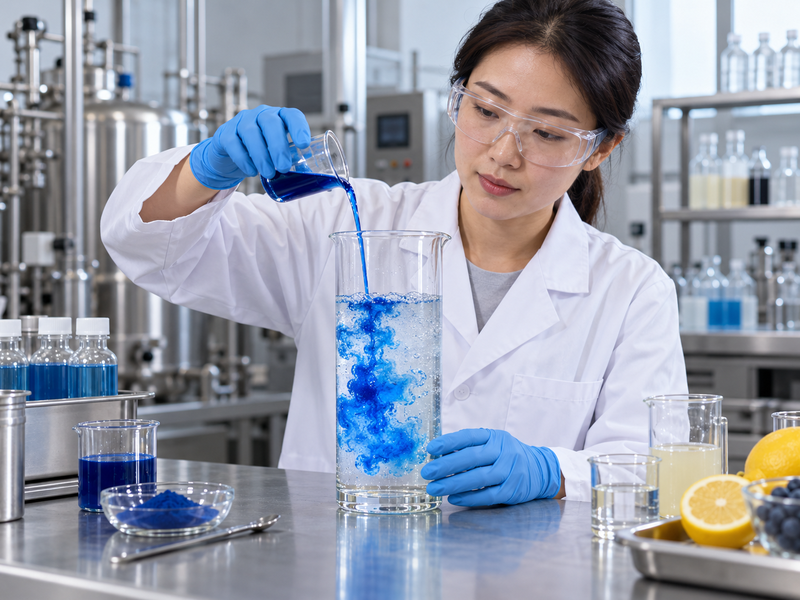
Define the commercial drink before comparing powders. Record whether the recipe is sugar-sweetened, reduced-sugar or unsweetened; the acid species and target pH; preservative choice; carbonation volume; packaging material; and distribution temperature. These choices change the environment around phycocyanin. The original carbonated-drink research compared several existing beverages and found that the sweetened and non-sweetened matrices did not retain pigment equally during cold storage. It did not isolate every formulation variable or establish a transferable ranking for brands.
Create a written product brief that distinguishes a transparent blue beverage from a cloudy fruit soda. A small amount of haze may be acceptable in one positioning but a release failure in the other. Specify whether consumers will view the drink through clear PET or only after opening an opaque can. That determines the practical color target and the light challenge. Include sensory acceptance: a visually successful dose can still alter taste.
Agree on these pass criteria before receiving ingredient samples, so the first attractive beaker does not become an accidental specification.
| Brief item | Record before sampling | Why it changes the decision |
|---|---|---|
| Drink type | Clear, cloudy, citrus or neutral | Sets haze and hue limits |
| Formula | Sugar, sweeteners, acids, preservatives | Defines the pigment environment |
| Distribution | Chilled or ambient; intended life | Sets storage challenge |
| Pack | Clear bottle, tinted bottle or can | Changes light exposure |
2. What extract specification should suppliers answer?
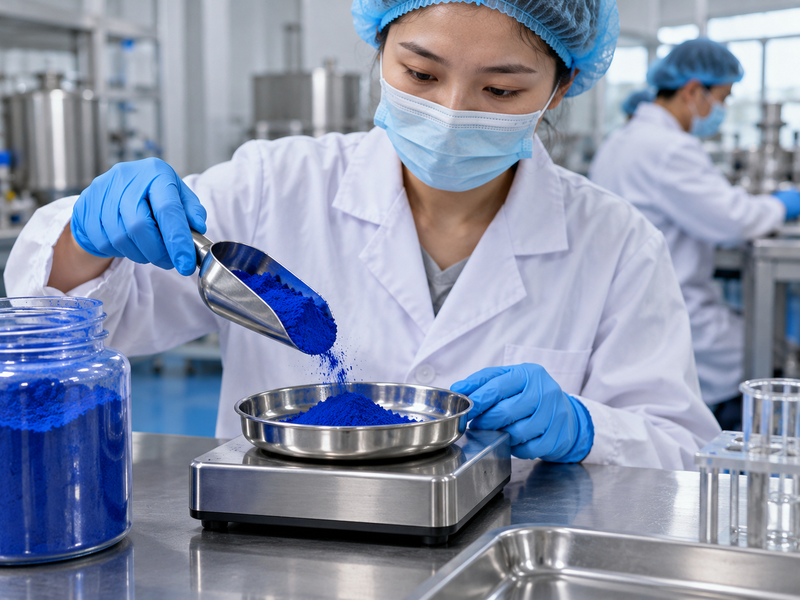
Request the identity and composition of the proposed colorant, including whether it is an aqueous spirulina extract, powder, or formulated mixture with carriers. Phycocyanin is the coloring component in the US-defined spirulina extract, but a technical E-value or absorbance ratio alone does not describe how a powder will dissolve in this soda. Ask for a technical data sheet, ingredient and carrier declaration, recommended handling conditions, the proposed analytical color-strength method and a current certificate of analysis for the exact lot sampled.
Compare quoted prices on a usable color-strength basis, with the test method clearly stated.
Use a controlled receiving check: record package integrity, lot number, moisture exposure, appearance and the shade produced in a standard diluent. Then assess the same material in the complete soda. Do not assume that a high assay value predicts retention under low pH, light or carbonation. If an alternative sample contains different carriers, count those carriers in the beverage formula and label review. Require a new pilot when the offered commercial grade or manufacturing lot differs materially from the screened sample.
| Supplier answer | Acceptance evidence | Escalation trigger |
|---|---|---|
| Extract identity | TDS and composition | Whole biomass offered instead |
| Color strength | Method and lot result | Method changes between lots |
| Carriers | Full ingredient declaration | Undisclosed carrier or allergen |
| Safety | Applicable lot COA | Missing lot linkage |
3. How should the carbonation pilot be designed?
Begin with a control drink and a small pigment-dose ladder selected by the brand’s visual target. Fill each arm with the real carbonation and headspace settings, then seal it using the intended closure and line sequence. Measure dissolved CO2, pH, fill volume, oxygen where relevant, and initial color. An opened sample held in a beaker is useful for screening but does not represent a pressurized commercial pack. Carbonation can affect mixing, foam, fill losses and the oxygen picked up during filling; those effects need line-level observation.
Use a staged design rather than changing every variable at once. First find a feasible dose in the baseline formula. Next cross the shortlisted dose with the actual sweetener and acid choices. Finally confirm it at pilot filling speed and in the intended container. Include duplicate or triplicate packs per time point so destructive sampling does not repeatedly open the same bottle. Set acceptance limits for color, sediment, pressure and taste from the product brief, not from the published experiment’s storage figures.
| Stage | Held constant | Deliberate change | Decision |
|---|---|---|---|
| Bench | Base recipe, pH | Pigment dose | Usable visual range |
| Formula | Dose, packaging | Sweetener and acid | Best candidate matrix |
| Pilot line | Chosen formula | Fill sequence and speed | Reproducibility in sealed packs |
4. Why test the sweetener and acid system together?
Do not credit a difference in blue retention to carbonation alone. Sucrose, high-intensity sweeteners and polyol blends create different soluble-solids and mouthfeel profiles, while citrate or another acidulant changes pH and the drink’s chemical surroundings. The 2024 beverage study observed pronounced differences between commercial formulations, including a sweetened matrix that retained more phycocyanin than a non-sweetened one under its conditions. That comparison is a practical warning against transferring a buffer result to a commercial recipe.
For each candidate formula, hold pigment lot and dose, target pH, carbonation, process and pack constant as far as possible. Record the actual concentrations and measure both pH and titratable acidity where the product team uses them. A sweetener swap can require acid rebalancing for taste; if so, run an additional controlled arm to separate the sweetener change from the pH change. Evaluate flavor and cost beside blue retention.
The selected formulation is the one that satisfies the complete drink brief, not necessarily the one with the highest laboratory absorbance.
5. Where should the pigment enter the process?
Map the actual sequence: syrup preparation, dilution, any heat treatment or filtration, cooling, carbonation and filling. Test whether the pigment can be added after the most damaging heat step without compromising food safety or line control. The published authors discussed filter sterilization and adding pigment before packaging as a possible route, but their process suggestion is not validation for a new factory. Any changed addition point needs the site’s own microbiological, filtration and process review.
Prepare a standardized pre-dispersion with the water quality and mixing time planned for production. Measure recovery from the preparation vessel and check for blue residue on filters, hoses and fillers. If color strength drops between the mix tank and finished bottle, inspect hold time, light exposure, temperature and contact surfaces before increasing dose. A higher dose can mask a process loss during a short trial and create excessive color when a later run improves.
Use the same sampling locations on every pilot arm so losses can be located rather than guessed.
| Sample point | Check | Corrective investigation |
|---|---|---|
| Pre-dispersion | Dissolution and hue | Mixing time or water quality |
| Mix tank | Color strength and pH | Heat, hold or ingredient order |
| Filled bottle | Color and dissolved CO2 | Filler pickup or foaming |
6. Which color and clarity measures matter?
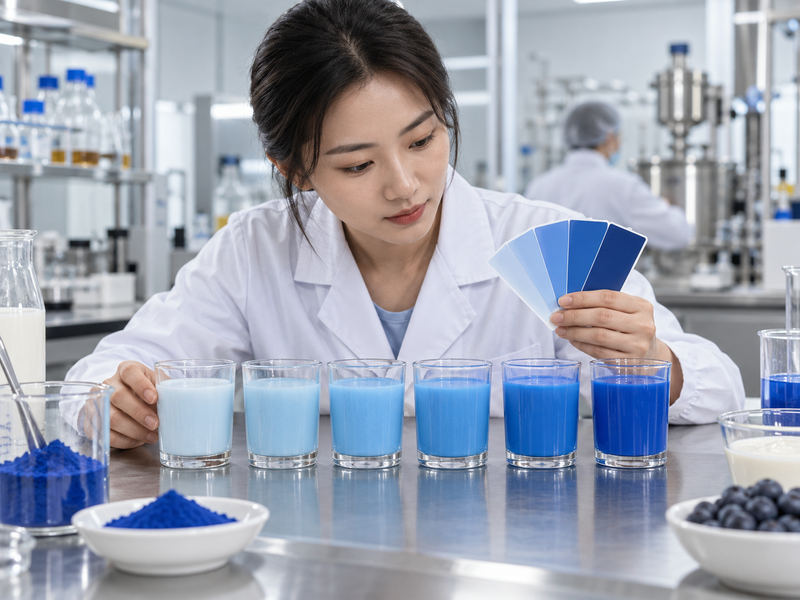
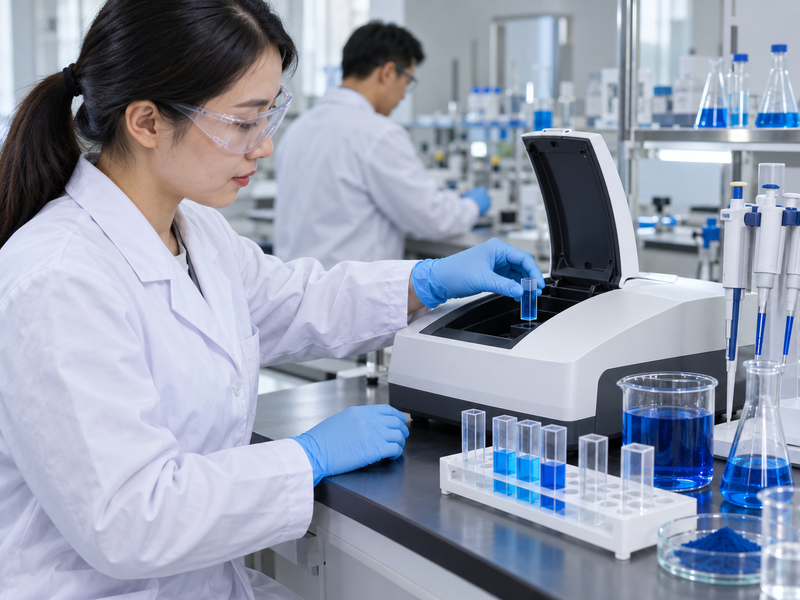
Record standardized photographs only as visual evidence; use a defined instrumental measure for comparison. A spectrophotometric pigment assay can track the phycocyanin signal while CIELAB or another calibrated color measurement captures what the finished drink looks like. Keep sample temperature, optical path and background consistent. For a clear soda, add turbidity and sediment checks. A drink may retain some pigment analytically yet shift toward dull violet or show fine haze that consumers reject.
Agree on the decision rule before reading storage results. Define permitted change from fill to the labeled-life endpoint and an absolute final color window against a reference. Photograph sealed packs in a controlled light box, then open separate packs for laboratory measurements and sensory tests. Track any precipitate, ring at the neck or particles at the base. If the can hides appearance until opening, also judge the pour into a standard glass.
Do not infer safety or microbial stability from color alone; those are separate finished-product validations.
7. How should sealed packs be stored and sampled?
Store unopened production-equivalent packs at the intended distribution temperature, plus a justified temperature-abuse condition. For a transparent container, compare specified light and dark exposures; for a can, confirm the closed-can product and the consumer pour. Sample at fill and at preselected intervals through the proposed shelf life. Record temperature continuously if possible, and note excursion duration. The original 12-week chilled experiment is useful for designing observations, but its reported degradation and proposed consume-by estimates belong to its own drinks.
Use separate sealed units at each time point. Repeatedly opening one bottle changes dissolved gas, oxygen and contamination exposure. At each pull, check visible shade, instrument color, pigment assay, turbidity, sediment, pH, pressure or dissolved CO2 and sensory acceptability. Connect each observation to its package and fill lot. If a candidate fails only after a light challenge, a less transparent pack may be a formulation option, but repeat the entire finished-pack validation before assigning a commercial date.
| Condition | Purpose | Sample rule |
|---|---|---|
| Intended cold chain | Main shelf-life decision | Unopened packs each interval |
| Temperature excursion | Distribution robustness | Defined time and recovery |
| Light exposure | Clear-pack challenge | Match retail lighting plan |
| Dark control | Separate light from time | Same fill lot and temperature |
8. What US use and labeling gate applies?
For a US-bound carbonated soft drink, confirm that the exact ingredient meets the identity and specifications for spirulina extract and that the finished product fits the non-alcoholic beverages category in 21 CFR 73.530. The rule allows use at levels consistent with good manufacturing practice and contains a restriction for foods with standards of identity unless the standard authorizes the added color. It also specifies contaminant limits and negative microcystin toxin.
A supplier marketing term such as “phycocyanin” does not alone prove the product meets this regulatory identity.
FDA’s February 2026 broader foods-generally amendment was delayed indefinitely in March 2026. Do not use that delayed amendment as clearance for an unlisted application. Ask the regulatory team to check the effective rule, destination-market requirements, formulation, labeling and any product standard at commercialization. Keep regulatory review separate from the physical stability trial: a visually stable blue soda still needs a lawful use and compliant label.
9. Which documents belong in the RFQ?
Send one brief that gives the supplier enough information to quote a relevant grade: intended non-alcoholic carbonated beverage, target pH range, processing temperature, sweetener system, packaging, destination, annual or trial volume and desired color. Request a lot-matched sample, technical sheet, full ingredient/carrier declaration, current COA, storage guidance and application-specific quotation. Ask which analytical method is used for color strength and what changes are treated as a new grade. A quotation without a grade and lot basis is difficult to compare.
Separate requested documents from verified evidence. The COA reports the supplier’s result for a lot; it is not proof that the finished soda will meet shelf-life or regulatory requirements. If the buyer needs independent testing, commission it under a defined method and sample chain. Record the receiving lot and use it throughout the pilot. A change in carrier or extract strength can change both dose economics and clarity, even where the quoted price per kilogram falls.
| RFQ field | Buyer supplies | Supplier response requested |
|---|---|---|
| Application | Soda formula and target shade | Proposed extract format |
| Process | Heat, filtration, filling | Handling recommendation |
| Market | Destination and label concept | Composition and lot documents |
| Demand | Trial and forecast quantity | Price, MOQ and lead time quotation |
10. When is a production order justified?
Release the ingredient only when a named lot or controlled grade passes the agreed color, clarity, sensory, processing and sealed-pack endpoints. The decision record should identify the formula version, colorant lot, packaging, carbonation target, fill line, storage profile and analytical method. It should also show the independent food-safety and regulatory approvals for the finished beverage. If only a bench beaker was tested, authorize further pilot work rather than a commercial shelf-life promise.
Write a change-control trigger into the purchase specification. New supplier grade, changed carrier, new sweetener, reformulated preservative, different bottle or wider distribution temperature should prompt targeted retesting. A color that survives one can format may not behave the same in a clear bottle. Confirm commercial repeatability with more than one fill and, where lot variation matters, more than one extract lot. Approval is a documented fit between a particular colorant and a particular soda system, not a general endorsement of phycocyanin for every carbonated drink.
FAQ
Q1. Does carbonation itself destroy phycocyanin? Carbonation is one factor in a full drink system. Test sealed packs with the actual acid, sweetener, gas level and fill process before assigning cause.
Q2. Can an opened-bottle test establish shelf life? No. Opening changes gas and oxygen exposure; use unopened, production-equivalent packs for each planned pull.
Q3. Is a sweetened formula always better? No. Published matrices differed, but their ingredients and concentrations cannot rank every future formula.
Q4. Is phycocyanin permitted in US soda? The effective rule lists non-alcoholic beverages for qualifying spirulina extract, subject to its restrictions and specifications; verify the exact product.
Q5. Can a supplier COA replace the soda pilot? No. It describes the ingredient lot, not color, flavor and stability after commercial filling.
Conclusion: Request a matched soda trial sample
For a carbonated soft drink, purchase the extract that passes the sealed-pack experiment and the destination-market review. Contact SpirulinaCN with the application, target color and specification, acid and sweetener system, package, anticipated quantity and destination. Request a lot-matched sample, technical sheet, current COA and application-specific quotation, then qualify the offered material in the actual soda line.