
However, a green drink that looks uniform after mixing may leave a dense layer in the bottle weeks later. Spirulina beverage sediment control means managing suspended biomass particles through formulation, processing and storage. Next, buyers should distinguish whole spirulina powder from soluble or extracted ingredients before setting an appearance target. A published beverage study involving Spirulina evaluated sedimentation alongside other stability measures, showing why a launch sample needs shelf-life observation.
Contents
- Why does whole spirulina powder settle?
- How does ingredient choice change the problem?
- Which particle measurements are useful?
- How should a bench trial separate causes?
- What can hydration and mixing change?
- How do viscosity and stabilizers affect suspension?
- What do pH and processing contribute?
- How should packaging and storage be tested?
- Which acceptance criteria belong in a specification?
- How should a brand investigate a sediment complaint?
1. Why does whole spirulina powder settle?
Identify the particles before changing a recipe
Whole spirulina biomass is a particulate ingredient, not a fully dissolved colorant. Particles and agglomerates can move downward under gravity, especially in a thin beverage held without agitation. A visible layer may include spirulina, other insoluble ingredients or their complexes. As a result, ask the lab to examine the material rather than assuming every green deposit has the same source. Then, record particle size, appearance and whether gentle shaking redistributes it. Sediment that redisperses is a different customer experience from a hard cake stuck to the bottle base.
Set the right goal. Some beverage concepts accept a “shake before use” presentation; others require a uniform ready-to-drink appearance without shaking. That choice affects ingredient grade, processing and label design. However, a fast pour test after mixing gives little information about month-two shelf life. Use clear containers for early trials and photograph a consistent fill level under the same lighting at each time point. Measure settled layer height or mass when useful. These are development tools, not universal release standards. The target should match what a retail customer will actually see and use.
2. How does ingredient choice change the problem?
Match the grade to the intended drink
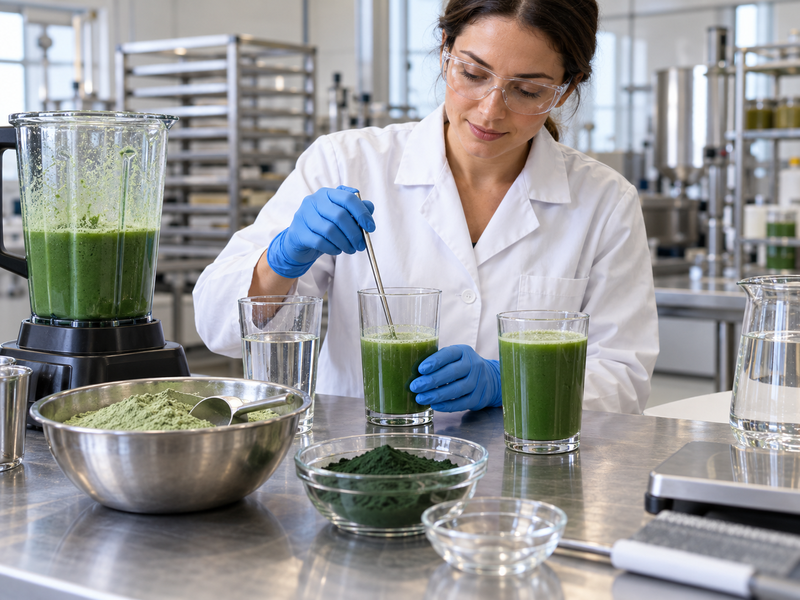
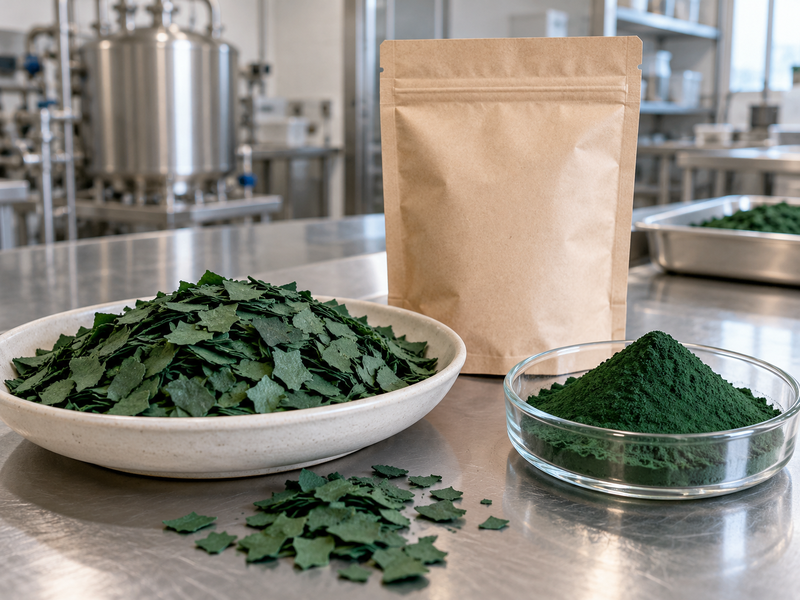
Whole biomass powder brings suspended solids and a characteristic flavor. A phycocyanin-rich blue extract has different composition, solubility and regulatory considerations; it cannot simply replace whole powder gram for gram. Meanwhile, a milled spirulina grade may reduce large visible particles yet increase other issues such as dust or foaming during manufacture. Request a complete ingredient specification: identity, particle-size distribution, moisture, microbiology, color method and any carriers. As a result, test commercial lots, not only a specially prepared sample from sales.
One common misstep: a brand chooses a green powder for its nutrient profile while expecting it to behave like a soluble dye. Still, a supplier can suggest another grade, but the brand must decide whether changing grade alters nutrition, ingredient declaration or marketing claims. Ask for both appearance and application data under the actual pH, process temperature and storage conditions. Use a simple formulation matrix with several grades at the same dosing basis. Do not compare only final color; compare settling, taste, dispersibility and cost per finished serving. Any claim about the finished beverage must be supported by its own composition and applicable market rules.
| Ingredient route | Expected behavior | Buyer check |
|---|---|---|
| Whole biomass | Suspended solids | Settling and flavor |
| Finer biomass | Smaller particles | Agglomeration and flow |
| Extract | Different solubility | Identity and allowed use |
| Blend with carrier | Modified handling | Full ingredient declaration |
3. Which particle measurements are useful?
Look at distribution and agglomerates
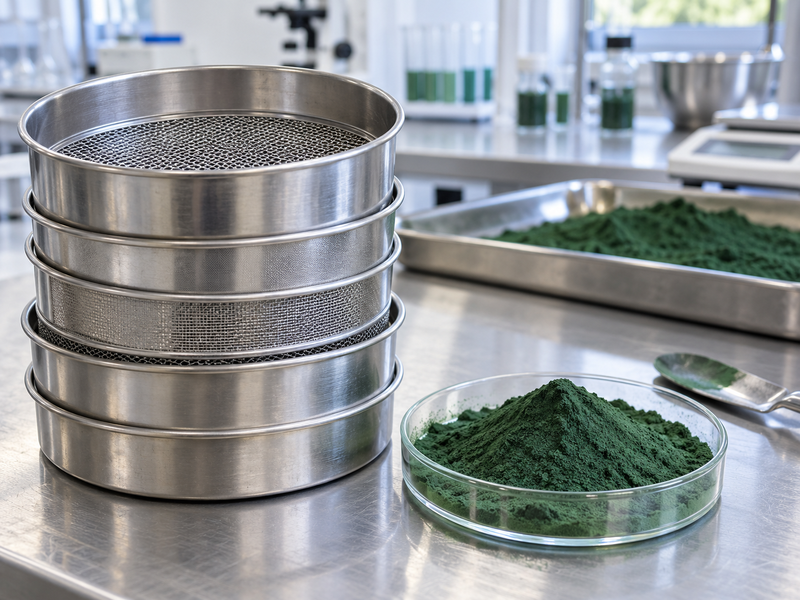
A single average particle size hides a coarse tail that may dominate visible sediment. Ask for the size distribution and method, then examine powder dispersed in the intended beverage base. For example, dry-powder sizing may differ from the size of wet agglomerates after hydration. Microscopy can show whether a deposit consists of intact spirulina fragments or clusters formed during mixing. Record whether sample preparation includes sonication, high shear or filtration because those steps can alter the result. Then, compare samples before and after the actual filling process.
Keep the test practical. A brand may use a cylinder test with photographs and a defined observation time to compare formulations. Instead, another may measure particle size or turbidity instrumentally. Whichever method you select, keep fill volume, temperature, light and agitation history constant. Varying bottle shape changes apparent layer height, so avoid comparing a tall narrow prototype against a wide commercial pack by eye. A research study on a Spirulina-containing drink treated sedimentation as one of several stability properties; its formula and process do not supply a universal threshold for yours. Build the limit from your product concept and consumer use.
4. How should a bench trial separate causes?
Change one meaningful factor at a time
Next, start with a control beverage and a clear list of variables: spirulina grade, dose, mixing order, hydration time, stabilizer and process treatment. Build a small matrix rather than changing all at once. Record lot numbers and full ingredient weights. If two trials differ in acidity and particle size, a better result cannot be attributed to either factor alone. Also, include a sample without spirulina to reveal sediment from fruit, minerals or other ingredients. Use the commercial water source and representative equipment if possible.
Follow each sample over time. Observe immediately, after filling, after temperature cycling and at planned shelf-life points. Note color, odor, redispersibility and any gas or package changes. A neat-looking bench bottle may fail after pumping or heat treatment. As a result, scale-up should include a pilot run because high-shear mixing in a beaker does not reproduce a full tank. Create a short trial report with photographs, measurements and a reason for selecting the next formulation. If safety or spoilage signs occur, stop the appearance study and route the sample through the product’s food-safety investigation. Sediment control cannot replace microbial and process validation.
| Trial factor | Keep fixed | Observe |
|---|---|---|
| Powder grade | Dose and base | Settling rate |
| Hydration | Grade and shear | Wet clumps |
| Stabilizer | pH and process | Texture and layer |
| Heat treatment | Formula and pack | Post-process change |
5. What can hydration and mixing change?
Wet the powder before asking it to disperse
Adding a dense powder to a full tank can create floating islands or wet clumps with dry cores. Trial a controlled pre-wet or staged addition if it fits the process. Next, record water temperature, mixing speed, addition rate and hydration time. However, high shear can break agglomerates, but it may also add heat, air or foam. Evaluate the resulting beverage, not only the dry powder. If powder clings to a tank wall, the apparent formula may differ from the target dose even before sedimentation begins.
Check the order of operations. A stabilizer may need hydration before spirulina enters. Adding acid early may alter other ingredients, while adding solids after a viscosity increase may trap lumps. Then, run small trials that change the sequence while holding composition steady. Next, take tank samples at top, middle and bottom before filling. Compare early and late bottles as the tank empties. If separation already exists in the filler bowl, a shelf-life additive alone will not fix uneven dosing. Keep cleaning and line-clearance records because residue from a prior flavor can change a trial’s appearance. A robust mixing instruction should be specific enough that another shift can repeat it.
6. How do viscosity and stabilizers affect suspension?
Balance particle support with drinkability
For example, increasing continuous-phase viscosity can slow particle movement, but a thick drink may conflict with the intended texture. Some hydrocolloids can help create a weak structure that suspends particles, subject to regulatory permission and label goals. Test each candidate under actual pH, heat process and storage temperature. A stabilizer that performs well in a neutral bench mix may lose function in an acidic drink or interact with minerals and fruit components. Also, record taste and mouthfeel alongside visible sediment so the formula does not solve one complaint by creating another.
Use the lowest effective intervention. A change in particle grade or pre-hydration may work without a new declared additive. Conversely, a low-viscosity ready-to-drink concept may need a clearly communicated shake instruction. Compare redispersibility after defined storage and handling. Do not add a stabilizer merely because a supplier suggests it; check its lawful use and permitted level in the destination market. Published stability work, including a Spirulina-containing beverage investigation, provides methods to consider but no transferable recipe. Commercial approval requires your own process and shelf-life results.
| Intervention | Potential gain | Trade-off |
|---|---|---|
| Finer grade | Smaller visible particles | More agglomeration risk |
| Pre-hydration | Fewer dry lumps | Added process time |
| Stabilizer | Slower settling | Mouthfeel and label |
| Shake instruction | Accepts redispersible layer | Consumer expectation |
7. What do pH and processing contribute?
Treat stability and safety as separate decisions
Acidity, heat, pressure and storage temperature can change protein behavior, color and particle aggregation. Next, test sediment before and after the planned processing step. Measure finished-product pH and keep the schedule used for microbial safety under qualified process authority where required. A low-acid shelf-stable drink can bring regulatory obligations that cannot be solved by a texture trial. The FDA’s acidified and low-acid foods guidance explains U.S. classification and process-filing concepts; a product’s formulation, pack and distribution determine applicability.
Watch the sequence: measure an unprocessed sample, a processed sample and stored packs. If sediment appears only after heat, investigate particle clumping or changes in other ingredients. Before filling, a settled layer points back to mixing and tank hold. Later storage deposits call for a review of particle behavior and pack temperature. Even so, do not lower the pH or reduce heat treatment solely to improve appearance without a food-safety reassessment. Give quality and process specialists authority over that decision. A beverage can look uniform while being unsafe, and a safe beverage can settle; both questions require their own evidence.
8. How should packaging and storage be tested?
Use the intended container and supply route
For example, bottle diameter, fill height and transparency alter how sediment appears to shoppers. A clear bottle exposes a small layer that an opaque carton hides, though hiding a layer does not remove a dosing or use problem. Use the commercial cap, headspace and process. Ship pilot packs through a representative route if distribution vibration could affect separation. Then, store samples upright and, where plausible, on their side. Observe recommended and reasonably foreseeable temperatures. Record whether an ordinary shake returns the intended appearance without persistent clumps.
Give the shelf-life study an honest clock. A one-week prototype cannot support a many-month appearance claim by itself. Plan real-time points through the proposed life, with accelerated screening as a supplement where scientifically justified. If color fades while sediment grows, treat both as part of stability. Retain photographed reference packs and controlled sensory notes. Packaging may also affect light exposure and oxidation, so do not choose a clear bottle solely for its initial look. If the label instructs shaking, test how much effort a typical adult user needs, then write an instruction that matches observed performance rather than an optimistic sales claim.
| Storage challenge | What to measure | Decision |
|---|---|---|
| Upright hold | Layer height | Display appearance |
| Transport vibration | Redispersibility | Distribution fit |
| Warm storage | Color and settling | Shelf-life claim |
| Side storage | Clump location | Pack usability |
9. Which acceptance criteria belong in a specification?
Write a visible and measurable target
Next, define ingredient identity and dose, particle-size method where useful, sediment measure, observation point, storage condition and redispersion method. A photograph can supplement a written limit if lighting and bottle geometry are standardized. Decide whether a thin loose layer is acceptable, whether clumps are prohibited and whether the initial poured serving must match the last. Also, record both release and end-of-life criteria. A specification that says “no settling” may be unrealistic for whole biomass, while “shake well” alone may permit an unpleasant hard cake.
Tie the rule to the customer. For a ready-to-drink bottle sold in clear glass, appearance at retail matters. For a concentrate diluted by a foodservice operator, rapid redispersion might be the key measure. State the test lot and number of packs sampled. If using an instrument, identify calibration and sample preparation. The acceptance limit must be agreed before results are reviewed; otherwise every failed trial invites a new interpretation. Align quality, regulatory and marketing teams so claims about “smooth” or “ready to drink” reflect the tested product. Keep specifications under change control when ingredient grade or process changes.

10. How should a brand investigate a sediment complaint?
Compare the complaint pack with a retained control
Record lot, purchase date, storage history, photograph, pack orientation and whether a gentle shake redistributes the layer. Then, obtain an unopened pack when possible. Next, compare it with retained samples from the same lot and the approved reference. Check powder lot, particle-size data, tank-mixing record, process settings, filling sequence and distribution conditions. If the complaint includes gas, leakage, off-odor or swelling, escalate through food-safety procedures rather than treating it as a cosmetic sediment issue. Preserve the original customer description; a later summary can lose useful detail.
Follow the batch pattern. For example, one bottle may reflect a pack-specific issue; widespread reports across early and late fill may point to tank suspension or formula. Do not blame consumers for failing to shake a drink that was sold as ready to pour. Decide whether to hold connected stock, revise a process, change a grade or adjust the product promise. Spirulina beverage sediment control succeeds when the ingredient, mixing method and shelf-life target fit one another. Ask the supplier for commercial-lot samples and run a pilot study in the final pack before approving the next production order.
| Complaint clue | Possible question | Record to inspect |
|---|---|---|
| Hard cake | Was hydration adequate? | Mix and size data |
| Early-fill difference | Did tank separate? | Fill-time samples |
| Warm-route pattern | Was stability tested? | Distribution study |
| Off-odor or gas | Is safety affected? | Hold and micro review |
FAQ
Q1: Can whole spirulina powder fully dissolve in a beverage? No. It contains particles, so formulate for suspension or acceptable redispersion.
Q2: Will finer milling always stop sediment? No. It can change settling but also alter clumping and processing behavior.
Q3: Is a stabilizer always needed? No. Grade choice and mixing may suffice; test texture, label and regulatory fit.
Q4: Can a brand rely on a one-day bench sample? No. Observe processed product in its final pack through a justified shelf-life study.
Q5: Does sediment mean the drink is unsafe? Not automatically. Investigate quality and safety indicators separately.