
Chlorella powder for plant protein shakes should earn its place in the complete serving. A brand might want a recognizable green ingredient, but whole broken-cell biomass is not a purified protein isolate. The real test is whether a named Chlorella vulgaris powder lot blends evenly with pea or soy protein, tastes acceptable in the intended flavor, and reconstitutes without objectionable grit or sediment.
A 2025 comparative study of eight commercial chlorella powders found compositional and sensory differences among samples, so a generic species name is a weak substitute for a lot-specific shake trial.
Contents
- What job does chlorella do in a protein-led shake?
- Which ingredient grade should be sampled?
- How much nutrition does a serving actually gain?
- How should the dry blend be tested?
- What reconstitution method reflects consumer use?
- How do grit, sediment and foam become acceptance limits?
- Which flavor and color trial is fair?
- What quality and label evidence is required?
- How should cost per accepted serving be compared?
- What makes a commercial lot releasable?
1. What job does chlorella do in a protein-led shake?
Start with the shake’s main promise. The pea, soy or other base probably supplies most of the protein; chlorella may add a distinct whole-biomass ingredient, green color or a modest nutrient contribution. Identify which outcome would justify its flavor and cost. Decide whether the product is a plain powder for water, a cocoa blend for milk or a ready-to-drink beverage; those are different use cases. This article concerns a powder consumers reconstitute as a protein shake.
Set the serving mass and proposed chlorella grams before discussing “high protein” language. A small addition can be visually strong yet add little to the protein total. If the brand’s main aim is a greens supplement rather than a protein shake, a different formulation and label comparison is needed. Keep the protein-led purchase decision central.
| Intended role | Test in finished serving | Possible failure |
|---|---|---|
| Named green ingredient | Ingredient amount and sensory result | Token dose without value |
| Nutrition | Full recipe and lot assay | Claim threshold not reached |
| Visual identity | Color in actual liquid | Shade outside brief |
| Process fit | Blend and filling behavior | Segregation or dust |
2. Which ingredient grade should be sampled?
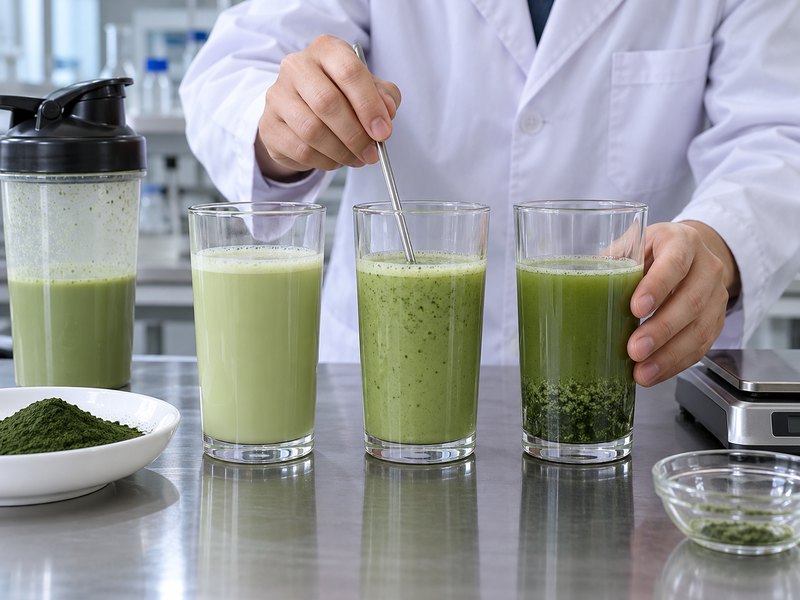
Ask for a single-ingredient C. vulgaris grade if that is the intended label identity, and verify cell-wall disruption separately from particle size. The supplier’s chlorella page distinguishes broken-cell processing from mesh fineness. Request a TDS, current sample-lot COA, particle-size distribution, moisture, bulk density and ingredient declaration. A fine-looking powder may still disperse poorly in the chosen protein matrix. Sample more than one lot if color or odor tolerances are narrow. Keep sealed retains to compare later commercial material.
The 2025 comparative study included different species and processing routes, which is precisely why its sensory rankings cannot be assigned to this supplier’s grade. For a quoted product, confirm pack format, MOQ and lead time in writing rather than inferring them from a category page.
| Grade field | Supplier document | Buyer test |
|---|---|---|
| Species and format | TDS and declaration | Identity approval |
| Cell disruption | Process description | Match product brief |
| Fineness | Distribution data | Shaker mouthfeel |
| Color and odor | Sample and COA as available | Blind finished-shake panel |
3. How much nutrition does a serving actually gain?
Multiply chlorella grams per serving by the lot’s nutrient fraction on the correct moisture basis. If an illustrative 1 g addition contained 60% protein, it would contribute 0.6 g protein before finished-product testing. That example is arithmetic, not a statement about the offered lot or a recommended dose. The shake’s protein base, sweetener and other ingredients determine the final label. Check whether the extra contribution changes any valid label statement at a dose consumers accept.
Also consider displacement: if chlorella replaces 1 g of a higher-protein isolate, total protein might fall even though an additional protein-containing ingredient appears on the label. Validate the finished serving and destination-specific rounding rules. Do not use a whole-biomass ingredient assay to promise a medical effect or an exact finished-product nutrient value.
| Calculation | Input | Decision |
|---|---|---|
| Chlorella protein | Dose × actual lot fraction | Increment before displacement |
| Base protein displaced | Replaced mass × its fraction | Net recipe change |
| Finished serving | Full recipe plus verification | Permitted label statement |

4. How should the dry blend be tested?
Prepare a control and candidate blends at fixed serving mass and realistic mixer fill. Record ingredient addition order, blend time, bulk density, flow through the intended filler and dust formation. Sample the start, middle and end of discharge for a validated marker of uniformity; do not assume a visually green batch is homogeneous. Chlorella’s density and particle distribution may differ from pea or soy protein and cause segregation in bins or sachets. Check clumping after normal humidity exposure in the production room.
A dry blend that passes in a sealed laboratory jar may bridge in a hopper or separate during transport. If a premix is needed, include its steps and cost in the final specification. Retain production samples from different fill positions and reconstitute them; finished-shake variation is what the buyer actually cares about.
| Sampling point | Measure | Action if poor |
|---|---|---|
| Mixer discharge | Marker variation | Change order or time |
| Filler start/end | Serving concentration | Check segregation |
| Stored pack | Caking and flow | Revise pack or moisture limit |
5. What reconstitution method reflects consumer use?
Write a consumer-use protocol before testing: powder mass, liquid type and volume, temperature, shaker size, shake duration and standing time. Run water if the label tells users to mix with water; run plant milk if that is the brand’s normal serving suggestion. Test a spoon stir as well if the package implies it will work. Compare immediately and after a plausible drinking delay. Note clumps on the lid, wetting time, foam and sediment.
A high-shear blender may make a mediocre shaker powder look better than consumers will experience. Use the same protein base and flavor in every arm. Because pea and soy proteins differ in hydration and viscosity, results from one cannot be transferred automatically to the other. State the method in the acceptance specification so procurement can compare future lots consistently.
| Consumer scenario | Fixed variables | Result to record |
|---|---|---|
| Water shaker | Volume and shake count | Clumps and sediment |
| Plant-milk shaker | Type and temperature | Mouthfeel and color |
| Delayed drinking | Standing time | Layering and re-dispersion |
6. How do grit, sediment and foam become acceptance limits?
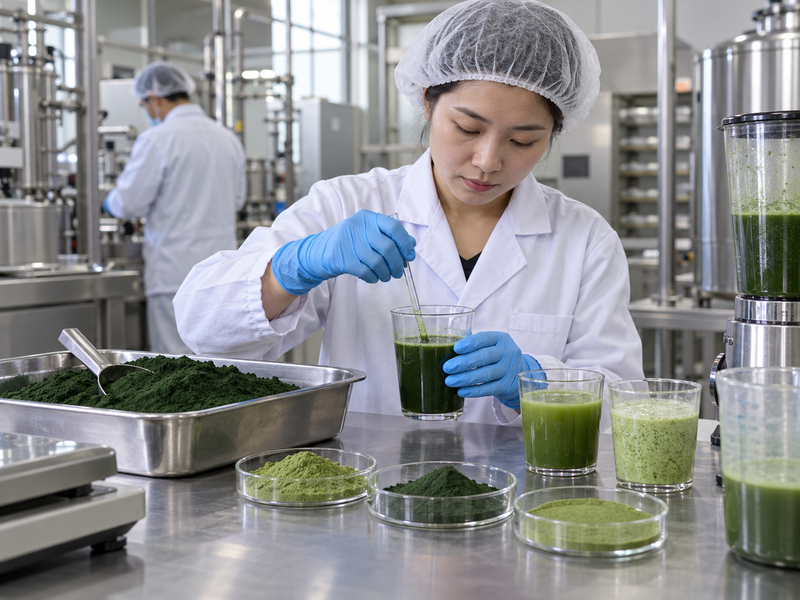
Set measurement rules rather than relying on “smooth enough.” Use a trained panel to score mouthfeel and throat coating, a timed photo for sediment height, and a standard number of re-shakes to assess recovery. Weigh residue caught in a sieve if that correlates with consumer grit. Record foam height at a fixed time and whether it causes serving-volume confusion. A finer powder can improve one aspect while increasing dust or foam, so evaluate the whole production-to-drinking route.
Separate harmless settling from hard sediment that will not redisperse. A lot can pass the incoming particle specification yet fail because it behaves differently in the specific protein-flavor matrix. Capture an acceptable reference sample and written tolerance. Those controls make a later procurement dispute about real performance rather than subjective preference.
7. Which flavor and color trial is fair?
Blind-test the actual cocoa, vanilla or fruit flavor with the same sweetener, acid and protein base. Score aroma on opening, first sip, aftertaste, appearance and acceptability after standing. A cocoa matrix may hide green color but not necessarily its flavor; a vanilla matrix may show every shade change. Prepare the control and chlorella arms with the same liquid and mixing protocol. Ask panelists to identify bitterness, grassy notes and chalkiness separately because the underlying protein base may cause some of them.
The eight-powder study found differences among commercial chlorella powders, so a sensory result should be attached to the actual grade and lot. If masking requires extra flavor or sweetener, price that reformulation before approving the ingredient.
8. What quality and label evidence is required?
Request species and processing identity, TDS, sample and shipment COAs, microbiological and contaminant results, and any certifications needed for the destination. Confirm allergen statements and whether processing aids or carriers appear in the grade. Evaluate the finished shake under applicable food or supplement rules; the category affects claim and manufacturing obligations. FDA dietary supplement CGMP guidance addresses component specifications for U.S. supplements, but a conventional food shake must be assessed under its own applicable framework.
Keep label claims tied to finished-product evidence. “Broken cell” is a material-processing descriptor, not itself proof of a health outcome. A COA is evidence for a particular lot, not permission to assume that every subsequent lot shares the same sensory profile.
| Evidence | What it supports | What it does not support |
|---|---|---|
| Ingredient COA | Lot release | Finished-shake protein claim |
| TDS | Grade target | Future lot consistency alone |
| Pilot blend | Process and sensory fit | Different flavor automatically |
| Market review | Claims and label | Other destinations automatically |

9. How should cost per accepted serving be compared?
Use delivered cost at the agreed order volume, pack and destination. Multiply by the grams in an accepted serving, then add any flavor or sweetener changes, premix labor, filler loss and rejected packs. Compare against the brand’s price ceiling. If the ingredient is intended to improve a protein claim, calculate cost per net gram of added protein after displacement of other protein ingredients. If the label claim does not change, be candid that the purchase serves a different role, such as appearance or ingredient story.
Include the cost of consumer complaints or reformulation risk when sediment and flavor are near the tolerance limit. Ask for a written commercial quote and repeat-lot specification. A sample jar and a headline price are insufficient for annual supply approval.
| Cost element | Calculation | Decision use |
|---|---|---|
| Powder | Delivered price × serving dose | Ingredient cost |
| Flavor fix | New recipe minus control | True formulation delta |
| Line yield | Sellable packs / input | Usable cost |
| Protein gain | Net finished-serving change | Claim value, if any |

10. What makes a commercial lot releasable?
The signed purchase specification should identify C. vulgaris, cell-disruption status, particle limits, color and odor reference, relevant analytical criteria, package and documentation. Link the release decision to a named sample lot and finished-shake tests at the approved dose. Require dry-blend uniformity, acceptable shaker performance, sensory score, serving-level label review and feasible cost. Set retest triggers for changed protein base, flavor system, processing method or commercial lot. A second lot trial is sensible if the product has a narrow flavor or color tolerance.
Define what happens if an incoming lot passes its COA but fails the functional shake test. This closes the gap between an attractive ingredient specification and a product consumers will actually mix and drink.
Turn the consumer protocol into a reproducible quality check. A retained reference powder and finished blend should be mixed with the same liquid volume, shaker and number of shakes each time a new commercial lot arrives. Photograph the cup immediately and after the stated standing time, and record the same grit and sediment scores used in the pilot.
If a formulation team later changes cocoa, sweetener or pea-protein source, run the test again; those ingredients can alter viscosity and sensory masking even when chlorella itself is unchanged. Do not let an unrecorded flavor adjustment become the only reason a lot seems acceptable.
The buying team also needs a route for borderline outcomes. For example, a lot may satisfy microbiology and composition yet show slower wetting than the approved reference. Decide whether process blending can correct it, whether a supplier investigation is needed, or whether the lot should be reserved for another validated application. Keep that decision separate from the regulatory assessment. A protein-shake brand’s acceptance threshold is partly a consumer-experience standard, and a legally saleable ingredient does not automatically meet it.
Writing that distinction into the order prevents disputes after production begins.
FAQ
Q1. Is chlorella a replacement for pea or soy isolate? No. Whole biomass has a different composition and a separate sensory role.
Q2. Does broken-cell mean ultra-fine? No. Cell-wall disruption and powder particle size require separate checks.
Q3. Can a blender trial predict shaker results? No. Use the package’s intended consumer mixing method.
Q4. What if powder settles but redistributes with one shake? Decide whether that meets the brand’s documented consumer standard and label directions.
Q5. Can an ingredient COA support a high-protein claim? It helps recipe calculation, but finished-product evidence and destination rules decide the claim.
Next step: Contact SpirulinaCN with the protein base, chlorella grams per serving, mixing method, flavor target, anticipated monthly quantity and destination. Request a matched broken-cell sample, particle data, TDS, lot COA and quote for a shaker-bottle trial.