
An automated feeder can report a steady setpoint while actual spirulina flow surges, stops or drifts during refill. Manufacturers need a dosing plan based on measured delivery into the product. Spirulina powder automated dosing control joins powder characterization, feeder selection, calibration, in-process checks and deviation response. Research on loss-in-weight feeder behavior shows why hopper design and refill behavior affect performance; its tested materials were not spirulina, so the line still needs a product-specific trial.
Contents
- What makes powder dosing difficult?
- Which feeder type fits the process?
- What material properties should be measured?
- How should calibration be performed?
- How is a target feed rate established?
- What happens during hopper refill?
- Where should delivery be verified?
- How are alarms and holds designed?
- How should operators investigate drift?
- What proves the system is ready?
1. What makes spirulina powder dosing difficult?
Distinguish setpoint from delivered mass
Fine powder can arch above a screw, stick to hopper walls, entrain air or change bulk density as the hopper empties. Humidity and handling history may make one lot feed differently from another. A controller that holds screw speed does not necessarily hold mass flow. Look beyond the screen: compare gravimetric output with an independent collected-mass check at startup, during stable running, just before refill and after refill. The checks reveal where the feeder model loses contact with physical delivery.
The spirulina powder agglomeration study found that treatment affected flow and wetting under its research conditions. It supports characterizing the actual grade, not assigning a universal flow value to all green biomass powders. Record whether powder arrives loose or compacted, and whether a bag has been exposed to humid air. If plant operators need to tap a hopper to restart flow, capture the interruption and its effect on downstream product. Build the control approach around the worst credible routine condition rather than a freshly opened ideal sample.
2. Which feeder type fits the process?
Match delivery mode to the decision needed
A volumetric screw meters a volume per revolution and depends on stable bulk density. A loss-in-weight feeder infers delivered mass from hopper weight change and adjusts screw speed, but measurement can be disturbed by vibration or refill. A weighed-batch system may suit discrete mixes better than continuous flow. Choose by process: a beverage premix can use a weighed charge into a covered vessel; an extrusion line may need continuous gravimetric feed matched to the main stream. State required mass flow range, turndown, accuracy and cleanability before requesting equipment quotes.
Test at the low and high rates actually planned, not only at the vendor’s preferred middle rate. Confirm that auger geometry and agitator action move the powder without unacceptable grinding, heat or segregation. The research on low-dose powder feeding demonstrates that cohesive fine powders can demand specific feeder designs, although its pharmaceutical material and tolerances differ from food manufacturing. Ask the supplier for a supervised trial with your spirulina lot. Record screw, hopper fill, vibration, refill settings and collection results so equipment comparisons are reproducible.
| Feed approach | Best-fit question | Main check |
|---|---|---|
| Weighed batch | Can each vessel receive a discrete charge? | Independent charge mass |
| Volumetric screw | Is bulk density stable enough? | Mass per timed run |
| Loss-in-weight | Can mass flow stay controlled? | Refill and vibration behavior |
| Premix pump | Can powder enter as slurry? | Slurry concentration and tank heel |
3. What material properties should be measured?
Characterize the grade that will be purchased
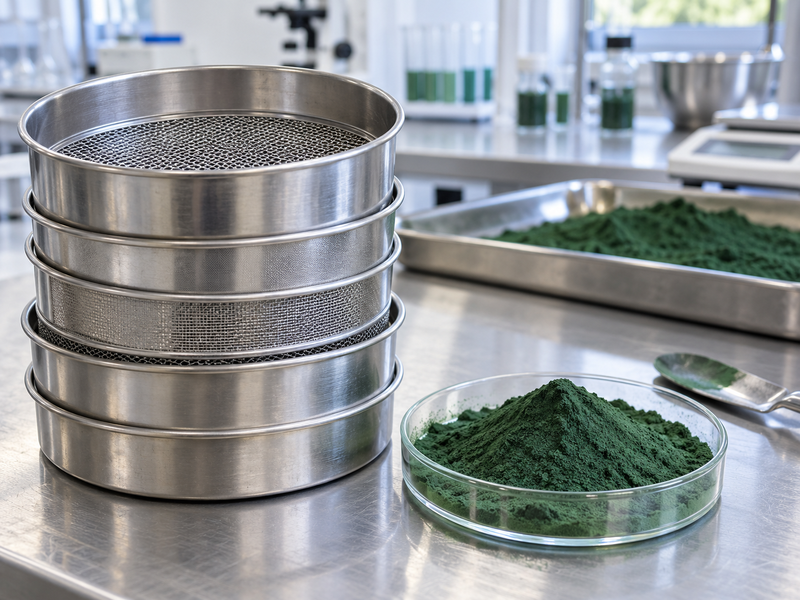
Measure loose and tapped bulk density, particle-size distribution, moisture or water activity where relevant, and practical flow through the chosen hopper. Observe wall deposits, dusting and compaction after transport. These properties are not substitutes for a feeder trial; they explain why one trial differs from another. A useful paired test: sample powder from the top and bottom of a shipped bag, then compare feeding after each portion reaches the hopper. If the bag has compacted, operators may see a transient change that a lab jar misses.
Use a consistent sample preparation and note how long the bag has been open. Track lot-to-lot differences against actual feeding performance. The site’s spirulina powder flowability guide can frame incoming-data requests, while the original agglomeration paper demonstrates that different powder forms can behave differently. Never convert a laboratory flow index directly into an equipment guarantee. If a material changes visibly during storage, investigate packaging and warehouse conditions before altering feeder settings.
4. How should calibration be performed?
Check weighing and delivery as separate functions
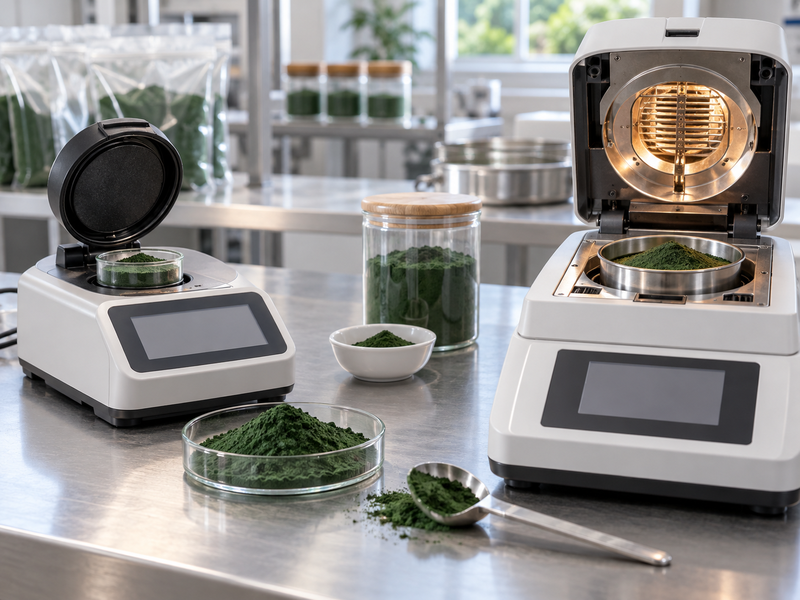
Confirm scale calibration status and perform a functional check at masses relevant to the intended dose. The NIST balance and scale calibration resource identifies traceability, measurement assurance and uncertainty as distinct considerations. Then collect timed feeder output on an independently checked balance. Compare measured mass with the controller’s integrated total and calculate deviation using a stated formula. Repeat under operating conditions: machine vibration, air movement and connected flexible sleeves can alter indicated weight even when a static check passed.
Document tare method, collection duration, hopper fill level and the number of repeats. Avoid using a sample so small that scale resolution dominates the result. Verify zero and span after maintenance, load-cell replacement or a collision. For a continuous process, check response to a setpoint change and return to target. An automated controller may compensate for a biased scale by changing screw speed, making product results appear temporarily normal while its displayed mass total remains wrong. Separate instrument checks from product sampling so each failure has a clear investigation route.
| Calibration layer | Evidence | Trigger to repeat |
|---|---|---|
| Scale check | Traceable weights and result | Scheduled interval or repair |
| Timed catch test | Independent mass and duration | New powder lot or setting |
| Controller total | Catch mass versus reported mass | Software or load-cell change |
| Dynamic response | Setpoint step and recovery | Screw or hopper modification |
5. How is a target feed rate established?
Tie powder flow to the main stream
Calculate target kilograms per hour from product throughput and the approved inclusion rate, with consistent wet or dry mass basis. For example, a hypothetical 1,000 kg per hour product stream at 0.5% powder requires 5 kg per hour if the percentage applies to final mass. This illustrates arithmetic rather than a recommended formula. Check the denominator: if water is added after dosing or product is lost before the filler, the correct target may need a process-specific correction. Record which flow meter or production count supplies the main-stream value.
For batch mixing, use a verified weighed charge and a batch-size tolerance. For continuous processing, interlock or alarm when the main stream stops while powder continues. Assess residence time between feeder and finished sample point; an out-of-limit interval may affect product produced after the alarm timestamp. A product trial should confirm that the chosen target produces accepted color, taste and nutrition data. Do not use visual green intensity alone as a mass-flow meter. The site’s powder blending uniformity guide provides related sampling questions for dry products.

6. What happens during hopper refill?
Measure the transition rather than assuming it away
Loss-in-weight systems often change control behavior while material enters the hopper because the weight signal includes refill mass. An original feeder hopper study describes how refill can shift operation toward volumetric delivery; its findings must be tested with spirulina on the chosen machine. Plan catch tests and product samples spanning the refill interval. Look for a pulse: compressed powder, an air surge or a temporary screw-speed hold may produce a short low or high delivery period hidden inside a respectable hourly average.
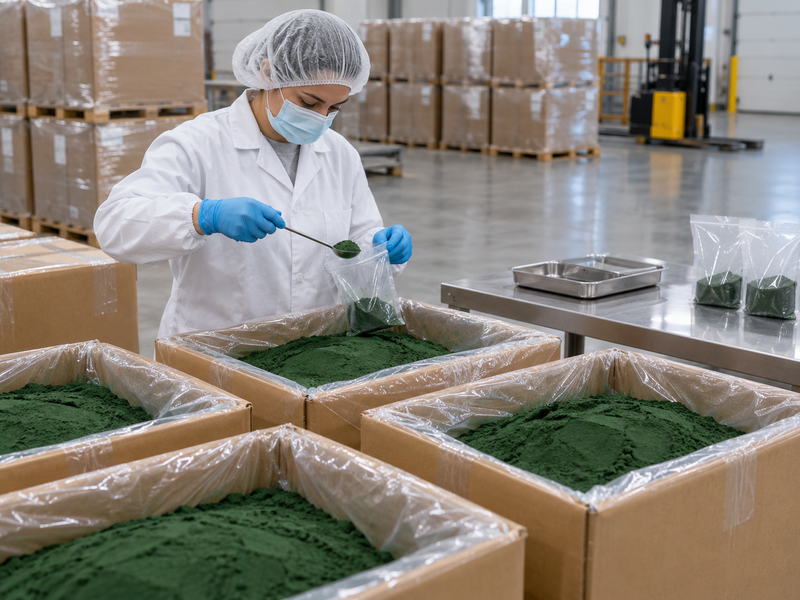
Record refill trigger level, refill quantity, source bag lot and duration. Keep the material entering the hopper at a consistent condition where practical. A bag change can introduce a different lot or a compacted bottom layer. If refill produces a measurable transient, tune the control strategy, buffer capacity or process scheduling, then repeat the test. Avoid simply widening the finished-product tolerance to make a feeder issue disappear. If every refill affects a limited number of units, the line needs a defined diversion or sampling method for those units.
| Refill signal | Possible explanation | Verification |
|---|---|---|
| Short low feed | Arching or slow restart | Timed catch test |
| Short high feed | Compacted material surge | Outlet sample and mass trace |
| Weight noise | Vibration or sleeve force | Static and dynamic scale check |
| Lot step-change | New bag or powder condition | Bag ID and bulk-density sample |
7. Where should delivery be verified?
Check the outlet and the finished product
An independent catch test at the feeder outlet verifies mechanical delivery. Downstream sampling verifies whether powder reaches product uniformly after transfer, blending and any screen. Both are necessary when losses or segregation can occur between the screw and pack. Follow the route: weigh material at the outlet, inspect transfer bends for buildup, then collect product at startup, steady run and end. In a liquid line, compare tank concentration with filled units if settling may occur. In a dry line, sample across discharge sequence and packaging heads.
Choose an assay or proxy appropriate for the matrix and validate its relation to dose. Color measurements can monitor consistency under controlled conditions, but formulation color may be influenced by other ingredients, pH or lighting. A mass balance can identify material held in a transfer system. The FAO verification guidance lists calibration, observation, sampling and record review as complementary verification activities. Use that combination when deciding whether feeder readings support release.
8. How are alarms and holds designed?
Define action before a deviation occurs
Set alert and action thresholds from trial capability and finished-product requirements. Decide how long a feed deviation may persist before product diversion or hold, considering residence time and sample delay. An alarm without disposition is incomplete: the operator must know which material is affected, who may restart and which checks close the event. Record actual value, setpoint, duration, feeder state, powder lot and downstream batch or unit range. Avoid copying a percentage from another plant; its process dynamics may differ.
Protect against both high and low dose. Low flow may produce off-spec appearance or nutrition content, while high flow may alter flavor, texture, labeling or cost. For continuous systems, test sensor loss, power interruption, empty hopper and main-line stop during commissioning. Give quality access to the event log. A stop-and-restart should trigger a defined purge or sample if powder can accumulate in the line. The Codex hygiene principles support documented monitoring and corrective action; the plant’s hazard and quality analysis determines exact alarm logic.
| Event | Immediate response | Release evidence |
|---|---|---|
| Feed below action limit | Stop or divert affected stream | Catch test and product check |
| Feed above action limit | Isolate affected units | Dose assessment |
| Lost weight signal | Stop automatic dosing | Instrument repair and challenge |
| Main stream stopped | Interlock feeder | Restart verification |
9. How should operators investigate drift?
Test one failure mechanism at a time
Review trend data before adjusting screw speed. Check hopper level, bridging, auger wear, buildup, scale vibration, flexible connections and the bag’s condition. Start with the physical evidence: a declining weight trace paired with low outlet mass suggests a measurement or calculation issue; a flat weight trace and empty outlet suggests flow interruption. Record what was observed before cleaning away deposits. Compare current powder with a retained sample if a lot change coincided with drift.
After corrective work, repeat the relevant catch test and downstream product check. A temporary manual intervention should have a time limit and documented owner. If feed error repeats at the same hopper level, design or refill settings may need revision. If it appears only in humid weather, review storage and exposure. Ask the powder supplier for physical-property data when material variation seems implicated, but do not assume every feeder fault comes from the ingredient. Close the event only after affected product is dispositioned and the control performs again under realistic conditions.

10. What proves the system is ready?
Approve a measured operating window
The readiness file should include the approved powder specification, feeder configuration, calibrated scales, catch-test results across the operating range, refill challenge, product uniformity results and alarm response test. Name the powder lots and batch sizes used. The repeatability question: can another shift run the procedure without engineering staff adjusting the hopper by feel? If not, improve the instruction or control design before routine production.
Set ongoing checks: startup verification, scheduled catch tests, lot-change challenge when material varies, preventive maintenance and trend review. Reassess after a screw, control software, hopper or powder-grade change. A low average dosing error is insufficient if short periods exceed the product’s defined acceptance range. Share the proven feed window with purchasing so an apparently similar powder grade is not substituted without evaluation. Keep deviations linked to affected finished units and close them through the plant’s normal quality system.
| Readiness proof | Owner | Routine trigger |
|---|---|---|
| Scale and catch-test record | Engineering and quality | Scheduled and after repair |
| Refill challenge | Operations | Setting or pack change |
| Finished-product samples | Quality | Startup and defined intervals |
| Alarm challenge | Engineering | Commissioning and change control |
FAQ
Q1: Does a loss-in-weight feeder guarantee accuracy? No. Refill, vibration and poor powder flow can disturb delivery.
Q2: Can green color replace a dose assay? It may be a validated proxy for consistency in a particular matrix, but it does not automatically measure powder mass.
Q3: When should catch tests run? At startup and at frequencies justified by trial capability, risk and changes.
Q4: Must every new lot be recalibrated? Check material behavior; repeat challenge tests when lot properties can affect feeding.
Q5: What should happen after an alarm? Isolate affected product, fix the cause and verify the restart under the written procedure.
Next step
Trial the actual powder on the intended feeder at low, normal, high and refill conditions. Approve dosing only after independent mass checks and downstream product results agree with the controller trace.