
A blue tablet coating can be a brand cue, but its color has to survive production. A buyer must decide whether the extract is appropriate for the target market, disperses in the film, covers evenly, and remains recognizable through shelf life. That differs from buying whole green spirulina powder for the tablet core. SpirulinaCN describes blue spirulina as a phycocyanin extract and green spirulina as whole biomass; purchase documents should name the correct one.
This guide turns a spirulina extract dietary supplement tablet coating inquiry into a sample and approval plan. It uses the current U.S. food color regulation as a specific example. A different destination, coating formula, or finished product needs its own review before commercial use.
Contents
- What exactly is being colored?
- Does the target market permit this coating use?
- Which extract and carrier facts belong in the specification?
- How should the first coating trial be designed?
- What shows that the film disperses and covers evenly?
- How should rub resistance and defects be evaluated?
- How do light, moisture, and packaging change the decision?
- Which documents should quality and regulatory teams request?
- How can buyers compare cost at an approved shade?
- What should be locked before the first purchase order?
1. What exactly is being colored?
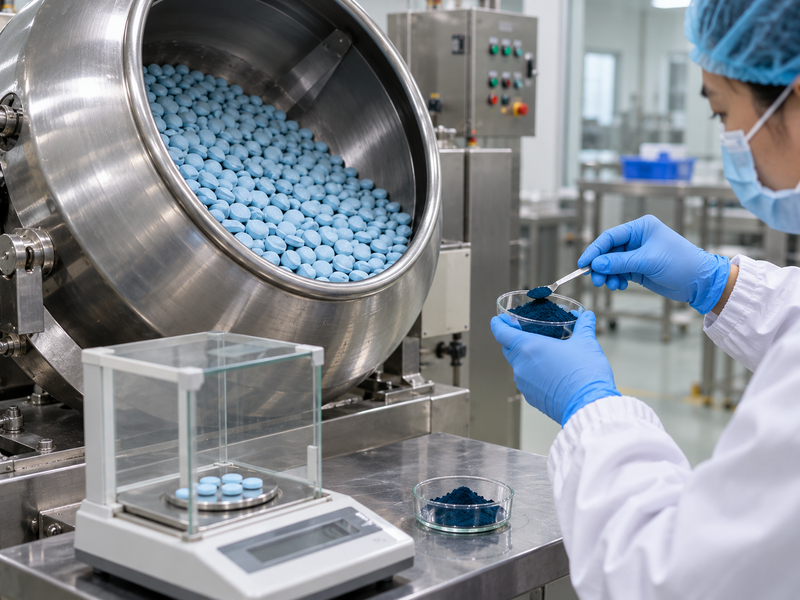
Start with a one-line product definition: “blue color in a film applied to a dietary supplement tablet,” or, if applicable, a coating on a supplement capsule. The extract is a color component of the coating dispersion. It is not the nutritional spirulina dose in the tablet core, and it does not justify treating a blue film as a protein or phycocyanin supplement serving. Record whether the core is uncoated, enteric coated, or already sealed, because surface roughness and absorbency change the shade and coating demand.
Map the coating platform. Aqueous film, sugar coat, and specialty finishes create different drying and handling conditions. Ask the formulator for polymer, plasticizer, opacifier, solvent, target weight gain, and process temperature. The supplier can then offer a grade for the actual medium. A commercial coating application page shows spirulina-derived blue marketed for coatings, but another SKU needs its own performance and regulatory review.
| Define before sampling | Why it matters | Buyer record |
|---|---|---|
| Core and dosage form | Surface and process differ | Tablet or capsule drawing |
| Film system | Dispersion and adhesion depend on it | Coating formula and solvent |
| Target shade | “Blue” is too broad | Physical or measured color standard |
| Sales markets | Authorized uses vary | Country list and product category |
2. Does the target market permit this coating use?
For the United States, read the current 21 CFR 73.530 before approving a U.S. claim. As of the October 2026 eCFR text, spirulina extract may color coating formulations applied to dietary supplement tablets and capsules at levels consistent with good manufacturing practice. The regulation defines the color additive as filtered aqueous extract of dried Arthrospira platensis biomass with phycocyanins as the principal coloring components.
It also specifies impurity limits and “negative for microcystin toxin.” The permission belongs to the listed application; it is not an open permission for every tablet, drug, or supplement use.
The eCFR also flags a broader February 2026 amendment that was delayed indefinitely in March 2026. Use the displayed current list, not a headline about the delayed expansion. If the project is a medicine, an uncoated supplement core, or a different jurisdiction, route it to the buyer’s regulatory specialist. For U.S. food color mixtures, check that proposed diluents are suitable under the same rule; approval of the pigment does not approve every carrier formulation.
| Regulatory question | Evidence to obtain | Decision owner |
|---|---|---|
| Is the item a supplement tablet/capsule coating? | Finished-product classification | Brand regulatory team |
| Is the extract within §73.530 identity/specifications? | Current TDS and lot COA | Supplier QA and buyer QA |
| Are mixture diluents suitable? | Full composition and carrier statement | Regulatory team |
| Are labels and target markets covered? | Market-specific label review | Brand or local counsel |
3. Which extract and carrier facts belong in the specification?
Ask for the ingredient identity, extraction description, carrier composition, color strength method, moisture, solubility or dispersibility description, particle behavior, and storage conditions. A grade code alone is not a technical specification. Two grades with similar blue color in water can behave differently in a polymer dispersion because their carrier systems and pigment concentration differ. Have the supplier state whether quoted potency is an absorbance-based color value, another assay, or merely a marketing grade label.
Do not copy a trial concentration from another coating system. Set the first addition range against target shade, film weight gain, and tablet surface. A lower-potency grade can require more powder, changing viscosity, spray rate, and cost. A higher-potency grade may be difficult to meter uniformly at low inclusion. Choose through film trials, not color value alone.
For the U.S. route, the regulation’s specifications deserve explicit attention: lead no more than 2 mg/kg, arsenic no more than 2 mg/kg, mercury no more than 1 mg/kg, and negative for microcystin toxin. Ask how the supplier reports these on the actual lot. These regulatory limits are not a substitute for the finished product’s own specifications.

4. How should the first coating trial be designed?
Run a small, documented trial in the actual coating vehicle. Start with a reference tablet core and a retained uncolored film control, then test a few preselected color loads. Keep polymer solids, weight gain, pan or fluid-bed conditions, and drying endpoint fixed while comparing the color. If operators alter several settings to make one extract work, the result cannot be compared fairly with another sample.
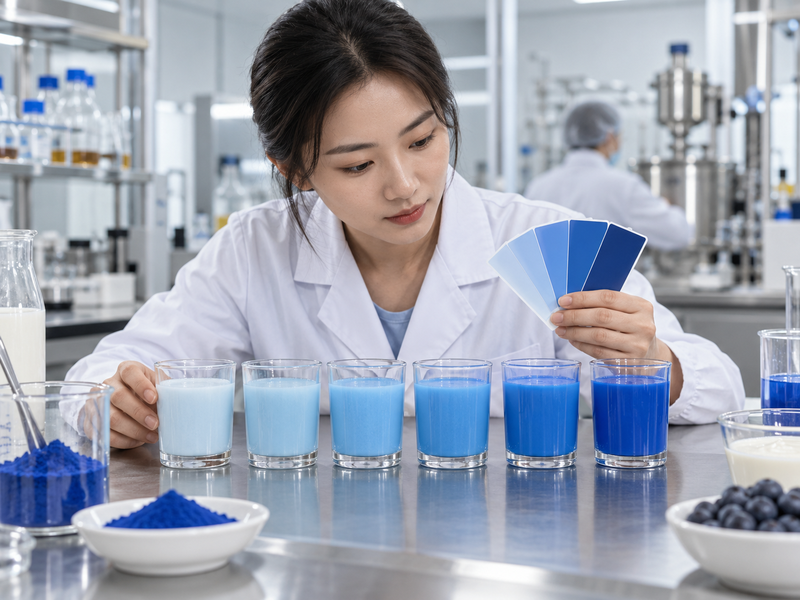
Record the color at three moments: mixed dispersion, freshly coated tablet, and equilibrated tablet after packaging. Photographing under uncontrolled lighting can hide a shade shift. A color instrument or a controlled light box makes trial repeats more useful, but a physical standard and a consistent viewing protocol also help. Include a second core lot if core color varies; an opaque film can mask that variation, while a thin translucent blue film may not.
Keep a small retain of each extract and coated pilot lot. The retain connects later observations to the exact supplier sample and production settings. If the pilot uses a sample that cannot be traced to a saleable grade and lot, the buyer still has an unresolved commercial qualification step.
| Trial variable | Hold constant or record | Failure signal |
|---|---|---|
| Dispersion solids | Same polymer basis | Viscosity drift |
| Color addition | Weighed against dry film | Shade variability |
| Spray and drying | Actual line window | Tack, mottling, heat exposure |
| Film weight gain | Measured per run | Unequal opacity |
5. What shows that the film disperses and covers evenly?
Before coating tablets, inspect the premix and the full coating dispersion. Look for floating color, grit, sediment, foam, and color stratification during the expected hold time. Measure or at least record viscosity at a consistent temperature; a stable blue sample is not useful if it blocks a spray nozzle or separates after a pause. The actual mixing order matters. Add powder according to the coating system’s validated procedure, and evaluate whether pre-wetting or a controlled powder addition avoids clumps.
Then check tablets from the start, middle, and end of the run. Compare faces and edges, not only a handful of attractive center samples. Score mottling, speckling, spray pattern marks, and core show-through against an agreed acceptance standard. If the formulation contains an opacifier, assess whether it improves hiding without dulling the intended blue. Record any extra coating time needed to reach the shade, because the additional film mass may affect dissolution or tablet size.
A pass requires both reproducible color and a workable production window. A single visually pleasing pilot at an unusually slow spray rate is a signal to retest, not a purchase approval.
6. How should rub resistance and defects be evaluated?
Tablets encounter dedusting, counting, bottling, blistering, shipping, and consumer handling. Agree on a practical handling challenge that resembles those steps. Inspect transfer to white contact material, scuffed edges, and blue dust in the pack. Record the test method so a second extract grade faces the same treatment. If a supplier says a pigment is “stable,” ask which film, substrate, pack, and exposure supported that claim.
Color failure can be a film failure rather than a pigment failure. Soft films rub; brittle films chip; too much color load can accentuate visible damage. In a comparative trial, separate pigment-related shade loss from mechanical film defects. Adjusting plasticizer or polymer may solve a film problem, but it changes the commercial formula and deserves another color check.
The finished product team should also confirm that any new coating weight, process adjustment, or prolonged wet exposure does not undermine tablet attributes already qualified for that product. The supplier can help choose a color grade; the manufacturer owns its finished-product performance criteria.
| Observation | Possible source | Next test |
|---|---|---|
| Blue dust in bottle | Weak film or abrasion | Handling challenge by pack type |
| Pale edges | Coverage or tablet geometry | Edge inspection at equal weight gain |
| Dark specks | Poor powder dispersion | Premix and screen check |
| Shade shift after drying | Process or formulation exposure | Compare wet, dry, and packed samples |
7. How do light, moisture, and packaging change the decision?
Phycocyanin color can be affected by formulation and processing conditions; SpirulinaCN’s blue extract page specifically calls out pH, heat, light, and other ingredients as factors to test. A coating film introduces its own microenvironment. Test the finished tablet in the proposed bottle or blister, not only extract in water. Include a clear-pack exposure if the commercial pack may admit light; compare with protected controls rather than assuming a dark laboratory drawer predicts retail display.
Set a shelf-life color acceptance criterion before observing results. Compare initial, intermediate, and intended end-of-life samples using the same viewing method. Record temperature, humidity, and light conditions. If the color changes, investigate the film formula and package protection as well as the extract. The aim is a repeatable decision under the brand’s actual pack, not a universal shelf-life promise from a raw-material specification.
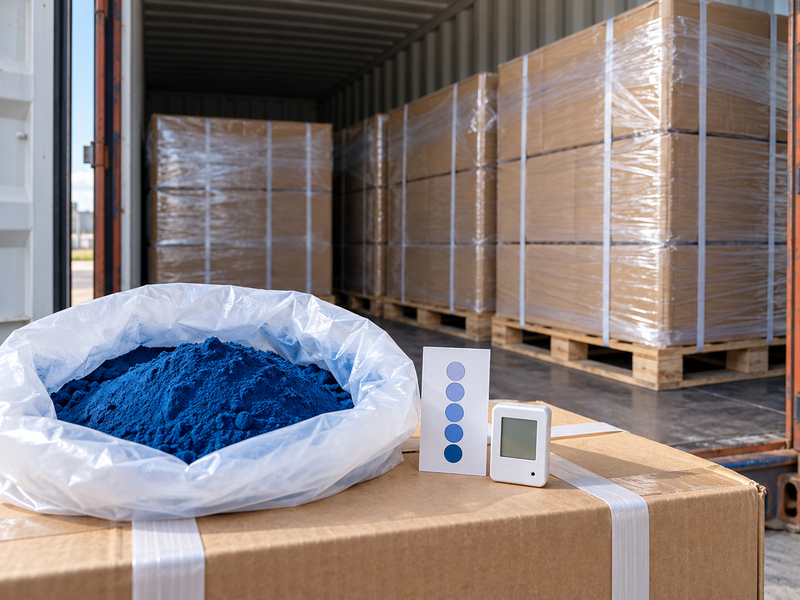
Avoid claiming that a room-temperature swatch proves the same performance after transport. Pack vibration and tablet-to-tablet contact may reveal abrasion that a tray sample misses. Likewise, a pigment that looks suitable in a gelatin capsule shell says little about this tablet film without a matched trial.
8. Which documents should quality and regulatory teams request?
Request a current technical data sheet, complete ingredient and carrier statement, lot-specific certificate of analysis, assay methods, safety information, manufacturing and traceability overview, and a sample label for the extract. Ask for the material’s botanical identity and the intended color-additive use to be stated consistently across documents. A marketing sheet saying “natural blue” does not resolve identity, permitted use, or carrier questions.
Tie each document to the actual proposed SKU. A COA for a different color grade or older lot is useful for screening a supplier but does not release the buyer’s production lot. Set a purchase specification with acceptance limits and agreed methods; arrange incoming checks appropriate to the buyer’s risk assessment. For U.S. use, have the regulatory reviewer compare the dossier with the current §73.530 and color-additive labeling rule cited there.
| Document | Specific question it answers | Common mismatch |
|---|---|---|
| TDS | What is the sold grade? | Ambiguous carrier or color method |
| Lot COA | Did this lot meet stated tests? | Different grade or missing method |
| Composition statement | What enters the film? | “Proprietary blend” with no reviewable detail |
| Traceability record | Which batch supplied the pilot? | Sample cannot be tied to saleable lot |
9. How can buyers compare cost at an approved shade?
Compare cost per accepted coated tablet, not price per kilogram of blue powder. Calculate the extract mass needed to achieve the accepted shade at the selected film weight gain, then add handling loss and the impact of any changed coating time. Keep a separate line for costs that are not pigment costs: extra film solids, longer drying, rejected tablets, or a package change. A cheap powder can become expensive if it forces high loading or poor process yield.
Use trial measurements in the quote worksheet. For example, if grade A and grade B both meet the same shade and rub criteria, compare their actual dry extract use per 100,000 tablets and quoted price at the same order quantity, destination, and trade term. If B has higher potency but weaker uniformity, a simple potency ratio is a misleading forecast. Do not present an estimated market price as a supplier offer.
Ask for MOQ, pack format, lead-time basis, storage conditions, and change notification with the quote. A coating program needs consistent shade across batches.

10. What should be locked before the first purchase order?
Issue a brief approval record: exact extract SKU, carrier composition, sample and lot identification, chosen coating formula, target color standard, acceptable variation, process window, finished-pack stability plan, release tests, and who signs off changes. Include the target markets and label position reviewed. Put the same grade and document requirements in the purchase order so the factory does not substitute another blue extract with an equivalent-sounding name.
Define a change trigger. A different carrier, new color-strength test method, extraction change, or manufacturing site may require a new regulatory and coating review. Even a nominally stronger grade can alter dispersion and appearance. Have QA decide which changes require advance notice and which trial must be repeated; do not leave this to a salesperson’s color match alone.
The buy decision is ready when the regulatory use, lot identity, film performance, package stability, and commercial terms point to the same SKU. If any one element remains open, request the missing evidence before scheduling a full production coating run.
FAQ
Q1. Is blue spirulina powder the same as whole green spirulina in a tablet core? No. The coating color is a spirulina extract; whole green biomass is a different ingredient with a different formulation role.
Q2. Does U.S. §73.530 authorize every blue tablet? No. The current text explicitly lists coating formulations applied to dietary supplement tablets and capsules, subject to its conditions. The buyer must classify the product and check the current rule.
Q3. Can a water color sample qualify a coating grade? It can screen hue, but film dispersion, coverage, rub resistance, and packed-tablet stability require a coating trial.
Q4. Should the supplier provide a COA before sampling? Request a current representative COA with the sample, then a lot-specific COA for the actual purchase lot. Neither replaces incoming approval.
Q5. Is the strongest grade automatically the cheapest? No. Compare the cost at the same accepted finished shade, process yield, and order terms.
Next step
For a spirulina extract dietary supplement tablet coating project, contact SpirulinaCN with the coating platform, target shade, destination markets, target specification, expected quantity, and packaging plan. Request a grade-matched sample, composition statement, TDS, and representative lot COA so your team can run one controlled coating evaluation.