
Spirulina blue for unheated snack seasoning mix is a dry-powder and topical-application decision. The extract must distribute through salt, sugar, acids, flavors and carriers, then remain visible on a snack after tumbling and packing. This is separate from coloring a hot-extruded cereal or dough. The current U.S. rule expressly lists seasoning mixes (unheated), a narrow category that needs product-specific review.
A commercial natural-color guide includes snack seasoning among formulation applications; the buyer still needs a controlled blend and adhesion trial for its own product.
Contents
- What should spirulina blue for unheated snack seasoning mix achieve?
- Which blue extract grade should be sampled?
- How should blend uniformity be tested?
- What do salt, acid and oil do to the color?
- How should caking and flow be checked?
- Will the seasoning adhere to the snack?
- What happens in the finished pack?
- How narrow is U.S. permission for this use?
- How should color cost be calculated?
- When is a seasoning color ready to buy?
1. What should spirulina blue for unheated snack seasoning mix achieve?
Draw the process boundary
State whether the color is added to a dry seasoning after all heat steps and whether that seasoning is then applied topically to a cooked snack. Map the actual process, including any heated oil spray, warm drum, post-application drying or baked finishing step. Calling a mix “unheated” in a purchasing email is insufficient if the real colored material later sees heat. This article’s process approach does not establish regulatory clearance to color an extruded cereal itself.
Record the base snack, oil pickup, seasoning application rate, proposed blue shade, pack and shelf life. A pale puff, brown chip and yellow corn snack will show the same blue powder differently. Specify the finished appearance on the snack rather than the blue shade in an empty blender. Include destination and label requirements before samples arrive. A trial brief with product mass, seasoning composition and line conditions lets a supplier recommend a realistic grade and quantity.
| Brief field | Record | Effect on decision |
|---|---|---|
| Process order | Color addition after heat? | Use and stability review |
| Snack surface | Base color and texture | Apparent shade |
| Binder | Oil or other tack phase | Adhesion |
| Pack | Barrier and headspace | Shelf performance |
2. Which blue extract grade should be sampled?
Request a dry-blend candidate
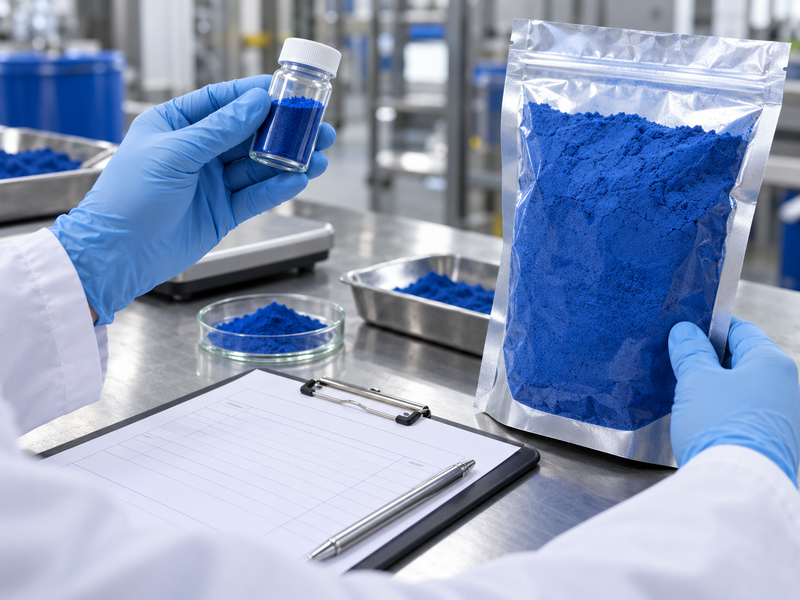
Ask for food-color-grade spirulina extract with its current composition, color assay method and lot value, carrier, particle or agglomerate description, moisture, storage conditions and COA. A grade that works in a beverage is not automatically suitable for a salt-rich dry mix. A very fine pigment may dust or segregate; a coarse carrier may show as visible flecks. Compare at least two candidates at the same finished snack shade, not equal powder weight.
The SpirulinaCN blue ingredient page identifies grade and application matching as part of sourcing. Request an application conversation that includes seasoning salt, acid, sugar, oil and package, then ask for enough sample to run a real blending and topical application trial. Record the sample lot and age. If a carrier changes, repeat the flow and label assessment even when the supplier’s E-value or color strength remains similar.
| Candidate evidence | Why it matters | Trial check |
|---|---|---|
| Assay and method | Compare strength | Same final shade |
| Carrier and moisture | Flow/caking | Storage challenge |
| Particle form | Segregation/dust | Blend and handling |
| Lot COA | Approved quality | Release comparison |
3. How should blend uniformity be tested?
Sample the mixer rather than the scoop
Build an uncolored control and color arms at defined inclusion rates in the same base seasoning. Record ingredient addition order, batch mass, mixer loading, speed, time and discharge sequence. Pull samples from multiple locations and early, middle and late discharge. Measure color under fixed conditions or use a validated image method, and examine visible blue specks. A bulk sample that looks uniformly blue can conceal local concentration that causes dark patches on the snack.
Check segregation after transfer into a tote and after vibration similar to transport. Salt crystals and fine extract may separate by size and density. If the first bags look different from the last, a premix with a portion of the seasoning carrier may help, but retest at the same final composition. Do not simply lengthen mixing without checking whether that creates more fines or heat. Establish a batch-level acceptance range and a sampling plan that production QA can repeat.
| Sample point | Look for | Action if failed |
|---|---|---|
| Mixer locations | Color hotspots | Change premix/addition |
| Discharge start/end | Segregation | Review flow and time |
| After transport | Settling | Reassess particle match |

4. What do salt, acid and oil do to the color?
Test the real seasoning chemistry
Record salt level, acidulant type and dose, sugar, flavor powders, antioxidants and any topical oil. Phycocyanin color is sensitive to its environment; an acid-containing seasoning can alter shade after moisture contact even when the dry blend looks blue. Oil affects whether the powder wets and adheres to the snack. Trial the extract in the complete formula, then use controlled omissions or additions to isolate a failure. A generic “heat stable” or “acid stable” sales claim is less useful than a measured result in this mix.
Where oil is sprayed, record oil temperature and rate. If the blue pigment is intended to remain in a dry mix, do not assume it dissolves in oil; judge the finished distribution and adhesion. Check color after normal snack moisture equilibration, not only immediately out of the tumbler. Changing vinegar powder, citric acid or flavor carrier later should trigger a focused repeat of color and flow tests. Keep the finished product’s taste and seasoning intensity in the acceptance criteria.

5. How should caking and flow be checked?
Protect production dosing
Measure the blend’s moisture or water activity as appropriate, bulk density and flow under the plant’s standard methods. Store samples in intended seasoning packs at normal and credible high-humidity conditions, then check clumps and dosing consistency. The color preparation’s carrier may change hygroscopicity. A blue mix that looks fine at the bench can bridge in a hopper after storage or produce a cloud of dust during weighing.
Record handling losses as well as visual color. Check whether any anti-caking agent is already approved for the formula and destination; do not add one informally to rescue a failed color trial. If a candidate flows only with a different package barrier, include that package cost in the grade decision. Inspect start-up and long-run dosing because caking can develop after repeated stops. A powder grade is commercially useful only when operators can meter it consistently without degrading finished snack uniformity.
| Flow test | Why | Pass decision |
|---|---|---|
| Fresh blend | Mixing baseline | No severe clumps |
| Stored blend | Humidity sensitivity | Re-dispersible and doseable |
| Hopper run | Plant execution | Stable feed |
| Dust check | Yield and housekeeping | Manageable loss |
6. Will the seasoning adhere to the snack?
Test the topical process
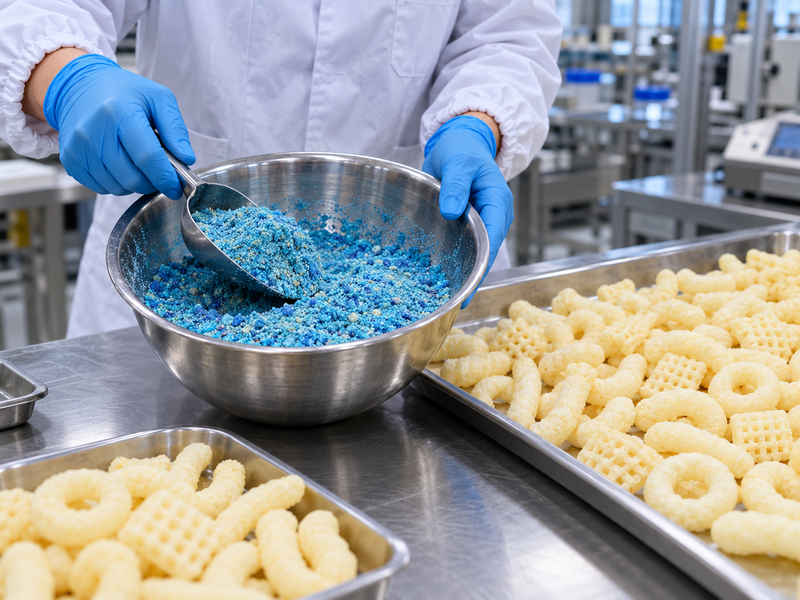
Apply the seasoning at the planned rate to the actual cooked snack using the real tumbler and binder system. Weigh snack before and after, then estimate seasoning pickup and inspect its distribution. Sample the first, middle and last product. A pale blue powder may appear strong in the mixer but nearly invisible on a brown or oil-darkened surface. Conversely, a high dose may create blue patches, loose dust or an off-flavor.
Run a controlled shake or handling test on the finished snack to see how much colored seasoning falls away. Check the bottom of the pack and the operator’s transfer equipment. If pickup is poor, first determine whether the binder rate, snack texture or particle size is responsible. Adding more extract to a seasoning that does not adhere simply increases loss. Reconfirm taste and salt perception after any process adjustment.
The quote should use the dose that passes on the snack, not the rate that looks attractive in a bowl.

7. What happens in the finished pack?
Include time and handling
Store finished packs under intended and credible stress conditions. Check blue shade, surface uniformity, seasoning fall-off, caking at the bag bottom, flavor and snack texture. Record actual light, temperature and humidity. A color powder’s ingredient shelf life does not establish a colored snack’s shelf life, especially when oil oxidation or moisture pickup changes the base appearance. Compare with an uncolored or existing-seasoning control to identify color-specific effects.
Photograph product from different pack locations under fixed light, not only the top layer. If blue dust accumulates at the bottom, customer perception and delivered color per serving may change. Check seals and barrier properties if humidity or light is the likely cause. A stronger color grade cannot solve all packaging failures. Set an end-of-life acceptance range before reviewing the data; otherwise a fading product may be rationalized as acceptable because the initial launch photograph looked good.
| Pack observation | Possible driver | Decision |
|---|---|---|
| Shade loss | Light, moisture, heat | Reformulate or repackage |
| Blue dust | Poor adhesion/abrasion | Process correction |
| Clumps | Moisture and carrier | Barrier/flow correction |
8. How narrow is U.S. permission for this use?
Read the operative words
Current 21 CFR 73.530 lists spirulina extract for coloring seasoning mixes (unheated) at levels consistent with good manufacturing practice. It separately excludes extruded cereals from its ready-to-eat cereal listing. The broader 2026 amendment was delayed indefinitely. Do not infer blanket permission to color a hot extruded snack, a heated seasoning or every finished food to which the mix might be applied.
Regulatory staff should assess the exact process, ingredient identity, carrier and final food category, including the rule’s specifications, labeling and standardized-food restrictions. If color is applied to a snack through an unheated seasoning, document that route and seek product-specific advice; this article is a formulation guide, not legal clearance for a finished SKU. Review other destination markets separately. Keep a dated regulatory decision in the formula file and reopen it if the process adds a bake or heat step.
9. How should color cost be calculated?
Use accepted snack, not ingredient price
Calculate cost per kilogram of seasoning at the passing blue dose, then cost per kilogram of accepted snack after actual pickup and yield. Include color lost to dust, additional premix labor, flow aids or higher-barrier packs if they are needed. A concentrated grade can be cheaper in use despite a higher purchase price; a low-priced grade that cakes or fails shelf life is not economical. Request comparable quotes by pack size, order quantity, lead time, delivery term and validity.
Run a sensitivity check for normal variation in seasoning application rate. If the line can apply 5% less seasoning than the bench target, will the blue still meet shade? Do not increase color to cover poor pickup without pricing the extra waste and checking taste. Freeze the calculation using pilot data and the exact supplier SKU. It should be possible for purchasing to explain why the chosen grade provides the lowest viable cost rather than simply the lowest unit price.
| Cost input | Pilot measure | Commercial result |
|---|---|---|
| Color dose | Passing mix level | Cost/kg seasoning |
| Pickup | Actual snack gain | Cost/kg snack |
| Loss | Dust and reject packs | Accepted yield |
| Packaging | Barrier need | Delivered cost |
10. When is a seasoning color ready to buy?
Approve the complete use case
Repeat the preferred grade in a production-relevant blend and topical application run. Confirm uniform mixer samples, stable flow, acceptable pickup, limited dust and finished-pack color through the intended shelf life. Freeze the supplier product code, color assay, carrier statement, dose, premix sequence and QA sampling method. Retain a reference seasoning and finished snack sample under defined conditions. Ask for change notification if a future lot uses a different carrier or assay basis.
If the blend passes but the snack remains patchy, the process has not passed. If the snack looks good on day one but the packed product fades or cakes, the purchase decision remains open. Record a no-go if no offered extract works at an acceptable cost and within the intended regulatory route. This keeps an unheated seasoning project separate from any unsupported claim about coloring the extrusion itself.
Purchase gate: Sign off both the dry mix and the finished, packed snack before ordering the commercial color lot.
On the first full run, make the color-control plan visible to the blending and snack-line teams. Take a seasoning sample before the hopper, then sample finished snack at start-up, mid-run and after a planned stop. Record actual pickup and compare shade after packing, not only at the tumbler exit. If the dry mix passes but the snack fails, hold the affected packs and investigate binder, application rate and segregation before adjusting pigment dose.
A repeatable release rule is more valuable than an unusually vivid pilot sample.
FAQ
Q1. Does “unheated seasoning mix” include a hot extruded cereal? Do not assume so. Current U.S. text names unheated seasoning mixes and separately excludes extruded cereals from its cereal category.
Q2. Can a beverage blue grade be used in a dry seasoning? Only after blend, flow, adhesion and market review for the exact grade.
Q3. How is uniformity checked? Sample several mixer locations and discharge points, then inspect the finished snack as well.
Q4. Why does blue seasoning collect at the bag bottom? Segregation, poor adhesion or abrasion may contribute; a controlled handling trial can separate them.
Q5. Is ingredient cost per kilogram the right comparison? Use cost per accepted kilogram of seasoned snack at the passing shade and real pickup.
Conclusion
A viable blue seasoning must blend, flow, adhere and retain color after packing. To request matched samples and a technical quote, contact SpirulinaCN with the application, target specification and shade, anticipated quantity, destination, seasoning salt/acid/oil profile, mixing method, snack base and package. Ask for the exact grade composition and lot COA, then trial the unheated mix and finished snack before a volume PO.