
Spirulina extract for sugar panned candy must survive repeated syrup deposition and drying while producing an even shell. A blue solution that looks clean in a beaker can leave white spots on a rotating dragee, tack between cycles or a washed-out appearance after polishing. A published confectionery patent application reports one composition and controlled panning comparison, but its specific recipe is an example rather than a universal solution.
This guide helps a candy maker decide which extract preparation to trial, how to measure shell performance and when a grade is ready for a commercial quote.
Contents
- How should spirulina extract for sugar panned candy be specified?
- How does panning differ from coloring a candy center?
- What should be asked about the extract and carrier?
- How should syrup compatibility be screened?
- Which pilot conditions must be recorded?
- How are coverage and white spots judged?
- What drying and polishing failures matter?
- What U.S. use restrictions apply?
- How should shade and cost be compared?
- When can a panning grade be approved?
1. How should spirulina extract for sugar panned candy be specified?
Define the finished shell
Describe the center, target shell weight gain, number of intended syrup cycles, desired shade, finish and bulk pack. A white sugar shell over a dark chocolate center has a different coverage problem from a pale nut or a precolored base. Record the syrup’s solids, temperature and pH plus whether the plant uses hard or soft panning. The goal is the saleable dragee, not merely an attractive drop of colored syrup.
Set measurable acceptance criteria: coverage with minimal white spots, shade variation within a brand-defined range, dry free-flowing pieces, acceptable breakage and no staining of the pack. Decide whether the color must appear before polishing or after a wax or glaze finish. Include local market and label requirements because an approved color additive still needs an appropriate ingredient declaration. The SpirulinaCN blue-spirulina page frames grade choice around final shade and processing rather than a universal product name.
| Brief item | Record | Effect on trial |
|---|---|---|
| Center type and color | Size, porosity, base shade | Coverage need |
| Syrup | Solids, pH, temperature | Color and drying |
| Shell target | Weight gain, finish | Number of coats |
| Route | Markets, pack, storage | Approval and stability |
2. How does panning differ from coloring a candy center?
Judge the repeated surface process
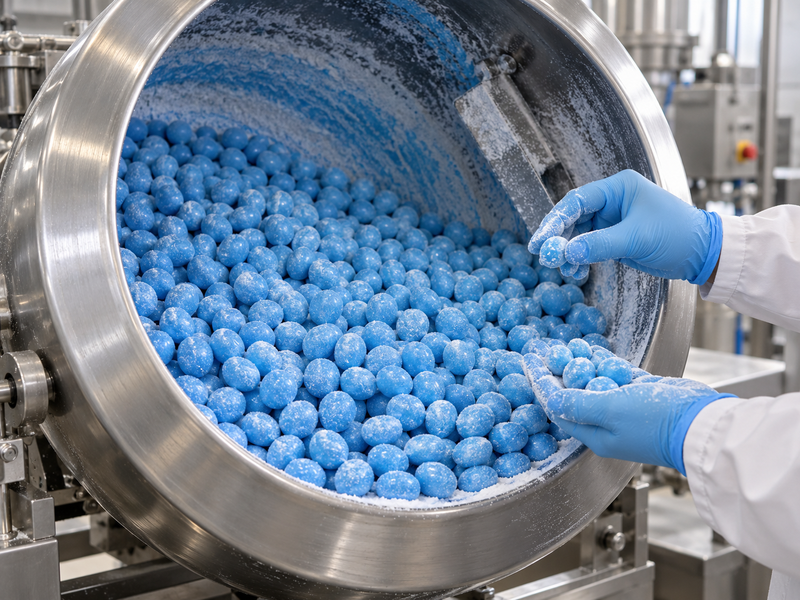
Panning adds many thin layers while the centers tumble and dry. Each layer must wet and spread without dissolving the previous shell or sticking pieces together. Color can concentrate on one face, leave pale gaps or abrade in later cycles. The process is therefore different from blending pigment through a hard-candy melt or a soft-candy core. Those methods do not answer whether a particular syrup and color preparation create a uniform panned surface.
Plan the pilot around shell build. Weigh centers before and after, record coating time, syrup used, number of cycles and rejected pieces. Pull samples after early, middle and final coats. An early unevenness pattern may be corrected by spray distribution or syrup rheology; a final rubbed-off appearance may implicate drying or polishing. Do not compensate for a process fault by adding more pigment until the cause is understood.
The patent’s panning example documents layer count and weight gain, illustrating the sort of process record a factory needs, not prescribing its exact values.
3. What should be asked about the extract and carrier?
Buy a defined formulation
Request the identity of the spirulina extract, grade or color value, test method, lot COA and complete carrier composition. A liquid color adds water and dissolved solids; a powder may require premixing and may alter the syrup’s solids. Two samples with similar pigment assay can pan differently because the carrier affects wetting and film formation. Compare candidate formulations at a matched finished shade, not at equal scoop weight.
The confectionery patent application reports improved hard-panning uniformity for its spirulina-extract, sucrose and dried-glucose-syrup combination versus the particular comparator used in that filing. It does not prove that all sucrose carriers beat all trehalose carriers, nor that a supplier sells the patented formulation. Use it to justify a carrier-controlled comparison. Ask whether any proposed stabilizer, acid, preservative or processing aid is permitted for the destination and compatible with the buyer’s label policy.
| Supplier field | Why it is needed | Evidence to request |
|---|---|---|
| Color assay | Normalize candidate strength | Method and lot value |
| Carrier composition | Predict syrup behavior | Ingredient statement |
| Form | Water/solids calculation | TDS and handling guide |
| Shelf conditions | Manage plant stock | Current specification |

4. How should syrup compatibility be screened?
Start small before loading the pan
Make a blank syrup and candidate-colored syrups at the plant’s intended solids and temperature. Record pH, color dispersion, sediment, viscosity or flow, and appearance after cooling. A simple film or rollout on a neutral surface can reveal streaking before a full run. Match added water and final solids among candidates. If a liquid color dilutes one syrup more than another, the comparison will confuse pigment behavior with drying behavior.
Next coat a small center batch at a controlled application rate. Watch whether the syrup spreads thinly, pools, beads or creates wet clumps. Reject any candidate that requires unsafe changes to the plant’s syrup handling or drying equipment. If a color looks dull, test whether the issue is an opaque carrier, a dark center, poor coverage or pigment loss before increasing dose.
A good syrup screening note should tell the next operator exactly what was mixed and what happened, including room temperature and humidity where they influence drying.
Buyer action: Ask the supplier for enough matched sample to complete a small pan run and retain stability pieces, not only a color swatch.
5. Which pilot conditions must be recorded?
Make a repeatable cycle log
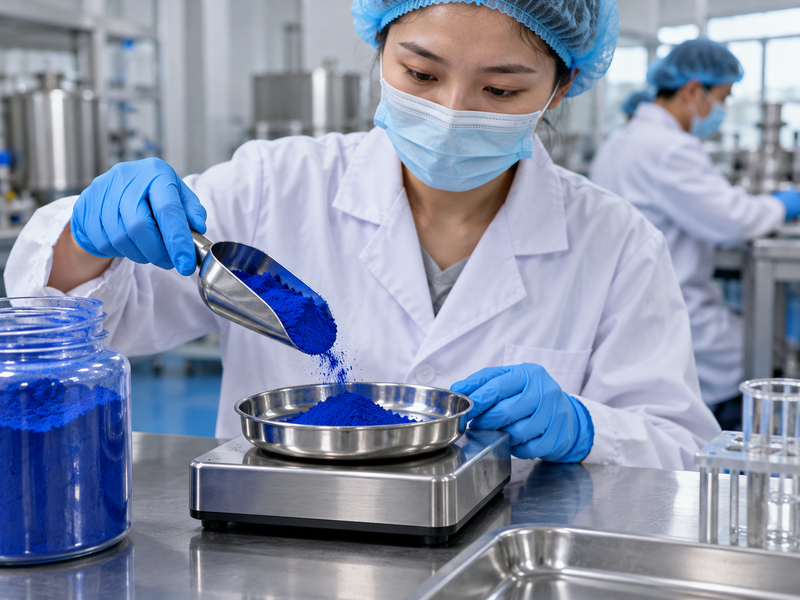
For each arm, record center mass, syrup solids and temperature, color mass, syrup application rate, pan speed or setting, inlet air conditions, drying time, cycle count and final shell gain. These variables need not be optimized at once; the point is to know whether two color grades were exposed to the same process. Note interruptions, clumps and adjustments. Sample both the first and last trays because a favorable midpoint sample can hide start-up or end-of-run defects.
The patent example logged syrup Brix, pH, room conditions, center weight, layer count and drying between layers. Its specific 70°Bx and layer count are case details, not a safe default for a different center or pan. Use the data fields as a recording model. Scale-up must then confirm whether a larger pan’s airflow and distribution preserve the same shell quality.
| Cycle log | Early coats | Final coats |
|---|---|---|
| Coverage | Pale center visible? | Uniform surface? |
| Drying | Time to free flow | Tack after polishing? |
| Mass | Syrup use and gain | Finished yield |
| Loss | Clumps and chips | Reject rate |
6. How are coverage and white spots judged?
Sample across the pan
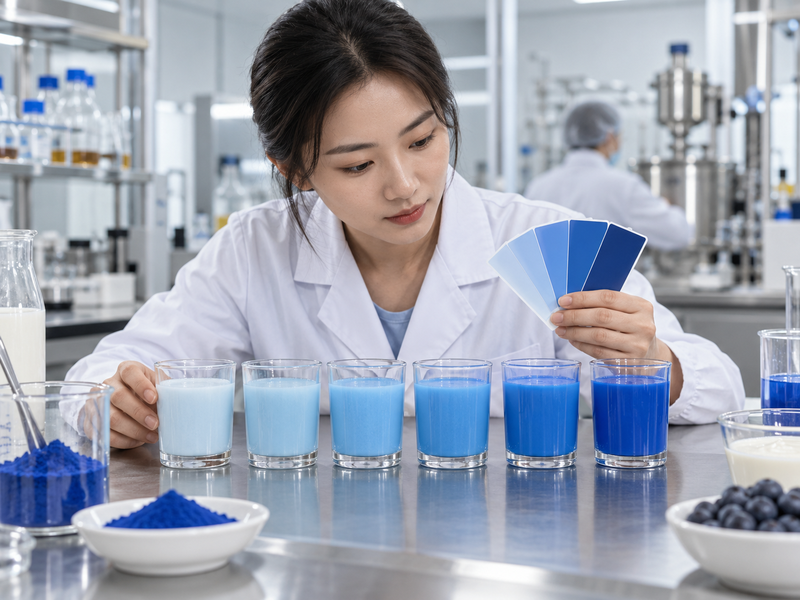
Define a visual rating and, if available, instrument color readings for randomly selected pieces from several locations and time points. Score pale patches, dark pools, mottling and exposed center separately. A batch can have an acceptable average blue but still fail because a small share of pieces is visibly defective. Compare against an approved physical reference under fixed light and after the intended final polish, not under changing phone-camera exposure.
Investigate defect pattern before adjusting formula. White spots that shrink with additional coats suggest insufficient shell build; spots that reappear after handling suggest abrasion. Streaks that follow syrup flow may point to mixing, viscosity or spray distribution. The patent comparison reported more even color and fewer white spots for its tested formulation, which makes those useful endpoints for a buyer’s own pilot. It does not establish a published acceptance percentage for every product.
Buyer action: Keep a photographic defect atlas and agreed reject limit before comparing quotes.
7. What drying and polishing failures matter?
Follow pieces into the pack
The shell must finish dry enough for free flow and packing without color rub-off. Check tack after each cycle, then examine chips, dust and color transfer during polishing, conveying and bulk handling. Weigh rejects and fines. A formulation that produces a saturated blue only by prolonging wet contact or raising syrup addition may slow throughput enough to erase a cheaper ingredient price.
Pack pilot pieces in the intended bag or carton and perform a controlled transport simulation or handling check. Inspect color transfer to neighboring pieces and pack surfaces, especially if the product will top pale frosting or ice cream. Keep moisture and light exposure realistic for the planned route. A freshly panned appearance is not the finished specification; the buyer purchases sellable, unpacked pieces after storage and distribution. If a gloss agent changes the apparent shade, make color approval after the final surface step.
| Failure | Likely investigation | Business consequence |
|---|---|---|
| Tack or clumps | Syrup water and drying | Throughput/rework |
| Dust or rub-off | Shell cohesion/polish | Pack staining |
| Fading | Heat, light, storage | Shelf-life limit |
8. What U.S. use restrictions apply?
Check the current regulation
Current 21 CFR 73.530 lists spirulina extract for coloring confections, including candy, at levels consistent with good manufacturing practice. Its identity, specifications, color-mixture diluent and labeling provisions still apply, as does the restriction concerning standardized foods. The broader 2026 amendment was delayed indefinitely; do not use an announced expansion as the legal basis for a new product. Sugar-panned candy must be assessed as the actual finished food and formulation.
Have regulatory staff check whether the supplier’s offered preparation fits the rule, whether its carriers are suitable for a color mixture and how it should be declared. Do not assume “natural” on a sales sheet supplies legal clearance or a claim substantiation. Other destinations have distinct rules for extracts, coloring foods and specific candy categories. Save a dated rule review with the product dossier, then repeat it if the composition, destination or law changes.
9. How should shade and cost be compared?
Calculate accepted-output cost
Compare candidates at the dose that actually produces the approved finished shell. Include the extra carrier or water they bring, syrup use, number of coats, drying time, rejects and any slower line speed. A strong color can be expensive per kilogram but economical per accepted dragee; a cheap color that needs more layers may be costly in labor and yield. Ask for quotes at the same delivery term, order quantity, pack format and currency.
Use a simple worksheet: total color cost plus incremental process and reject cost, divided by accepted kilograms of candy. Run a sensitivity check for shade variation and supplier price changes, then verify assumptions in production. Avoid publishing a universal dosing cost because the center, shell target and supplied grade determine it. Request the lot assay method and commercial specification so the approved economics can be reproduced after the pilot lot is gone.
| Cost input | Measure in pilot | Quote input |
|---|---|---|
| Color use | Mass per accepted kg | Price per kg |
| Syrup and coats | Added usage/time | Plant cost |
| Rejects | Chips, spots, tack | Yield loss |
| Logistics | Pack and shelf requirements | Delivered price |
10. When can a panning grade be approved?
Repeat and lock the specification
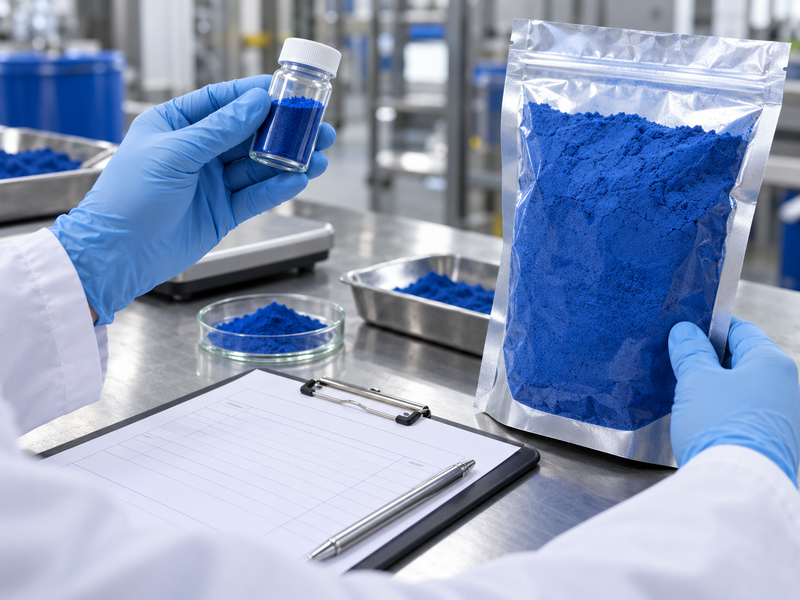
Approve a candidate only after a production-relevant repeat run makes the target shade with acceptable coverage, dry time, handling loss and storage result. Freeze the exact product code, carrier statement, color assay method, addition and syrup conditions, and finished reference. Keep a retained sample and photographs of acceptable and reject pieces. Ask the supplier how changes in extraction, carrier or assay method will be communicated before a replacement lot is sent.
The approval should name who signs off sensory, quality, regulatory and purchasing decisions. A pilot might show that neither offered grade works; that is a valid result. Revise the shell target, center or process and run a new comparison rather than accepting hidden white spots to meet a launch date. The quote becomes meaningful only when it is tied to the grade and amount that passed the buyer’s actual pan.
Purchase gate: Request a bulk PO after the same color preparation passes shell uniformity, drying, handling and market review.
Translate the pilot into a production control sheet: acceptable syrup solids and temperature, coating rate, drying endpoint, color dose and shell gain. Note what happens if a batch pauses between coats. A line operator needs an action for tack or mottling, not only a photograph of ideal candy. During the first commercial run, compare samples from different pan loads and packing times with the approved reference.
If a change in center size or incoming moisture moves the result outside tolerance, treat it as a new process condition and revalidate before broad distribution.
FAQ
Q1. Can blue extract simply replace a synthetic dye in the existing syrup? Use a side-by-side pilot; carrier, water and spreading behavior may differ.
Q2. Is higher color value always better? No. Judge uniform finished color and accepted-output cost at the actual dose.
Q3. Does the patent provide a standard panning formula? No. It describes one applicant’s formulation and comparison, useful for trial design rather than universal settings.
Q4. Why do white spots appear? Insufficient coverage, uneven wetting, exposed centers or abrasion are different possibilities; inspect the defect timing.
Q5. Can a successful bench rollout replace a pan trial? No. Rotating application, drying, polishing and packing create additional risks.
Conclusion
The right sugar-panning color creates a uniform, dry and durable shell at viable throughput. To request a matched sample and technical quote, contact SpirulinaCN with the application, target specification and shade, anticipated quantity, destination, center type, syrup solids, panning cycle conditions and package. Ask for current composition, assay method and lot COA, then compare the offered grades in the buyer’s pan.