
Phycocyanin for toffee soft candy manufacturing is a process decision before it is a color purchase. A blue that disperses in water can fade in a cooked, dairy- or fat-containing soft chew, and an attractive fresh sample can change during warm distribution. A published preliminary toffee study gives a useful test pattern: evaluate color alongside water activity, texture and storage temperature. It does not establish a universal dose or guaranteed shelf life for a different recipe.
This guide turns that pattern into a commercial pilot and purchasing gate for a core-colored soft candy, distinct from a hard candy mass, gummy or surface coating.
Contents
- What must phycocyanin for toffee soft candy manufacturing achieve?
- Which blue extract grade should be screened?
- Where can color enter the process?
- How should a first pilot be designed?
- Which measures show that the candy still works?
- How should storage temperature be tested?
- What happens when acid, dairy or fat changes?
- How should the U.S. color rule be checked?
- What belongs in the supplier comparison?
- When is the trial ready for a bulk quote?
1. What must phycocyanin for toffee soft candy manufacturing achieve?
Define the sellable piece
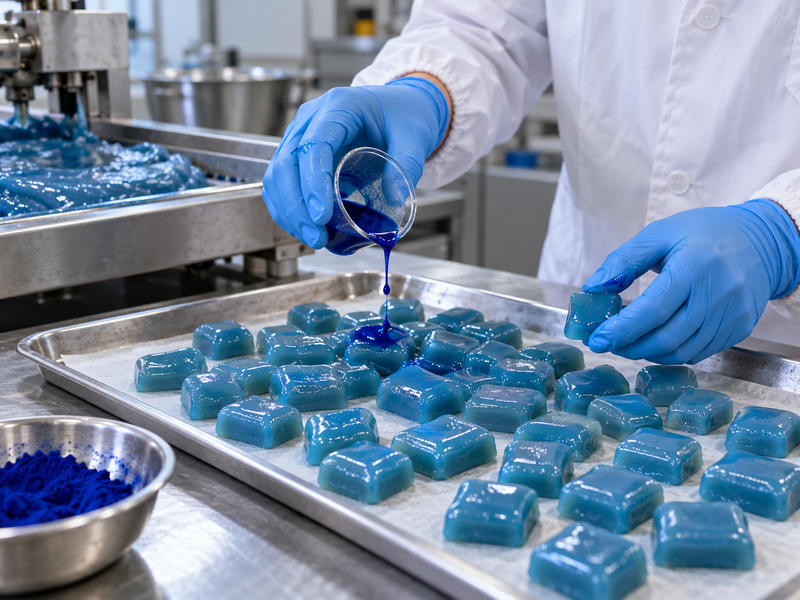
Record the cooked base, final moisture, fat and dairy content, planned acid addition, piece size, wrapper and target shade. A soft, aerated toffee and a dense fruit chew can expose color to different heating, mixing and storage conditions. Set a reference appearance under controlled lighting and include a tolerated range if the product will be sold across multiple lots. Decide whether the blue must remain visible through an opaque base or is intended as a pastel accent.
The target must also include the claims and market. “Blue spirulina” can refer to an extract preparation with carriers rather than whole green biomass; ask for ingredient composition and the declaration appropriate to the destination. The SpirulinaCN blue ingredient page notes that grade names, color values and carriers vary. Before buying an E-grade, specify what the E value measures and compare supplied lots by the same method.
| Target field | Record before sampling | Why it matters |
|---|---|---|
| Base formula | Dairy/fat/acid and solids | Color environment |
| Process | Cook, cool and mix temperatures | Exposure window |
| Appearance | Reference piece and lighting | Repeatable acceptance |
| Route | Markets and storage conditions | Label and stability review |
2. Which blue extract grade should be screened?
Compare finished color, not grade names
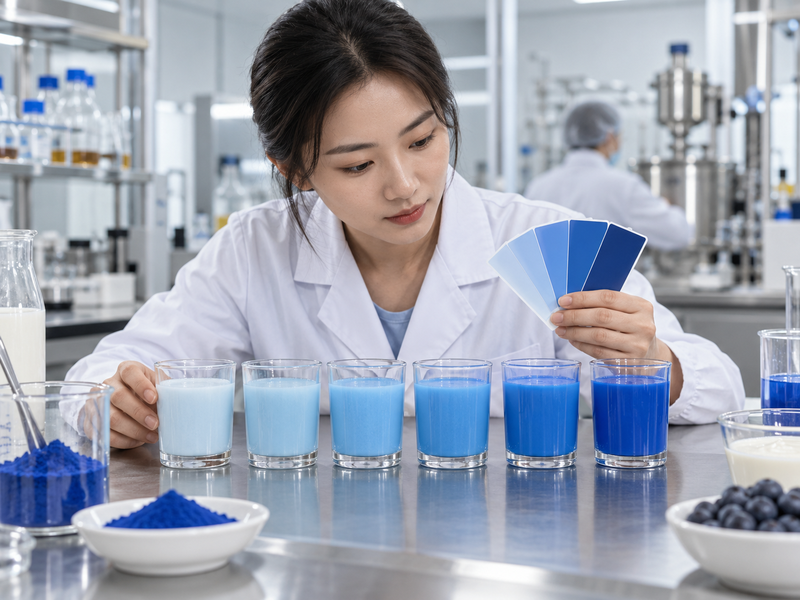
Ask for two candidate grades, for example E6 and E18 if offered for the application, with current TDS, composition, carrier details, COAs and the supplier’s color assay method. A stronger ingredient may require less mass but can be harder to distribute evenly at very low inclusion; a lower-strength powder may add more carrier or shift water and solids. The purchasing decision is therefore finished shade per usable kilogram of candy, not a simple price-per-kilogram contest.
Screen the same base and process at several carefully chosen inclusion levels. Record delivered color mass, premix water, mixing time and finished piece weight. Avoid copying a research paper’s test concentrations into a purchase specification: the toffee study examined its own formulation, pigment and conditions. A different fat level, color carrier or wrapper can change the result.
Choose the smallest level that meets shade and shelf-life criteria after sensory review; do not declare a grade “best” from a beaker photograph.
| Candidate comparison | E6-type offer | E18-type offer |
|---|---|---|
| Assay basis | Verify method/units | Verify method/units |
| Carrier load | Calculate at target shade | Calculate at target shade |
| Dispersibility | Pilot in base | Pilot in base |
| Cost | Per accepted candy batch | Per accepted candy batch |
3. Where can color enter the process?
Find a controlled low-heat window
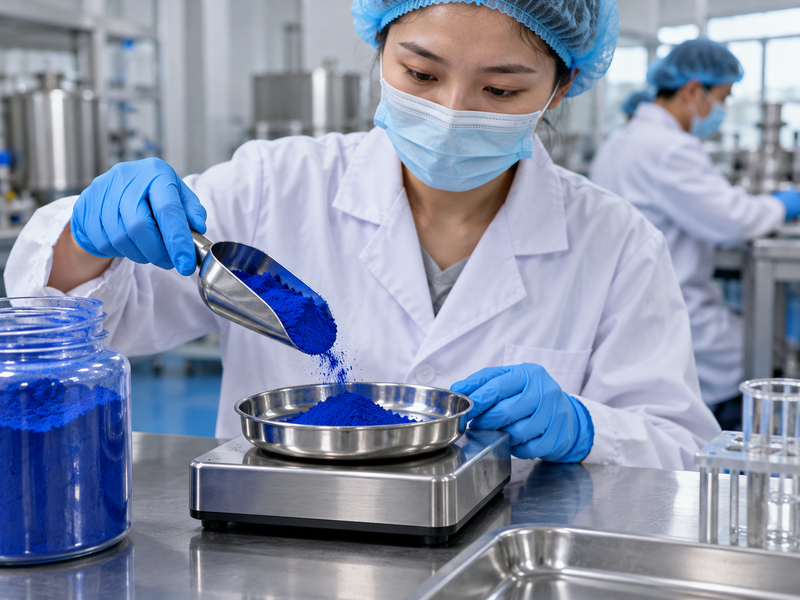
Do not place phycocyanin into the highest-temperature cook simply because conventional dyes are added there. Map the actual temperature and residence time from cooker exit through cooling, aeration, addition and forming. Trial a point that reduces heat exposure while allowing full mixing before viscosity rises too far. A practical method is to disperse the powder in an approved portion of the water phase, then add that premix at a documented temperature. Its water contribution belongs in the formula mass balance.
Late addition has limits. It can make streaks, introduce air, affect texture or create inconsistent pieces across the batch. Respect equipment safety and the plant’s validated process; do not ask operators to open a hot cooker or bypass controls for color. Compare at least two feasible addition points at the same final composition, then sample the start, middle and end of the run. If all late-addition options leave streaks, a higher color dose is unlikely to fix mixing uniformity.
4. How should a first pilot be designed?
Hold everything else steady
Prepare an uncolored control and a small matrix crossing two candidate grades or levels with feasible addition points. Use one base batch where possible, then divide it under a controlled procedure. Measure mass, temperature, time and final solids for every branch. Label samples with a code so sensory assessors are not steered by grade names. The pilot should produce enough wrapped pieces for immediate tests and storage at each condition, not just a tray for day-one photographs.
Write acceptance rules before looking at results. Examples include a color-distance band from the approved reference, no visible streaking, texture within the brand’s own specification and no material flavor change. These are company-defined gates, not published universal thresholds. Record adverse observations such as foam collapse, oiling, graining or excess stickiness even if color is attractive. The toffee research evaluated water activity and texture, showing why color cannot be the sole endpoint.
| Pilot arm | Kept constant | Main question |
|---|---|---|
| No color | Base and wrapping | Process baseline |
| Grade A, early feasible addition | Dose/solids | Heat tolerance |
| Grade A, later addition | Dose/solids | Mixing uniformity |
| Grade B, matched shade | Base/process | Grade economics |
5. Which measures show that the candy still works?
Pair color with product quality
Measure instrumental or controlled visual color on cut and outer surfaces; record water activity, moisture or solids, texture, piece weight and sensory notes against the uncolored control. Choose methods already validated for the product. Water activity matters to stability decisions, but a phycocyanin addition does not automatically make a confection safe or unsafe. In the cited preliminary study, the tested additions did not significantly change water activity or texture in that specific toffee formulation.
That result is a hypothesis to test, not a waiver for a different line.
Look for within-batch variation. A good average shade can hide blue streaks near the mixer wall or pale late-run pieces. Photograph each sample under fixed light, then retain wrapped pieces in the same packaging planned for sale. Track whether the wrapper allows moisture transfer or light exposure. If a powder carrier affects tack or graining, record the effect as a formulation issue rather than calling the color itself unstable.
6. How should storage temperature be tested?
Challenge the actual route
Use normal, cool and credible warm-abuse conditions that reflect the proposed warehouse and distribution route. The toffee study compared 4, 20 and 40°C and observed larger overall color changes at the higher temperature in its tested products. Its exact numerical changes should not be turned into a promise for another candy. Define reading times across the intended shelf life and include both the candidate and uncolored control in the final wrapper.
Test appearance, texture and flavor together. A warmer sample may fade, darken or shift hue while also becoming stickier or firmer. Record temperature excursions and evaluate whether a cold-chain promise is commercially realistic. If only refrigerated samples pass but the product is sold through ambient retail, either redesign the formulation and pack or reject that color route. A stability claim should be based on the buyer’s own finished-product data, not the ingredient’s unopened-powder shelf life.
| Storage arm | Purpose | Decision output |
|---|---|---|
| Planned condition | Intended shelf life | Accept or fail |
| Cool reference | Separate temperature effect | Diagnostic comparison |
| Warm challenge | Distribution resilience | Risk and pack decision |
7. What happens when acid, dairy or fat changes?
Reopen the color trial
Phycocyanin’s behavior depends on its surrounding formula. Acid can change pH and shade; fat and dairy change how a water-soluble color spreads and how the eye perceives blue. If product development changes citric acid, milk solids, fat blend, flavor or sweetener after the color trial, repeat the relevant tests. Keep a measured pH at the point of addition and in the finished candy, rather than relying on a recipe target alone.
For a fat-rich matrix, a water-phase premix may make more sense than throwing dry extract into fat. But adding water can affect cook yield, water activity and texture. The right sequence is a controlled comparison, not a universal mixing instruction. If a blue piece becomes gray or green when a flavor acid is introduced, isolate pH, heat and mixing in separate arms. Do not change all three at once and then order a more concentrated extract without knowing the cause.

8. How should the U.S. color rule be checked?
Read the operative category
The current 21 CFR 73.530 permits spirulina extract for coloring confections, including candy, at levels consistent with good manufacturing practice, subject to the rule’s identity, specifications, labeling and standard-of-identity restriction. This covers a U.S. category relevant to toffee-type candy; it does not establish that any offered product, carrier or finished label is compliant. The broader amendment published in February 2026 was delayed indefinitely, so use the current text, not an expansion headline.
Ask regulatory staff to verify that the proposed ingredient is spirulina extract as described by the rule, its color mixture contains suitable permitted diluents and the intended candy category is appropriate. Review every export market separately. Avoid health-benefit copy for a color-level inclusion unless the finished product and jurisdiction support it. Keep a dated copy of the rule and supplier formulation statement in the product approval file.
9. What belongs in the supplier comparison?
Compare like with like
Request matched samples, current specifications, lot COAs, pigment assay methods, carrier composition, recommended storage and an application discussion for the actual soft-candy process. Note sample lot and age. A commercially useful quote states pack size, quantity tier, lead time, trade term and validity, then allows calculation at the dose that passed finished-product trials. A lower price per kilogram can lose when its required inclusion is higher or when it fails the warm-storage gate.
Separate supplier evidence from plant evidence. A certificate can tell you a lot met selected release tests; it cannot prove your candy will retain shade after your cook, wrap and distribution. Ask whether a production lot will match the approved sample’s specification and what change notice is provided for a new carrier or assay method. The supplier’s blue range is a starting point for grade discussion, not a substitute for a lot-specific offer.
| Buying metric | Calculate from | Accept only if |
|---|---|---|
| Cost per batch | Quote × passing inclusion | Trial passes |
| Color consistency | Lot COAs and pilot | Method comparable |
| Process fit | Factory trial | No critical defect |
| Supply fit | Pack, lead time, terms | Production plan workable |
10. When is the trial ready for a bulk quote?
Freeze the decision record
The final candidate should pass at least one repeat run at production-relevant scale, using the intended addition point and wrapper. Approve the color reference, acceptable variation, finished-product checks and storage result before purchasing substitutes sample excitement for specification control. Record the exact supplier grade, lot, carrier, dose, premix procedure, process temperature and approval signers. Keep a retained sample so later production lots have a physical benchmark.
Send the supplier the process brief and failed as well as successful observations. They may propose a different grade, but treat that proposal as a new candidate requiring comparison. If no candidate meets shade, texture and shelf-life gates at a viable cost, record a no-go and revise the product target rather than weakening acceptance criteria after the fact. This produces a defensible sourcing decision and a specific quote request.
Purchase gate: Approve the lot specification and commercial terms only after color and candy quality pass in the buyer’s own formula.
Before transferring the formula, write a short operator instruction with the premix mass, addition temperature band, mixing endpoint and hold-time limit observed in the successful pilot. Give QA the approved color reference and sampling points. This matters because a replacement operator may follow the ingredient dose exactly yet introduce it earlier or mix it for less time, producing a different shade.
On the first full run, compare early, middle and late pieces with the pilot benchmark and hold the lot if the result crosses the predefined limit.
FAQ
Q1. Can phycocyanin go into the high-heat cook? Its performance there must be tested; a later controlled addition often deserves comparison because heat exposure can damage shade.
Q2. Does E18 always cost less in use than E6? No. Compare the accepted finished dose, carrier effects and actual quoted price.
Q3. Can the published toffee study supply our dosage? No. Its concentrations and outcomes apply to the tested formulation and conditions.
Q4. What is the most useful storage test? Finished wrapped pieces under planned storage plus a credible warm challenge, with color and candy-quality readings.
Q5. Is blue spirulina the same as whole spirulina powder? No. Request the ingredient identity and composition for the proposed color preparation.
Conclusion
The sellable answer is a blue soft candy that remains acceptable after processing and distribution. To request E6/E18 or other matched samples and a technical quote, contact SpirulinaCN with the application, target specification and shade, anticipated quantity, destination, base formula, cooling and addition temperatures, and planned wrapper and storage route. Ask for lot COAs, composition and assay methods, then run the pilot before a bulk PO.