
Blue spirulina for gelatin dessert cups is a packaged-dessert decision. A vivid blue in the mixing tank can look gray in a cloudy gel, separate during cooling or fade under a lit display. A cup is also viewed through its wall and lid, so clarity, bubbles and fill level affect the apparent shade. DIC has described spirulina-derived blue in jelly applications in its product announcement, but those examples do not validate a different gelatin system or shelf life.
This guide sets up a manufacturing trial for spoonable cups rather than a gummy-candy process.
Contents
- How should blue spirulina for gelatin dessert cups be specified?
- How is the color grade selected?
- When should blue enter the gel process?
- How should clarity and shade be measured?
- What should the pH trial include?
- How do filling and cooling change appearance?
- Which shelf-life conditions matter?
- What does the current U.S. rule allow?
- How should suppliers be compared?
- When is the color ready for a production order?
1. How should blue spirulina for gelatin dessert cups be specified?
Specify the actual dessert
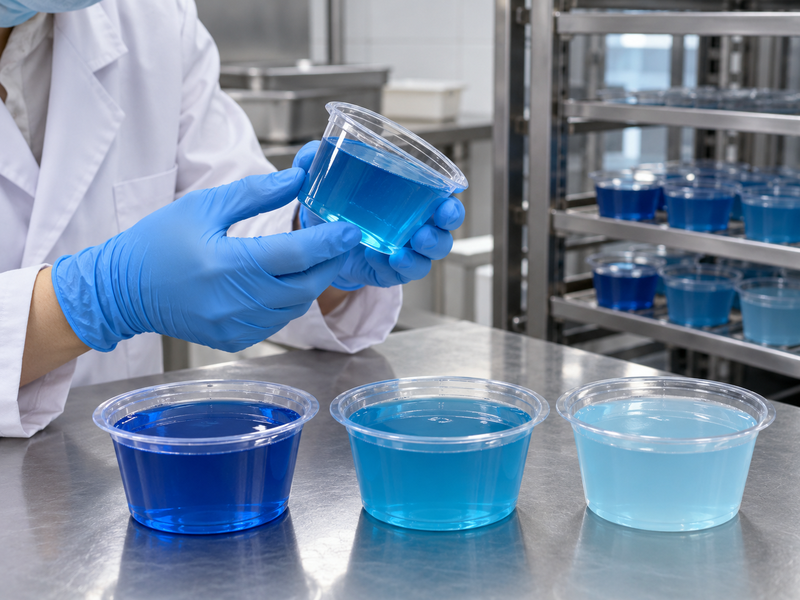
Record gelatin type and level, sweetener, acid, fruit or dairy ingredients, target pH, fill temperature, cup material, lid and display route. A clear blue gel, opaque blue dessert and blue layer in a multicolor cup need different acceptance criteria. Define whether the consumer should see the color through the sidewall, from above after opening, or both. Include serving size, target shelf life and normal storage temperature; color acceptance cannot be detached from the product’s food-safety and quality program.
Agree a shade reference and a clarity reference using filled, lidded cups rather than an open beaker. The same liquid can appear darker through a deep cup than a shallow one. Give QA a controlled light source and viewing background. A product-development brief that says only “bright blue” cannot tell purchasing which grade or dose passed. Ask the supplier for a current composition statement because “blue spirulina” may be a formulated extract with carriers, not a single standard powder.
| Brief field | Buyer defines | Trial consequence |
|---|---|---|
| Gel system | Gelatin and other gelling agents | Heat/cooling behavior |
| Acidity | Target and tolerance | Hue and stability |
| Cup/lid | Material and light exposure | Display color |
| Viewing standard | Side/top and background | Objective acceptance |
2. How is the color grade selected?
Match the grade to the cup
Request two food-color candidates with current TDS, full composition, assay method, lot COA, handling instructions and sample lot identification. A liquid grade may be easier to meter but contributes water; a powder may reduce freight or storage volume but needs a controlled dispersion step. Compare both at equivalent finished shade and the same gel solids, not at equal added mass. A stronger grade may lower dose yet create local blue streaks if it enters poorly mixed gel.
The SpirulinaCN blue product page presents several E-value options and advises application tests against pH, heat and other ingredients. Treat the E label as a supplier-specific shorthand until the assay conditions and dilution basis are confirmed. Ask for lot-specific color value and carrier composition. A supplier’s jelly photograph is evidence of a possible application, not evidence that its listed grade will remain stable in the buyer’s fruit acid, gelatin and display pack.
| Grade question | Powder option | Liquid option |
|---|---|---|
| Dosing | Weigh and pre-disperse | Meter and account for water |
| Storage | Confirm humidity and light | Confirm temperature and micro control |
| Comparison | Match final shade | Match final shade |
| Approval | Lot COA plus cup trial | Lot COA plus cup trial |
3. When should blue enter the gel process?
Map heat exposure before moving the addition point
Gelatin is normally dissolved in a warm phase, while phycocyanin-containing colors can lose intensity with unfavorable heat exposure. Record actual temperature and residence time from dissolution through mixing, holding, filling and chilling. Trial addition after the hottest necessary step at a point that still permits uniform mixing. Do not change a validated heating or food-safety process solely to protect color. If the product requires a hot fill, test the real fill profile rather than judging color from a cooled bench sample.
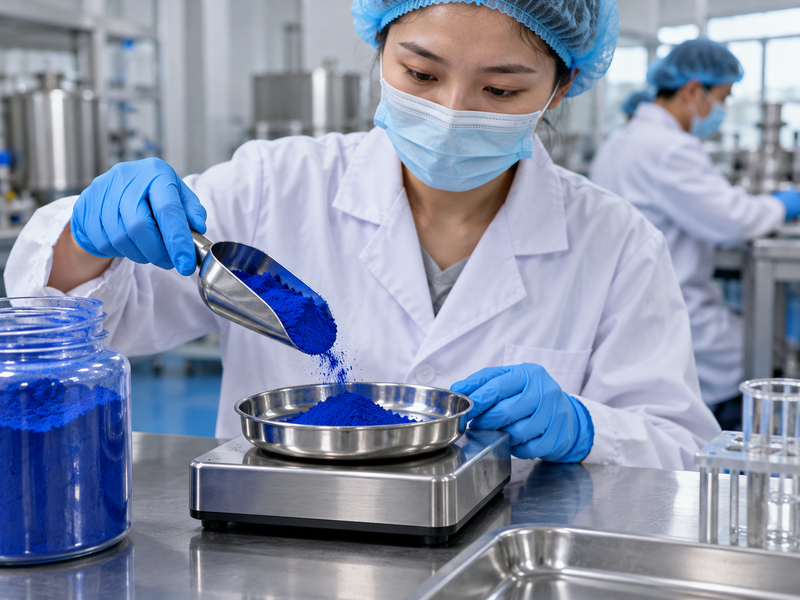
Prepare a premix with an approved portion of the formula water, or follow the candidate’s technical instructions, and include that water in the batch balance. Compare a feasible early and later addition point at identical composition. Pull samples from the start and end of filling to detect line-hold exposure. If a late addition makes bubbles or streaks, address mixing and deaeration before increasing pigment dose. The decision is the coolest workable entry point, not the coolest theoretical point on a flowchart.
4. How should clarity and shade be measured?
Separate optical defects
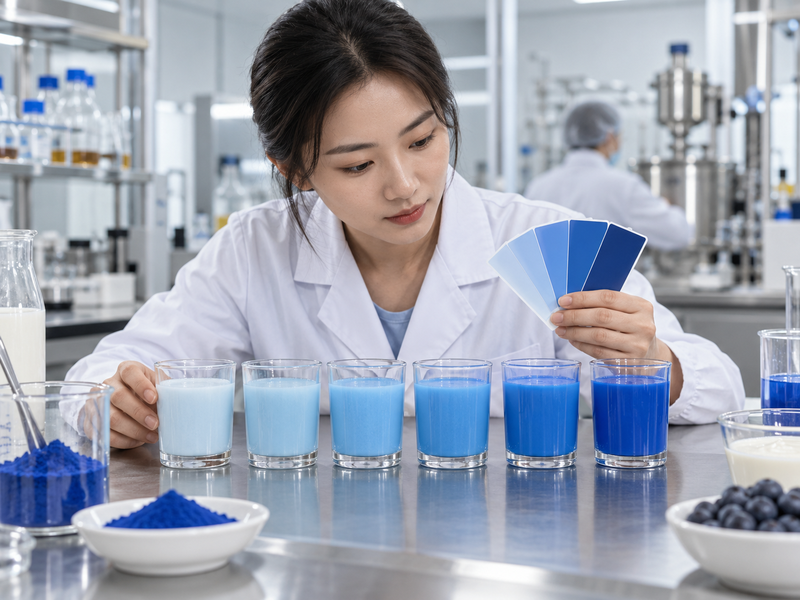
Measure color after full gel setting in the intended cup. Record color with a fixed background and geometry, plus visual notes on haze, particles, trapped air and gradients from top to bottom. If a spectrophotometer is used, define whether it reads through the cup wall or on a standardized sample cell; those readings may not be interchangeable. Retain a reference cup from the approved lot where storage permits and archive calibrated photographs for later comparison.
A blue formulation can be uniform but look muted because the gel is cloudy; another can look bright at the surface but pale at the bottom. Slice or inspect the cup as appropriate to identify distribution. Include an uncolored control to see whether haze originates from gelatin, fruit, minerals or the color preparation. Set acceptable defect rates before the trial. Do not call a dose increase successful if it makes the gel darker while leaving sediment or an unattractive gray tone under retail light.
| Appearance test | What it distinguishes | Decision |
|---|---|---|
| Sidewall view | Overall shade and layers | Consumer appeal |
| Top view | Foam or surface ring | Fill quality |
| Cut/section | Gradients and particles | Dispersion |
| Control cup | Base haze | Root cause |
5. What should the pH trial include?
Test the full acid window
Run the chosen grade at the target pH and at credible production limits, using the same formula solids and addition sequence. Record pH after mixing and after the gel sets. Acid type and fruit ingredients can affect perceived shade as well as measured pH; a change in flavor system deserves a repeat check. Avoid a blanket statement that blue spirulina “works in acid” or “cannot work in acid.” The relevant question is whether this formulation passes its appearance and shelf-life specification throughout the process range.
If the product is layered, measure the pH of each layer and inspect the boundary where colors could migrate or shift. Separate pigment color change from clouding or syneresis in the gel itself. A blue layer that passes in isolation may fail next to a more acidic fruit layer. Keep sample codes and pH readings with the image file so a later team can reconstruct why a grade was accepted or rejected.
Ask the supplier to evaluate the actual pH window rather than request a generic “acid stable” certificate.
6. How do filling and cooling change appearance?
Inspect cups, not only bulk gel
Measure color and temperature at tank release, first fill, mid-run and last fill. A long hold may expose the late cups to more heat than the first; a changing mixing level may alter air incorporation or pigment distribution. Log fill weight and any foam or bubbles. After chilling, check set time, gel strength and water release under the buyer’s normal quality method. The color should not hide a gel defect or create a new one.
Package geometry matters. Clear cups magnify streaks along the wall and make condensation visible. A lid with printed graphics may cast a color bias. If a hot-fill or thermal process is required, preserve the validated process and run the pigment through it. Do not infer microbiological safety from color stability. A commercial line trial should confirm that the candidate can be dosed consistently at the intended throughput, with reasonable clean-down and no residue that stains following products.
| Sampling point | Observe | Why |
|---|---|---|
| First cup | Start-up shade and foam | Dosing stabilization |
| Mid-run | Representative color | Process center |
| Last cup | Hold-time effect | Worst exposure |
| After set | Clarity, water release | Saleable product |
7. Which shelf-life conditions matter?
Use the intended pack and display
Store finished cups in their commercial packaging at the planned temperature, then include a credible distribution or retail-light challenge. Measure shade, clarity, pH, gel condition and sensory quality at scheduled times. The color supplier’s unopened ingredient shelf life does not establish the dessert’s shelf life. A lighted display may expose the front row differently from boxes in the back; if display is part of the route, it belongs in the validation plan.
Check for fading, hue drift, settling, layer bleed and color appearing in separated liquid. Sample more than one cup at each time point so a single outlier does not define a lot. Record actual temperature rather than just a nominal refrigerator setting. If the blue stays attractive but the gel loses texture or releases water, the product still fails. Conversely, an acceptable gel with unacceptable color needs either a revised grade, process or packaging strategy before a purchasing commitment.

8. What does the current U.S. rule allow?
Confirm the actual food category
Current 21 CFR 73.530 lists spirulina extract for coloring gelatin, as well as certain other desserts, at levels consistent with good manufacturing practice. The rule also states identity, specifications, mixture-diluent, labeling and standardized-food conditions. A 2026 expansion was delayed indefinitely, so an announced category list is not the operative permission. Regulatory staff should confirm that the proposed cup and ingredient preparation fit the current text.
The rule does not bless every product sold as “blue spirulina.” Review the actual extract identity, carrier composition and declaration. If the cup is a composite dessert with layers or toppings, assess every component and the finished product. Other destination markets may apply different color or ingredient rules; the U.S. listing does not travel with the export. Keep a dated regulatory review alongside the approved formulation and supplier documents.
9. How should suppliers be compared?
Calculate color cost in accepted cups
Ask for matched samples, current specifications, assay methods, COAs, carrier details, suggested storage and quote terms. Run candidates in one controlled gel system and compare them at the same approved finished shade after storage. The lowest ingredient price is not necessarily the lowest cost if its dose is higher, if it requires extra premix labor or if display failures create waste. Price by accepted cups or saleable batches, with a sensitivity range for dose and yield.
Confirm whether the production lot will meet the sample’s specification and what notice the supplier provides if the carrier or method changes. DIC’s jelly example shows a commercial use case; SpirulinaCN’s blue range invites grade matching. Neither substitutes for the buyer’s gel-cup trial. Request documentation tied to the exact offered SKU, market and volume, then decide whether its handling requirements fit the plant.
| Comparison | Measure | Approval basis |
|---|---|---|
| Shade | Set and stored cups | Reference range |
| Process | Dispersion and dosing | Repeatable line run |
| Quality | Gel, pH, sensory | Product specification |
| Economics | Dose, labor, waste | Cost per accepted cup |
10. When is the color ready for a production order?
Freeze a cup-level specification
Repeat the preferred candidate at production-relevant scale. Approve the exact grade, lot assay range, premix method, addition temperature, fill conditions, target pH and finished cup color standard. Confirm the same test plan passes through the end of the intended shelf life. Retain labeled samples and establish how QA will respond when a future lot is paler, hazier or arrives with a different carrier statement.
If the candidate passes only in an open laboratory beaker, the decision is still pending. If it passes the line but fails under display light, revisit packaging or distribution before ordering bulk pigment. Document the commercial quote with quantity tier, pack size, lead time, delivery term and validity. This gives purchasing a real conversion path from sample to repeat supply without claiming that one ingredient works in every gelatin cup.
Purchase gate: Approve the finished, lidded cup at its shelf-life endpoint as well as the ingredient COA.
For the first production shipment, specify how many cups QA will sample at the start, middle and end of filling and after setting. Record the lighting and cup orientation used for color approval. If a batch needs a color correction, define who may authorize it and whether the new dose changes water balance or labeling. A clear response plan prevents an operator from adding extra color to a warm holding tank after a subjective glance.
The process record then gives the supplier useful evidence if a later lot behaves differently.
FAQ
Q1. Is gelatin on the current U.S. spirulina-extract color list? Yes, subject to all conditions in 21 CFR 73.530 and product-specific review.
Q2. Can a liquid blue grade be added without changing the recipe? Account for its water and other components in the mass balance and test the gel.
Q3. Can a gummy-candy result predict a spoonable cup? No. Gel structure, package, heat history and appearance criteria differ.
Q4. Why does a clear gel look dull blue? Base haze, bubbles, background, cup depth or color degradation may contribute; use controls to isolate them.
Q5. What sample size should be requested? Enough for a controlled line or pilot batch plus packed storage cups, based on the buyer’s equipment.
Conclusion
Select blue by the appearance and quality of the packed cup after real processing and storage. To request a matched grade and quote, contact SpirulinaCN with the application, target specification and shade, anticipated quantity, destination, gelatin system, pH range, fill temperature, cup/lid details and shelf-life target. Request the current TDS and lot COA, then test the offered SKU in the exact dessert.