
A hard boiled egg shell color trial with spirulina extract is a narrow, seasonal procurement decision. The goal is an attractive blue shell that survives drying, handling and packing without unacceptable rub-off or transfer to edible egg, while keeping cracked eggs out of the coloring run. In the United States, the effective 21 CFR 73.530 allows spirulina extract to seasonally color the shells of hard-boiled eggs at levels consistent with good manufacturing practice.
That wording is not permission to color the egg contents or every egg product.
Contents
- What seasonal egg product is being purchased for?
- Which extract identity and documents matter?
- How should shell variation be controlled?
- How should the dye bath be designed?
- What contact time and drying checks are useful?
- How should rub-off and transfer be tested?
- Which cracked eggs must be excluded?
- What does the US authorization actually say?
- What belongs in the egg-kit supplier RFQ?
- When is a seasonal order justified?
1. What seasonal egg product is being purchased for?
Specify whether the business sells a shell-coloring kit, pre-colored hard-boiled eggs, or another seasonal pack. The process, responsibility and validation differ. A kit may have consumer instructions and a separate color preparation; an egg packer controls a plant bath and must manage egg handling, drying and refrigerated distribution. Define the market, season, expected volume, desired blue shade, shell types and pack design before requesting an extract sample. The color’s proposed contact with food should be described precisely, not as generic “egg dye.”
Write the acceptance criteria around real use. A pale blue for a pastel holiday range may be successful where a saturated blue for a retail display is not. Define acceptable variation across white and brown shells and whether a speckled shell is permitted. Decide whether color will be assessed wet, after full drying and after handling in the final carton. Include a control group of otherwise identical uncolored hard-boiled eggs.
The purchase decision is whether a particular extract grade can deliver an acceptable seasonal shell result under controlled food-handling conditions.
| Product format | Main control | Buying question |
|---|---|---|
| Consumer kit | Instructions and contact time | Can users obtain consistent shell color? |
| Pre-colored pack | Bath and drying line | Does shade survive handling? |
| Display sample | Lighting and carton | Is the final appearance acceptable? |
2. Which extract identity and documents matter?
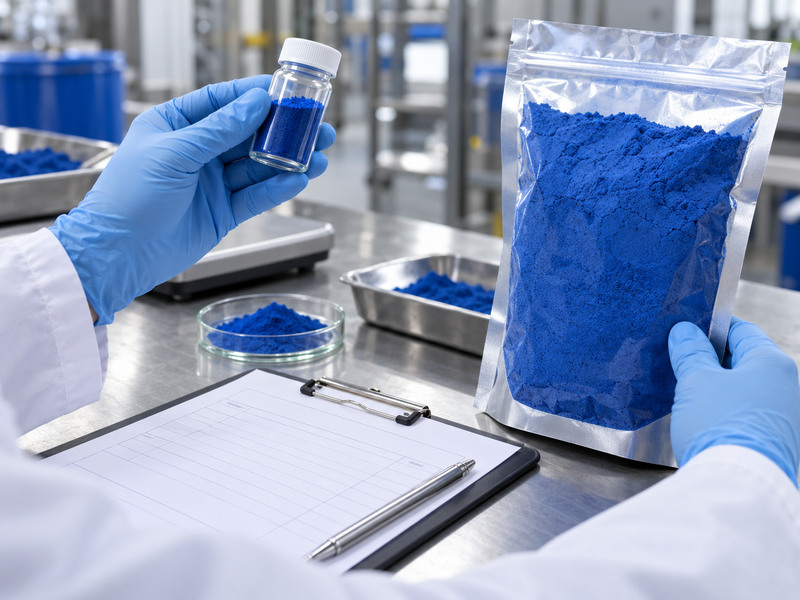
Ask for a food-color grade of blue spirulina extract, its technical sheet, ingredient and carrier declaration, current lot COA, color-strength method, handling advice and a lot-matched sample. Whole green spirulina biomass is a different material and should not be accepted as interchangeable with the regulated extract. The effective US rule identifies spirulina extract as a filtered aqueous extraction of dried Arthrospira platensis biomass with phycocyanins as principal coloring components.
It specifies limits for lead, arsenic and mercury and requires a negative result for microcystin toxin.
Use supplier documents to screen candidates, then verify the offered lot and intended bath. A blue powder may disperse differently depending on carrier and water composition. Record shade and dissolution in a standard small-volume test before moving to eggs. If the supplier’s grade changes, do not assume the same bath concentration will give the same shell color. The buyer should request evidence for the exact material, not infer certifications, available grades or tested results from a general website description.
| Document | Decision use | Missing-data response |
|---|---|---|
| TDS | Confirm extract format and handling | Request before pilot |
| Composition | Check carrier and label | Clarify each ingredient |
| Lot COA | Verify relevant specifications | Hold lot review |
| Color method | Compare doses fairly | Agree one method |
3. How should shell variation be controlled?
Shell color, porosity, texture and surface treatment can affect visible dye uptake. Sort pilot eggs by shell color and supplier lot, and use a consistent cooking and cooling procedure. Randomize eggs across bath arms so one arm does not receive all smooth white shells while another receives porous brown shells. Record shell size, appearance, cracks and any cleaning or sanitizing step. The goal is to estimate normal variation in the actual raw-material stream, not create an unrealistically uniform laboratory sample.
Use standardized photographs and a calibrated color measurement at several points on the shell if available. Record both average shade and variation within and between eggs. A brand may accept natural mottling but reject a batch with large pale patches. Evaluate eggs after drying and after packing, not only as they leave the bath. If the business plans to color both white and brown eggs, qualify them as separate appearance groups rather than forcing one concentration to meet two incompatible targets.
Build procurement’s color reference from representative production eggs.
| Shell variable | Control in pilot | Why it matters |
|---|---|---|
| White versus brown | Separate groups | Background shade differs |
| Surface condition | Same preparation | Uptake may vary |
| Size and texture | Balanced allocation | Contact area and mottling |
| Cracks | Reject before bath | Transfer and handling risk |
4. How should the dye bath be designed?
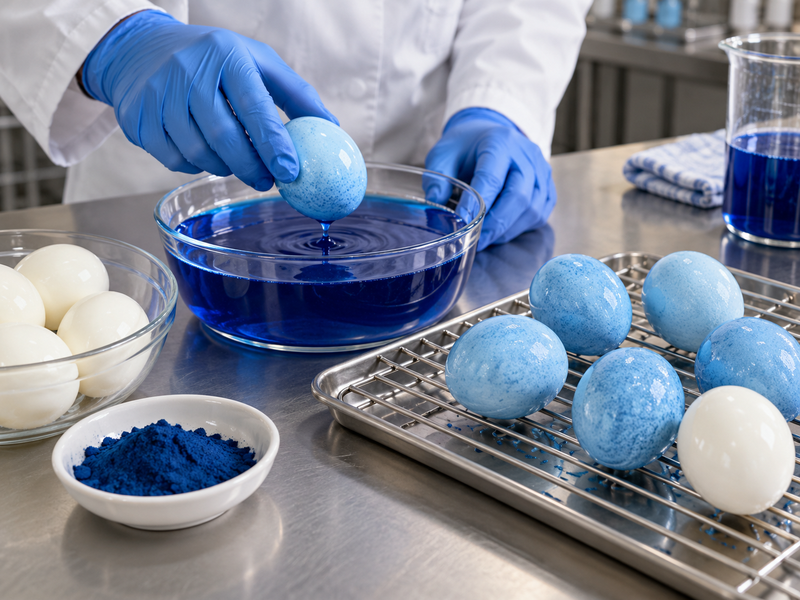
Begin with a small matrix of extract concentration and contact time chosen from the desired shade and practical line capacity. Hold water quality, bath volume per egg, temperature, agitation and shell preparation constant. Record bath pH and color at the beginning and end of each run. A bath used for many eggs may change as pigment is taken up or diluted, so test the planned replenishment or replacement rule. A small fresh beaker cannot model a commercial bath that runs for a full shift.
The 2017 FDA rule established the seasonal hard-boiled shell use; it is a legal use boundary, not an industrial bath recipe. The brand must establish practical concentrations by experiment and by good manufacturing practice. Track extract consumed per egg, waste and cleaning effort. If a carrier changes foam or residue, include that in the cost comparison. Do not publish a universal dose without evidence from the intended eggs and production method.
| Bath arm | Controlled factors | Main output |
|---|---|---|
| Lower concentration | Same contact and shells | Pale shade feasibility |
| Higher concentration | Same contact and shells | Saturation and rub-off |
| Longer contact | Same concentration | Uptake versus throughput |
5. What contact time and drying checks are useful?
Time each step from immersion to drained and fully dry shell. Measure shade when wet, after drying and after a defined handling interval. A wet shell can look darker than the retail egg; judging it too early may lead to a misleading dose selection. Record bath temperature and time because they affect both throughput and food-handling controls. Keep eggs in a documented temperature program appropriate to the finished product, with the site’s food-safety team approving the process.
Test drying at the planned line speed and spacing. Examine whether eggs touch each other before the color is fixed, leaving transfer marks. Look for pooled dye at the lower shell, drip streaks and stains on equipment. Measure whether longer contact improves color enough to justify slower throughput. Compare the cost per accepted colored egg, not just extract per bath.
If a kit is intended for consumers, instructions should be tested by users under the specified conditions; a professional pilot bath cannot prove that household handling will reproduce the same shade.

6. How should rub-off and transfer be tested?
Design a repeatable dry and lightly damp rub test using the handling pressure and contact material expected in packing and consumer use. Check for pigment on gloves, cartons, adjacent eggs and display surfaces. Record shell appearance before and after the rub. Set a maximum acceptable transfer before choosing a dose, because a darker shell is not better if it stains the package. Test again after the intended refrigerated hold, when surface condensation may change rub-off.
Assess transfer to the edible egg separately. Crack representative intact colored eggs using a standard method and inspect the white and yolk for unintended blue contamination. The use permission is for the shell, so an observed transfer should trigger investigation of cracks, bath process and handling. Do not treat a successful shell-rub result as proof that the interior is unaffected. Retain photographs and lot records for the decision.
If a kit permits consumers to handle the dyed egg, evaluate the likely contact conditions and instructions rather than claiming “no transfer” without product-specific evidence.
| Test | Surface examined | Pass question |
|---|---|---|
| Dry rub | Shell and cloth | Does color mark handling surfaces? |
| Condensation rub | Shell and carton | Does chilled moisture increase transfer? |
| Peel inspection | Egg white and yolk | Is there unintended interior color? |
7. Which cracked eggs must be excluded?
Use a documented crack-rejection step before the coloring bath and again before packing. Cracks can allow bath liquid or surface color to reach the edible portion and create a food-safety problem independent of cosmetic appearance. Define how staff or equipment detects hairline fractures, how suspect eggs are segregated and what happens if a crack is discovered after coloring. Do not rely on color to hide a defect.
Record rejection rates by egg lot and processing condition so a high failure rate is investigated rather than absorbed into ingredient cost.
Keep coloring and handling controls within the packer’s validated hard-boiled egg safety program. The color-additive rule does not replace cooking, cooling, sanitation or temperature requirements. If the bath is recirculated, establish cleaning and replacement rules under the site’s hazard analysis. A supplier’s COA describes the extract lot; it cannot prove that the packer’s bath or eggs are safe. The purchase specification should state that the extract is one controlled input to an already compliant egg process.
A trial that produces good-looking shells but excessive crack rejection fails the commercial gate.
| Checkpoint | Action | Record |
|---|---|---|
| Before bath | Remove cracked eggs | Count by incoming lot |
| After drying | Inspect new fractures | Count by process arm |
| Before packing | Final rejection | Accepted yield |

8. What does the US authorization actually say?
The effective 21 CFR 73.530 includes use of spirulina extract to seasonally color the shells of hard-boiled eggs at levels consistent with good manufacturing practice. The 2017 FDA final rule describes the expansion for this particular application. Do not broaden that language to raw eggs, soft-boiled eggs, liquid egg, yolks, whites or permanent general egg coloring. Verify the exact marketed product and its instructions before claiming US eligibility.
The February 2026 foods-generally expansion was delayed indefinitely. It does not erase the effective rule’s narrow shell wording. The regulation also limits uses in foods with standards of identity unless those standards authorize added color, and it has extract identity, specifications and labeling provisions. Destination markets outside the US require their own check. Regulatory review should sign off on the actual kit or packed-egg scenario and ingredient labeling, separate from the shade and rub-off pilot.
9. What belongs in the egg-kit supplier RFQ?
Tell the supplier whether the application is a seasonal kit or pre-colored hard-boiled egg shells, the target shade, bath method, planned throughput, destination and anticipated quantity. Request a lot-matched sample, technical sheet, full carrier declaration, current COA, color-strength method, handling guidance and application-specific quotation. Ask whether the proposed grade is suitable for the buyer’s bath preparation, but validate that answer in the plant. For a kit, ask what pack size and storage are quoted; do not assume a standard format exists.
Compare suppliers by cost per acceptable egg after rejected shells, bath usage, drying time and packaging marks. A stronger pigment can still be uneconomic if it produces too much rub-off or uneven uptake. Keep lot identity tied to the test record. If the supplier offers a different grade or carrier after the pilot, repeat the relevant bath and transfer tests. The quoted material and the tested material should match.
A company-wide quality statement is not a substitute for the current lot’s COA or a destination-specific regulatory review.
| RFQ detail | Buyer provides | Supplier asked to provide |
|---|---|---|
| Use | Seasonal shell application | Exact extract grade |
| Process | Bath, time and temperature | Preparation guidance |
| Quality | Shade and rub-off target | Lot documents |
| Commercial | Volume and market | Quote and pack options |

10. When is a seasonal order justified?
Approve a named extract grade only after representative eggs meet shade, variation, rub-off, crack rejection, interior-transfer, food-handling and regulatory gates. Record shell colors and lots, bath concentration, contact time, water conditions, drying method, pack and refrigerated hold. An attractive wet shell is not sufficient. The seasonal order should be sized against accepted yield and bath usage from a pilot, not an assumed per-egg dose from a laboratory dish.
Create change triggers for a new egg supplier or shell color, extract grade, carrier, bath chemistry, drying line or carton. Confirm incoming color strength and lot documentation before the seasonal run. Keep reference eggs or controlled photographs for staff training, recognizing that stored physical eggs may not remain a valid long-term standard. If a process change increases cracks or interior transfer, stop and investigate under the site’s food-safety plan.
The intended purchase outcome is a repeatable shell-color method for a defined seasonal product, with no claim that egg contents are authorized for coloring.
FAQ
Q1. May spirulina extract color egg contents in the US? The effective rule’s egg-specific use is seasonal coloring of hard-boiled egg shells; do not extend it to contents.
Q2. Is any blue spirulina powder interchangeable? No. Confirm the regulated extract identity, composition and lot evidence.
Q3. Should brown and white eggs share one color specification? Test them separately; shell backgrounds can produce different apparent shades.
Q4. Is a darker wet shell a better result? Judge the shell after drying, handling and packing, including rub-off.
Q5. Does the supplier COA cover egg-handling safety? No. The packer must validate cooking, cooling, bath and crack controls.
Conclusion: Qualify the shell, not just the blue bath
The right seasonal extract produces an acceptable dry shell within a controlled hard-boiled egg process and the narrow legal use. Contact SpirulinaCN with the application, target shell shade and specification, bath method, anticipated quantity and destination. Request a lot-matched sample, technical sheet, current COA and application-specific quotation for a representative egg pilot.