
Phycocyanin powder flowability for sachet filling is a line-performance purchase decision. A blue powder may have acceptable color strength and moisture on a certificate yet bridge in a hopper, dust onto seals or vary in dose between stick packs. Research on dried C-phycocyanin powder properties and freeze-dried wall-material systems shows why powder structure and carriers matter; those experimental materials are not assumed to be available from a commercial supplier.
Qualify the offered food-grade lot in the intended formula, humidity and pack format.
Contents
- Which sachet line and finished product are in scope?
- What supplier grade data should be requested?
- How should bulk density and flow be screened?
- What happens during hopper hold?
- How do humidity and film affect filling?
- How should dose variation and dust be measured?
- Does the filled powder reconstitute as intended?
- What color-use and label checks apply?
- How can lots be compared in a pilot RFQ?
- When is a production purchase justified?
1. Which sachet line and finished product are in scope?
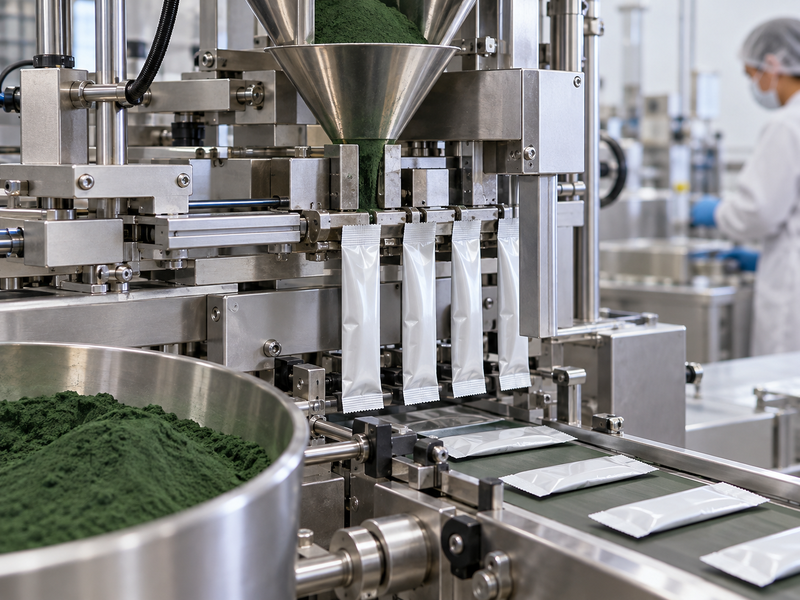
Define whether the line fills neat blue colorant, a dry beverage mix, a dessert powder or another blend. Specify target mass per pack, permitted mass variation, filler type, hopper capacity, line speed, sealing method, film and room-humidity range. A free-flowing powder at a slow bench funnel can compact or bridge at a high-speed auger; a fine material may feed well but create dust at the seal jaw.
If phycocyanin is only a small fraction of a blend, its segregation and color uniformity may matter more than its neat-powder flow.
Document the consumer preparation step. A beverage sachet needs a blue color that disperses in the stated water volume and temperature; a culinary premix may be heated later. The end use sets regulatory review and reconstitution criteria. Write the line’s reject thresholds for weight, seal contamination, underfilled packs and cleaning before accepting a sample. A purchase approval should cover the specific filler and film at the planned speed, not an abstract “good flow” rating.
| Brief field | Record | Failure it can expose |
|---|---|---|
| Filler | Auger, cup or other | Bridging or dose drift |
| Pack | Stick width, film, seal | Powder in seal |
| Room | Temperature and RH | Moisture pickup |
| End use | Dilution and preparation | Weak or speckled blue |
2. What supplier grade data should be requested?
Request a lot-matched sample of the proposed blue spirulina extract powder, a technical sheet, current COA, ingredient and carrier declaration, particle-size distribution, moisture and color-strength method. Ask for bulk and tapped density, flow data and storage recommendations if measured for that grade. Do not infer that a supplier has these data until it provides them. Different drying methods or carriers can create different particle surfaces; a laboratory result from another powder cannot be transcribed into this grade’s specification.
The 2020 encapsulation study compared powder characteristics including moisture, color and flow during storage. Its PEG-based experimental carriers are not a recommendation for food sachets and should not be presented as a sold SKU. The wall-material study also examined properties such as solubility and hygroscopicity. Use these papers to justify which data to ask for, then measure the actual candidate.
A technical E-value reflects a pigment-related test; it does not establish hopper behavior.
| Requested field | Why it matters | Buyer check |
|---|---|---|
| Carrier composition | Blend and label fit | Full declaration |
| Particle size | Segregation and dust | Sample measurement |
| Density | Filler volume setting | Bulk/tapped comparison |
| Moisture and color | Storage and dose | Lot result and incoming test |
3. How should bulk density and flow be screened?
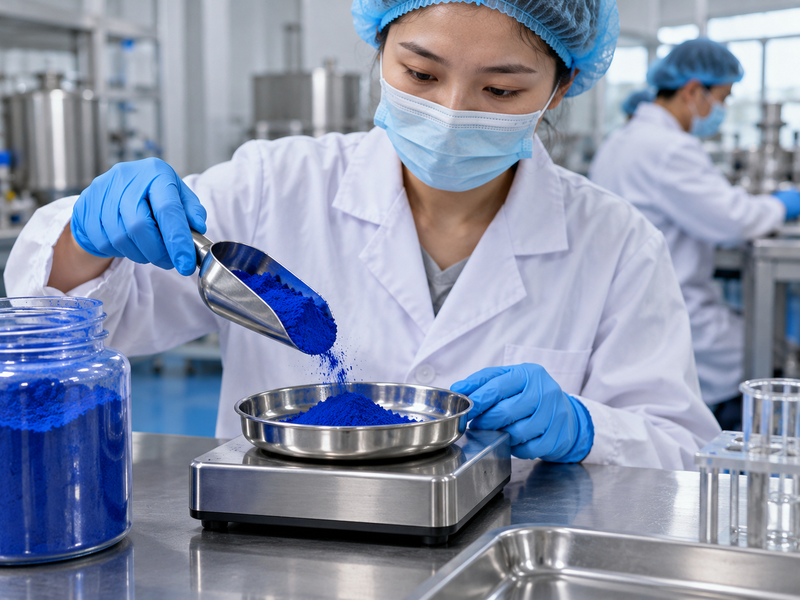
Measure loose bulk density, tapped density and a flow indicator using a documented method and sample conditioning. These tests help select candidates for the line, but none alone predicts performance under vibration, static, humidity or hopper pressure. Compare the candidate to an approved reference if one exists, and test the whole final blend as well as neat pigment. A tiny blue component can be diluted in a carrier that changes the blend’s density, making a volumetric filler setting inaccurate even when neat pigment pours freely.
Record how the powder behaves after sitting in the test container, after gentle vibration and after a transfer. Look for caking, ratholes and uneven discharge. If a candidate is more cohesive than the reference, a slower line or different feeder may be necessary; calculate the operational cost before choosing on price per kilogram. Keep sample age and storage consistent across grades.
A fair screen holds room condition and test method constant, then moves shortlisted lots onto the actual filler where bridging and dose variability can be observed directly.
| Bench measure | Useful signal | Limitation |
|---|---|---|
| Bulk density | Hopper and pack volume | Does not show bridging |
| Tapped density | Compaction tendency | Not a line simulation |
| Flow time | Relative discharge | Sensitive to apparatus |
| Visual transfer | Dust and clumps | Needs standardized handling |
4. What happens during hopper hold?
Run the pigment or finished blend through the intended production sequence: loading, hopper residence, pauses and restarts. Take samples at the start, middle and end of the hopper discharge. Watch for bridging above the feeder, rat-holing down the center, compaction below the agitator and pigment segregation. Record how often the operator must tap or stir the hopper. An ingredient that passes only with frequent manual intervention may compromise throughput and hygiene at scale.
Measure pack weights over the complete run, not just the first ten sachets. If blue pigment is a small component, analyze blend uniformity as well; consistent total mass can hide uneven colorant distribution. Check whether a hold over a shift or overnight changes discharge after restart. The production team should define the longest plausible hold time rather than adopting an arbitrary laboratory period.
If the candidate fails, investigate feeder settings and blend order before concluding the raw material is unsuitable, but document every change so the approval applies to the process actually tested.
| Run segment | Observation | Acceptance question |
|---|---|---|
| Startup | First-pack weight and hue | Is priming controlled? |
| Steady state | Mass variability | Is dosing repeatable? |
| Pause/restart | Bridging or surge | Is intervention needed? |
| Hopper end | Segregation | Does final color drift? |
5. How do humidity and film affect filling?
Control and record relative humidity during trials, including conditions expected in the factory’s worst routine season. Expose an open sample for the planned hopper time and measure moisture pickup, clumping, flow and color change. Hygroscopicity depends on the actual carrier and particle structure; the freeze-dried microencapsulation research examined that property but cannot predict a different commercial powder. Keep the rest of the blend in the test, because sugar and other ingredients can dominate moisture behavior.
Test the intended film and seal settings. Fine blue dust can migrate onto heat-seal surfaces; a weak seal can admit moisture after packing even when the room trial looked good. Inspect seal cleanliness and strength, leakage and powder trapped in folds. Choose a packaging barrier appropriate to the product’s tested moisture sensitivity, then verify through storage. Do not declare a universal water-vapor barrier target without a finished-pack study. If lower humidity is required, document whether the site can maintain it consistently at production speed.
6. How should dose variation and dust be measured?
Use a statistically useful sequence of packs across startup, steady operation, pauses and hopper depletion. Weigh each pack or a defined sample, calculate variability and identify systematic drift. If pigment is blended into a premix, assay or color-test selected sachets to confirm blue distribution; total weight alone cannot demonstrate uniform colorant dose. Define the target and tolerance in advance, including an upper limit if over-coloring affects label or cost. A short perfect run is less informative than a representative full operating cycle.
Place observations at the filling head, on sealing jaws, inside the pack exterior and in cleaning areas. Record visible dust, filter loading, seal contamination and operator exposure according to the plant’s hygiene program. A powder that creates less dust may be worth a higher unit price if it reduces rejects and cleaning downtime, but calculate this from measured plant data. Do not make a supplier dust-free claim from a bench funnel.
If changing particle size or carrier improves dosing, obtain a new lot-matched sample and repeat reconstitution and label checks.
| Measure | Sample location | Decision rule |
|---|---|---|
| Net weight | Packs across full run | Within predefined tolerance |
| Pigment uniformity | Start, middle, end packs | Meets color-dose range |
| Seal contamination | Sealed packs and jaws | No unacceptable blue deposit |
| Dusting | Hopper/filler area | Within hygiene plan |
7. Does the filled powder reconstitute as intended?
Open sachets from the start, middle and end of the line and prepare them exactly as the consumer instructions say. Measure time to disperse, visible specks, sediment, foam and blue shade. Test the declared water volume and temperature; a powder that flows well can still float or clump when poured into cold water. If the end product is a beverage, assess taste and background matrix. A neat extract’s dissolution may not match that of a sugar-, acid- or protein-containing blend.
Check reconstitution after finished-pack storage, not only on day one. Moisture entering through a poor seal can create lumps and reduce color performance. If the intended product will be heated after mixing, run that preparation step and evaluate the resulting shade rather than claiming heat stability from a dry powder assay. Keep color-strength results linked to the exact sachet lot and preparation method. A production purchase should pass both machine dosing and consumer-use performance; one cannot substitute for the other.
| Consumer test | Observe | Reject if |
|---|---|---|
| Cold-water mix | Dispersion and blue hue | Persistent specks |
| Standing period | Sediment and shade | Unacceptable settling |
| Stored sachet | Caking and reconstitution | Lost usability |

8. What color-use and label checks apply?
For US products, verify that the colorant meets the identity and specifications of spirulina extract under 21 CFR 73.530, and that the exact finished-food category is listed. The effective text includes beverage mixes and powders, and a specific allowance for coating formulations applied to dietary supplement tablets and capsules; it does not grant universal permission for every sachet’s eventual use.
Check the end product, its directions, any standard of identity and all ingredients in the powder mixture before commercial release.
The February 2026 foods-generally amendment was delayed indefinitely. Do not infer it has expanded permissible uses. Carrier ingredients need their own destination and label review. A phycocyanin assay, flow test or clean seal says nothing about legal status. Confirm rules and labeling for each sales market and for the specific SKU; keep that regulatory signoff separate from the line trial and food-safety acceptance.
9. How can lots be compared in a pilot RFQ?
Send a complete description of the intended final product, pigment fraction, filler type, target pack mass, line speed, room humidity, film, destination and anticipated demand. Request comparable lot-matched samples and technical sheets, full carrier compositions, current COAs, color-strength methods, particle and density data where available, pack format, storage guidance and application-specific quotations. Quote the delivered cost per acceptable sachet, considering rejects, cleaning, line speed and pigment dose. Do not assume all requested measurements or certifications are available from the supplier.
Use the same blend preparation, equipment settings and run length for each candidate, changing one parameter only if the line requires it and logging the adjustment. Retain reference packs and a sample of each ingredient lot. When the preferred grade is selected, negotiate acceptance criteria for color strength, moisture, particle behavior and change notification based on demonstrated manufacturing risk. A new drying method or carrier can alter flow even if color strength remains within range, so it should trigger a controlled comparison before substitution.
| RFQ field | Buyer supplies | Supplier asked to supply |
|---|---|---|
| Application | Final food and preparation | Suitable grade |
| Line | Filler, speed, film, RH | Physical data and sample |
| Quality | Dose and blue endpoint | Method and lot COA |
| Commercial | Quantity and destination | Quote, MOQ, lead time |

10. When is a production purchase justified?
Approve a grade only after it meets the pre-agreed hopper, weight, uniformity, dust, seal and reconstitution criteria in the intended line environment. Record the sampled lot, final blend version, filler settings, room humidity, film and run duration. Complete separate regulatory, food-safety and finished-pack storage reviews. If the material passed a neat-powder funnel but was never run through the actual sachet filler, procurement should authorize another pilot rather than full-volume purchase.
Build change control around carrier composition, particle size, drying method, color strength, line speed, blend ingredients and film. Incoming checks may be shorter than the original trial, but they should catch the physical properties that caused past failures. A change in humidity control can also invalidate a seemingly stable process. Keep a reference pack from the approved run for visual and analytical comparisons.
The final buying specification should describe what the powder must do in the filler and in the customer’s cup, alongside its laboratory composition.
FAQ
Q1. Does a high E-value mean the powder will fill well? No. Color strength does not establish density, flow or dose consistency.
Q2. Is a low moisture result enough? No. Measure moisture pickup and flow during the actual hopper hold and after packing.
Q3. Should neat powder or the final blend be tested? Both are useful; the production decision must use the final blend on the intended line.
Q4. Can pack weight prove uniform pigment dose? Not always. A blend may segregate while net weight remains consistent.
Q5. Are all colored sachet uses authorized in the US? No. Check the exact finished-food category in the effective rule.
Conclusion: Buy for consistent filled packs
Sachet filling performance requires an ingredient that doses, seals and reconstitutes consistently under the plant’s real conditions. Contact SpirulinaCN with the application, target specification and dose, filler and film, line humidity, anticipated quantity and destination. Request a lot-matched sample, technical sheet, current COA and application-specific quotation for a controlled pilot.