
If you are sourcing spirulina extract for blue breadcrumbs, the decision is whether a named color grade can survive your crumb process and look consistent when the crumbs coat the intended food. Crumb substrate, extract distribution, dryer exposure, particle-size spread and abrasion can all change what the customer sees. In the United States, 21 CFR 73.530 expressly lists breadcrumbs for spirulina extract, with conditions; the February 2026 expansion order for foods generally was delayed indefinitely.
The breadcrumb listing does not by itself settle the status of every finished breaded food. Build the purchase specification around the actual breadcrumb line and end use.
Contents
- What exactly is the blue breadcrumb purchase decision?
- Which spirulina extract identity and documents are required?
- How should the crumb substrate be selected?
- Where should the extract enter the process?
- How should drying exposure be tested?
- Which particle and fines measurements matter?
- How can color uniformity be judged objectively?
- What must be checked on the coated finished food?
- How should a pilot lot be accepted or rejected?
- What belongs in the supplier request and quote?
1. What exactly is the blue breadcrumb purchase decision?
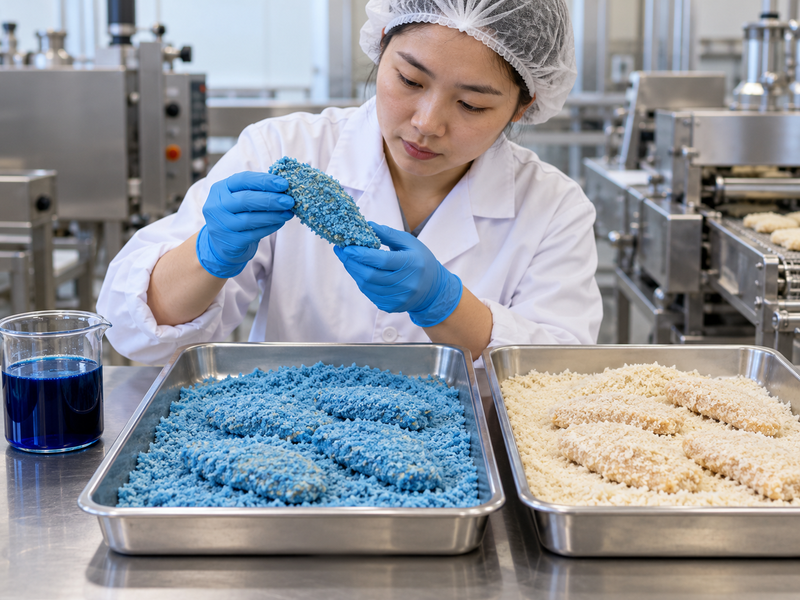
Define whether you sell dry blue crumbs as an ingredient, apply them to a food, or do both. Specify the crumb recipe, shape, size range, moisture target and packaging. State whether the desired shade is bright blue, muted blue, or an intentionally uneven specialty effect, and provide a physical reference. A food technologist then needs to see that shade after drying, packing, distribution and use, not merely after mixing. The technical purchase gate is repeatability at a workable dose within the exact line.
A color that works only with unusually gentle processing may not fit a commercial dryer. Likewise, a small sample may be visually impressive but fail when fine particles segregate in a tote.
Name the finished application before interpreting regulation. The U.S. rule lists breadcrumbs as an authorized coloring category under good manufacturing practice and a standards-of-identity restriction. It does not declare every food that later carries the breadcrumbs authorized. Have the brand’s regulatory reviewer assess the actual finished food and destination; a coating on a meat product can bring additional jurisdictional questions. Treat this as a release gate, not an afterthought attached to a visually successful sample.
| Decision input | Set before trials | Evidence for acceptance |
|---|---|---|
| Crumb product | Recipe, size, moisture and pack | Production specification |
| Blue target | Physical shade standard | Color under agreed light |
| End use | Food and application method | Regulatory review and coated sample |
| Commercial scale | Batch and dryer conditions | Repeat pilot at line speed |
2. Which spirulina extract identity and documents are required?
Ask for the exact as-sold color SKU, not the broad phrase “blue spirulina.” The U.S. identity in 21 CFR 73.530 is a filtered aqueous extract of dried Arthrospira platensis biomass with phycocyanins as principal coloring components. Whole green spirulina powder and an extract from another organism should not be assumed to meet that identity.
Request the ingredient and carrier composition, species statement, extraction description, technical data sheet, lot certificate of analysis, color strength method and applicable impurity tests. Check whether the sample and quoted production material are the same SKU.
A supplier’s blue spirulina product page can start the conversation, but it is not a lot dossier or a regulatory opinion. Ask about recommended handling only as a hypothesis to test. The grade must also suit the destination’s rules, including any diluent restrictions for color-additive mixtures. Record the legal entity and manufacturing location in the approval file so a later substitution cannot silently change the source.
If the supplier offers more than one carrier or potency, qualify each separately; otherwise a price comparison between powders may compare unlike materials.
| Document | Purchasing question it answers | Follow-up if incomplete |
|---|---|---|
| TDS and composition | What is actually delivered? | Request all carriers and identifiers |
| Lot COA | Does this lot meet agreed limits? | Link to sample and shipment |
| Color method | Can dose be compared fairly? | Obtain wavelength and dilution basis |
| Identity statement | Does it match intended jurisdiction? | Regulatory review before trial release |
3. How should the crumb substrate be selected?
Run the first trial in the exact commercial crumb, not a convenient white starch powder. Bread formulation, crust proportion, browning and particle porosity affect apparent blue. Yellow or tan crumbs can pull blue toward green or gray, while highly variable crumb color increases shade variation even when the extract is well dispersed. Make at least three substrate references: the normal control, a lighter permissible version if available, and the intended production base.
If changing the base would alter labeling, taste or cost, capture that tradeoff explicitly. Do not approve a blue dose established on a white laboratory carrier for a darker production bread.
Record initial crumb moisture and water activity with the company’s validated methods. Color distribution may depend on how much water the crumb can accept during dosing and how the subsequent dryer removes it. Screen for oversized or very dark crust fragments that may resist even coating. The objective is not to force every crumb to identical color; it is to know what visible variation the buyer and customer accept.
If the crumb is destined for a baked or fried product, retain enough sample to assess the post-use appearance later.
4. Where should the extract enter the process?
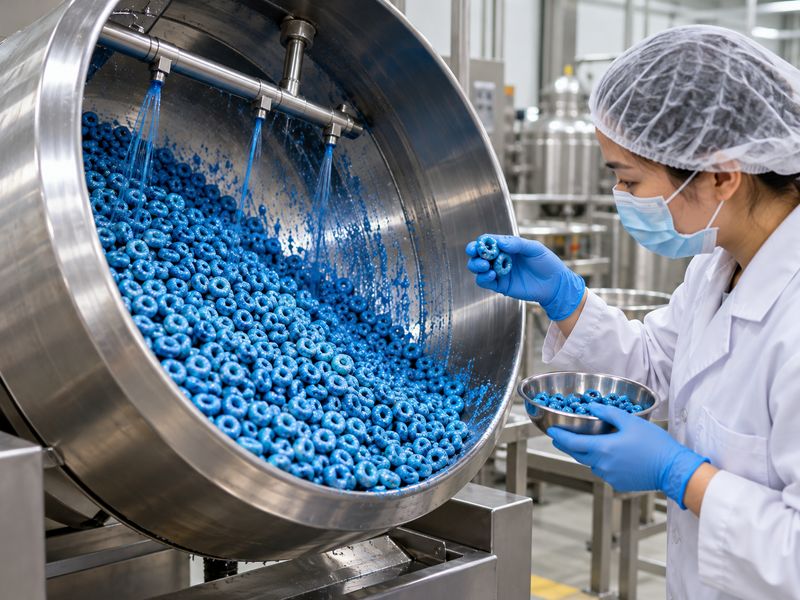
Map mixing, liquid dosing, any tempering step, drying, sieving and final blending on one process sheet. A premix may help distribute a concentrated extract, but it can also add water or carrier that changes drying demand. An atomized application may cover surfaces more evenly than a single-point liquid pour; that is a pilot question, not a universal recommendation. If color is blended into the dough before breadcrumb manufacture, it experiences bread baking as well as crumb drying.
If applied to finished crumb, it experiences a different moisture and hygiene route. Compare those routes on the same reference substrate and record actual mass balance.
Measure extract use as purchased weight per kilogram of finished crumb and, where helpful, color units per kilogram. Document losses to vessel walls, overspray and sieve fines. Do not quote a target percentage from a different supplier’s pigment because carrier content and assay can differ. Set a maximum color dose with regulatory and sensory reviewers after the intended market and labeling have been checked. The best addition point is the one that produces repeatable, acceptable crumbs without creating an unmanaged moisture or contamination step.
| Addition route | Main trial observation | Cost or process consequence |
|---|---|---|
| Dough addition | Shade after bake and milling | Heat exposure and colored scrap |
| Pre-dry crumb dosing | Wet distribution and dryer loss | Added water and drying load |
| Post-dry blending | Surface coverage and segregation | Hygiene and moisture control |
5. How should drying exposure be tested?
Blue phycocyanin is sensitive to processing conditions, so a lab swatch is not evidence for a specific industrial dryer. A published review of phycocyanin stability discusses effects of heat, light and pH; it cannot predict a breadcrumb line’s exact color loss. Record inlet and outlet temperatures, product temperature where measurable, residence time, air flow and starting moisture for each trial. Sample before and after drying.
Measure final moisture and water activity against the existing crumb specification, then compare color only among samples that also meet product safety and shelf-life requirements.
Run a small operating window rather than one idealized setting: normal condition, the warmer or longer credible limit, and a line-stop or rework scenario if these occur in practice. This exposes whether the process has sufficient margin. Avoid solving color retention by leaving crumbs wetter than the approved specification. Keep the same packaged samples for accelerated and real-time observation, with clear limits on what accelerated testing can predict. A supplier’s stability claim is useful only when its test matrix and conditions resemble this crumb process.

6. Which particle and fines measurements matter?
Screen the colored crumbs into the commercial size fractions and weigh each fraction. Fine particles often carry a different visible color intensity from larger pieces because they expose more surface and may collect more applied liquid. They also settle during transportation and may cloud a coating bath or accumulate at the bottom of a bag. Take top, middle and bottom samples after realistic handling. Compare size distribution before and after conveying, packing and a transport simulation.
The acceptance question is whether the shipped product is still the product the customer approved.
Record abrasion as an observable loss: dust on package walls, color transfer to the line, and change in the fraction retained on each sieve. If a very fine fraction is unacceptable, decide whether to remove it, reblend it under control, or adjust processing. Do not quietly discard high-color fines when calculating cost per usable kilogram. A formulation with a low ingredient dose but high sift-out loss can cost more than a slightly higher dose that survives handling.
This is why procurement should ask for both extract price and the pilot’s yield into saleable crumbs.
| Sample point | Measurement | Acceptance question |
|---|---|---|
| Dryer outlet | Sieve fractions and color | Did drying alter particle balance? |
| Packed bag top/bottom | Shade and mass fraction | Did color segregate? |
| After simulated transport | Fines and dust | Will customer receive same appearance? |
| Coating line return | Recovered fines | Is rework controlled? |
7. How can color uniformity be judged objectively?
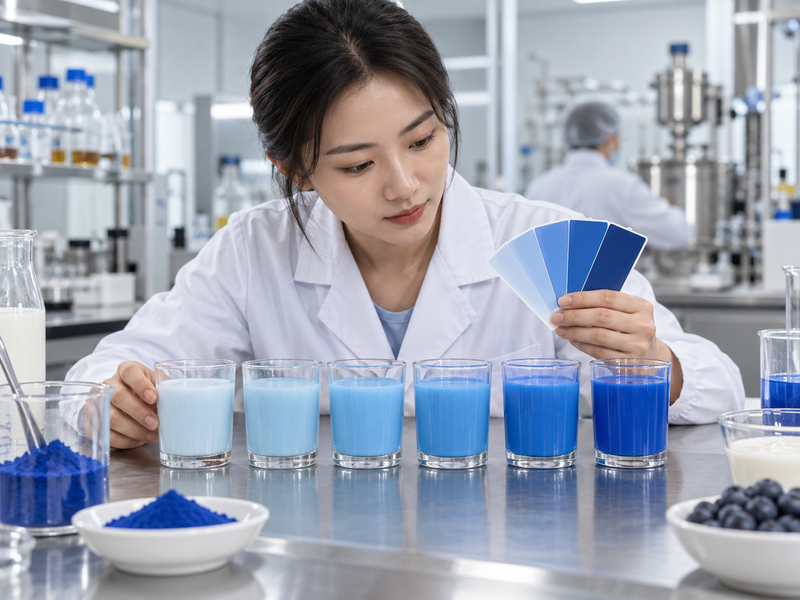
Use a visual standard under agreed lighting plus instrument readings from multiple representative points. A single average color number can hide blotchy crumbs. Photograph samples with a fixed camera setup and include the control and shade reference in each frame. If using CIELAB measurements, define sample cup, fill depth, instrument geometry, number of readings and acceptable spread. Record whether the instrument sees the whole particulate mixture or a selected size fraction. Compare within-batch variation and between-batch variation at the same sampling plan.
Judge color at relevant stages: immediately after dosing, after drying, after the packed hold and after application to the intended product. Make a clear pass/fail rule before viewing the results. For example, the team might require both an acceptable visual panel score and an agreed instrument range, but the actual range must come from the brand’s reference material and customer needs. Do not present one universal numerical tolerance as an industry standard.
A controlled shade reference can make supplier discussions more productive than subjective terms such as “bright enough.”
8. What must be checked on the coated finished food?
Apply the crumbs through the intended batter, predust, adhesion or coating operation. Measure pickup and loss after tumble or conveyance. Observe the food before and after its actual cooking or reheating instructions. A crumb that looks blue in a clear bag may appear gray on a browned substrate or lose distinction after frying. Moisture from the food can also change the visible shade during chilled or frozen storage.
If the product is sold uncooked, test the appearance throughout the expected retail chain and after consumer preparation. Document both color and ordinary coating performance; a blue crumb that fails adhesion is not a viable ingredient.
The U.S. breadcrumb listing should be reviewed alongside the identity and category of the finished food. In particular, the 2025 codified text of §73.530 includes a restriction involving standardized foods. Have the responsible reviewer check the current rule, labeling and any other competent authority for the destination. A pilot should be marked technical only until that decision is recorded. This keeps a promising coating trial from being mistaken for launch clearance.
| Finished-food gate | Observe or measure | Owner |
|---|---|---|
| Coating pickup | Mass gain and bare areas | Process R&D |
| Cooked appearance | Shade and browning | Sensory/R&D |
| Storage appearance | Drift and uneven wetting | Shelf-life team |
| Market permission | Exact food and label | Regulatory lead |
9. How should a pilot lot be accepted or rejected?
Write a pilot protocol with a blank results sheet before ordering a commercial lot. Include the exact blue extract SKU and lot, crumb base lot, dose calculation, application point, dryer profile, finished moisture, sieve distribution, shade method, packing and end-use test. A trial can fail for different reasons: insufficient initial color, heat loss, uneven coverage, excessive fines, sensory interference or an unresolved regulatory use. Assign each failure to a possible next experiment rather than simply raising the pigment dose.
More extract may deepen shade while also increasing cost, carrier load or unwanted appearance.
Keep a retain sample from each pilot and record photographs under identical conditions. If the supplier changes the extract formulation or carrier, do not assume the old approval transfers. Repeat the most sensitive gates with the replacement material. The release criterion should cover both technical and documentary evidence: acceptable crumbs, a lot-linked COA, suitable specification and a signed market review. A single attractive photograph is insufficient evidence for a purchase order intended to serve thousands of packs.
10. What belongs in the supplier request and quote?
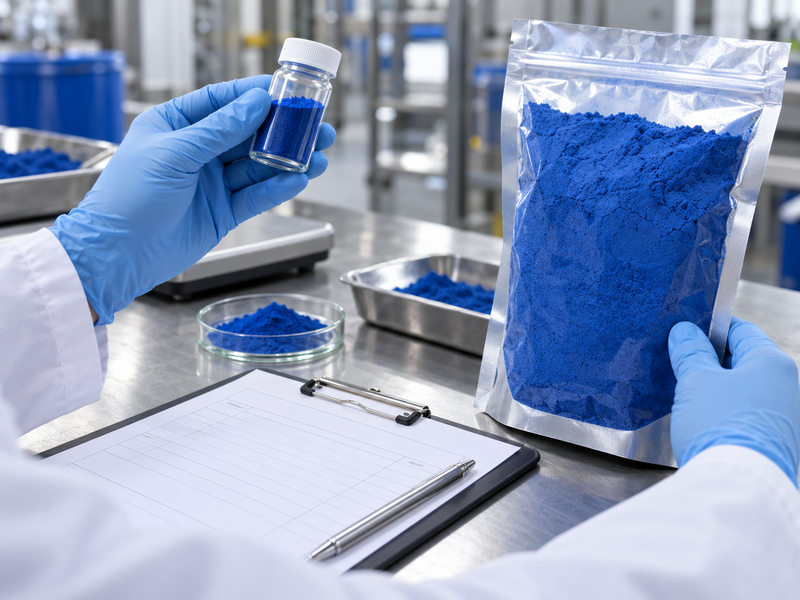
Send the crumb formulation or a permissible summary, process map, dryer exposure, target shade, pack format, intended finished food, destination and anticipated quantity. Request a named food-color grade, a sample from a traceable lot, complete as-sold composition, TDS, lot COA, color-strength test method, packaging specification and quote basis. Ask whether the commercial shipment will use the same grade and whether a change-control notice is available.
State that the price comparison will be made per kilogram of saleable crumbs at an approved shade, not solely per kilogram of pigment.
Procurement should also define the sample-to-volume sequence. A lab screen qualifies the concept, a line pilot measures process and yield, and a production trial checks repeatability. If the supplier cannot document the named material or the brand cannot validate the finished-food use, hold the commercial order even if the crumb looks promising. That is a practical purchasing decision, not a judgment that blue crumbs cannot be made. It ties supplier evidence and process evidence to the specific product being launched.
FAQ
Q1. Are blue breadcrumbs specifically listed for U.S. spirulina extract use? Yes, breadcrumbs appear in §73.530, subject to the rule’s identity, specifications and restrictions. Review the finished food separately.
Q2. Can whole green spirulina powder substitute for blue extract? No automatic substitution follows. It is a different material with different appearance and regulatory questions.
Q3. Is a pale crumb always necessary? No. A pale base may help a bright shade, but judge the actual commercial crumb and target appearance.
Q4. Does a passing dryer sample prove shelf stability? No. Check packed holds, light exposure, segregation and the intended coating process.
Q5. Should the cheapest extract per kilogram win? Compare color strength, dose, processing losses and saleable crumb yield before comparing cost.
Next step: Contact SpirulinaCN with your crumb recipe, drying profile, shade reference, end-use food, destination, pack format and anticipated quantity. Request a named blue spirulina food-color sample, lot specification and COA for a controlled breadcrumb pilot.