
A request to replace Blue 1 with “spirulina blue” sounds like a color swap, but it is a full formulation project. Spirulina blue vs Blue 1 compares a phycocyanin-rich aqueous extract from Arthrospira with a certified synthetic color. They differ in chemistry, sourcing, legal listings and sensitivity to the food matrix. Neither can be assumed to match the other’s shade or dose. This guide gives food and beverage teams a sequence for legal screening, bench trials, pilot runs and commercial cost review.
The FDA’s Blue 1 status record confirms that FD&C Blue No. 1 remains a listed, certification-required color for foods; a voluntary reformulation target is a separate business decision.
Contents
- What material is each color?
- What is the regulatory starting point?
- How should a shade target be defined?
- Which pH and heat trials are essential?
- How should light and shelf life be tested?
- What changes in the ingredient declaration?
- How do dosing and plant handling differ?
- What does a matched-shade cost model include?
- Which product categories merit first trials?
- What evidence closes a reformulation?
1. What material is each color?
Start with exact identities and specifications
Blue 1 is the certified color FD&C Blue No. 1, also known as Brilliant Blue FCF. Spirulina blue in food sourcing usually means spirulina extract whose principal coloring components are phycocyanins, not whole green spirulina powder. The US spirulina extract regulation defines it as a filtered aqueous extract of dried Arthrospira platensis biomass. Commercial extract preparations may contain allowed diluents or carriers, so request full composition and color value.
A blue sales photo says little about the exact product entering the plant.
Put both colors into a comparison sheet with source, legal name, supplier code, strength method, carrier, package, storage and certificate format. Blue 1 typically arrives with certification details; spirulina extract needs its own identity and contaminant checks under its listing. A blue spirulina ingredient page can help request a suitable grade, but the buyer must confirm that the quoted lot meets the exact destination-market specification.
Do not substitute a whole-biomass sample into a blue-extract trial: its green solids, flavor and color behavior answer a different question.
2. What is the regulatory starting point?
Confirm each color for the precise food category
Blue 1 is listed for foods generally in the United States, subject to applicable rules and batch certification. Spirulina extract is exempt from batch certification but has specified food uses and limitations under 21 CFR 73.530. The current category list includes non-alcoholic beverages and several other foods, with exclusions for certain standardized foods. The FDA issued a broader spirulina extract order in February 2026 but delayed its effective date pending objections.
A team should check the operative regulation immediately before approving a use rather than relying on a summary of the proposed expansion.
Record product category, market, dosage, color identity and proposed declaration on a regulatory worksheet. A beverage base, confection and cereal may face different questions. Export SKUs need separate review of local permitted colors and naming conventions. Do not infer legality from a competitor’s label or a supplier’s claim that the material is “natural.” If the reformulation is motivated by retailer policy rather than law, record that policy’s exact language and deadline too.
The project can then distinguish legal compliance, customer requirements and marketing preference without confusing them. Regulatory approval is a gate before scale-up, not a box to tick after ordering drums.
| Regulatory point | Blue 1 | Spirulina extract |
|---|---|---|
| US listing | 21 CFR 74.101 | 21 CFR 73.530 |
| Certification | FDA batch certification | Exempt from certification |
| Food scope | Listed broadly | Check listed categories |
| Label name | Verify declaration | Verify declaration |
3. How should a shade target be defined?
Compare the color consumers actually see
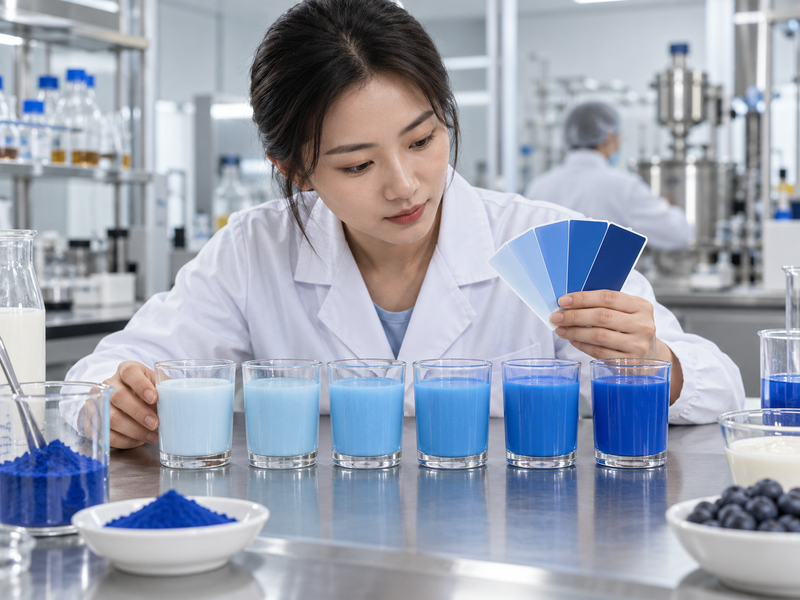
Take a retained sample of the current product and define its accepted range using calibrated Lab* measurements, photographs under fixed lighting and a physical reference. A request for “the same blue” is not precise enough when haze, opacity and container color differ. In clear beverages, measure through the retail bottle as well as in a lab cuvette. For opaque frosting, measure the surface after aeration. Record the target at release and at end of shelf life; the latter may be the harder benchmark.
Run a dose curve for spirulina extract in the unchanged base before reformulating other ingredients. Note hue, chroma, turbidity and any green or violet shift. Blue 1 and phycocyanin-rich extract have different spectral characteristics, so a perfect instrumental match may not look identical under every light source. A blind visual panel can assess whether differences are consumer-relevant after the physical measurements identify candidates. If no candidate reaches the desired shade without a poor flavor or high dose, do not hide that limitation.
Adjust the target or product concept with marketing approval rather than calling an unmatched color “equivalent.”

4. Which pH and heat trials are essential?
Test the full process window
Phycocyanin is a protein-associated pigment, and its color can be sensitive to pH and heat. An original stability study measured different outcomes across defined temperatures and pH values. That evidence justifies screening but does not predict a commercial formula’s exact loss. Measure the base pH before and after extract addition, then test realistic minimum and maximum process conditions. Include hold times, not just peak temperature. A brief pasteurization and a long hot tank residence may produce different outcomes.
Compare color at four points: pre-process, immediately after process, after cooling and after a storage hold. Use the same samples for Blue 1 controls so changes in the base are visible. Consider whether a late-addition point is technically and microbiologically acceptable; do not move an ingredient after a kill step without a validated process review. If acidification is part of food safety, it cannot be loosened merely to protect blue color. Reformulation may require a different color system or a different product format.
Ask the supplier for application data but confirm performance under the plant’s actual pH, time and equipment.
| Stress condition | Trial setup | Outcome to record |
|---|---|---|
| Target pH | Normal recipe | Initial hue |
| pH tolerance | Allowed process range | Color margin |
| Heat | Actual time-temperature profile | Retention after cooling |
| Hold | Worst realistic residence | Additional loss |
5. How should light and shelf life be tested?
Make packaging part of the experiment
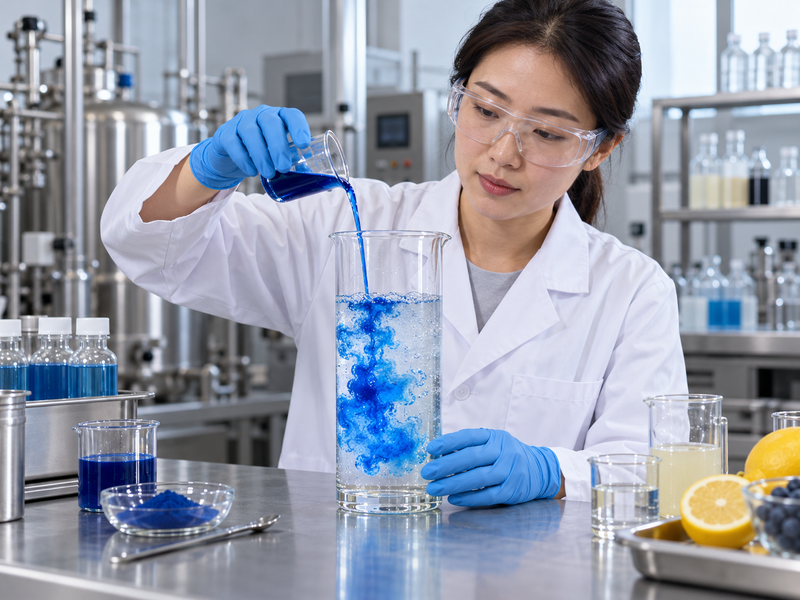
Light, oxygen, temperature and the surrounding formula may alter spirulina blue over time. Compare finished samples in the actual retail pack under normal and stressed storage conditions. A transparent bottle on a lit shelf can behave differently from an opaque carton. Test headspace and cap integrity if oxygen exposure is suspected. Blue 1 controls show how the existing color behaves under the same conditions, but the replacement must meet the brand’s own acceptance criteria rather than merely outperform a weak control.
Measure color at planned checkpoints through the claimed shelf life. Add visual notes for haze, precipitation, rings or color separation. A sample can retain an acceptable average blue value while developing unattractive particles. If light protection solves the problem, calculate the cost and marketing impact of a new package. Avoid declaring a shelf-life victory from accelerated storage alone; correlate it with real-time samples where feasible. Maintain retained batches for complaint investigation.
The release specification should include an end-of-life appearance criterion, not only the color of extract powder upon receipt. That makes future lot qualification commercially meaningful.
6. What changes in the ingredient declaration?
Approve words after approving materials
A Blue 1 replacement changes the exact color name, potentially the position of ingredients, and any claim such as “no artificial colors.” Confirm the finished ingredient statement and retailer policy in every destination market. The FDA distinguishes certified and certification-exempt colors, but “exempt from certification” is a regulatory category, not a statement that a material is free of all processing or risk. Review any carriers in the commercial extract preparation; they may appear on the label depending on their role and applicable rules.
The FDA color-additive guidance explains that an approved color’s regulation states its permitted uses and declaration. In 2026 the agency discussed discretion for certain voluntary absence-of-artificial-color claims, but a brand should still verify its exact wording and current policy before printing. Do not use a broad “chemical-free” claim. If a front-panel “blue spirulina” phrase is proposed, ensure the ingredient is genuinely spirulina extract and avoid implying it has the nutrient profile of whole green spirulina.
Marketing, quality and regulatory staff should sign off the same formula version.
| Artwork item | Review question | Evidence |
|---|---|---|
| Color name | Correct for market? | Regulatory listing |
| Carrier | Declared if required? | Full composition |
| Front claim | Supported by policy? | Approved claim memo |
| Nutrition image | Could mislead? | Actual formula data |
7. How do dosing and plant handling differ?
Translate bench color to the production line
Blue 1 and spirulina extract may be delivered as powders or liquids with different strengths, carriers and handling needs. The extract may require protection from moisture, light or heat and may disperse differently in cold and warm water. Define a standard predispersion method: liquid type, concentration, mixing order, time and temperature. If a powder clumps when added directly to a tank, a bench test using high shear may conceal a line problem. Assess dusting, feeder accuracy, line stains and cleaning time during a pilot.
Confirm the color-value method and batch-to-batch variation. E-grade or supplier color numbers can be useful within a defined method but are not universal units. Match the pilot dose to the actual commercial lot, then set an approved dose adjustment window controlled by quality and regulatory staff. A color adjustment cannot exceed a legal use limit or silently change the declared formula.
The supplier’s blue extract range offers possible grade choices; ask for normal-lot certificates and application samples before locking the bill of materials. Record yield losses in hoses, premix vessels and filters.

8. What does a matched-shade cost model include?
Price the approved finished result
Do not compare dollars per kilogram of Blue 1 and spirulina extract without accounting for strength and survival through processing. Calculate dose required to reach the same acceptable shade at end of shelf life. Add carrier mass, process loss, yield, extra mixing time, testing, storage, freight, packaging changes and any flavor adjustment. A concentrated extract might need less mass but cost more per usable color unit; a stable current color might require less operational control. Which route wins depends on the specific food and quotations.
Include a sensitivity analysis for lot variation and process conditions. If a 10 percent color-value change forces a noticeable dose adjustment, set a practical control plan. If a new opaque package protects the color, include its price and production changeover cost. Model minimum-order inventory and remaining shelf life of the color stock. A reformulation can still be commercially attractive because it meets a retailer or brand commitment; put that value explicitly in the business case rather than pretending raw ingredient price tells the whole story.
Finance should receive a tested recipe and realistic range, not an ideal bench calculation.
| Cost line | Measurement basis | Source |
|---|---|---|
| Color dose | End-of-life matched shade | Pilot trial |
| Process loss | Before/after yield | Plant run |
| Extra materials | Carrier, stabilizer, flavor | Final formula |
| Waste and stock | MOQ and shelf life | Supplier quote |
9. Which product categories merit first trials?
Prioritize where the process supports the pigment
Start with product concepts whose pH, heat exposure, package and shelf life give a plausible path to the target blue, and whose legal category is confirmed. A cold-mixed frosting, powder beverage mix and heat-processed acidic drink present different technical burdens. That does not mean one category is universally safe or unsuitable; commercial grades and stabilizing systems differ. Use a screening matrix with legal fit, color target, process severity and packaging. Advance the most promising SKUs first rather than replacing every Blue 1 use at once.
For each chosen SKU, write a minimum viable trial: exact base formula, three doses, commercial-lot sample, process profile, shade measurement and storage checks. Compare Blue 1 control and spirulina candidate in parallel. If the first category fails, use the data to locate the limiting factor before expanding the program. A clear failure at low pH may suggest a different color source or product architecture, not simply an overworked supplier.
Record where the extract works and where it does not; that makes the next brand decision faster and avoids sweeping claims like “spirulina blue replaces Blue 1 in all foods.”
10. What evidence closes a reformulation?
Release the new SKU through normal change control
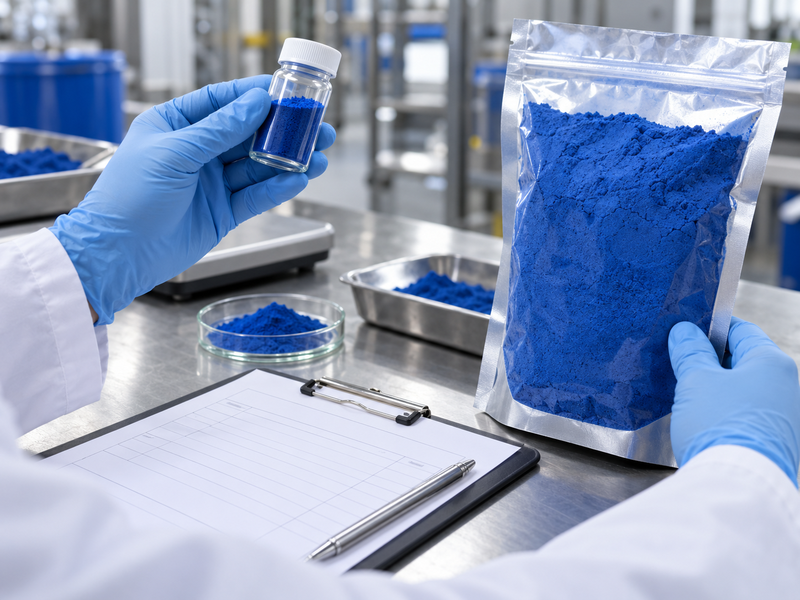
Completion requires an approved color ingredient specification, market-specific regulatory decision, final formula, pilot report, shelf-life data, label artwork and supply plan. Compare the first commercial lot with the pilot reference under the same test method. Quality should release incoming extract only after identity, certificate and relevant safety checks pass. Product development should approve shade and sensory. Operations should approve the dosing and cleaning procedure. Regulatory staff should sign off the final ingredient statement and claims.
One department cannot quietly waive another’s gate because launch date is near.
Keep Blue 1 stock and the old formula controlled during transition to avoid mixed artwork and material. Define which finished lot is the first reformulated one and how customer samples are identified. Set ongoing color and stability monitoring, especially across the first several extract lots. A supplier inquiry should request enough commercial-lot history to make this plan credible. The decision record should include limitations: the replacement works for a specified product, process and pack, not for every future blue application.
That is a useful conclusion a factory can maintain.
| Launch gate | Required record | Approver |
|---|---|---|
| Color legality | Exact market and use | Regulatory |
| Product performance | Pilot and shelf-life data | R&D |
| Material quality | Lot-linked specification | Quality |
| Scale-up | Dosing and cleaning SOP | Operations |
Frequently asked questions
Is Blue 1 banned in US food? The FDA record currently lists it for food use with batch certification. A brand may still choose to reformulate under its own policy or retailer requirement.
Is spirulina blue whole spirulina? No. Food-color spirulina extract is filtered aqueous extract with phycocyanins as principal coloring components.
Can spirulina extract replace Blue 1 at the same dose? Do not assume so. Match the finished shade after processing and shelf life, then calculate the required dose.
Does “natural” make spirulina extract legal in every food? No. Check the operative listing and the exact product category in each market.
Will spirulina extract always fade faster? Stability depends on grade, matrix, pH, heat, light and packaging. Test the actual commercial formula rather than asserting a universal comparison.
Conclusion
The spirulina blue vs Blue 1 decision belongs to a controlled reformulation. Confirm exact legal use, define a finished shade, test pH, heat and shelf life, then model cost at that accepted result. Close the project with lot-linked specifications and approved artwork so the new blue can be produced repeatedly.