
Choosing between gardenia blue vs spirulina blue now requires a current regulatory check as well as a color trial. In the United States, gardenia (genipin) blue gained a specified food-color listing in 2025. Spirulina extract has its own longer-standing listing, and a proposed 2026 general-use expansion was delayed. Neither color is simply “approved everywhere.” The two materials also have different chemistry and may behave differently under heat, acid, light and storage. This guide gives buyers a practical comparison framework for an actual beverage or candy SKU.
The FDA gardenia blue status record identifies its current US food categories and restrictions.
Contents
- What are the two blue materials?
- Which US uses are currently listed?
- How should other markets be checked?
- Which shade and opacity differences matter?
- How should pH and heat be screened?
- What does shelf-life testing need to show?
- Which safety and identity records matter?
- How should labeling be reviewed?
- How should buyers compare real cost?
- What decides the winning color?
1. What are the two blue materials?
Verify the chemical and manufacturing identities
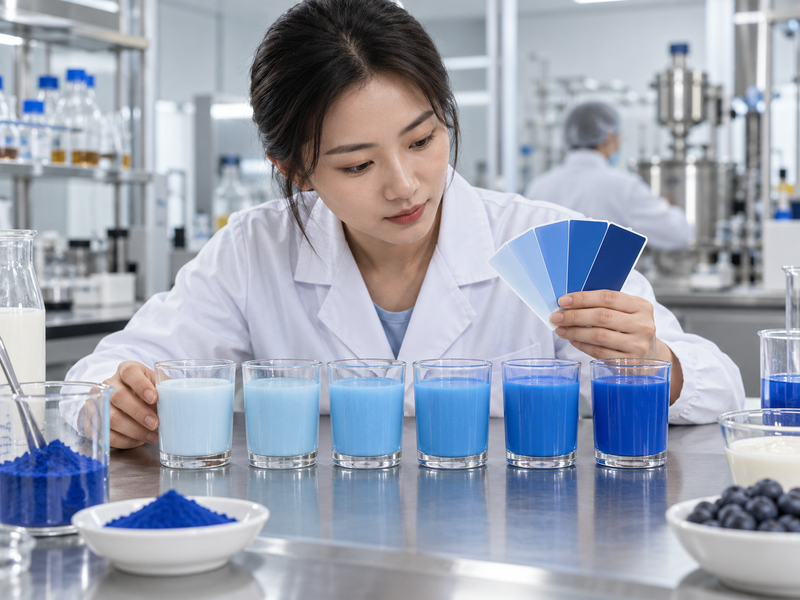
US-listed gardenia (genipin) blue is a defined color additive made from gardenia-derived genipin reacting with specified amino-acid material under controlled conditions. It is not gardenia fruit juice, and it should not be confused with jagua blue or any unrelated “gardenia blue” supplied for another market. Spirulina blue for US food use is spirulina extract, a filtered aqueous extract of dried Arthrospira platensis whose principal coloring components are phycocyanins. It is not whole green spirulina biomass.
Ask each supplier for its exact regulatory identity, manufacturing description, composition, carriers and lot certificate.
The FDA’s spirulina extract record and the gardenia record allow a buyer to check names, but commercial materials still require grade-specific documents. An extract marketed as “blue spirulina” may contain a carrier; a gardenia blue product may have its own formulated format. Record solids content and color-strength method before comparing prices. Request normal production samples rather than small laboratory showpieces. The first sourcing gate is exact identity, because color performance and legal permission attach to the specific listed substance, not to a broad plant-origin story.
2. Which US uses are currently listed?
Read each operative regulation, not an old summary
The FDA’s 2025 gardenia blue rule permits specified uses at good-manufacturing-practice levels: sport drinks, flavored or enhanced noncarbonated water, fruit drinks and ades, ready-to-drink teas, hard candy and soft candy, subject to the rule’s conditions. This is a useful range, but it is not a general food-color permission. An application in yogurt, for example, needs its own legal basis rather than analogy to a fruit drink. Check standards of identity where relevant.
Spirulina extract is listed under 21 CFR 73.530 for a different enumerated set that includes non-alcoholic beverages, confections and several other categories. FDA’s February 2026 order to broaden the listing was delayed in March, so the category question needs a fresh check before artwork approval. Regulatory staff should document exact SKU category, country, use level and current text.
A supplier saying “FDA approved” without specifying the product category is not enough for either color. Retain the dated legal review in the project file.
| US question | Gardenia blue | Spirulina extract |
|---|---|---|
| Listing | 21 CFR 73.168 | 21 CFR 73.530 |
| Scope | Specified drinks and candies | Enumerated food categories |
| Standardized foods | Check restriction | Check restriction |
| Certification | Exempt | Exempt |
3. How should other markets be checked?
Build a destination-by-destination matrix
A color permitted in one country or food category may be restricted or unlisted elsewhere. Ask regulatory staff or qualified local counsel to check the exact substance, food category, maximum use level, specifications and declaration in every intended market. Do not treat “natural blue” as a harmonized international category. A product sold through a cross-border e-commerce channel may still have destination-market labeling and ingredient obligations. A single global formula may need market-specific color alternatives or a narrower distribution plan.
Suppliers should provide documents that support the intended markets, not merely one US approval sheet. For each destination, record the legal citation and date reviewed, then tie it to the quoted grade. If a reformulation will serve multiple regions, put regulatory fit before sensory ranking. A beautiful gardenia sample cannot enter a market where the exact form or use is not permitted. Likewise, a spirulina extract listing for one category does not automatically extend to another.
The blue spirulina ingredient page can initiate a grade inquiry, but the buyer must request a market-specific regulatory dossier and confirm it independently.
4. Which shade and opacity differences matter?
Match the finished product, not the dry powder
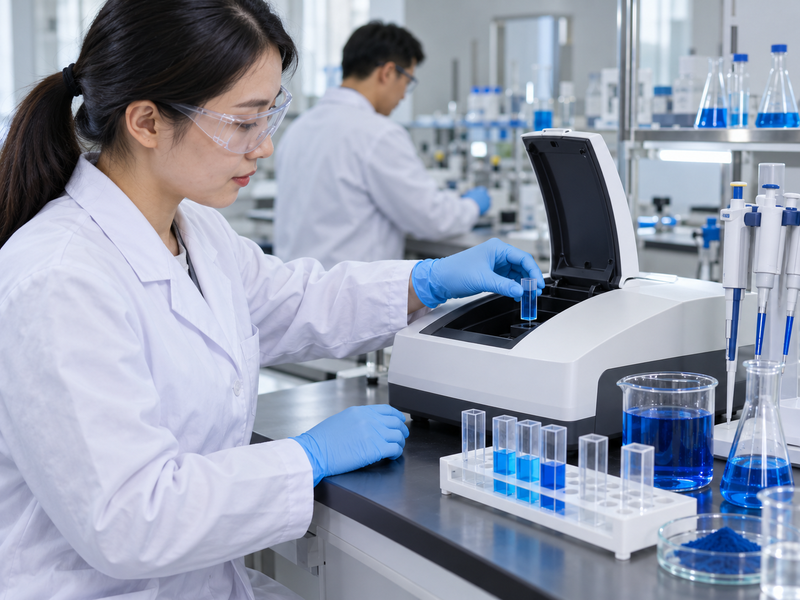
Gardenia blue and spirulina extract can produce different blue hues, chroma and opacity depending on formulation and dose. A supplier’s powder photograph has limited value. Build a reference from the current or desired finished product, then prepare dose curves in the actual base. Use calibrated Lab* color data and photographs under fixed light. In clear beverages, inspect haze and particulate matter against both white and dark backgrounds. In candy, assess surface and cut center after the normal process.
Compare candidates at matched finished shade rather than equal grams. If one requires a higher dose, evaluate whether it changes taste, texture or formulation cost. Record whether the blue drifts toward violet or green after heating or during storage. A color can match on day one but miss at shelf end. Agree on an acceptable range before a preferred sample is chosen. If exact matching is impossible, let the brand decide whether a new shade is acceptable rather than claiming technical equivalence.
Retain a physical reference from the approved trial to judge future commercial lots and supplier substitutions.
| Color property | Measurement | Business implication |
|---|---|---|
| Hue | Lab* and visual reference | Brand appearance |
| Opacity | Turbidity or visual check | Clear drink suitability |
| Dose | Grams per batch | Cost and label |
| Drift | Shelf-life color change | Launch reliability |
5. How should pH and heat be screened?
Test each color within the real process
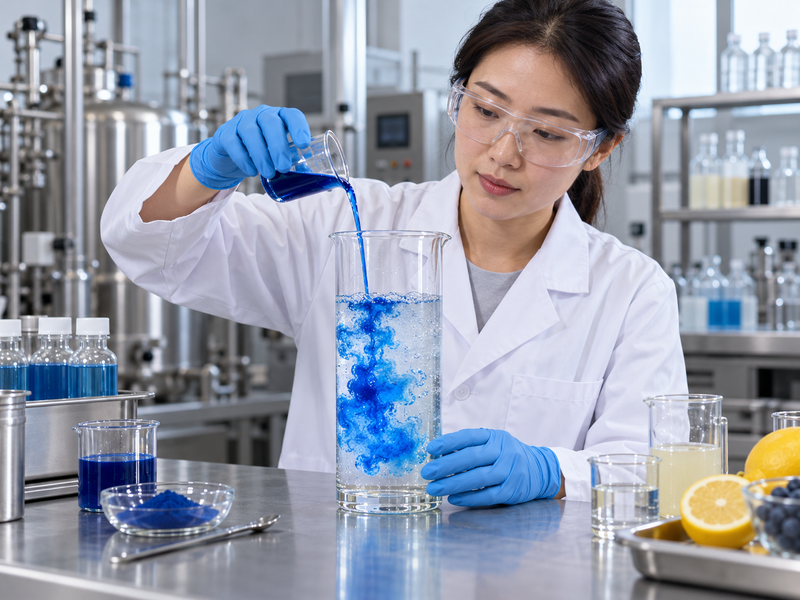
An original phycocyanin study measured changes with temperature and pH for a defined spirulina-derived preparation. Gardenia blue has a different pigment chemistry; published studies of other gardenia preparations cannot substitute for a commercial grade trial. Use the product’s actual pH, allowed tolerance, heating profile and hold time. Compare unheated and processed controls and note color after cooling. If the plant has a long warm hold before filling, include that time.
A short bench heat shock may understate production loss.
Do not generalize “gardenia is heat stable” or “spirulina cannot be heated.” Both are overly broad. A grade’s carrier and stabilizing system can matter, as can the food matrix. If a beverage’s acid level is tied to microbial safety, changing it for color requires a complete process review. If a candy’s cook temperature destroys one candidate, trial a permitted late-addition method only if production can control it. Write the pass criterion as finished hue and appearance after the full process.
The supplier’s application guide can suggest starting conditions, but it cannot replace the plant’s pilot data.

6. What does shelf-life testing need to show?
Include the package and retail environment
Test both colors in the final formula and proposed pack under real-time and appropriate accelerated conditions. Measure shade, haze, precipitation, rings and any odor change at set intervals. Transparent containers may expose color to more light than opaque packs. Headspace oxygen, dissolved oxygen and storage temperature may also differ between a benchtop bottle and commercial filling. Use the same package and fill conditions for both candidates so the comparison is fair. A day-one match is not a launch decision.
Set acceptance criteria at the declared end of shelf life, not only at production release. Where accelerated tests are used, keep real-time samples to confirm the prediction. If one color requires a new light barrier or refrigeration, include that business change in the decision. Retain samples from the pilot and first commercial run for complaint analysis. A color that shifts but stays within the brand’s approved range may be acceptable; a color that meets a lab absorbance number while forming visible particles may not.
The finished product, not the extract solution, is what consumers judge.
| Shelf variable | Trial choice | Record |
|---|---|---|
| Light | Retail display simulation | Hue and fade |
| Temperature | Normal and stress | Color trend |
| Oxygen | Actual fill and pack | Headspace condition |
| Time | Through claimed life | Pass or fail |
7. Which safety and identity records matter?
Buy against the listed specifications
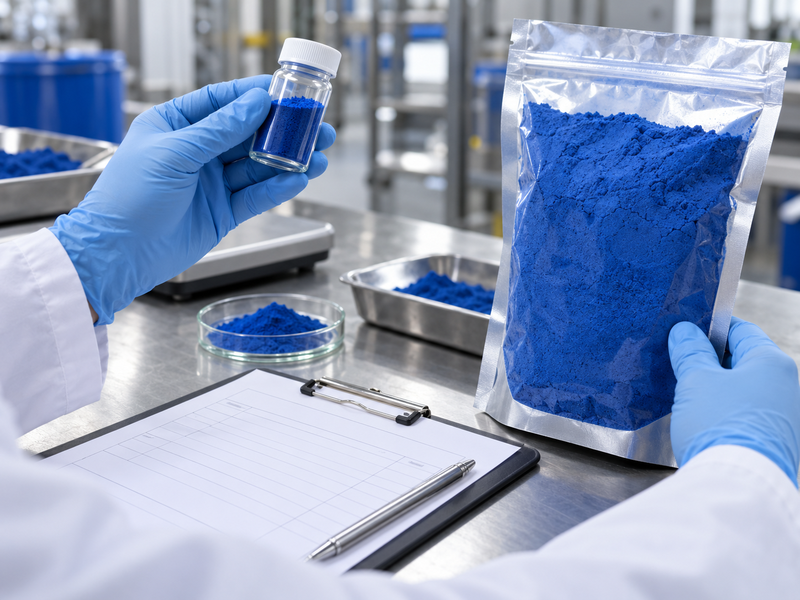
Each color has a legal identity and specifications as well as a supplier’s commercial quality sheet. Request the exact composition, production site, batch certificate, color strength, carrier and relevant contaminant or microbiological results. Check that the certificate belongs to the delivered lot and uses the same units and methods as the purchase specification. For spirulina extract, the US listing includes a negative microcystin requirement and elemental limits.
For gardenia blue, read the listed identity and specifications in the operative rule rather than borrowing those of another genipin color.
Quality should review supplier change controls for source material, process and formulation. A change in carrier can alter solubility or label declarations even if the color value appears stable. Test first commercial lots against the pilot reference in a standard matrix. Keep an unopened retain from each lot and clear deviation procedures. The FDA gardenia status record and spirulina record identify the regulatory substances; a buyer’s certificate must identify the physical lot.
A marketing sheet alone cannot release a color additive into food production.
8. How should labeling be reviewed?
Use exact names and avoid origin shortcuts
The finished label should reflect the actual color additive and any declaration rules in the destination market. “Plant-based blue” may be a marketing description, but it is not a substitute for the required ingredient name. Gardenia blue originates through a defined genipin reaction; spirulina extract is a filtered algal extract. Avoid suggesting that either one provides the nutrition of whole gardenia fruit or whole spirulina at color-use doses.
If a brand wants a “no artificial colors” statement, review current FDA policy, retailer definitions and the complete formula, including all other colors.
Artwork should be signed off after the final grade and carrier are chosen. A later supplier switch may require a new declaration or claim review even if the beverage looks identical. Consider product-page copy, marketplace images and customer sales sheets as part of the label-control system. The regulatory record should name country, SKU, formula version and exact color. If two markets require different colors, give them distinct item codes and packaging controls.
A buyer can then manage supply without creating mislabeled stock through an unrecorded color substitution.
| Copy item | Check | Sign-off |
|---|---|---|
| Ingredient statement | Exact color name | Regulatory |
| Origin description | Accurate process | Regulatory and supplier |
| Front claim | Complete formula support | Brand and regulatory |
| Export artwork | Destination rules | Local reviewer |
9. How should buyers compare real cost?
Calculate cost at an accepted shelf-end shade
Price per kilogram does not tell a buyer which blue is cheaper in a saleable product. Determine each color’s commercial dose at the approved post-process and shelf-end shade. Include carrier mass, process loss, packaging, extra mixing, testing, minimum order, freight and waste. A color that needs a lighter-resistant bottle may create a larger expense than its ingredient price. A grade that stays within shade range across lots may reduce adjustment and reject costs.
Use supplier quotes and measured pilot data; do not assume one blue universally outperforms the other.
Build scenarios for expected, weak and strong color-value lots. If a supplier changes its color-value method, the cost comparison may no longer be valid. Include the cost of a second approved source where supply continuity matters. For a US SKU, do not assign a cost to a color before the exact category is legally allowed. The total cost model should compare compliant products that consumers will accept. If the preferred color is more expensive, document whether brand positioning or customer policy justifies it.
Finance can then decide with the true tradeoff visible.
10. What decides the winning color?
Use hard gates before weighted preferences
Start with legal use and safety specification. A candidate that fails either gate is not eligible, regardless of shade. Next test matched color after the full process and through shelf life. Then assess sensory impact, line handling, label fit and total cost. A gardenia blue may be an attractive option for a listed beverage or candy category; a spirulina extract may fit other listed categories. The outcome is product-specific. Do not publish a blanket winner based on supplier claims or one cup under studio lighting.
Document the chosen grade, supplier, lot reference, dose range, package, process, market and artwork version. Specify how new lots will be checked and who may approve dose adjustments. Keep a fallback plan if a future lot differs or a regulatory change affects the category. A supplier contact request should state the intended food, pH, process, shelf life and market to obtain relevant spirulina-blue samples.
The final decision memo should let the receiving plant reproduce the accepted blue without guessing why the lab chose it.
| Gate | Required pass | Decision owner |
|---|---|---|
| Legal use | Exact market and category | Regulatory |
| Quality | Lot and listed specs | Quality |
| Product | Shade and shelf life | R&D |
| Commercial | Cost and continuity | Procurement |
Frequently asked questions
Is gardenia blue approved for all US foods? No. Its 2025 FDA listing names specific drink and candy categories. Check the operative rule for the proposed SKU.
Is spirulina extract generally approved in 2026? FDA issued a broader order but delayed its effective date. Review the current 21 CFR 73.530 uses before approving a new category.
Which blue survives heat better? There is no universal answer across grades and foods. Test actual process temperature and hold time in the finished matrix.
Can the two colors share one label name? No. They are distinct substances with distinct declarations and documentation requirements.
Should buyers compare dry-powder intensity? Only as an initial observation. Match finished-product shade after processing and shelf life to make the sourcing decision.
Conclusion
For gardenia blue vs spirulina blue, exact identity and current category permission are the first gates. A controlled matched-shade trial then reveals how each performs under pH, heat, light and storage. Choose the compliant color that meets the consumer-visible target at a sustainable commercial cost.