
Chlorella powder for bread manufacturers should be judged in a real flour and fermentation system, not selected from a nutrient table alone. A 2006 white-bread study measured dough and loaf characteristics after adding chlorella and found color and sensory changes in its tested recipe. Its most accepted dose is not a universal production target.
A bakery seeking broken-cell Chlorella vulgaris powder needs to specify the exact material and decide whether dough handling, loaf volume, crumb, flavor and shelf life remain within its own commercial limits.
Contents
- What bread is the trial meant to improve?
- Which chlorella identity and processing must be specified?
- How should flour substitution be calculated?
- What dough-handling observations matter?
- How should proofing and loaf volume be measured?
- What crumb and crust color will consumers accept?
- How should flavor and texture be tested?
- What must the shelf-life trial capture?
- Which quality and label checks precede a quote?
- When can a bakery approve a production lot?
1. What bread is the trial meant to improve?
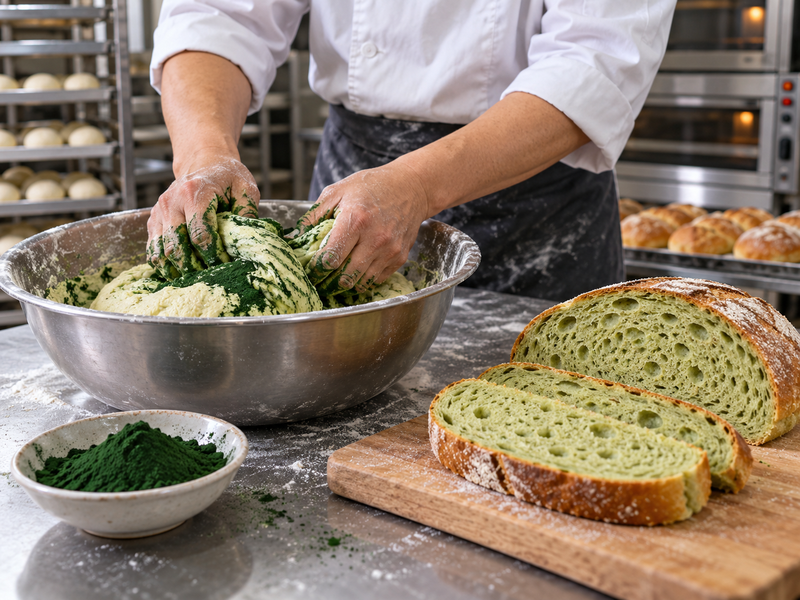
State whether the target is a pan loaf, roll, flatbread or enriched loaf. Note the flour blend, protein level, hydration, dough improvers, fat, sweetener and fermentation schedule. A white pan loaf exposes green crumb; a seeded wholegrain bread may absorb some color visually but has different water demand and flavor. Define the purpose of chlorella: a declared whole-food ingredient, a green visual cue or a quantified nutrient contribution. Those goals can conflict. A small addition might show color without materially changing a nutrient statement.
Record the control loaf’s height, sliceability, crumb firmness and consumer acceptance before changing the formula. A bakery buying an ingredient for a protein claim should calculate actual grams per serving from the finished recipe and test under the destination’s label rules. A green loaf alone proves no nutrition outcome.
| Bread brief | Control measurement | Decision limit |
|---|---|---|
| Pan loaf | Specific volume and slice height | Minimum sellable size |
| Rolls | Unit weight and shape | Uniform pack fit |
| Wholegrain loaf | Crumb color and flavor | Brand acceptance |
2. Which chlorella identity and processing must be specified?
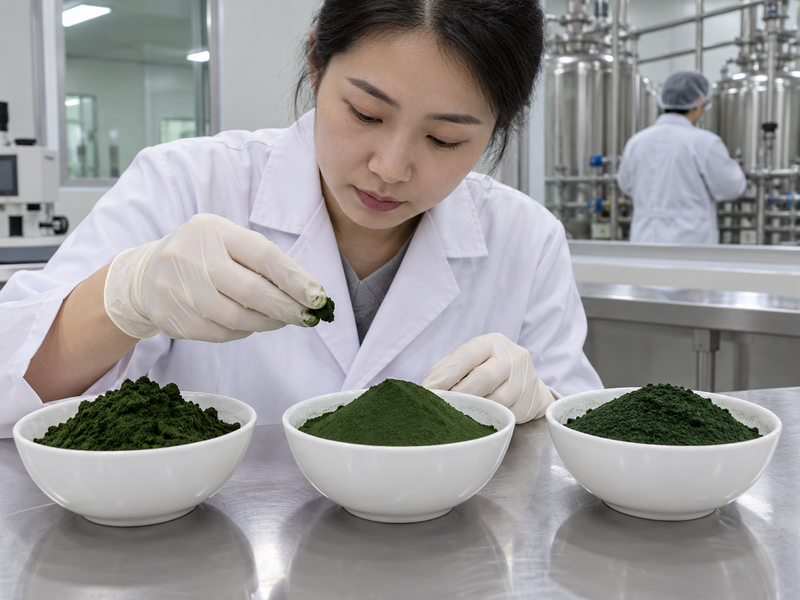
Request a TDS naming the species, whether cell walls have been disrupted, the disruption method where available, particle-size distribution, moisture and ingredient declaration. “Fine powder” does not prove broken-cell processing; SpirulinaCN’s chlorella category distinguishes those attributes. Ask for the actual sample-lot COA with microbiology and contaminants relevant to the intended market. Keep a retain sample and photograph its color. Specify whether the candidate is pure biomass or a premix.
A supplier’s broad species label may cover different materials, while flour replacement and sensory behavior can shift with processing. Match the commercial lot to the grade tested in pilot bread. Do not infer digestibility or nutrient claims from a broken-cell label without the evidence required for the finished product.
| Ingredient field | Document | Why the bakery needs it |
|---|---|---|
| Species | TDS and identity record | Repeatable ingredient definition |
| Cell processing | Process declaration | Avoid confusing it with mesh |
| Particle size | Distribution, not one mesh label | Specks and dry-blend behavior |
| Lot quality | COA and acceptance tests | Release incoming material |
3. How should flour substitution be calculated?
Create a control and a small ladder of internally selected chlorella levels. State whether each level replaces flour on a flour-weight basis or is added on top of the existing dough; do not mix these methods in one comparison. Keep total dough weight and the intended salt and yeast percentages documented. If chlorella displaces flour, the gluten and starch fractions change. Adjust water only through a documented second stage after first observing the unadjusted comparison; otherwise the ingredient effect becomes hard to isolate.
Report baker’s percentages and absolute kilograms for the intended batch size. The older bread study reported formulation-specific changes in color and sensory acceptance, which supports a ladder rather than importing its preferred level. Run at least one candidate at the real mixer scale before interpreting production behavior.
| Arm | Flour treatment | Water treatment | Purpose |
|---|---|---|---|
| Control | Standard | Standard | Baseline |
| A | Defined chlorella replacement | Initially fixed | Identify first effects |
| B | Higher defined replacement | Initially fixed | Locate sensory ceiling |
| C | Selected A or B | Controlled adjustment | Optimize hydration |
4. What dough-handling observations matter?
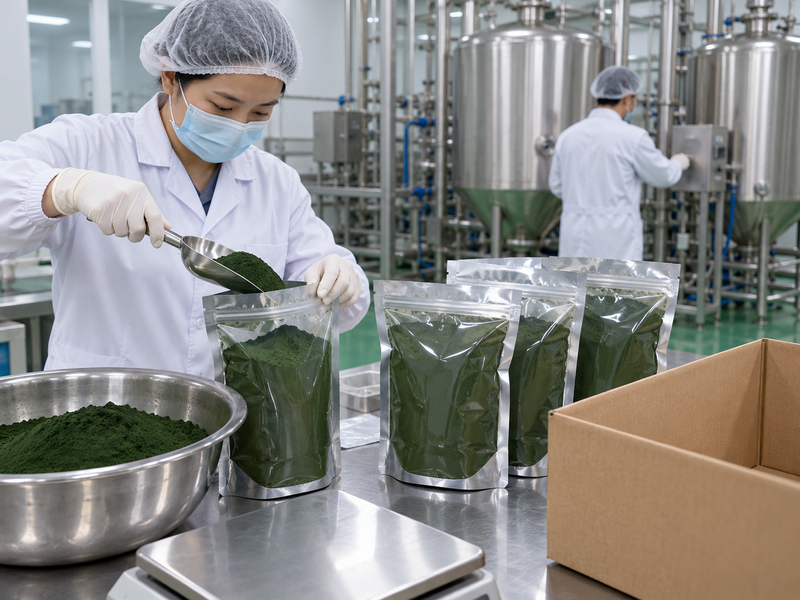
Record mixing time, dough temperature, absorption, stickiness, elasticity and machinability at divider and molder. Check whether green powder disperses evenly in dry flour or creates concentrated streaks after water addition. A premix step may help, but it must be included in labor and line cost. Log operator observations using defined categories rather than a single “good dough” note. Weigh scrap and rework, because a dough that requires flour dusting or extra handling can raise cost even if finished loaves look acceptable.
Compare first, middle and last pieces from a commercial mixer to see whether dry blend uniformity holds. If the bakery uses sourdough or long fermentation, repeat the test in that actual process; a short proof can hide problems that appear later. Check production timing against the existing schedule, not a laboratory ideal.
5. How should proofing and loaf volume be measured?
Keep dough weight, pan size, proof temperature, humidity and bake endpoint identical across arms. Record proof rise at fixed times and measure loaf volume or specific volume using one validated method after cooling. Include variation across several loaves. A few high loaves selected for photography do not demonstrate production consistency. Note collapse, uneven crown, tunneling or dense zones. Measure baked weight and baking loss; a visually similar loaf can carry a different moisture profile.
The 2006 study observed changes in its white-bread system, but those results cannot predict performance of a specific broken-cell C. vulgaris powder in modern industrial dough. Establish numerical pass bands from the control distribution and the bakery’s pack requirements. If volume falls, test whether a modest water or mixing adjustment restores it without damaging flavor or shelf life.
| Production result | Same-method measure | Purchase consequence |
|---|---|---|
| Proof rise | Height at timed checkpoints | Schedule fit |
| Specific volume | Volume divided by cooled mass | Slice and pack fit |
| Bake loss | Raw vs cooled weight | Yield and moisture |
| Defects | Count per batch | Rework and rejection |
6. What crumb and crust color will consumers accept?
Set a visual target before the trial. Photograph identical center slices under fixed light and background, then compare on the day of baking and through shelf life. Instrument color readings can help when a buyer needs a narrow shade, but the consumer sees a whole slice, including streaks and air cells. Examine both crust and crumb because browning can hide color outside while the center remains green.
The bread study found lower lightness and color differences in its tested loaves; it does not prove that every flour base will reach the same hue. Check whether opaque film or clear packaging changes customer perception. If a brand wants a vibrant green loaf, define the dose’s sensory cost; if it wants only a subtle ingredient inclusion, the color threshold may limit dose and any nutrient claim.
7. How should flavor and texture be tested?
Use a blind comparison at release and after storage. Score aroma when the pack opens, first bite, grassy or marine aftertaste, softness, chew and crumb resilience. Serve plain bread first; toppings can conceal an objectionable note. Then assess the intended use, such as toast or a sandwich, if that drives purchase. Measure crumb firmness with a consistent method and temperature. A powder could affect perceived dryness even if measured loaf volume is acceptable.
Do not let a color preference override an off flavor that emerges after heating. Document the panel’s rejection reason separately for flavor, appearance and texture; this guides a possible lower dose or different grade. A sample that passes a warm, same-day tasting still needs a packaged, cooled test because bread aroma and firmness change after baking.
8. What must the shelf-life trial capture?
Pack control and trial loaves in the intended film or bag and hold them under the proposed distribution conditions. At planned checkpoints, measure crumb firmness, moisture or water activity as relevant, visible mold according to the bakery’s protocol, color and sensory acceptance. Chlorella should not be marketed as a preservative without direct evidence and permitted claims. Maintain identical cooling and slicing hygiene because those steps can dominate microbiological outcomes. If the bakery uses frozen dough or par-baked distribution, test that route specifically.
A room-temperature pan loaf result cannot be transferred to a frozen roll. Keep batch and ingredient-lot identifiers with each retain sample. If the product is intended for several markets, check whether label and shelf-life requirements differ before using one result for all destinations.
| Hold stage | Record | Reason |
|---|---|---|
| Day of pack | Color, firmness, microbial baseline | Release comparison |
| Midlife | Texture, odor and moisture | Detect drift |
| End of proposed life | Acceptance and spoilage checks | Validate date |
9. Which quality and label checks precede a quote?
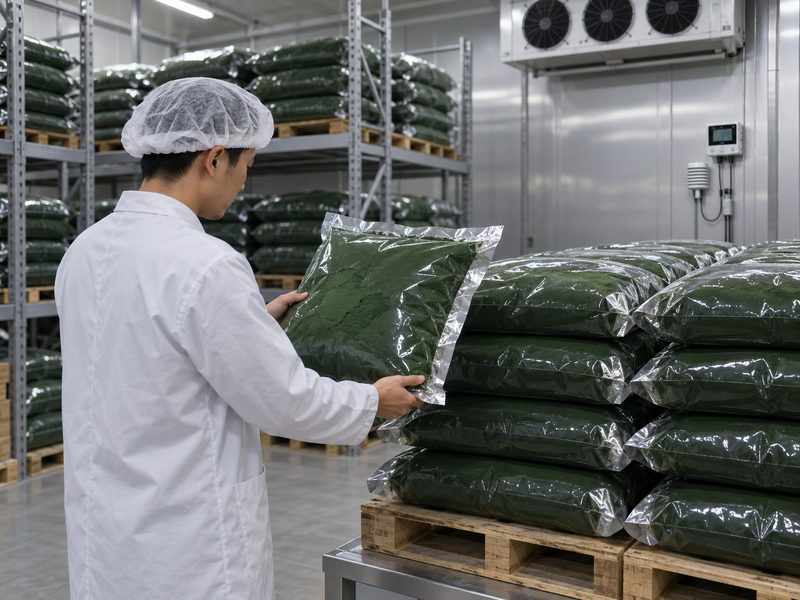
Build a material approval file with species identity, processing declaration, TDS, actual-lot COA, allergen statement and any organic or other certification needed. Specify relevant microbiology and contaminant limits according to the bread’s hazard analysis and destination. Confirm that the proposed production supply matches the tested sample. Calculate the finished serving’s nutrient content with the complete recipe and validate any claim under local rules; an ingredient’s assay is not a finished-loaf label.
Request commercial pricing on a consistent delivered basis, with pack size, MOQ, forecast, lead time and quote validity stated in writing. Compare cost per accepted loaf after dough scrap and yield changes. Do not buy a lower-priced grade that makes the baker add enough flavor or process time to erase the saving.
| Approval item | Evidence | Owner |
|---|---|---|
| Raw material | Lot COA and TDS | Quality |
| Formula | Baker’s-percent trial sheet | R&D |
| Bread performance | Volume and sensory records | Bakery operations |
| Commercial terms | Written quote and forecast | Procurement |

10. When can a bakery approve a production lot?
Approve the named grade when it passes incoming quality, dough handling, proof schedule, volume, crumb color, flavor and shelf-life gates in a production-relevant trial. State the accepted inclusion range and water adjustment in the master formula. Keep a control retain and representative loaf photographs. A second powder lot is useful when color or aroma tolerances are narrow. Require requalification if the flour system, cell-disruption process or oven profile changes materially.
Put the decisive metrics and deviation actions into the purchase specification; “chlorella powder” alone is not enough. If a trial fails, isolate whether the issue is dose, powder attributes or process before seeking another grade. A clear no-go can prevent months of avoidable reformulation and stock exposure.
Translate the trial into a shift instruction that a baker can execute. It should state the weigh-up tolerance, dry-blend order, mixing endpoint, water adjustment, dough temperature target, proof endpoint and expected loaf-weight range. Place the ingredient lot code on the production record, not only on a warehouse receipt. Train operators to identify unusual green streaks, dry pockets or a sudden change in dough resistance, and define when they should stop and ask quality to inspect.
A successful lab loaf does not protect commercial production unless the addition is repeatable at the plant’s normal schedule and mixer loading.
Cost the accepted loaf rather than the powder. Include ingredient cost, any extra water or process time, scrap at the divider, underweight loaves, slice damage and changes in shelf-life returns. If a visually greener loaf requires enough chlorella to reduce volume or flavor acceptance, a lower dose may create a better product even if its ingredient story is less dramatic. Record that decision plainly.
At receiving, compare the next lot with the trial retain for color, odor and required analytical fields, and bake a confirmation control if the tolerance is narrow. Procurement then has a clear basis for repeat orders.
Use the same cooled-loaf age for every comparison; otherwise staling differences may be mistaken for ingredient effects during release testing.
FAQ
Q1. Does a bread study specify the right industrial dose? No. It provides a trial precedent in one recipe; set your ladder from your loaf brief.
Q2. Is fine mesh the same as broken-cell chlorella? No. Particle size and cell-wall disruption are separate attributes.
Q3. What should stay constant in the first bake? Base formula, pan, proof, oven and measurement methods, with flour substitution documented.
Q4. Is a green loaf automatically a higher-protein loaf? No. The contribution depends on grams used and the whole formula.
Q5. Can a day-one loaf establish shelf life? No. Test the intended pack and distribution route through the proposed end date.
Next step: Contact SpirulinaCN with your flour system, fermentation and oven profile, target inclusion, loaf limits, anticipated quantity and destination. Request a matched broken-cell C. vulgaris sample, TDS, lot COA and pilot-volume quote for a controlled bread trial.