
A sports nutrition brand can buy a higher-protein spirulina grade and still gain very little protein in its finished serving. The decision depends on inclusion rate, actual lot assay, taste and the quoted price of usable powder. This 60% vs 65% spirulina powder for sports nutrition blends guide turns those variables into a side-by-side purchasing test. SpirulinaCN lists SP-FG-100 at a crude-protein specification of at least 60% and SP-HP-65 at at least 65%; neither minimum is a promise about every future COA result or the protein claim on a finished label.
Contents
- What exactly differs between the two grades?
- How much protein does each grade add per serving?
- Which assay evidence makes the comparison fair?
- When does taste outweigh a higher protein number?
- How should a paired blend trial be designed?
- What does the protein difference cost in the finished formula?
- Which physical properties affect production?
- What quality and label checks must pass?
- How should buyers compare repeat supply?
- What decision rule should go into the purchase order?
1. What exactly differs between the two grades?
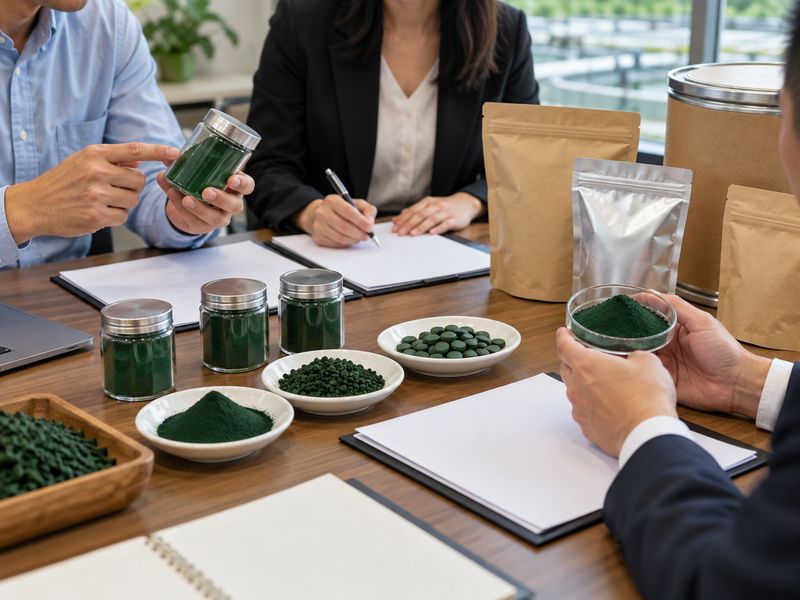
Both are whole green spirulina biomass, not isolated protein or blue phycocyanin extract. The current product listing describes SP-FG-100 as at least 60% crude protein and 80–120 mesh, with 25 kg drum packaging. It describes SP-HP-65 as at least 65% crude protein and 100–120 mesh, with 20 kg carton packaging. Those are published grade specifications; request a current TDS and the COA for the actual sample or sales lot before writing either value into a formula. A premium grade could differ in color, odor or flow because the lot and processing profile differ. Do not attribute a sensory result automatically to its protein percentage. Start with identity: put both SKU codes, analytical basis, sample lot and proposed commercial pack on one comparison sheet. That prevents a purchasing team from comparing one grade’s brochure number with the other’s laboratory result.
| Published attribute | SP-FG-100 | SP-HP-65 | Buyer check |
|---|---|---|---|
| Crude protein minimum | 60% | 65% | Actual lot result and method |
| Particle range | 80–120 mesh | 100–120 mesh | Distribution in intended liquid |
| Listed bulk pack | 25 kg drum | 20 kg carton | Current quote and handling fit |
| Product type | Whole biomass | Whole biomass | Do not treat either as protein isolate |
2. How much protein does each grade add per serving?
Multiply grams of spirulina in a serving by the lot protein fraction. At a hypothetical 3 g inclusion, 60% contributes 1.80 g and 65% contributes 1.95 g before manufacturing and label-rounding questions: a difference of 0.15 g. At 5 g, the gap is 0.25 g. These are arithmetic illustrations using grade minimums, not formulation targets or a claim that either lot tests exactly at its minimum. The rest of a shake’s protein normally comes from the complete recipe. If your target is a protein label statement, calculate it from every ingredient and validate the finished product under the destination’s labeling rules. The key check: determine whether 0.15–0.25 g changes any business decision at an inclusion your sensory panel will accept. If it does not, the premium may need another justification, such as a documented brand specification. Do not call a finished drink “high protein” based solely on a spirulina ingredient listing.
| Spirulina per serving | At 60% | At 65% | Difference |
|---|---|---|---|
| 1 g | 0.60 g | 0.65 g | 0.05 g |
| 3 g | 1.80 g | 1.95 g | 0.15 g |
| 5 g | 3.00 g | 3.25 g | 0.25 g |
3. Which assay evidence makes the comparison fair?
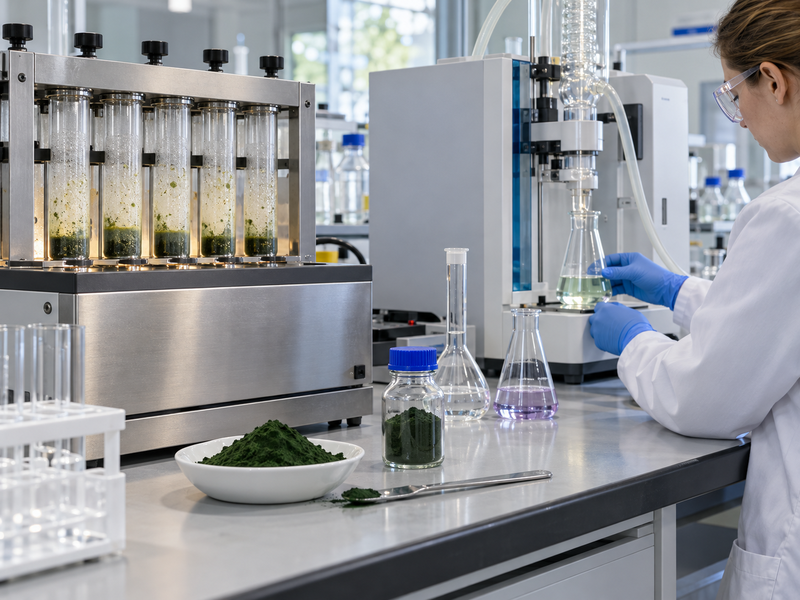
Ask for the current technical specifications and lot COAs for both samples. Record the reported protein method, nitrogen conversion factor where applicable, moisture basis, laboratory, sample date and measurement uncertainty if available. A dry-basis protein result can look higher than an as-sold result simply because water has been removed from the denominator. An apparent five-point gap can shrink if the two figures use different bases or laboratories. Use the same method and basis for the direct purchase comparison. A COA is evidence about a stated lot, not a permanent guarantee. Arrange a confirmation test with your qualified laboratory if the finished label or contractual threshold depends on a narrow margin. FDA dietary supplement CGMP guidance explains the manufacturer’s responsibility for appropriate specifications and quality controls; apply the obligations relevant to your product and market. For deeper assay mechanics, use the site’s protein testing guide as a companion, not a substitute for your two lot records.
4. When does taste outweigh a higher protein number?
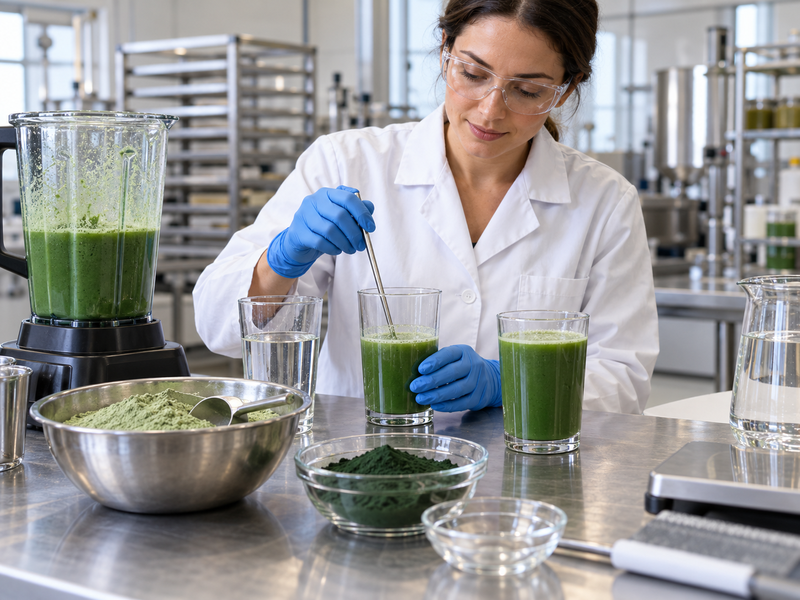
The usual obstacle is the amount of whole biomass a consumer will enjoy in the actual matrix. Spirulina brings its own green color and algal flavor; cocoa, berry acid, sweetener and plant protein each change perception. Prepare a blind, coded panel at the same spirulina inclusion for both grades, then a second comparison at any proposed inclusion change. Record odor on opening, flavor at first sip, aftertaste, color and visible sediment after the intended standing time. Evaluate in water only if consumers will mix with water; otherwise use the real milk or beverage base. Keep sweetness, mixing energy and serving temperature identical. A useful result: if tasters prefer the 60% grade at a 3 g inclusion, the extra 0.15 g of theoretical protein from 65% may be an expensive trade. Conversely, an acceptable 65% lot can help when every small protein increment matters. Either decision must come from the matrix trial, not the grade name.
5. How should a paired blend trial be designed?
Build a control without spirulina, then two arms with identical formula weight and spirulina dose. Replace displaced base solids consistently so an arm does not look thicker simply because its total dry mass rose. Use coded samples prepared in the same mixer, for the same time, in the same beverage and serving volume. Test immediately and after a realistic wait. Photograph cups under fixed light, but also log instrument color if your brand has a shade standard. Score clumps, foam, sediment and re-dispersion after a shake. If the 65% grade wins at equal dose, run a dose ladder around the preferred level; a smaller addition may recoup its price premium, but only if the flavor and visual result still meet the brief. Retain powder and finished-mix samples. The trial record should name both lot numbers and the exact batch sequence, allowing procurement to buy the material formulation actually approved.
| Trial arm | Spirulina dose | Other solids | Decision purpose |
|---|---|---|---|
| Control | 0 | Base recipe | Establish baseline |
| A | Same fixed dose | Matched mass | Test 60% grade |
| B | Same fixed dose | Matched mass | Test 65% grade |
| C, if needed | Lower or higher | Matched mass | Find acceptable range |
6. What does the protein difference cost in the finished formula?
Request quotes for the same delivery term, destination, order volume, currency and validity period. Divide delivered spirulina cost per kilogram by the assayed protein fraction to see the ingredient cost per kilogram of spirulina protein. Then convert it into cost per finished serving at the formulation’s actual inclusion. This is a purchasing comparison, not proof that all protein has identical nutritional quality or that a premium grade automatically improves a claim. Packaging differences can change handling and freight, so include them. For a hypothetical quote of $10/kg at 60% and $12/kg at 65%, cost per kilogram of assayed protein would be about $16.67 versus $18.46. Those invented prices illustrate the formula only; do not treat them as market quotations. Check the break-even point: at equal protein target, the 65% grade can use less mass, but the saved mass may be small next to premium pricing. Add yield loss, rejects and blend adjustments before approval.
| Cost field | Calculation or evidence | Why it matters |
|---|---|---|
| Delivered unit cost | Quote plus freight and duties | Comparable purchase basis |
| Cost per gram used | Delivered cost × serving dose | Finished unit economics |
| Assayed protein cost | Delivered cost ÷ lot protein fraction | Normalized grade comparison |
| Trial loss | Rejected or retained powder | Real usable yield |
7. Which physical properties affect production?
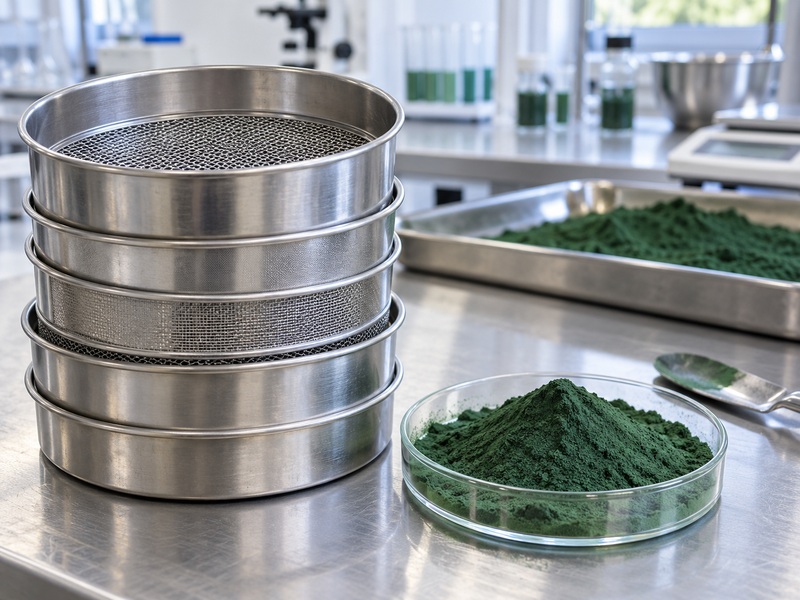
Ask for particle-size distribution, bulk density and moisture on each candidate lot, then verify behavior in your line. Published mesh bands overlap, so a nominally higher-protein grade may not change mouthfeel much. Still, fine powder can dust at charging, bridge in a hopper or form lumps when poured into liquid. The relevant measure depends on the product: a sachet filler needs weight consistency; a tub blend needs segregation control; a ready-to-mix shake needs rapid wetting and tolerable settling. Conduct the same production-scale mixing sequence for both grades and sample beginning, middle and end of the run. Check blend uniformity for the marker your QC team has validated. Make an open-pack handling note as well: a grade that disperses beautifully in a lab cup may absorb moisture or cake during repeated production access. Change the powder specification only after the line trial shows a commercial advantage.
8. What quality and label checks must pass?
Confirm species identity, composition, lot traceability, microbiology, relevant contaminants and any destination-specific limits. Request the supplier’s current TDS, COA and appropriate food-safety evidence for the exact SKU. Determine whether organic or other voluntary claims are intended; a generic company certificate does not prove the shipped lot qualifies. The finished-product manufacturer must set ingredient acceptance criteria in its own quality system. FDA’s overview distinguishes food CGMPs under Part 117 and dietary supplement CGMPs under Part 111, so do not assume one product category’s paperwork settles the other’s obligations. Review protein wording against finished-product analytical data and the destination’s labeling requirements. If the marketing team wants “65% protein spirulina,” specify whether that claim describes ingredient grade or the finished shake. Those are different statements and need different evidence.
9. How should buyers compare repeat supply?
A paired sample is only a starting point. Ask for recent COAs from each grade, with dates and lot identifiers, to see variation in protein, moisture and color. Decide which parameters become binding specifications. If protein minimum drives selection, agree on the release method, sampling plan and remedy for an off-spec lot. Ask how a harvest or process change will be communicated. Forecast annual demand in realistic call-offs. The published grade list identifies pack formats, but availability, MOQ and lead time need written confirmation. Keep the approval portable: compare the next lot with the same formula, sensory standard and laboratory method.
| Supply question | Evidence to request | Purchase consequence |
|---|---|---|
| Recent variability | Multiple lot COAs | Set realistic limits |
| Forecast fit | Volume and call-off quote | Compare price at scale |
| Pack and transit | Written pack specification | Model handling and freight |
| Change notice | Written process | Decide when to retest |

10. What decision rule should go into the purchase order?
Choose the 65% grade if verified protein, sensory performance and delivered cost support the formula. Choose 60% if it meets the brief at lower cost or better operational fit. If neither passes, revise the dose or formulation. Put the approved SKU, protein method and limit, physical limits, pack, destination and lot documents into the buying record. Tie the first commercial lot to a verification sample. This states what would make an alternative lot unacceptable. Compare the site’s grade overview with your measured outcome, then obtain a live quote. The finished serving matters more than a five-point brochure difference.
FAQ
Q1. Is 65% spirulina a protein isolate? No. SP-HP-65 is listed as whole spirulina biomass with a higher crude-protein minimum; it still contains other biomass constituents.
Q2. Can I use the 65% figure on a finished shake label? Only after checking the exact wording and finished-product evidence under the destination’s rules. An ingredient specification does not establish a final nutrition declaration.
Q3. Does mesh size prove the higher-protein grade disperses better? No. The listed mesh ranges overlap, and wetting depends on the whole formulation and mixing process.
Q4. How many lots should I review? Ask for several recent, identifiable COAs and test the actual proposed supply lot. The required sampling depth depends on your quality risk and contract.
Q5. Which grade should a new brand sample first? Sample both at the same inclusion and assay basis. A paired trial reveals whether the protein increment has enough value to justify its delivered cost.
Make the grade decision with paired evidence
The useful comparison is protein delivered in an acceptable serving, at a price and specification that can be repeated. For 60% vs 65% spirulina powder for sports nutrition blends, request paired SP-FG-100 and SP-HP-65 samples with current TDSs, lot COAs, assay methods and volume quotes through SpirulinaCN’s contact page. Include your application, target specification, anticipated quantity, destination, serving size and target label statement so the supplier can match the trial and commercial offer.